

William of Worcester's Chronicle of England
William of Worcester, born around 1415, and died around 1482 was secretary to John Fastolf, the renowned soldier of the Hundred Years War, during which time he collected documents, letters, and wrote a record of events. Following their return to England in 1440 William was witness to major events. Twice in his chronicle he uses the first person: 1. when writing about the murder of Thomas, 7th Baron Scales, in 1460, he writes '… and I saw him lying naked in the cemetery near the porch of the church of St. Mary Overie in Southwark …' and 2. describing King Edward IV's entry into London in 1461 he writes '… proclaimed that all the people themselves were to recognize and acknowledge Edward as king. I was present and heard this, and immediately went down with them into the city'. William’s Chronicle is rich in detail. It is the source of much information about the Wars of the Roses, including the term 'Diabolical Marriage' to describe the marriage of Queen Elizabeth Woodville’s brother John’s marriage to Katherine, Dowager Duchess of Norfolk, he aged twenty, she sixty-five or more, and the story about a paper crown being placed in mockery on the severed head of Richard, 3rd Duke of York.
Available at Amazon in eBook and Paperback format.
On 2nd February 1650 Nell Gwyn was born.
Samuel Pepys' Diary. 3rd April 1665. Thence home and to the office a while, and then home to supper and to bed. All the pleasure of the play was, the King [aged 34] and my Baroness Castlemayne [aged 24] were there; and pretty witty Nell [aged 15], [Nell Gwynne] at the King's house, and the younger Marshall sat next us; which pleased me mightily.


Samuel Pepys' Diary. 8th December 1666. Very good company we were at dinner, and merry, and after dinner, he being gone about business, my wife and I and Mrs. Pierce and Betty and Balty [aged 26], who come to see us to-day very sick, and went home not well, together out, and our coach broke the wheel off upon Ludgate Hill [Map]. So we were fain to part ourselves and get room in other people's coaches, and Mrs. Pierce and I in one, and I carried her home and set her down, and myself to the King's playhouse, which troubles me since, and hath cost me a forfeit of 10s., which I have paid, and there did see a good part of "The English Monsiuer", which is a mighty pretty play, very witty and pleasant. And the women do very well; but, above all, little Nelly [aged 16]; that I am mightily pleased with the play, and much with the House, more than ever I expected, the women doing better than ever I expected, and very fine women. Here I was in pain to be seen, and hid myself; but, as God would have it, Sir John Chichly [aged 26] come, and sat just by me.
Samuel Pepys' Diary. 23rd January 1667. I staid till dinner was over, and there being no use of me I away after dinner without taking leave, and to the New Exchange, there to take up my wife and Mercer, and to Temple Bar to the Ordinary, and had a dish of meat for them, they having not dined, and thence to the King's house, and there saw "The Numerous Lieutenant", a silly play, I think; only the Spirit in it that grows very tall, and then sinks again to nothing, having two heads breeding upon one, and then Knipp's singing, did please us. Here, in a box above, we spied Mrs. Pierce; and, going out, they called us, and so we staid for them; and Knipp took us all in, and brought to us Nelly [aged 16]; a most pretty woman, who acted the great part of Coelia to-day very fine, and did it pretty well: I kissed her, and so did my wife; and a mighty pretty soul she is. We also saw Mrs. Halls which is my little Roman-nose black girl, that is mighty pretty: she is usually called Betty. Knipp made us stay in a box and see the dancing preparatory to to-morrow for "The Goblins", a play of Suckling's, not acted these twenty-five years; which was pretty; and so away thence, pleased with this sight also, and specially kissing of Nell.
Samuel Pepys' Diary. 2nd March 1667. After dinner, with my wife, to the King's house to see "The Mayden Queene", a new play of Dryden's [aged 35], mightily commended for the regularity of it, and the strain and wit; and, the truth is, there is a comical part done by Nell [aged 17]1, which is Florimell, that I never can hope ever to see the like done again, by man or woman. The King [aged 36] and Duke of York [aged 33] were at the play. But so great performance of a comical part was never, I believe, in the world before as Nell do this, both as a mad girle, then most and best of all when she comes in like a young gallant; and hath the notions and carriage of a spark the most that ever I saw any man have. It makes me, I confess, admire her. Thence home and to the office, where busy a while, and then home to read the lives of Henry 5th and 6th, very fine, in Speede, and to bed. This day I did pay a bill of £50 from my father, being so much out of my own purse gone to pay my uncle Robert's legacy to my aunt Perkins's child.
Note 1. "Her skill increasing with her years, other poets sought to obtain recommendations of her wit and beauty to the success of their writings. I have said that Dryden was one of the principal supporters of the King's house, and ere long in one of his new plays a principal character was set apart for the popular comedian. The drama was a tragi-comedy called 'Secret Love, or the Maiden Queen,' and an additional interest was attached to its production from the King having suggested the plot to its author, and calling it 'his play.'"-Cunningham's Story of Nell Gwyn, ed: 1892, pp. 38,39.


Samuel Pepys' Diary. 7th March 1667. Thence home late, and find my wife hath dined, and she and Mrs. Hewer going to a play. Here was Creed, and he and I to Devonshire House, to a burial of a kinsman of Sir R. Viner's [aged 36]; and there I received a ring, and so away presently to Creed, who staid for me at an alehouse hard by, and thence to the Duke's playhouse, where he parted, and I in and find my wife and Mrs. Hewer, and sat by them and saw "The English Princesse, or Richard the Third"; a most sad, melancholy play, and pretty good; but nothing eminent in it, as some tragedys are; only little Mis. Davis did dance a jig after the end of the play, and there telling the next day's play; so that it come in by force only to please the company to see her dance in boy's 'clothes; and, the truth is, there is no comparison between Nell's [aged 17] dancing the other day at the King's house in boy's clothes and this, this being infinitely beyond the other. Mere was Mr. Clerke and Pierce, to whom one word only of "How do you", and so away home, Mrs. Hewer with us, and I to the office and so to Sir W. Batten's [aged 66], and there talked privately with him and Sir W. Pen [aged 45] about business of Carcasse against tomorrow, wherein I think I did give them proof enough of my ability as well as friendship to Sir W. Batten, and the honour of the office, in my sense of the rogue's business.


Samuel Pepys' Diary. 25th March 1667. So home, and to the office, and by and by to dinner, a poor dinner, my wife and I, at Sir W. Pen's [aged 45], and then he and I before to Exeter House [Map], where I do not stay, but to the King's playhouse; and by and by comes Mr. Lowther [aged 26] and his wife [aged 16] and mine, and into a box, forsooth, neither of them being dressed, which I was almost ashamed of. Sir W. Pen and I in the pit, and here saw "The Mayden Queene" again; which indeed the more I see the more I like, and is an excellent play, and so done by Nell [aged 17], her merry part, as cannot be better done in nature, I think.
Samuel Pepys' Diary. 1st May 1667. Thence away to the King's playhouse, by agreement met Sir W. Pen [aged 46], and saw "Love in a Maze" but a sorry play: only Lacy's [aged 52] clowne's part, which he did most admirably indeed; and I am glad to find the rogue at liberty again. Here was but little, and that ordinary, company. We sat at the upper bench next the boxes; and I find it do pretty well, and have the advantage of seeing and hearing the great people, which may be pleasant when there is good store. Now was only Prince Rupert [aged 47] and my Lord Lauderdale [aged 50], and my Lord, the naming of whom puts me in mind of my seeing, at Sir Robert Viner's [aged 36], two or three great silver flagons, made with inscriptions as gifts of the King [aged 36] to such and such persons of quality as did stay in town the late great plague, for the keeping things in order in the town, which is a handsome thing. But here was neither Hart [aged 41], Nell [aged 17], nor Knipp; therefore, the play was not likely to please me.


Samuel Pepys' Diary. 1st May 1667. Thence to Westminster; in the way meeting many milk-maids with their garlands upon their pails, dancing with a fiddler before them1 and saw pretty Nelly [aged 17] standing at her lodgings' door in Drury-lane in her smock sleeves and bodice, looking upon one: she seemed a mighty pretty creature. To the Hall and there walked a while, it being term. I thence home to the Rose, and then had Doll Lane venir para me.... [Missing text: 'but it was in a lugar mighty ouvert, so as we no poda hazer algo; so parted and then met again at the Swan, where for la misma reason we no pode hazer, but put off to recontrar anon, which I only used as a put-off;']. To my Lord Crew's [aged 69], where I found them at dinner, and among others. Mrs. Bocket, which I have not seen a long time, and two little dirty children, and she as idle a prating and impertinent woman as ever she was.
Note 1. On the 1st of May milkmaids used to borrow silver cups, tankards, &c., to hang them round their milkpails, with the addition of flowers and ribbons, which they carried upon their heads, accompanied by a bagpipe or fiddle, and went from door to door, dancing before the houses of their customers, in order to obtain a small gratuity from each of them. "In London thirty years ago, When pretty milkmaids went about, It was a goodly sight to see Their May-day pageant all drawn out. "Such scenes and sounds once blest my eyes And charm'd my ears; but all have vanish'd, On May-day now no garlands go, For milkmaids and their dance are banish'd". Hone's Every-Day Book, vol. i., pp. 569, 570.
Samuel Pepys' Diary. 24th May 1667. Up, and to the office, where, by and by, by appointment, we met upon Sir W. Warren's accounts, wherein I do appear in every thing as much as I can his enemy, though not so far but upon good conditions from him I may return to be his friend, but I do think it necessary to do what I do at present. We broke off at noon without doing much, and then home, where my wife not well, but yet engaged by invitation to go with Sir W. Pen [aged 46]. I got her to go with him by coach to Islington to the old house, where his lady [aged 43] and Madam Lowther [aged 16], with her exceeding fine coach and mean horses, and her mother-in-law, did meet us, and two of Mr. Lowther's [aged 26] brothers, and here dined upon nothing but pigeon-pyes, which was such a thing for him to invite all the company to, that I was ashamed of it. But after dinner was all our sport, when there come in a juggler, who, indeed, did shew us so good tricks as I have never seen in my life, I think, of legerdemaine, and such as my wife hath since seriously said that she would not believe but that he did them by the help of the devil. Here, after a bad dinner, and but ordinary company, saving that I discern good parts in one of the sons, who, methought, did take me up very prettily in one or two things that I said, and I was so sensible of it as to be a caution to me hereafter how I do venture to speak more than is necessary in any company, though, as I did now, I do think them incapable to censure me. We broke up, they back to Walthamstow, Essex [Map], and only my wife and I and Sir W. Pen to the King's playhouse, and there saw "The Mayden Queene" which, though I have often seen, yet pleases me infinitely, it being impossible, I think, ever to have the Queen's [aged 28] part, which is very good and passionate, and Florimel's part, which is the most comicall that ever was made for woman, ever done better than they two are by young Marshall and Nelly [aged 17].
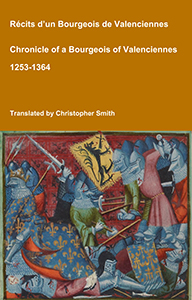
Chronicle of a Bourgeois of Valenciennes
Récits d’un bourgeois de Valenciennes aka The Chronicle of a Bourgeois of Valenciennes is a vivid 14th-century vernacular chronicle written by an anonymous urban chronicler from Valenciennes in the County of Hainaut. It survives in a manuscript that describes local and regional history from about 1253 to 1366, blending chronology, narrative episodes, and eyewitness-style accounts of political, military, and social events in medieval France, Flanders, and the Low Countries. The work begins with a chronological framework of events affecting Valenciennes and its region under rulers such as King Philip VI of France and the shifting allegiances of local nobility. It includes accounts of conflicts, sieges, diplomatic manoeuvres, and the impact of broader struggles like the Hundred Years’ War on urban life in Hainaut. Written from the perspective of a burgher (bourgeois) rather than a monastery or royal court, the chronicle offers a rare lay viewpoint on high politics and warfare, reflecting how merchants, townspeople, and civic institutions experienced the turbulence of the 13th and 14th centuries. Its narrative style combines straightforward reporting of events with moral and civic observations, making it a valuable source for readers interested in medieval urban society, regional politics, and the lived experience of war and governance in pre-modern Europe.
Available at Amazon in eBook and Paperback format.

Samuel Pepys' Diary. 13th July 1667. After rising, my Lord Anglesey [aged 53], this being the second time of his being with us, did take me aside and asked me where I lived, because he would be glad to have some discourse with me. This I liked well enough, and told him I would wait upon him, which I will do, and so all broke up, and I home to dinner, where Mr. Pierce dined with us, who tells us what troubles me, that my Lord Buckhurst [aged 24] hath got Nell [aged 17] away from the King's house, lies with her, and gives her £100 a year, so as she hath sent her parts to the house, and will act no more1.
Note 1. Lord Buckhurst and Nell Gwyn, with the help of Sir Charles Sedley [aged 28], kept "merry house" at Epsom next door to the King's Head Inn (see Cunningham's "Story of Nell Gwyn", ed. 1892, p. 57).

Samuel Pepys' Diary. 14th July 1667. A very fine day, and so towards Epsum, talking all the way pleasantly, and particularly of the pride and ignorance of Mrs. Lowther, in having of her train carried up? The country very fine, only the way very dusty. We got to Epsum by eight o'clock, to the well; where much company, and there we 'light, and I drank the water: they did not, but do go about and walk a little among the women, but I did drink four pints, and had some very good stools by it. Here I met with divers of our town, among others with several of the tradesmen of our office, but did talk but little with them, it growing hot in the sun, and so we took coach again and to the towne, to the King's Head, where our coachman carried us, and there had an ill room for us to go into, but the best in the house that was not taken up. Here we called for drink, and bespoke dinner; and hear that my Lord Buckhurst [aged 24] and Nelly [aged 17] are lodged at the next house, and Sir Charles Sidly [aged 28] with them and keep a merry house. Poor girl! I pity her; but more the loss of her at the King's house. Here I saw Gilsthrop, Sir W. Batten's [aged 66] clerk that hath been long sick, he looks like a dying man, with a consumption got, as is believed, by the pox, but God knows that the man is in a sad condition, though he finds himself much better since his coming thither, he says. W. Hewer [aged 25] rode with us, and I left him and the women, and myself walked to church, where few people, contrary to what I expected, and none I knew, but all the Houblons, brothers, and them after sermon I did salute, and walk with towards my inne, which was in their way to their lodgings. They come last night to see their elder brother, who stays here at the waters, and away to-morrow. James [aged 37] did tell me that I was the only happy man of the Navy, of whom, he says, during all this freedom the people have taken of speaking treason, he hath not heard one bad word of me, which is a great joy to me; for I hear the same of others, but do know that I have deserved as well as most. We parted to meet anon, and I to my women into a better room, which the people of the house borrowed for us, and there to dinner, a good dinner, and were merry, and Pendleton come to us, who happened to be in the house, and there talked and were merry.
 Become a Member via our Buy Me a Coffee page to read more.
Samuel Pepys' Diary. 22nd August 1667. After dinner with my Lord Bruncker [aged 47] and his mistress to the King's playhouse, and there saw "The Indian Emperour"; where I find Nell [aged 17] come again, which I am glad of; but was most infinitely displeased with her being put to act the Emperour's daughter; which is a great and serious part, which she do most basely. The rest of the play, though pretty good, was not well acted by most of them, methought; so that I took no great content in it. But that, that troubled me most was, that Knipp sent by Moll to desire to speak to me after the play; and she beckoned to me at the end of the play, and I promised to come; but it was so late, and I forced to step to Mrs. Williams's lodgings with my Lord Bruncker and her, where I did not stay, however, for fear of her shewing me her closet, and thereby forcing me to give her something; and it was so late, that for fear of my wife's coming home before me, I was forced to go straight home, which troubled me.

Samuel Pepys' Diary. 22nd August 1667. Returning to the office, did ask whether we might visit Commissioner Pett [aged 57], to which, I confess, I have no great mind; and it was answered that he was close prisoner, and we could not; but the Lieutenant of the Tower would send for him to his lodgings, if we would: so we put it off to another time. Returned to the office, where we sat all the morning, and at noon to Captain Cocke's [aged 50] to dinner; where Lord Bruncker [aged 47] and his Lady, Matt. Wren [aged 38], and Bulteale, and Sir Allen Apsly [aged 51]; the last of whom did make good sport, he being already fallen under the retrenchments of the new Committee, as he is Master Falconer1 which makes him mad, and swears that we are doing that the Parliament would have done-that is, that we are now endeavouring to destroy one another. But it was well observed by some at the table, that they do not think this retrenching of the King's charge will be so acceptable to the Parliament, they having given the King [aged 37] a revenue of so many £100,000's a-year more than his predecessors had, that he might live in pomp, like a king.
Note 1. The post of Master Falconer was afterwards granted to Charles's [her illegitimate son] son by Nell Gwyn [aged 17], and it is still held by the Duke of St. Albans, as an hereditary office. B.
Samuel Pepys' Diary. 26th August 1667. Then to the office, where we sat upon a particular business all the morning: and my Lord Anglesey [aged 53] with us: who, and my Lord Bruncker [aged 47], do bring us news how my Chancellor's [aged 58] seal is to be taken away from him to-day. The thing is so great and sudden to me, that it put me into a very great admiration what should be the meaning of it; and they do not own that they know what it should be: but this is certain, that the King [aged 37] did resolve it on Saturday, and did yesterday send the Duke of Albemarle [aged 58], the only man fit for those works, to him for his purse: to which the Chancellor answered, that he received it from the King, and would deliver it to the King's own hand, and so civilly returned the Duke of Albemarle without it; and this morning my Chancellor is to be with the King, to come to an end in the business. After sitting, we rose, and my wife being gone abroad with Mrs. Turner [aged 44] to her washing at the whitster's, I dined at Sir W. Batten's [aged 66], where Mr. Boreman was, who come from White Hall; who tells us that he saw my Chancellor come in his coach with some of his men, without his Seal, to White Hall to his chamber; and thither the King and Duke of York [aged 33] come and staid together alone, an hour or more: and it is said that the King do say that he will have the Parliament meet, and that it will prevent much trouble by having of him out of their enmity, by his place being taken away; for that all their enmity will be at him. It is said also that my Chancellor answers, that he desires he may be brought to his trial, if he have done any thing to lose his office; and that he will be willing, and is most desirous, to lose that, and his head both together. Upon what terms they parted nobody knows but the Chancellor looked sad, he says. Then in comes Sir Richard Ford [aged 53], and says he hears that there is nobody more presses to reconcile the King and Chancellor than the Duke of Albemarle and Duke of Buckingham [aged 39]: the latter of which is very strange, not only that he who was so lately his enemy should do it, but that this man, that but the other day was in danger of losing his own head, should so soon come to be a mediator for others: it shows a wise Government. They all say that he [Clarendon] is but a poor man, not worth above £3000 a-year in land; but this I cannot believe: and all do blame him for having built so great a house, till he had got a better estate. Having dined, Sir J. Minnes [aged 68] and I to White Hall, where we could be informed in no more than we were told before, nobody knowing the result of the meeting, but that the matter is suspended. So I walked to the King's playhouse, there to meet Sir W. Pen [aged 46], and saw "The Surprizall", a very mean play, I thought: or else it was because I was out of humour, and but very little company in the house. But there Sir W. Pen and I had a great deal of discourse with Moll; who tells us that Nell [aged 17] is already left by my Lord Buckhurst [aged 24], and that he makes sport of her, and swears she hath had all she could get of him; and Hart1, her great admirer, now hates her; and that she is very poor, and hath lost my Baroness Castlemayne [aged 26], who was her great friend also but she is come to the House, but is neglected by them all2. Thence with Sir W. Pen home, and I to the office, where late about business, and then home to supper, and so to bed.
Note 1. Charles Hart, great-nephew of Shakespeare, a favourite actor. He is credited with being Nell Gwyn's first lover (or Charles I, as the wits put it), and with having brought her on the stage. He died of stone, and was buried at Stanmore Magna, Middlesex, where he had a country house.
Note 2. Lord Buckhurst's liaison with Nell Gwyn probably came to an end about this time. We learn from Pepys that in January, 1667-68, the King sent several times for Nelly (see January 11th, 1667-68). Nell's eldest son by Charles II, [her illegitimate son] Charles Beauclerc, was not born till May 8th, 1670. He was created Earl of Burford in 1676 and Duke of St. Albans in 1684.
Become a Member via our Buy Me a Coffee page to read more.
Samuel Pepys' Diary. 5th October 1667. At noon home, and by coach to Temple Bar to a India shop, and there bought a gown and sash, which cost me 26s., and so she [Mrs. Pepys] and Willet away to the 'Change [Map], and I to my Lord Crew [aged 69], and there met my Lord Hinchingbrooke [aged 19] and Lady Jemimah, and there dined with them and my Lord, where pretty merry, and after dinner my Lord Crew and Hinchingbroke [Map] and myself went aside to discourse about my Lord Sandwich's [aged 42] business, which is in a very ill state for want of money, and so parted, and I to my tailor's, and there took up my wife and Willet, who staid there for me, and to the Duke of York's playhouse, but the house so full, it being a new play, "The Coffe House", that we could not get in, and so to the King's house: and there, going in, met with Knepp, and she took us up into the tireing-rooms: and to the women's shift, where Nell [aged 17] was dressing herself, and was all unready, and is very pretty, prettier than I thought.

Samuel Pepys' Diary. 5th October 1667. And so walked all up and down the house above, and then below into the scene-room, and there sat down, and she gave us fruit and here I read the questions to Knepp, while she answered me, through all her part of "Flora's Figary's", which was acted to-day. But, Lord! to see how they were both painted would make a man mad, and did make me loath them; and what base company of men comes among them, and how lewdly they talk! and how poor the men are in clothes, and yet what a shew they make on the stage by candle-light, is very observable. But to see how Nell [aged 17] cursed, for having so few people in the pit, was pretty; the other house carrying away all the people at the new play, and is said, now-a-days, to have generally most company, as being better players.
Samuel Pepys' Diary. 26th October 1667. Up, and we met all this morning at Sir W. Pen's [aged 46] roome, the office being fowle with the altering of our garden door. There very busy, and at noon home, where Mrs. Pierce and her daughter's husband and Mr. Corbet dined with me. I had a good dinner for them, and mighty merry. Pierce and I very glad at the fate of the officers of Ordnance, that they are like to have so much blame on them. Here Mrs. Pierce tells me that the two Marshalls at the King's house are Stephen Marshall's, the great Presbyterian's daughters: and that Nelly [aged 17] and Beck Marshall, falling out the other day, the latter called the other my Lord Buckhurst's [aged 24] whore. Nell answered then, "I was but one man's whore, though I was brought up in a bawdy-house to fill strong waters to the guests; and you are a whore to three or four, though a Presbyter's praying daughter!" which was very pretty. Mrs. Pierce is still very pretty, but paints red on her face, which makes me hate her, that I thank God I take no pleasure in her at all more.
Samuel Pepys' Diary. 26th December 1667. Up and to Westminster, and there to the Swan [Map], and by chance met Mr. Spicer and another 'Chequer clerk, and there made them drink, and there talked of the credit the 'Chequer is now come to and will in a little time, and so away homeward, and called at my bookseller's, and there bought Mr. Harrington's [aged 56] works, "Oceana", &c., and two other books, which cost me £4, and so home, and there eat a bit, and then with my wife to the King's playhouse, and there saw "The Surprizall"; which did not please me to-day, the actors not pleasing me; and especially Nell's [aged 17] acting of a serious part, which she spoils. Here met with Sir W. Pen [aged 46], and sat by him, and home by coach with him, and there to my office a while, and then home to supper and to bed. I hear this day that Mrs. Stewart [aged 20] do at this day keep a great court at Somerset House [Map], with her husband the Duke of Richmond [aged 28], she being visited for her beauty's sake by people, as the Queen [aged 29] is, at nights; and they say also that she is likely to go to Court again, and there put my Baroness Castlemayne's [aged 27] nose out of joynt. God knows that would make a great turn. This day I was invited to have gone to my cozen Mary Pepys' burial, my uncle Thomas' daughter, but could not.
Samuel Pepys' Diary. 28th December 1667. Up, and to the office, where busy all the morning, at noon home, and there to dinner with my clerks and Mr. Pelting, and had a very good dinner, among others a haunch of venison boiled, and merry we were, and I rose soon from dinner, and with my wife and girle to the King's house, and there saw "The Mad Couple", which is but an ordinary play; but only Nell's [aged 17] and Hart's [aged 42] mad parts are most excellently done, but especially hers: which makes it a miracle to me to think how ill she do any serious part, as, the other day, just like a fool or changeling; and, in a mad part, do beyond all imitation almost1. Many fine faces here to-day.
Note 1. It pleased us mightily to see the natural affection of a poor woman, the mother of one of the children brought on the stage: the child crying, she by force got upon the stage, and took up her child and carried it away off of the stage from Hart.
Samuel Pepys' Diary. 11th January 1668. Lay some time, talking with my wife in bed about Pall's [aged 27] business, and she do conclude to have her married here, and to be merry at it; and to have W. Hewer [aged 26], and Batelier, and Mercer, and Willet bridemen and bridemaids, and to be very merry; and so I am glad of it, and do resolve to let it be done as soon as I can. So up, and to the office, where all the morning busy, and thence home to dinner, and from dinner with Mercer, who dined with us, and wife and Deb. to the King's house, there to see "The Wild-goose Chase", which I never saw, but have long longed to see it, being a famous play, but as it was yesterday I do find that where I expect most I find least satisfaction, for in this play I met with nothing extraordinary at all, but very dull inventions and designs. Knepp come and sat by us, and her talk pleased me a little, she telling me how Mis Davis [aged 20] is for certain going away from the Duke's house, the King [aged 37] being in love with her; and a house is taken for her, and furnishing; and she hath a ring given her already worth £600: that the King did send several times for Nelly [aged 17], and she was with him, but what he did she knows not; this was a good while ago, and she says that the King first spoiled Mrs. Weaver, which is very mean, methinks, in a Prince, and I am sorry for it, and can hope for no good to the State from having a Prince so devoted to his pleasure. She told me also of a play shortly coming upon the stage, of Sir Charles Sidly's [aged 28], which, she thinks, will be called "The Wandering Ladys", a comedy that, she thinks, will be most pleasant; and also another play, called "The Duke of Lerma"; besides "Catelin", which she thinks, for want of the clothes which the King promised them, will not be acted for a good while.

Chronicle of a Bourgeois of Valenciennes
Récits d’un bourgeois de Valenciennes aka The Chronicle of a Bourgeois of Valenciennes is a vivid 14th-century vernacular chronicle written by an anonymous urban chronicler from Valenciennes in the County of Hainaut. It survives in a manuscript that describes local and regional history from about 1253 to 1366, blending chronology, narrative episodes, and eyewitness-style accounts of political, military, and social events in medieval France, Flanders, and the Low Countries. The work begins with a chronological framework of events affecting Valenciennes and its region under rulers such as King Philip VI of France and the shifting allegiances of local nobility. It includes accounts of conflicts, sieges, diplomatic manoeuvres, and the impact of broader struggles like the Hundred Years’ War on urban life in Hainaut. Written from the perspective of a burgher (bourgeois) rather than a monastery or royal court, the chronicle offers a rare lay viewpoint on high politics and warfare, reflecting how merchants, townspeople, and civic institutions experienced the turbulence of the 13th and 14th centuries. Its narrative style combines straightforward reporting of events with moral and civic observations, making it a valuable source for readers interested in medieval urban society, regional politics, and the lived experience of war and governance in pre-modern Europe.
Available at Amazon in eBook and Paperback format.

Samuel Pepys' Diary. 20th February 1668. Up, and to the office a while, and thence to White Hall by coach with Mr. Batelier with me, whom I took up in the street. I thence by water to Westminster Hall [Map], and there with Lord Brouncker [aged 48], Sir T. Harvy [aged 42], Sir J. Minnes [aged 68], did wait all the morning to speak to members about our business, thinking our business of tickets would come before the House to-day, but we did alter our minds about the petition to the House, sending in the paper to them. But the truth is we were in a great hurry, but it fell out that they were most of the morning upon the business of not prosecuting the first victory; which they have voted one of the greatest miscarriages of the whole war, though they cannot lay the fault anywhere yet, because Harman [aged 43] is not come home. This kept them all the morning, which I was glad of. So down to the Hall, where my wife by agreement stayed for me at Mrs. Michell's, and there was Mercer and the girl, and I took them to Wilkinson's the cook's in King Street (where I find the master of the house hath been dead for some time), and there dined, and thence by one o'clock to the King's house: a new play, "The Duke of Lerma", of Sir Robert Howard's [aged 42]: where the King [aged 37] and Court was; and Knepp and Nell [aged 18] spoke the prologue most excellently, especially Knepp, who spoke beyond any creature I ever, heard. The play designed to reproach our King with his mistresses, that I was troubled for it, and expected it should be interrupted; but it ended all well, which salved all. The play a well-writ and good play, only its design I did not like of reproaching the King, but altogether a very good and most serious play.
Samuel Pepys' Diary. 7th May 1668. Thence called Knepp from the King's house, where going in for her, the play being done, I did see Beck Marshall come dressed, off of the stage, and looks mighty fine, and pretty, and noble: and also Nell [aged 18], in her boy's clothes, mighty pretty. But, Lord! their confidence! and how many men do hover about them as soon as they come off the stage, and how confident they are in their talk! Here I did kiss the pretty woman newly come, called Pegg, that was Sir Charles Sidly's [aged 29] mistress, a mighty pretty woman, and seems, but is not, modest. Here took up Knepp into our coach, and all of us with her to her lodgings, and thither comes Bannister with a song of hers, that he hath set in Sir Charles Sidly's play for her, which is, I think, but very meanly set; but this he did, before us, teach her, and it being but a slight, silly, short ayre, she learnt it presently. But I did get him to prick me down the notes of the Echo in "The Tempest", which pleases me mightily. Here was also Haynes, the incomparable dancer of the King's house, and a seeming civil man, and sings pretty well, and they gone, we abroad to Marrowbone, and there walked in the garden, the first time I ever was there; and a pretty place it is, and here we eat and drank and stayed till 9 at night, and so home by moonshine.... [Note. Missing text "I all the way having mi mano abaxo la jupe de Knepp com much placer and freedom; but endeavoring afterward to tocar her con mi cosa, ella did strive against that, but yet I do not think that she did find much fault with it, but I was a little moved at my offering it and nor having it."] And so set Mrs. Knepp at her lodging, and so the rest, and I home talking with a great deal of pleasure, and so home to bed.
Samuel Pepys' Diary. 7th January 1669. Up, and to the office, where busy all the morning, and then at noon home to dinner, and thence my wife and I to the King's playhouse, and there saw "The Island Princesse", the first time I ever saw it; and it is a pretty good play, many good things being in it, and a good scene of a town on fire. We sat in an upper box, and the jade Nell [aged 18] come and sat in the next box; a bold merry slut, who lay laughing there upon people; and with a comrade of hers of the Duke's house, that come in to see the play.
On 8th May 1670 [her illegitimate son] Charles Beauclerk 1st Duke St Albans was born illegitimately to King Charles II of England Scotland and Ireland [aged 39] and Nell Gwyn [aged 20].


In December 1670 and January 1671 Nell Gwyn [aged 20] performed for the last time in The Conquest of Granada.
In February 1671 Nell Gwyn [aged 20] moved into the brick townhouse at 79 Pall Mall [Map] which was owned by the Crown. She lived there for the rest of her life.
John Evelyn's Diary. 1st March 1671. His Majesty's [aged 40] Surveyor, Mr. Wren [aged 47], faithfully promised me to employ him. I having also bespoke his Majesty for his work at Windsor Castle [Map], which my friend, Mr. May [aged 49], the architect there, was going to alter, and repair universally; for, on the next day, I had a fair opportunity of talking to his Majesty about it, in the lobby next the Queen's [aged 32] side, where I presented him with some sheets of my history. I thence walked with him through St James' Park [Map] to the garden, where I both saw and heard a very familiar discourse between ... and Mrs. Nelly [aged 21], as they called an impudent comedian, she looking out of her garden on a terrace at the top of the wall, and ... [Note. the elipsis here is John Evelyn being coy about the King's conversation with Nell Gwyn.] standing on the green walk under it. I was heartily sorry at this scene. Thence the King walked to the Duchess of Cleveland [aged 30], another lady of pleasure, and curse of our nation.


Around 1680 Simon Pietersz Verelst [aged 36]. Portrait of Nell Gwyn [aged 29].
John Evelyn's Diary. 24th January 1682. This evening I was at the entertainment of the Morocco Ambassador at the Duchess of Portsmouth's [aged 32] glorious apartments at Whitehall [Map], where was a great banquet of sweetmeats and music; but at which both the Ambassador and his retinue behaved themselves with extraordinary moderation and modesty, though placed about a long table, a lady between two Moors, and among these were the King's [aged 51] natural children, namely, Lady Lichfield [aged 17] and Sussex [aged 20], the Duchess of Portsmouth, Nelly [aged 31], etc., concubines, and cattle of that sort, as splendid as jewels and excess of bravery could make them; the Moors neither admiring nor seeming to regard anything, furniture or the like, with any earnestness, and but decently tasting of the banquet. They drank a little milk and water, but not a drop of wine; they also drank of a sorbet and jacolatt [Note. This may be chocolate?]; did not look about, or stare on the ladies, or express the least surprise, but with a courtly negligence in pace, countenance, and whole behavior, answering only to such questions as were asked with a great deal of wit and gallantry, and so gravely took leave with this compliment, that God would bless the Duchess of Portsmouth and the Prince [aged 9], her son meaning the little Duke of Richmond. The King came in at the latter end, just as the Ambassador was going away. In this manner was this slave (for he was no more at home) entertained by most of the nobility in town, and went often to Hyde Park [Map] on horseback, where he and his retinue showed their extraordinary activity in horsemanship, and flinging and catching their lances at full speed; they rode very short, and could stand upright at full speed, managing their spears with incredible agility. He went sometimes to the theaters, where, upon any foolish or fantastical action, he could not forbear laughing, but he endeavored to hide it with extraordinary modesty and gravity. In a word, the Russian Ambassador, still at Court behaved himself like a clown compared to this civil heathen.


Become a Member via our Buy Me a Coffee page to read more.
John Evelyn's Diary. 30th March 1684. Easter day. The Bp. of Rochester [Dr. Turner] [aged 46] preach'd before, the King [aged 53] after which his Ma*, accompanied with three of his natural sonns, the Dukes of Northumberland [aged 18], Richmond [aged 11], and [her illegitimate son] St. Alban's [aged 13] (sons of Cleaveland [aged 43], Portsmouth [aged 34] and Nelly [aged 34] respectively), went up to the Altar; ye three boyes entering before the King within the railes, at the right hand, and three Bishops on the left, viz. London [aged 52] (who officiated), Durham [aged 51], and Rochester, with the Sub-dean Dr. Holder. the King kneeling before the Altar, taking his offering, the Bishop first receiv'd, and then his Ma* after which he retir'd to a canopied seate on the right hand. Note, there was perfume burnt before the Office began. I had receiv'd ye Sacrament at Whitehall early with the Lords and Household, ye Bp. of London officiating. Then went to St. Martin's [Map], where Dr. Tenison [aged 47] preach'd (recover'd from ye small-pox); then went againe to Whitehall as above. In the afternoone went to St. Martin's againe.
John Evelyn's Diary. 6th February 1685. Prayers were solemnly made in all the Churches, especialy in both ye Court Chapells, where the Chaplaines reliev'd one another every halfe quarter of an houre from the time he began to be in danger till he expir'd, according to the forme prescrib'd in the Church Offices. Those who assisted his Majesty's [aged 54] devotions were, the Abp. of Canterbury [aged 68], the Bishops of London [aged 53], Durham [aged 52], and Ely [aged 47], but more especialy Dr. Ken, the Bp. of Bath and Wells [aged 47] receiving the Holy Sacrament, but his Ma* told them he would consider of it, which he did so long 'till it was too late. Others whisper'd that the Bishops and Lords, except the Earles of Bath [aged 56] and Feversham [aged 44], being order'd to withdraw the night before, Hurlston, the 'Priest, had presumed to administer the Popish Offices. He gave his breeches and keys to ye Duke [aged 51], who was almost continually kneeling by his bed-side, and in teares. He also recommended to him the care of his natural children, all except the Duke of Monmouth [aged 35], now in Holland, and in his displeasure. He intreated the Queene [aged 46] to pardon him (not without cause); who a little before had sent a Bishop to excuse her not more frequently visiting him, in reguard of her excessive griefe, and withall, that his Ma* would forgive it if at any time she had offended him. He spake to ye Duke to be kind to the Dutchesse of Cleaveland [aged 44], and especialy Portsmouth [aged 35], and that Nelly [aged 35] might not starve.
John Evelyn's Diary. 6th January 1686. Passed the Privie Seale, amongst others, the creation of Mrs. Sedley J (concubine to) Countesse of Dorchester [aged 28], which the Queene took very grievously [aged 27], so as for two dinners, standing neere her I observed she hardly eate one morsel, nor spake one word to the King [aged 52], or to any about her, tho' at other times she us'd to be extreamly pleasant, full of discourse and good humour. The Roman Catholics were also very angry, because they had so long valu'd the sanctity of their religion and proselytes. Dryden [aged 54] the famous playwriter, and his two sonns, and Mrs. Nelly [aged 35] (Misse to ye late) were said to go to masse; such proselytes were no greate losse to the church. This night was burnt to the ground my Lord Mountague's palace in Bloomsbury, than wch for painting and furniture there was nothing more glorious in England. This happen'd by the negligence of a servant, airing, as they call it, some of the goods by the fire in a moist season; indeede so wet and mild a winter had scarce ben seene in man's memory. At this Seale there also pass'd the creation of Sr H. Walgrave [aged 25] to be a Peere. He had married one of the King's natural daughters [aged 19] by Mrs. Churchill. These two Seales my brother Commissioners pass'd in the morning before I came to towne, at. wch I was not displeas'd. We likewise pass'd Privy Seales for 5.2/6,000 upon severall accounts, pensions, guards, wardrobes, pri vie purse, &c. besides divers pardons, and one more wch I must not forget (and wch by Providence I was not present at) one Mr. Lytcott to be Secretary to the Ambassador to Rome. We being three Commissioners, any two were a quorum.
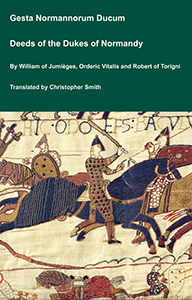
The Deeds of the Dukes of Normandy
The Gesta Normannorum Ducum [The Deeds of the Dukes of Normandy] is a landmark medieval chronicle tracing the rise and fall of the Norman dynasty from its early roots through the pivotal events surrounding the Norman Conquest of England. Originally penned in Latin by the monk William of Jumièges shortly before 1060 and later expanded at the behest of William the Conqueror, the work chronicles the deeds, politics, battles, and leadership of the Norman dukes, especially William’s own claim to the English throne. The narrative combines earlier historical sources with firsthand information and oral testimony to present an authoritative account of Normandy’s transformation from a Viking settlement into one of medieval Europe’s most powerful realms. William’s history emphasizes the legitimacy, military prowess, and governance of the Norman line, framing their expansion, including the conquest of England, as both divinely sanctioned and noble in purpose. Later chroniclers such as Orderic Vitalis and Robert of Torigni continued the history, extending the coverage into the 12th century, providing broader context on ducal rule and its impact. Today this classic work remains a foundational source for understanding Norman identity, medieval statesmanship, and the historical forces that reshaped England and Western Europe between 800AD and 1100AD.
Available at Amazon in eBook and Paperback format.

Before 14th November 1687 Mary Beale aka Cradock [aged 54] (attributed). Portrait of Nell Gwyn [aged 37].

Before 14th November 1687 Simon Pietersz Verelst [aged 43]. Portrait of Nell Gwyn [aged 37].
On 14th November 1687 Nell Gwyn [aged 37] died.