

Anne Boleyn. Her Life as told by Lancelot de Carle's 1536 Letter.
In 1536, two weeks after the execution of Anne Boleyn, her brother George and four others, Lancelot du Carle, wrote an extraordinary letter that described Anne's life, and her trial and execution, to which he was a witness. This book presents a new translation of that letter, with additional material from other contemporary sources such as Letters, Hall's and Wriothesley's Chronicles, the pamphlets of Wynkyn the Worde, the Memorial of George Constantyne, the Portuguese Letter and the Baga de Secrets, all of which are provided in Appendices.
Available at Amazon in eBook and Paperback format.
Paternal Family Tree: Stanhope

In 1628 [his father] Henry Stanhope and [his mother] Katherine Wotton Countess Chesterfield [aged 19] were married. He the son of [his grandfather] Philip Stanhope 1st Earl Chesterfield [aged 44] and [his grandmother] Catherine Hastings Countess Chesterfield.
Before 9th May 1630 [his step-father] Jehan Lord of Heenvliet [aged 35] and [his mother] Katherine Wotton Countess Chesterfield [aged 21] were married.
In 1634 Philip Stanhope 2nd Earl Chesterfield was born to [his father] Henry Stanhope and [his mother] Katherine Wotton Countess Chesterfield [aged 25].
On 29th November 1634 [his father] Henry Stanhope died.
In 1649 [his half-brother] Charles Kirkoven 1st Earl Bellomont [aged 5] was created 1st Baron Wotton.
John Evelyn's Diary. 15th October 1650. Sir Thomas Osborne [aged 18] (afterward Lord Treasurer) and Lord Stanhope [aged 16] shot for a wager of five louis, to be spent on a treat; they shot so exact that it was a drawn match.
John Evelyn's Diary. 1st November 1650. Took leave of my Lord Stanhope [aged 16], going on his journey toward Italy; also visited my Lord Hatton [aged 45], Comptroller of his Majesty's Household, the Countess of Morton [aged 41], Governess to the Lady Henrietta [aged 6], and Mrs. Gardner [aged 23], one of the Queen's maids of honor.


In 1652 Philip Stanhope 2nd Earl Chesterfield [aged 18] and Anne Percy 2nd Countess Chesterfield [aged 17] were married. She by marriage Countess Chesterfield. She the daughter of Algernon Percy 10th Earl of Northumberland [aged 49] and Anne Cecil. He the son of Henry Stanhope and Katherine Wotton Countess Chesterfield [aged 43]. They were fourth cousin once removed.
On 19th May 1653 Arthur Capell 1st Earl Essex [aged 21] and [his sister-in-law] Elizabeth Percy Countess Essex [aged 17] were married. She the daughter of [his father-in-law] Algernon Percy 10th Earl of Northumberland [aged 50] and Anne Cecil. They were fourth cousin once removed.
In 1654 [his wife] Anne Percy 2nd Countess Chesterfield [aged 19] died.

After 1654 Philip Stanhope 2nd Earl Chesterfield [aged 20] and Elizabeth Butler Countess Chesterfield [aged 13] were married. She by marriage Countess Chesterfield. She the daughter of James Butler 1st Duke Ormonde [aged 43] and Elizabeth Preston Duchess Ormonde [aged 38]. He the son of Henry Stanhope and Katherine Wotton Countess Chesterfield [aged 45].
Before 1655 [his brother-in-law] Charles Stanley 8th Earl of Derby [aged 26] and [his half-sister] Dorothea Helena Kirkoven Countess Derby [aged 24] were married. She by marriage Countess Derby. She the daughter of [his step-father] Jehan Lord of Heenvliet [aged 60] and [his mother] Katherine Wotton Countess Chesterfield [aged 45]. He the son of James Stanley 7th Earl of Derby and Charlotte Thouars Countess Derby [aged 55].
Adam Murimuth's Continuation and Robert of Avesbury’s 'The Wonderful Deeds of King Edward III'
This volume brings together two of the most important contemporary chronicles for the reign of Edward III and the opening phases of the Hundred Years’ War. Written in Latin by English clerical observers, these texts provide a vivid and authoritative window into the political, diplomatic, and military history of fourteenth-century England and its continental ambitions. Adam Murimuth Continuatio's Chronicarum continues an earlier chronicle into the mid-fourteenth century, offering concise but valuable notices on royal policy, foreign relations, and ecclesiastical affairs. Its annalistic structure makes it especially useful for establishing chronology and tracing the development of events year by year. Complementing it, Robert of Avesbury’s De gestis mirabilibus regis Edwardi tertii is a rich documentary chronicle preserving letters, treaties, and official records alongside narrative passages. It is an indispensable source for understanding Edward III’s claim to the French crown, the conduct of war, and the mechanisms of medieval diplomacy. Together, these works offer scholars, students, and enthusiasts a reliable and unembellished account of a transformative period in English and European history. Essential for anyone interested in medieval chronicles, the Hundred Years’ War, or the reign of Edward III.
Available at Amazon in eBook and Paperback format.
On 12th September 1656 [his grandfather] Philip Stanhope 1st Earl Chesterfield [aged 72] died. His grandson Philip [aged 22] succeeded 2nd Earl Chesterfield, 2nd Baron Stanhope of Shelford in Nottinghamshire.
In 1658 Philip Stanhope 2nd Earl Chesterfield [aged 24] was imprisoned for wounding Captain John Whalley in a duel at Tower of London [Map].

On 14th November 1659 [his brother-in-law] Thomas Butler 6th Earl Ossory [aged 25] and Emilia Nassau Beverweert Countess Ossory [aged 24] were married at Den Bosch. He the son of [his father-in-law] James Butler 1st Duke Ormonde [aged 49] and [his mother-in-law] Elizabeth Preston Duchess Ormonde [aged 44].
In 1660 [his mother] Katherine Wotton Countess Chesterfield [aged 51] was created 1st Countess Chesterfield.
Samuel Pepys' Diary. 17th January 1660. Tuesday. Early I went to Mr. Crew's [aged 62], and having given Mr. Edward [aged 12] money to give the servants, I took him into the coach that waited for us and carried him to my house, where the coach waited for me while I and the child went to Westminster Hall, and bought him some pictures. In the Hall I met Mr. Woodfine, and took him to Will's and drank with him. Thence the child and I to the coach, where my wife was ready, and so we went towards Twickenham. In our way, at Kensington we understood how that my Lord Chesterfield [aged 26] had killed another gentleman about half an hour before, and was fled.
Note. Philip Stanhope, second Earl of Chesterfield, ob. 1713, act. suae 80. We learn, from the memoir prefixed to his "Printed Correspondence", that he fought three duels, disarming and wounding his first and second antagonists, and killing the third. The name of the unfortunate gentleman who fell on this occasion was Woolly. Lord Chesterfield, absconding, went to Breda, where he obtained the royal pardon from Charles II [aged 29]. He acted a busy part in the eventful times in which he lived, and was remarkable for his steady adherence to the Stuarts. Lord Chesterfield's letter to Charles II, and the King's answer granting the royal pardon, occur in the Correspondence published by General Sir John Murray, in 1829: "Jan. 17th, 1659. The Earl of Chesterfield and Dr. Woolly's son of Hammersmith, had a quarrel about a mare of eighteen pounds price; the quarrel would not be reconciled, insomuch that a challenge passed between them. They fought a duel on the backside of Mr. Colby's house at Kensington, where the Earl and he had several passes. The Earl wounded him in two places, and would fain have then ended, but the stubbornness and pride of heart of Mr. Woolly would not give over, and the next pass [he] was killed on the spot. The Earl fled to Chelsea, and there took water and escaped. The jury found it chance-medley".-Rugge's "Diurnal", Addit MSS.,British Museum. B.].
In September 1660 [his step-father] Daniel O'Neill [aged 48] and [his mother] Katherine Wotton Countess Chesterfield [aged 51] were married.
Before 1662 [his brother-in-law] William Alington 1st and 3rd Baron Alington [aged 21] and [his sister] Catherine Stanhope Baroness Alington were married. She by marriage Baroness Alington of Killard. She the daughter of [his father] Henry Stanhope and [his mother] Katherine Wotton Countess Chesterfield [aged 52]. They were third cousin once removed.
In 1662 [his brother-in-law] Thomas Butler 6th Earl Ossory [aged 27] by writ of acceleration6th Earl Ossory. Emilia Nassau Beverweert Countess Ossory [aged 26] by marriage Countess Ossory.
In May 1662 [his brother-in-law] Richard Butler 1st Earl Arran [aged 22] was created 1st Earl Arran.
On 26th October 1662 William Cavendish 1st Duke Devonshire [aged 22] and [his sister-in-law] Mary Butler Duchess Devonshire [aged 16] were married. She the daughter of [his father-in-law] James Butler 1st Duke Ormonde [aged 52] and [his mother-in-law] Elizabeth Preston Duchess Ormonde [aged 47]. He the son of William Cavendish 3rd Earl Devonshire [aged 45] and Elizabeth Cecil Countess Devonshire [aged 43]. They were fifth cousins.


Samuel Pepys' Diary. 3rd November 1662. Thence to my Lord Sandwich [aged 37], from whom I receive every day more and more signs of his confidence and esteem of me. Here I met with Pierce the chyrurgeon, who tells me that my Baroness Castlemaine's [aged 21] is with child; but though it be the King's, yet her Lord [aged 28] being still in town, and sometimes seeing of her, though never to eat or lie together, it will be laid to him. He tells me also how the Duke of York [aged 29] is smitten in love with my Lady Chesterfield [aged 22]1 (a virtuous lady, daughter to my Lord of Ormond [aged 52]); and so much, that the Duchess of York [aged 25] hath complained to the King [aged 32] and her father [aged 53] about it, and my Lady Chesterfield is gone into the country for it. At all which I am sorry; but it is the effect of idleness, and having nothing else to employ their great spirits upon.
Note 1. Lady Elizabeth Butler, daughter of James Butler, first Duke of Ormond, second wife of Philip Stanhope [aged 28], second Earl of Chesterfield. She died July, 1665 (see "Memoires de Grammont", chap. viii.). Peter Cunningham thinks that this banishment was only temporary, for, according to the Grammont Memoirs, she was in town when the Russian ambassador was in London, December, 1662, and January, 1662- 63. "It appears from the books of the Lord Steward's office... that Lord Chesterfield set out for the country on the 12th May, 1663, and, from his 'Short Notes' referred to in the Memoirs before his Correspondence, that he remained at Bretby, in Derbyshire, with his wife, throughout the summer of that year" ("Story of Nell Gwyn", 1852, p. 189).
On 19th November 1662 [his sister] Catherine Stanhope Baroness Alington died.
William of Worcester's Chronicle of England
William of Worcester, born around 1415, and died around 1482 was secretary to John Fastolf, the renowned soldier of the Hundred Years War, during which time he collected documents, letters, and wrote a record of events. Following their return to England in 1440 William was witness to major events. Twice in his chronicle he uses the first person: 1. when writing about the murder of Thomas, 7th Baron Scales, in 1460, he writes '… and I saw him lying naked in the cemetery near the porch of the church of St. Mary Overie in Southwark …' and 2. describing King Edward IV's entry into London in 1461 he writes '… proclaimed that all the people themselves were to recognize and acknowledge Edward as king. I was present and heard this, and immediately went down with them into the city'. William’s Chronicle is rich in detail. It is the source of much information about the Wars of the Roses, including the term 'Diabolical Marriage' to describe the marriage of Queen Elizabeth Woodville’s brother John’s marriage to Katherine, Dowager Duchess of Norfolk, he aged twenty, she sixty-five or more, and the story about a paper crown being placed in mockery on the severed head of Richard, 3rd Duke of York.
Available at Amazon in eBook and Paperback format.
Samuel Pepys' Diary. 23rd December 1662. By and by comes James Pearce Surgeon, who among other things tells me that my Baroness Castlemaine's [aged 22] interest at Court increases, and is more and greater than the Queen's [aged 24]; that she hath brought in Sir H. Bennet [aged 44], and Sir Charles Barkeley [aged 32]; but that the Queen is a most good lady, and takes all with the greatest meekness that may be. He tells me too that Mr. Edward Montagu [aged 27] is quite broke at Court with his repute and purse; and that he lately was engaged in a quarrell against my Lord Chesterfield [aged 28]: but that the King [aged 32] did cause it to be taken up. He tells me, too, that the King is much concerned in the Chancellor's [aged 53] sickness, and that the Chancellor is as great, he thinks, as ever he was with the King. He also tells me what the world says of me, "that Mr. Coventry [aged 34] and I do all the business of the office almost:" at which I am highly proud. He being gone I fell to business, which was very great, but got it well over by nine at night, and so home, and after supper to bed.
Samuel Pepys' Diary. 1st January 1663. Lay with my wife at my Lord's lodgings, where I have been these two nights, till 10 o'clock with great pleasure talking, then I rose and to White Hall, where I spent a little time walking among the courtiers, which I perceive I shall be able to do with great confidence, being now beginning to be pretty well known among them. Then to my wife again, and found Mrs. Sarah with us in the chamber we lay in. Among other discourse, Mrs. Sarah tells us how the King [aged 32] sups at least four or [five] times every week with my Baroness Castlemaine's [aged 22]; and most often stays till the morning with her, and goes home through the garden all alone privately, and that so as the very centrys take notice of it and speak of it. She tells me, that about a month ago she [Baroness Castlemaine] quickened at my Lord Gerard's [aged 45] at dinner, and cried out that she was undone; and all the lords and men were fain to quit the room, and women called to help her. In fine, I find that there is nothing almost but bawdry at Court from top to bottom, as, if it were fit, I could instance, but it is not necessary; only they say my Lord Chesterfield [aged 29], groom of the stole to the Queen [aged 24], is either gone or put away from the Court upon the score of his lady's [aged 22] having smitten the Duke of York [aged 29], so as that he is watched by the Duchess of York [aged 25], and his lady is retired into the country upon it. How much of this is true, God knows, but it is common talk.
Samuel Pepys' Diary. 19th January 1663. He, the next day (of which the Duke was warned by somebody that saw the passion my Lord Chesterfield [aged 29] was in the night before), went and told the Duke how much he did apprehend himself wronged, in his picking out his lady of the whole Court to be the subject of his dishonour; which the Duke [aged 29] did answer with great calmness, not seeming to understand the reason of complaint, and that was all that passed but my Lord did presently pack his lady into the country in Derbyshire, near the Peake; which is become a proverb at Court, to send a man's wife to the Devil's arse a' Peake [Map], when she vexes him.
Samuel Pepys' Diary. 19th January 1663. This day, by Dr. Clerke, I was told the occasion of my Lord Chesterfield's [aged 29] going and taking his [his wife] lady [aged 22] (my Lord Ormond's daughter) from Court. It seems he not only hath been long jealous of the Duke of York [aged 29], but did find them two talking together, though there were others in the room, and the lady by all opinions a most good, virtuous woman.
Samuel Pepys' Diary. 25th January 1663. By and by comes in my Lady Wright, and so I went away, end after talking with Captn. Ferrers, who tells me of my Baroness Castlemaine's [aged 22] and Sir Charles Barkeley [aged 33] being the great favourites at Court, and growing every day more and more; and that upon a late dispute between my Lord Chesterfield [aged 29], that is the Queen's [aged 24] Lord Chamberlain, and Mr. Edward Montagu [aged 28], her Master of the Horse, who should have the precedence in taking the Queen's upperhand abroad out of the house, which Mr. Montagu challenges, it was given to my Lord Chesterfield. So that I perceive he goes down the wind in honour as well as every thing else, every day.


In May 1663 [his daughter] Elizabeth Stanhope Countess Strathmore and Kinghorne was born to Philip Stanhope 2nd Earl Chesterfield [aged 29] and [his wife] Elizabeth Butler Countess Chesterfield [aged 22]. She married 21st September 1691 her fourth cousin once removed John Lyon 4th Earl Strathmore and Kinghorne, son of Patrick Lyon 3rd Earl Strathmore and Kinghorne and Helen Middleton Countess Strathmore and Kinghorne, and had issue.

Samuel Pepys' Diary. 24th June 1663. We did talk highly of Sir W. Batten's [aged 62] corruption, which Mr. Coventry [aged 35] did very kindly say that it might be only his heaviness and unaptness for business, that he do things without advice and rashly, and to gratify people that do eat and drink and play with him, and that now and then he observes that he signs bills only in anger and fury to be rid of men. Speaking of Sir G. Carteret [aged 53], of whom I perceive he speaks but slightly, and diminishing of him in his services for the King [aged 33] in Jersey; that he was well rewarded, and had good lands and rents, and other profits from the King, all the time he was there; and that it was always his humour to have things done his way. He brought an example how he would not let the Castle there be victualled for more than a month, that so he might keep it at his beck, though the people of the town did offer to supply it more often themselves, which, when one did propose to the King, Sir George Carteret being by, says Sir George, "Let me know who they are that would do it, I would with all my heart pay them". "Ah, by God", says the Commander that spoke of it, "that is it that they are afeard of, that you would hug them", meaning that he would not endure them. Another thing he told me, how the Duke of York [aged 29] did give Sir G. Carteret and the Island his profits as Admirall, and other things, toward the building of a pier there. But it was never laid out, nor like to be. So it falling out that a lady being brought to bed, the Duke was to be desired to be one of the godfathers; and it being objected that that would not be proper, there being no peer of the land to be joyned with him, the lady replied, "Why, let him choose; and if he will not be a godfather without a peer, then let him even stay till he hath made a pier of his own1".
Note 1. In the same spirit, long after this, some question arising as to the best material to be used in building Westminster Bridge, Lord Chesterfield [aged 29] remarked, that there were too many wooden piers (peers) at Westminster already. B.

Samuel Pepys' Diary. 28th December 1663. Up and by coach to my Lord's lodgings, but he was gone abroad, so I lost my pains, but, however, walking through White Hall I heard the King [aged 33] was gone to play at Tennis, so I down to the new Tennis Court; and saw him and Sir Arthur Slingsby [aged 40] play against my Lord of Suffolke [aged 44] and my Lord Chesterfield [aged 29]. The King beat three, and lost two sets, they all, and he particularly playing well, I thought.
In September 1664 [his brother-in-law] Richard Butler 1st Earl Arran [aged 25] and Mary Stewart Countess Arran [aged 13] were married. She by marriage Countess Arran. She the daughter of James Stewart 4th Duke Lennox 1st Duke Richmond and Mary Villiers Duchess Lennox Duchess Richmond [aged 42]. He the son of [his father-in-law] James Butler 1st Duke Ormonde [aged 53] and [his mother-in-law] Elizabeth Preston Duchess Ormonde [aged 49]. They were half fifth cousin once removed.
In July 1665 [his wife] Elizabeth Butler Countess Chesterfield [aged 25] died.
Chronicle of Abbot Ralph of Coggeshall
The Chronicle of Abbot Ralph of Coggeshall (Chronicon Anglicanum) is an indispensable medieval history that brings to life centuries of English and European affairs through the eyes of a learned Cistercian monk. Ralph of Coggeshall, abbot of the Abbey of Coggeshall in Essex in the early 13th century, continued and expanded his community’s chronicle, documenting events from the Norman Conquest of 1066 into the tumultuous reign of King Henry III. Blending eyewitness testimony, careful compilation, and the monastic commitment to record-keeping, this chronicle offers a rare narrative of political intrigue, royal power struggles, and social upheaval in England and beyond. Ralph’s work captures the reigns of pivotal figures such as Richard I and King John, providing invaluable insights into their characters, decisions, and the forces that shaped medieval rule. More than a simple annal, Chronicon Anglicanum conveys the texture of medieval life and governance, making it a rich source for scholars and readers fascinated by English history, monastic authorship, and the shaping of the medieval world.
Available at Amazon in eBook and Paperback format.

After July 1665 Philip Stanhope 2nd Earl Chesterfield [aged 31] and Elizabeth Dormer Countess Chesterfield [aged 12] were married. She by marriage Countess Chesterfield. She the daughter of Charles Dormer 2nd Earl Carnarvon [aged 32] and Elizabeth Capell Countess Carnarvon [aged 32]. He the son of Henry Stanhope and Katherine Wotton Countess Chesterfield [aged 56]. They were third cousin once removed.
On 9th April 1667 [his mother] Katherine Wotton Countess Chesterfield [aged 58] died. Earl Chesterfield extinct. Her son [his half-brother] Charles Kirkoven 1st Earl Bellomont [aged 23] inherited Boughton aka Bocton Place, Kent [Map].
Samuel Pepys' Diary. 9th June 1667. To Sir W. Coventry [aged 39], and there talked with him a great while; and mighty glad I was of my good fortune to visit him, for it keeps in my acquaintance with him, and the world sees it, and reckons my interest accordingly. In comes my Lord Barkeley [aged 65], who is going down to Harwich, Essex [Map] also to look after the militia there: and there is also the Duke of Monmouth [aged 18], and with him a great many young Hectors, the Lord Chesterfield [aged 33], my Lord Mandeville [aged 33], and others: but to little purpose, I fear, but to debauch the country women thereabouts. My Lord Barkeley wanting some maps, and Sir W. Coventry recommending the six maps of England that are bound up for the pocket, I did offer to present my Lord with them, which he accepted: and so I will send them him.

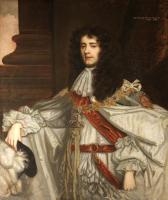
John Evelyn's Diary. 15th July 1669. Having two days before had notice that the University intended me the honor of Doctorship, I was this morning attended by the beadles belonging to the Law, who conducted me to the Theater, where I found the [his former father-in-law] Duke of Ormond [aged 58] (now Chancellor of the University) with the Earl of Chesterfield [aged 35] and Mr. Spencer [aged 40] (brother to the late Earl of Sunderland). Thence, we marched to the Convocation House, a convocation having been called on purpose; here, being all of us robed in the porch, in scarlet with caps and hoods, we were led in by the Professor of Laws, and presented respectively by name, with a short eulogy, to the Vice-Chancellor, who sat in the chair, with all the Doctors and Heads of Houses and masters about the room, which was exceedingly full. Then, began the Public Orator his speech, directed chiefly to the Duke of Ormond, the Chancellor; but in which I had my compliment, in course. This ended, we were called up, and created Doctors according to the form, and seated by the Vice-Chancellor among the Doctors, on his right hand; then, the Vice-Chancellor made a short speech, and so, saluting our brother Doctors, the pageantry concluded, and the convocation was dissolved. So formal a creation of honorary Doctors had seldom been seen, that a convocation should be called on purpose, and speeches made by the Orator; but they could do no less, their Chancellor being to receive, or rather do them, this honor. I should have been made Doctor with the rest at the public Act, but their expectation of their Chancellor made them defer it. I was then led with my brother Doctors to an extraordinary entertainment at Doctor Mewes's, head of St John's College, Oxford University, and, after abundance of feasting and compliments, having visited the Vice-Chancellor and other Doctors, and given them thanks for the honor done me, I went toward home the 16th, and got as far as Windsor, Berkshire [Map], and so to my house the next day.


On 3rd February 1673 [his son] Philip Stanhope 3rd Earl Chesterfield was born to Philip Stanhope 2nd Earl Chesterfield [aged 39] and [his wife] Elizabeth Dormer Countess Chesterfield [aged 20]. He married 1692 his fifth cousin once removed Elizabeth Savile, daughter of George Savile 1st Marquess Halifax and Gertrude Pierrepont Marchioness Halifax, and had issue.
On 6th April 1673 [his half-sister] Dorothea Helena Kirkoven Countess Derby [aged 43] died.
In 1674 [his daughter] Mary Stanhope was born to Philip Stanhope 2nd Earl Chesterfield [aged 40] and [his wife] Elizabeth Dormer Countess Chesterfield [aged 21]. She married June 1698 Thomas Coke and had issue.
In or after 1675 [his daughter] Catherine Stanhope was born to Philip Stanhope 2nd Earl Chesterfield [aged 41] and [his wife] Elizabeth Dormer Countess Chesterfield [aged 22]. She married 13th June 1706 Godfrey Clarke.
In 1676 [his son] Charles Stanhope aka Wooton was born to Philip Stanhope 2nd Earl Chesterfield [aged 42] and [his wife] Elizabeth Dormer Countess Chesterfield [aged 23].
In November 1677 [his wife] Elizabeth Dormer Countess Chesterfield [aged 24] died.
Anne Boleyn. Her Life as told by Lancelot de Carle's 1536 Letter.
In 1536, two weeks after the execution of Anne Boleyn, her brother George and four others, Lancelot du Carle, wrote an extraordinary letter that described Anne's life, and her trial and execution, to which he was a witness. This book presents a new translation of that letter, with additional material from other contemporary sources such as Letters, Hall's and Wriothesley's Chronicles, the pamphlets of Wynkyn the Worde, the Memorial of George Constantyne, the Portuguese Letter and the Baga de Secrets, all of which are provided in Appendices.
Available at Amazon in eBook and Paperback format.
On 25th August 1679 [his half-brother] Charles Kirkoven 1st Earl Bellomont [aged 36] and [his sister-in-law] Frances Willoughby Countess Bellomont [aged 36] were married. She by marriage Baroness Wotton. His paternal grandfather Thomas Wotton 2nd Baron Wotton had been the last of the previous creation of Baron Wotton. He the son of Jehan Lord of Heenvliet and Katherine Wotton Countess Chesterfield.
John Evelyn's Diary. 4th December 1679. I dined, together with [his former brother-in-law] Lord Ossory [aged 45] and the Earl of Chesterfield [aged 45], at the Portugal Ambassador's [aged 53], now newly come, at Cleveland House, a noble palace, too good for that infamous.... [Note. Probably a reference to Barbara Villiers 1st Duchess of Cleveland [aged 39]] The staircase is sumptuous, and the gallery and garden; but, above all, the costly furniture belonging to the Ambassador, especially the rich Japan cabinets, of which I think there were a dozen. There was a billiard table, with as many more hazards as ours commonly have; the game being only to prosecute the ball till hazarded, without passing the port, or touching the pin; if one miss hitting the ball every time, the game is lost, or if hazarded. It is more difficult to hazard a ball, though so many, than in our table, by reason the bound is made so exactly even, and the edges not stuffed; the balls are also bigger, and they for the most part use the sharp and small end of the billiard stick, which is shod with brass, or silver. The entertainment was exceedingly civil; but, besides a good olio, the dishes were trifling, hashed and condited after their way, not at all fit for an English stomach, which is for solid meat. There was yet good fowls, but roasted to coal, nor were the sweetmeats good.
In 1680 [his half-brother] Charles Kirkoven 1st Earl Bellomont [aged 36] was created 1st Earl Bellomont. [his sister-in-law] Frances Willoughby Countess Bellomont [aged 37] by marriage Countess Bellomont.
In 1683 Charles Kirkoven 1st Earl Bellomont [aged 39] died. Earl Bellomont and Baron Wotton extinct. He was buried at Canterbury Cathedral [Map]. He willed Boughton aka Bocton Place, Kent [Map] to his nephew, Charles Stanhope aka Wooton [aged 7], son of his half-brother Philip Stanhope 2nd Earl Chesterfield [aged 49].
On 21st September 1691 [his son-in-law] John Lyon 4th Earl Strathmore and Kinghorne [aged 28] and Elizabeth Stanhope Countess Strathmore and Kinghorne [aged 28] were married. She the daughter of Philip Stanhope 2nd Earl Chesterfield [aged 57] and Elizabeth Butler Countess Chesterfield. He the son of Patrick Lyon 3rd Earl Strathmore and Kinghorne [aged 48] and Helen Middleton Countess Strathmore and Kinghorne [aged 46]. They were fourth cousin once removed.
In 1692 Philip Stanhope 3rd Earl Chesterfield [aged 18] and Elizabeth Savile [aged 15] were married. She the daughter of George Savile 1st Marquess Halifax [aged 58] and Gertrude Pierrepont Marchioness Halifax. He the son of Philip Stanhope 2nd Earl Chesterfield [aged 58] and Elizabeth Dormer Countess Chesterfield. They were fifth cousin once removed.

John Evelyn's Diary. 7th April 1695. Lord Halifax [deceased] died suddenly at London, the day his [his daughter-in-law] daughter [aged 18] was married to the Earl of Nottingham's [aged 61] son [aged 22] at Burleigh. Lord H. was a very rich man, very witty, and in his younger days somewhat positive.

In June 1698 [his son-in-law] Thomas Coke [aged 24] and Mary Stanhope [aged 24] were married. She the daughter of Philip Stanhope 2nd Earl Chesterfield [aged 64] and Elizabeth Dormer Countess Chesterfield.
In 1704 [his daughter] Mary Stanhope [aged 30] died.
On or before 6th February 1704 [his son] Charles Stanhope aka Wooton [aged 28] died. Boughton aka Bocton Place, Kent [Map] was inherited by his elder brother Philip Stanhope 3rd Earl Chesterfield [aged 31].
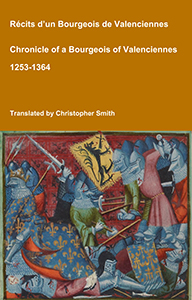
Chronicle of a Bourgeois of Valenciennes
Récits d’un bourgeois de Valenciennes aka The Chronicle of a Bourgeois of Valenciennes is a vivid 14th-century vernacular chronicle written by an anonymous urban chronicler from Valenciennes in the County of Hainaut. It survives in a manuscript that describes local and regional history from about 1253 to 1366, blending chronology, narrative episodes, and eyewitness-style accounts of political, military, and social events in medieval France, Flanders, and the Low Countries. The work begins with a chronological framework of events affecting Valenciennes and its region under rulers such as King Philip VI of France and the shifting allegiances of local nobility. It includes accounts of conflicts, sieges, diplomatic manoeuvres, and the impact of broader struggles like the Hundred Years’ War on urban life in Hainaut. Written from the perspective of a burgher (bourgeois) rather than a monastery or royal court, the chronicle offers a rare lay viewpoint on high politics and warfare, reflecting how merchants, townspeople, and civic institutions experienced the turbulence of the 13th and 14th centuries. Its narrative style combines straightforward reporting of events with moral and civic observations, making it a valuable source for readers interested in medieval urban society, regional politics, and the lived experience of war and governance in pre-modern Europe.
Available at Amazon in eBook and Paperback format.
Around 13th June 1706 [his son-in-law] Godfrey Clarke [aged 22] and Catherine Stanhope [aged 31] were married. She brougt a dowry of £8,000. She the daughter of Philip Stanhope 2nd Earl Chesterfield [aged 72] and Elizabeth Dormer Countess Chesterfield.
On 28th January 1714 Philip Stanhope 2nd Earl Chesterfield [aged 80] died. He was buried at Shelford, Nottinghamshire [Map]. His son Philip [aged 40] succeeded 3rd Earl Chesterfield, 3rd Baron Stanhope of Shelford in Nottinghamshire.
Adeline Horsey Recollections. Bretby [Map] was the scene of the enforced retirement of the lovely [his former wife] Lady Chesterfield, whose jealous husband brought her thither from the Court of Charles II De Grammont followed her, and I have often sat in the summer-house, described in his " Memoirs", where he patiently waited for his inamorata to pass by.
Grammont. Hamilton, if possible, more astonished, and more confounded than himself, was far from being in a proper state to afford him advice on the present occasion: he listened to nothing but jealousy, and breathed nothing but revenge; but these emotions being somewhat abated, in hopes that there might be calumny, or at least exaggeration in the charges against Lady Chesterfield, he desired her husband to suspend his resolutions, until he was more fully informed of the fact; assuring him, however, that if he found the circumstances such as he had related, he should regard and consult no other interest than his.
Upon this they parted; and Hamilton found, on the first inquiry, that almost the whole court was informed of the adventure, to which every one added something in relating it. Vexation and resentment inflamed his heart, and by degrees extinguished every remnant of his former passion.
He might easily have seen her, and have made her such reproaches as a man is generally inclined to do on such occasions; but he was too much enraged to enter into any detail which might have led to an explanation: he considered himself as the only person essentially injured in this affair; for he could never bring his mind to think that the injuries of the husband could be placed in competition with those of the lover.
He hastened to Lord Chesterfield, in the transport of his passion, and told him that he had heard enough to induce him to give such advice, as he should follow himself in the same situation, and that, if he wished to save a woman so strongly prepossessed, and who, perhaps, had not yet lost all her innocence, though she had totally lost her reason, he ought not to delay one single instant, but immediately to carry her into the country, with the greatest possible expedition, without allowing her the least time to recover her surprise.

Grammont. Those who appeared the most attentive to their conduct, were not the least interested in it; Hamilton and Lord Chesterfield watched them narrowly; but Lady Denham, vexed that Lady Chesterfield should have stepped in before her, took the liberty of railing against her rival with the greatest bitterness. Hamilton had hitherto flattered himself, that vanity alone had engaged Lady Chesterfield in this adventure; but he was soon undeceived, whatever her indifference might have been when she first commenced this intrigue. We often proceed farther than we at first intended, when we indulge ourselves in trifling liberties, which we think of no consequence; for though perhaps the heart takes no part at the beginning, it seldom fails to be engaged in the end.
Grammont. The court, as we have mentioned before, was an entire scene of gallantry and amusements, with all the politeness and magnificence, which the inclinations of a prince, naturally addicted to tenderness and pleasure, could suggest; the beauties were desirous of charming, and the men endeavoured to please; all studied to set themselves off to the best advantage; some distinguished themselves by dancing; others by show and magnificence; some by their wit, many by their amours, but few by their constancy. There was a certain Italian at court, famous for the guitar; he had a genius for music, and he was the only man who could make any thing of the guitar: his style of play was so full of grace and tenderness, that he would have given harmony to the most discordant instruments. The truth is, nothing was so difficult as to play like this foreigner. The king's relish for his compositions had brought the instrument so much into vogue, that every person played upon it, well or ill; and you were as sure to see a guitar on a lady's toilette, as rouge or patches. The Duke of York played upon it tolerably well, and the Earl of Arran like Francisco himself. This Francisco had composed a saraband, which either charmed or infatuated every person; for the whole guitarery at court were trying at it, and God knows what an universal strumming there was. The Duke of York, pretending not to be perfect in it, desired Lord Arran to play it to him. Lady Chesterfield had the best guitar in England. The Earl of Arran, who was desirous of playing his best, conducted his royal highness to his sister's apartments; she was lodged at court, at her father's, the Duke of Ormond's, and this wonderful guitar was lodged there too. Whether this visit had been preconcerted or not, I do not pretend to say; but it is certain that they found both the lady and the guitar at home; they likewise found there Lord Chesterfield, so much surprised at this unexpected visit, that it was a considerable time before he thought of rising from his seat, to receive them with due respect.
Jealousy, like a malignant vapour, now seized upon his brain; a thousand suspicions, blacker than ink, took possession of his imagination, and were continually increasing; for whilst the brother played upon the guitar to the duke, the sister ogled and accompanied him with her eyes, as if the coast had been clear, and no enemy to observe them. This saraband was at least repeated twenty times; the duke declared it was played to perfection. Lady Chesterfield found fault with the composition; but her husband, who clearly perceived that he was the person played upon, thought it a most detestable piece. However, though he was in the last agony, at being obliged to curb his passion, while others gave a free scope to theirs, he was resolved to find out the drift of the visit; but it was not in his power; for having the honour to be chamberlain to the queen, a messenger came to require his immediate attendance on her majesty. His first thought was to pretend sickness; the second to suspect that the queen, who sent for him at such an unseasonable time, was in the plot; but at last, after all the extravagant ideas of a suspicious man, and all the irresolutions of a jealous husband, he was obliged to go.
We may easily imagine what his state of mind was when he arrived at the palace. Alarms are to the jealous, what disasters are to the unfortunate: they seldom come alone, but form a series of persecution. He was informed that he was sent for to attend the queen at an audience she gave to seven or eight Muscovite ambassadors: he had scarce begun to curse the Muscovites, when his brother-in-law appeared, and drew upon himself all the imprecations he bestowed upon the embassy: he no longer doubted his being in the plot with the two persons he had left together; and in his heart sincerely wished him such recompense for his good offices as such good offices deserved. It was with great difficulty that he restrained himself from immediately acquainting him what was his opinion of such conduct: he thought that what he had already seen was a 'sufficient proof of his wife's infidelity; but before the end of the very same day, some circumstances occurred, which increased his suspicions, and persuaded him, that they had taken advantage of his absence, and of the honourable officiousness of his brother-in-law. He passed, however, that night with tranquillity; but the next morning, being reduced, to the necessity either of bursting or giving vent to his sorrows and conjectures, he did nothing but think and walk about the room until Park-time. He went to court, seemed very busy, as if seeking for some person or other, imagining that people guessed at the subject of his uneasiness: he avoided every body; but at length meeting with Hamilton, he thought he was the very man that he wanted; and having desired him to take an airing with him in Hyde Park, he took him up in his coach, and they arrived at the Ring, without a word having passed between them.


Grammont. Miss Hamilton had much difficulty to suppress her laughter during this harangue: however, she told him, that she thought herself much honoured by his intentions towards her, and still more obliged to him for consulting her, before he made any overtures to her relations: "It will be time enough," said she, "to speak to them upon the subject at your return from the waters; for I do not think it is at all probable that they will dispose of me before that time, and in case they should be urgent in their solicitations, your nephew William will take care to acquaint you; therefore, you may set out whenever you think proper; but take care not to injure your health by returning too soon."
The Chevalier de Grammont, having heard the particulars of this conversation, endeavoured as well as he could to be entertained with it; though there were certain circumstances in the declaration, notwithstanding the absurdity of others, which did not fail to give him some uneasiness. Upon the whole, he was not sorry for Russell's departure; and, assuming an air of pleasantry, he went to relate to the king, how Heaven had favoured him, by delivering him from so dangerous a rival. "He is gone then, Chevalier?" said the king "Certainly, Sir," said he, "I had the honour to see him embark in a coach, with his asthma, and country equipage, his perruque à calotte, neatly tied with a yellow riband, and his old-fashioned hat covered with oil-skin, which becomes him uncommonly well: therefore, I have only to contend with William Russell, whom he leaves as his resident with Miss Hamilton; and, as for him, I neither fear him upon his own account, nor his uncle's: he is too much in love himself, to pay attention to the interests of another; and as he has but one method of promoting his own, which is by sacrificing the portrait, or some love-letters of Mrs. Middleton, I have it easily in my power to counteract him in such kind of favours, though I confess I have pretty well paid for them."
"Since your affairs proceed so prosperously with the Russells," said the king, "I will acquaint you that you are delivered from another rival, much more dangerous, if he were not already married: my brother has lately fallen in love with Lady Chesterfield." "How many blessings at once!" exclaimed the Chevalier de Grammont: "I have so many obligations to him for this inconstancy, that I would willingly serve him in his new amour, if Hamilton was not his rival: nor will your majesty take it ill, if I promote the interests of my mistress's brother, rather than those of your majesty's brother." "Hamilton, however," said the king, "does not stand so much in need of assistance, in affairs of this nature. as the Duke of York; but I know Lord Chesterfield is of such a disposition, that he will not suffer men to quarrel about his wife, with the same patience as the complaisant Shrewsbury; though he well deserves the same fate." Here follows a true description of Lord Chesterfield.
He had a very agreeable face, a fine head of hair, an indifferent shape, and a worse air; he was not, however, deficient in wit: a long residence in Italy had made him ceremonious in his commerce with men, and jealous in his connection with women. He had been much hated by the king, because he had been much beloved by Lady Castlemaine: it was reported that he had been in her good graces prior to her marriage; and as neither of them denied it. it was the more generally believed.
He had paid his devoirs to the eldest daughter of the Duke of Ormond, while his heart was still taken up with his former passion. The king's love for Lady Castlemaine, and the advancement he expected from such an alliance, made him press the match with as much ardour as if he had been passionately in love: he had therefore married Lady Chesterfield without loving her, and had lived some time with her in such coolness, as to leave her no room to doubt of his indifference. As she was endowed with great sensibility and delicacy, she suffered at this contempt: she was at first much affected with his behaviour, and afterwards enraged at it; and, when he began to give her proofs of his affection, she had the pleasure of convincing him of her indifference.
They were upon this footing, when she resolved to cure Hamilton, as she had lately done her husband, of all his remaining tenderness for Lady Castlemaine. For her it was no difficult undertaking: the conversation of the one was disagreeable, from the unpolished state of her manners, her ill-timed pride, her uneven temper, and extravagant humours: Lady Chesterfield, on the contrary, knew how to heighten her charms, with all the bewitching attractions in the power of a woman to invent, who wishes to make a conquest.
Besides all this, she had greater opportunities of making advances to him, than to any other: she lived at the Duke of Ormond's, at Whitehall, where Hamilton, as was said before, had free admittance at all hours: her extreme coldness, or rather the disgust which she shewed for her husband's returning affection, wakened his natural inclination to jealousy: he suspected that she could not so very suddenly pass from anxiety to indifference for him, without some secret object of a new attachment; and, according to the maxims of all jealous husbands, he immediately put in practice all his experience and industry, in order to make a discovery, which was to destroy his own happiness.
Hamilton, who knew his disposition, was, on the other hand, upon his guard, and the more he advanced in his intrigue, the more attentive was he to remove every degree of suspicion from the earl's mind: he pretended to make him his confidant, in the most unguarded and open manner, of his passion for Lady Castlemaine: he complained of her caprice, and most earnestly desired his advice how to succeed with a person whose affections he alone had entirely possessed.
Chesterfield, who was flattered with this discourse, promised him his protection with greater sincerity than it had been demanded: Hamilton, therefore, was no further embarrased than to preserve Lady Chesterfield's reputation, who, in his opinion, declared herself rather too openly in his favour: but whilst he was diligently employed in regulating, within the rules of diseretion, the partiality she expressed for him, and in conjuring her to restrain her glances within bounds, she was receiving those of the Duke of York; and, what is more, made them favourable returns.
He thought that he had perceived it, as well as every one besides; but he thought likewise, that all the world was deceived as well as himself: how could he trust his own eyes, as to what those of Lady Chesterfield betrayed for this new rival? He could not think it probable, that a woman of her disposition could relish a man, whose manners had a thousand times been the subject of their private ridicule; but what he judged still more improbable was, that she should begin another intrigue before she had given the finishing stroke to that in which her own advances had engaged her: however, he began to observe her with more circumspection, when he found by his discoveries, that if she did not deceive him, at least the desire of doing so was not wanting. This he took the liberty of telling her of; but she answered him in so high a strain, and treated what he said so much like a phantom of his own imagination, that he appeared confused without being convinced: all the satisfaction he could procure from her, was her telling him, in a haughty manner, that such unjust reproaches as his ought to have had a better foundation.
Lord Chesterfield had taken the same alarm; and being convinced, from the observations he had made, that he had found out the happy lover who had gained possession of his lady's heart, he was satisfied; and without teazing her with unnecessary reproaches, he only waited for an opportunity to confound her, before he took his measures.
After all, how can we account for Lady Chesterfield's conduct, unless we attribute it to the disease incident to most coquettes, who, charmed with superiority, put in practice every art to rob another of her conquest, and spare nothing to preserve it.

Grammont. Hamilton, who saw him as yellow as jealousy itself, and particularly thoughtful, imagined that he had just discovered what all the world had perceived long before; when Chesterfield, after a broken insignificant preamble, asked him how he succeeded with Lady Castlemaine. Hamilton, who very well saw that he meant nothing by this question, nevertheless thanked him; and as he was thinking of an answer: "Your cousin," said the earl, "is extremely coquettish, and I have some reason to suppose she is not so prudent as she ought to be." Hamilton thought the last charge a little too severe; and as he was endeavouring to refute it: "Good God," said my lord, "you see, as well as the whole court, what airs she gives herself: husbands are always the last people that are spoken to about those affairs that concern them the most; but they are not always the last to perceive it themselves: though you have made me your confidant in other matters, yet I am not at all surprised you have concealed this from me; but as I flatter myself with having some share in your esteem, I should be sorry you should think me such a fool as to be incapable of seeing, though I am so complaisant as not to express my sentiments: nevertheless, I find that affairs are now carried on with such barefaced boldness, that at length I find I shall be forced to take some course or other. God forbid that I should act the ridiculous part of a jealous husband: the character is odious; but then I do not intend, through an excess of patience, to be made the jest of the town. Judge, therefore, from what I am going to tell you, whether I ought to sit down unconcerned, or whether I ought to take measures for the preservation of my honour.

Grammont. "His royal highness honoured me yesterday by a visit to my wife." Hamilton started at this beginning. "Yes," continued the other, "he did give himself that trouble, and Lord Arran took upon himself that of bringing him: do not you wonder that a man of his birth should act such a part? What advancement can he expect from one who employs him in such base services? But we have long known him to be one of the silliest creatures in England, with his guitar, and his other whims and follies." Chesterfield, after this short sketch of his brother-in-law's merit, began to relate the observations he had made during the visit, and asked Hamilton what he thought of his cousin Arran, who had so obligingly left them together. "This may appear surprising to you," continued he, "but hear me out, and judge whether I have reason to think that the close of this pretty visit passed in perfect innocence. Lady Chesterfield is amiable, it must be acknowledged; but she is far from being such a miracle of beauty as she supposes herself: you know she has ugly feet; but perhaps you are not acquainted that she has still worse legs." "Pardon me," said Hamilton, within himself: and the other continuing the description: "Her legs," said his lordship, "are short and thick; and, to remedy these defects as much as possible, she seldom wears any other than green stockings."
Hamilton could not for his life imagine the drift of all this discourse, and Chesterfield guessing his thoughts: "Have a little patience," said he: "I went yesterday to Miss Stewart's, after the audience of those damned Muscovites: the king arrived there just before me; and as if the duke had sworn to pursue me wherever I went that day, he came in just after me. The conversation turned upon the extraordinary appearance of the ambassadors. I know not where that fool Crofts had heard that all these Muscovites had handsome wives; and that all their wives had handsome legs. Upon this the king maintained, that no woman ever had such handsome legs as Miss Stewart; and she, to prove the truth of his majesty's assertion, with the greatest imaginable ease, immediately shewed her leg above the knee. Some were ready to prostrate themselves, in order to adore its beauty; for indeed none can be handsomer; but the duke alone began to criticize upon it. He contended that it was too slender, and that as for himself he would give nothing for a leg that was not thicker and shorter, and concluded by saying, that no leg was worth any thing without green stockings: now this, in my opinion, was a sufficient demonstration that he had just seen green stockings, and had them fresh in his remembrance."
Hamilton was at a loss what countenance to put on, during a narrative which raised in him nearly the same conjectures: he shrugged up his shoulders, and faintly said that appearances were often deceitful; that Lady Chesterfield had the foible of all beauties, who place their merit on the number of their admirers; and whatever airs she might imprudently have given herself, in order not to discourage his royal highness, there was no ground to suppose that she would indulge him in any greater liberties to engage him: but in vain was it that he endeavoured to give that consolation to his friend which he did not feel himself. Chesterfield plainly perceived he did not think of what he was saying; however, he thought himself much obliged to him for the interest he seemed to take in his concerns.
Hamilton was in haste to go home to vent his spleen and resentment in a letter to his cousin: the style of this billet was very different from those which he formerly was accustomed to write to her: reproaches, bitter expostulations, tenderness, menaces, and all the effusions of a lover, who thinks he has reason to complain, composed this epistle; which, for fear of accidents, he went to deliver himself.
Grammont. The court was filled with the story of this adventure; nobody was ignorant of the occasion of this sudden departure, but very few approved of Lord Chesterfield's conduct. In England they looked with astonishment upon a man who could be so uncivil as to be jealous of his wife; and in the city of London it was a prodigy, till that time unknown, to see a husband have recourse to violent means to prevent what jealousy fears, and what it always deserves. They endeavoured, however, to excuse poor Lord Chesterfield, as far as they could safely do it, without incurring the public odium, by laying all the blame on his bad education. This made all the mothers vow to God, that none of their sons should ever set a foot in Italy, lest they should bring back with them that infamous custom of laying restraint upon their wives.
As this story for a long time took up the attention of the court, the Chevalier de Grammont, who was not thoroughly acquainted with all the particulars, inveighed more bitterly than all the citizens of London put together against this tyranny; and it was upon this occasion that he produced new words to that fatal saraband which had unfortunately so great a share in the adventure. The Chevalier passed for the author; but if Saint Evremond had any part in the composition, it certainly was greatly inferior to his other performances, as the reader will see in the following chapter.
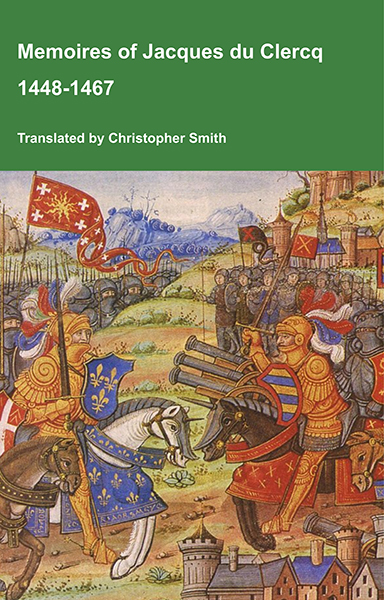
This is a translation of the 'Memoires of Jacques du Clercq', published in 1823 in two volumes, edited by Frederic, Baron de Reissenberg. In his introduction Reissenberg writes: 'Jacques du Clercq tells us that he was born in 1424, and that he was a licentiate in law and a counsellor to Philip the Good, Duke of Burgundy, in the castellany of Douai, Lille, and Orchies. It appears that he established his residence at Arras. In 1446, he married the daughter of Baldwin de la Lacherie, a gentleman who lived in Lille. We read in the fifth book of his Memoirs that his father, also named Jacques du Clercq, had married a lady of the Le Camelin family, from Compiègne. His ancestors, always attached to the counts of Flanders, had constantly served them, whether in their councils or in their armies.' The Memoires cover a period of nineteen years beginning in in 1448, ending in in 1467. It appears that the author had intended to extend the Memoirs beyond that date; no doubt illness or death prevented him from carrying out this plan. As Reissenberg writes the 'merit of this work lies in the simplicity of its narrative, in its tone of good faith, and in a certain air of frankness which naturally wins the reader’s confidence.' Du Clercq ranges from events of national and international importance, including events of the Wars of the Roses in England, to simple, everyday local events such as marriages, robberies, murders, trials and deaths, including that of his own father in Book 5; one of his last entries.
Available at Amazon in eBook and Paperback format.
Grammont. Lord Chesterfield readily agreed to follow this advice, which he had already considered as the only counsel a friend could give him; but his lady, who did not suspect he had made this last discovery of her conduct, thought he was joking with her when he told her to prepare for going into the country in two days: she was the more induced to think so, as it was in the very middle of an extremely severe winter; but she soon perceived that he was in earnest: she knew, from the air and manner of her husband, that he thought he had sufficient reason to treat her in this imperious style; and, finding all her relations serious and cold to her complaint, she had no hope left in this universally abandoned situation, but in the tenderness of Hamilton. She imagined she should hear from him the cause of her misfortunes, of which she was still totally ignorant, and that his love would invent some means or other to prevent a journey, which she flattered herself would be even more affecting to him than to herself; but she was expecting pity from a crocodile.
At last, when she saw the eve of her departure was come; that every preparation was made for a long journey; that she was receiving farewell visits in form, and that still she heard nothing from Hamilton, both her hopes and her patience forsook her in this wretched situation. A few tears, perhaps, might have afforded her some relief, but she chose rather to deny herself that comfort, than to give her husband so much satisfaction. Hamilton's conduct, on this occasion, appeared to her unaccountable; and, as he still never came near her, she found means to convey to him the following billet.
"Is it possible that you should be one of those, who, without vouchsafing to tell me for what crime I am treated like a slave, suffer me to be dragged from society? What means your silence and indolence, in a juncture wherein your tenderness ought most particularly to appear, and actively exert itself? I am upon the point of departing, and am ashamed to think that you are the cause of my looking upon it with horror, as I have reason to believe that you are less concerned at it than any other person: do, at least, let me know to what place I am to be dragged; what is to be done with me within a wilderness; and on what account you, like all the rest of the world, appear changed in your behaviour towards a person, whom all the world could not oblige to change with regard to you, if your weakness or your ingratitude did not render you unworthy of her tenderness."
This billet did but harden his heart, and make him more proud of his vengeance: he swallowed down full draughts of pleasure, in beholding her reduced to despair, being persuaded that her grief and regret for her departure were on account of another person: he felt uncommon satisfaction in having a share in tormenting her, and was particularly pleased with the scheme he had contrived to separate her from a rival, upon the very point, perhaps, of being made happy Thus fortified as he was against his natural tenderness, with all the severity of jealous resentment, he saw her depart with an indifference which he did not even endeavour to conceal from her; this unexpected treatment, joined to the complication of her other misfortunes, had almost in reality plunged her into despair.
Kings Wessex: Great x 19 Grand Son of King Edmund "Ironside" I of England
Kings Gwynedd: Great x 17 Grand Son of Owain "Great" King Gwynedd
Kings Seisyllwg: Great x 23 Grand Son of Hywel "Dda aka Good" King Seisyllwg King Deheubarth
Kings Powys: Great x 18 Grand Son of Maredudd ap Bleddyn King Powys
Kings Godwinson: Great x 19 Grand Son of King Harold II of England
Kings England: Great x 9 Grand Son of King Edward III of England
Kings Scotland: Great x 18 Grand Son of King Duncan I of Scotland
Kings Franks: Great x 25 Grand Son of Charles "Charlemagne aka Great" King of the Franks King Lombardy Holy Roman Emperor
Kings France: Great x 20 Grand Son of Hugh I King of the Franks
Kings Duke Aquitaine: Great x 23 Grand Son of Ranulf I Duke Aquitaine
Great x 4 Grandfather: Edward Stanhope 
Great x 3 Grandfather: Michael Stanhope 4 x Great Grand Son of King Edward III of England
Great x 4 Grandmother: Elizabeth Bourchier  3 x Great Grand Daughter of King Edward III of England
Great x 2 Grandfather: Thomas Stanhope 5 x Great Grand Son of King Edward III of England
Great x 4 Grandfather: Nicholas Rawson of Aveley in Essex
Great x 3 Grandmother: Anne Rawson
Great x 4 Grandmother: Beatrix Cooke
Great x 1 Grandfather: John Stanhope 6 x Great Grand Son of King Edward III of England
Great x 3 Grandfather: John Port
Great x 2 Grandmother: Margaret Port
GrandFather: Philip Stanhope 1st Earl Chesterfield 7 x Great Grand Son of King Edward III of England
Great x 4 Grandfather: Giles Alington
Great x 3 Grandfather: Giles Alington
Great x 2 Grandfather: Richard Alington
Great x 4 Grandfather: John Middleton of Calais
Great x 3 Grandmother: Alice Middleton
Great x 1 Grandmother: Cordelia Alington
Father: Henry Stanhope 8 x Great Grand Son of King Edward III of England
Great x 4 Grandfather: George Hastings 1st Earl Huntingdon  4 x Great Grand Son of King Edward III of England
Great x 3 Grandfather: Francis Hastings 2nd Earl Huntingdon 5 x Great Grand Son of King Edward III of England
Great x 4 Grandmother: Anne Stafford Countess Huntingdon  4 x Great Grand Daughter of King Edward III of England
Great x 2 Grandfather: George Hastings 4th Earl Huntingdon 6 x Great Grand Son of King Edward III of England
Great x 4 Grandfather: Henry Pole 1st Baron Montagu  4 x Great Grand Son of King Edward III of England
Great x 3 Grandmother: Catherine Pole Countess Huntingdon 5 x Great Grand Daughter of King Edward III of England
Great x 4 Grandmother: Jane Neville Baroness Montagu  4 x Great Grand Daughter of King Edward III of England
Great x 1 Grandfather: Francis Hastings 7 x Great Grand Son of King Edward III of England
Great x 3 Grandfather: John Port
Great x 2 Grandmother: Dorothy Port Countess Huntingdon
GrandMother: Catherine Hastings Countess Chesterfield 8 x Great Grand Daughter of King Edward III of England
Great x 4 Grandfather: John Harrington 
Great x 3 Grandfather: John Alexander Harrington
Great x 2 Grandfather: James Harrington
Great x 4 Grandfather: Robert Moton of Peckleton in Leicestershire
Great x 3 Grandmother: Elizabeth Moton
Great x 1 Grandmother: Sarah Harrington
Great x 4 Grandfather: Nicholas Sidney 
Great x 3 Grandfather: William Sidney
Great x 4 Grandmother: Anne Brandon 
Great x 2 Grandmother: Lucy Sidney
Great x 4 Grandfather: Hugh Pakenham
Great x 3 Grandmother: Anne Pakenham
Philip Stanhope 2nd Earl Chesterfield 9 x Great Grand Son of King Edward III of England
Great x 4 Grandfather: Robert Wotton of Boughton Malherbe 
Great x 3 Grandfather: Edward Wotton of Boughton Place in Kent
Great x 2 Grandfather: Thomas Wotton
Great x 1 Grandfather: Edward Wotton 1st Baron Wotton
GrandFather: Thomas Wotton 2nd Baron Wotton