

Abbot John Whethamstede’s Chronicle of the Abbey of St Albans
Abbot John Whethamstede's Register aka Chronicle of his second term at the Abbey of St Albans, 1451-1461, is a remarkable text that describes his first-hand experience of the beginning of the Wars of the Roses including the First and Second Battles of St Albans, 1455 and 1461, respectively, their cause, and their consequences, not least on the Abbey itself. His text also includes Loveday, Blore Heath, Northampton, the Act of Accord, Wakefield, and Towton, and ends with the Coronation of King Edward IV. In addition to the events of the Wars of the Roses, Abbot John, or his scribes who wrote the Chronicle, include details in the life of the Abbey such as charters, letters, land exchanges, visits by legates, and disputes, which provide a rich insight into the day-to-day life of the Abbey, and the challenges faced by its Abbot.
Available at Amazon in eBook and Paperback format.
Paternal Family Tree: Marshall
Maternal Family Tree: Aoife ni Diarmait Macmurrough Countess Pembroke and Buckingham 1145-1188
In August 1189 William Marshal 1st Earl Pembroke [aged 43] and Isabel Clare Countess Pembroke [aged 17] were married at Temple Church, London [Map]. The title Earl Pembroke (1C 1138) was not included in the settlement since it had been rescinded as a consequence of Isabel's father having supported King Stephen. The difference in their ages was 26 years. She the daughter of Richard "Strongbow" Clare 2nd Earl Pembroke and Aoife ni Diarmait Macmurrough Countess Pembroke and Buckingham.
In 1191 Richard Marshal 3rd Earl Pembroke was born to [his father] William Marshal 1st Earl Pembroke [aged 45] and [his mother] Isabel Clare Countess Pembroke [aged 19].
In 1199 [his father] William Marshal 1st Earl Pembroke [aged 53] was created 1st Earl Pembroke.
On 7th May 1202 Hamelin Warenne Earl of Surrey [aged 73] died. His son [his future brother-in-law] William succeeded 5th Earl Surrey and inherited his estates including Conisbrough Castle [Map]. He undertook further building work including the Great Hall and service buildings in the Inner Bailey. [his sister] Maud Marshal Countess Norfolk and Surrey [aged 8] by marriage Countess Surrey.
Around December 1206 [his brother-in-law] Hugh Bigod 3rd Earl Norfolk [aged 24] and [his sister] Maud Marshal Countess Norfolk and Surrey [aged 12] were married. She the daughter of [his father] William Marshal 1st Earl Pembroke [aged 60] and [his mother] Isabel Clare Countess Pembroke [aged 34]. He the son of Roger Bigod 2nd Earl Norfolk [aged 62] and Ida Tosny Countess Norfolk [aged 50]. They were third cousins.
After 1208 [his brother] Anselm Marshal 6th Earl Pembroke and [his sister-in-law] Maud Bohun Countess Pembroke and Winchester were married. She by marriage Countess Pembroke. She the daughter of Humphrey Bohun 2nd Earl Hereford 1st Earl Essex [aged 4] and Matilda Lusignan Countess Hereford and Essex. He the son of [his father] William Marshal 1st Earl Pembroke [aged 62] and [his mother] Isabel Clare Countess Pembroke [aged 36]. They were half third cousin once removed.
In September 1214 [his brother] William "The Younger" Marshal 2nd Earl Pembroke [aged 24] and [his sister-in-law] Alice Béthune Countess Pembroke were married. She by marriage Countess Pembroke. She the daughter of Baldwin Béthune Count Aumale and Hawise Blois 2nd Countess Albemarle and Essex. He the son of [his father] William Marshal 1st Earl Pembroke [aged 68] and [his mother] Isabel Clare Countess Pembroke [aged 42].
On 20th May 1217 [his father] William Marshal 1st Earl Pembroke [aged 71] and Ranulf de Blondeville Gernon 6th Earl Chester 1st Earl Lincoln [aged 47] fought at Lincoln, Lincolnshire [Map] during the Second Battle aka Fair of Lincoln.
Rebels William Mowbray 6th Baron Thirsk [aged 44] and William Ros [aged 17] were captured. William de Albini [aged 66] fought for the rebels. Thomas Chateaudun I Count Perche [aged 22] died fighting for the rebels.
Bishop Peter de Roches led a division of the royal army and earned some distinction by his valour.
In or before 1218 [his brother-in-law] Gilbert Clare 5th Earl Gloucester 4th Earl Hertford [aged 37] and [his sister] Isabel Marshal Countess Cornwall, Gloucester and Hertford [aged 17] were married. She by marriage Countess Gloucester, Countess Hertford. The difference in their ages was 20 years. She the daughter of [his father] William Marshal 1st Earl Pembroke [aged 71] and [his mother] Isabel Clare Countess Pembroke [aged 45]. He the son of Richard Clare 3rd Earl Hertford and Amice Fitzrobert Countess Hertford. They were third cousins. He a great x 2 grandson of King Henry I "Beauclerc" England.
On 14th May 1219 [his father] William Marshal 1st Earl Pembroke [aged 73] died. His son [his brother] William [aged 29] succeeded 2nd Earl Pembroke.
In 1220 [his mother] Isabel Clare Countess Pembroke [aged 48] died. She was buried in the choir of Tintern Abbey [Map].
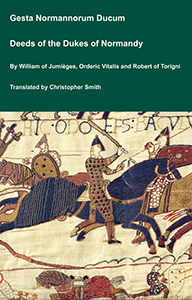
The Deeds of the Dukes of Normandy
The Gesta Normannorum Ducum [The Deeds of the Dukes of Normandy] is a landmark medieval chronicle tracing the rise and fall of the Norman dynasty from its early roots through the pivotal events surrounding the Norman Conquest of England. Originally penned in Latin by the monk William of Jumièges shortly before 1060 and later expanded at the behest of William the Conqueror, the work chronicles the deeds, politics, battles, and leadership of the Norman dukes, especially William’s own claim to the English throne. The narrative combines earlier historical sources with firsthand information and oral testimony to present an authoritative account of Normandy’s transformation from a Viking settlement into one of medieval Europe’s most powerful realms. William’s history emphasizes the legitimacy, military prowess, and governance of the Norman line, framing their expansion, including the conquest of England, as both divinely sanctioned and noble in purpose. Later chroniclers such as Orderic Vitalis and Robert of Torigni continued the history, extending the coverage into the 12th century, providing broader context on ducal rule and its impact. Today this classic work remains a foundational source for understanding Norman identity, medieval statesmanship, and the historical forces that reshaped England and Western Europe between 800AD and 1100AD.
Available at Amazon in eBook and Paperback format.
In 1221 Roger Bigod 2nd Earl Norfolk [aged 77] died. His son [his brother-in-law] Hugh [aged 39] succeeded 3rd Earl Norfolk. [his sister] Maud Marshal Countess Norfolk and Surrey [aged 27] by marriage Countess Norfolk.
Around 1222 Richard Marshal 3rd Earl Pembroke [aged 31] and Gervase Dinant Countess Pembroke were married. He the son of William Marshal 1st Earl Pembroke and Isabel Clare Countess Pembroke.
On 23rd April 1224 [his brother] William "The Younger" Marshal 2nd Earl Pembroke [aged 34] and [his sister-in-law] Eleanor Plantagenet Countess Pembroke and Leicester [aged 9] were married. She by marriage Countess Pembroke. The difference in their ages was 25 years. She the daughter of King John of England and Isabella of Angoulême Queen Consort England [aged 36]. He the son of [his father] William Marshal 1st Earl Pembroke and [his mother] Isabel Clare Countess Pembroke. They were fifth cousins.
On 13th October 1225 [his brother-in-law] William Warenne 5th Earl of Surrey and [his sister] Maud Marshal Countess Norfolk and Surrey [aged 31] were married. She the daughter of [his father] William Marshal 1st Earl Pembroke and [his mother] Isabel Clare Countess Pembroke. He the son of Hamelin Warenne Earl of Surrey and Isabella Warenne Countess Boulogne 4th Countess of Surrey. They were half second cousin once removed.
On 30th March 1231 [his brother-in-law] Richard of Cornwall 1st Earl Cornwall [aged 22] and [his sister] Isabel Marshal Countess Cornwall, Gloucester and Hertford [aged 30] were married at Fawley, Lambourn. She by marriage Countess Cornwall. She the daughter of [his father] William Marshal 1st Earl Pembroke and [his mother] Isabel Clare Countess Pembroke. He the son of King John of England and Isabella of Angoulême Queen Consort England [aged 43]. They were fifth cousins.
On 6th April 1231 William "The Younger" Marshal 2nd Earl Pembroke [aged 41] died. His brother Richard [aged 40] succeeded 3rd Earl Pembroke. Gervase Dinant Countess Pembroke by marriage Countess Pembroke.
Flowers of History by Roger of Wendover 1233. How the marshal remonstrated teith the king.
By these and like injuries, high and low were alike oppressed, and Earl Richard [aged 41], marshal of the kingdom, seeing this, and that the laws of the kingdom were being destroyed, was incited by his zeal in the cause of justice, and, in company with some other nobles, boldly went to the king, and, in the hearing of numbers, reproached him with having by ill advice introduced these foreigners of Poitou to the oppression of the kingdom and of his natural subjects, and to the subversion of the laws and liberties; he therefore humbly begged of the king at once to put a stop to such abuses, owing to which, his crown and kingdom were in imminent danger of destruction; he moreover declared that, if he refused to amend matters, he and the other nobles of the kingdom would withdraw themselves from his councils as long as he held communication with these foreigners. To this Peter bishop of Winchester replied, that his lord the king was surely allowed to summon as many foreigners as he chose for the protection of his kingdom and crown, and as many and such men as would be able to reduce his haughty and rebellious subjects to their proper obedience. The earl Marshal and the other nobles being unable to obtain any other answer, left the court in dismay, and made a fixed determination one with another to fight for this cause, which concerned them all, till their souls were separated from their bodies.
Flowers of History by Roger of Wendover 1233. How the marshal was warned of treachery against him.
The earls and barons in grand knightly array proceeded to London on the 1st of August to the appointed conference, and amongst the rest was Richard earl marshal [aged 42], who took up his abode with his sister [aged 32], the wife of Richard the king's brother [aged 24]; she then asked him the reason of his journey, to which he replied, that he had come to attend the conference. She then said to him, "Know, my dear brother, that your enemies are plotting to take you prisoner, and they will give you up to the king and the bishop of Winchester, in order that they may serve you the same as they did the earl of Kent [aged 63]." The marshal would hardly believe these words of his sister's, until she showed by evident proofs the manner of his capture, and by whom he would be taken. He then began to believe her, and when night came on he took the road, and did not draw rein till he arrived in Wales. There came to the conference the earls of Chester [aged 26] and Lincoln [aged 41], the earl of Ferrers, and earl Richard the king's brother, with some other earls and several barons, but nothing was done there on account of the absence of the earl marshal and Gilbert Bassett [aged 45], and some other nobles who did not make their appearance; on which the king, by the advice of Peter bishop of Winchester, and Stephen Seagrave, sent letters to all the nobles of the kingdom who owed him knight's service, inviting them to come, provided with horses and arms, to Gloucester, on Sunday before the Assumption of the blessed virgin Mary. Richard Marshal and some others however, who were confederated, refused to come at the time appointed, and the king, treating them as traitors, burnt their villages, destroyed their parks and warrens, and besieged their castles. The nobles who were confederated with one another, it was said, were the earl marshal, Gilbert Bassett and his brothers, all distinguished soldiers, Richard Siward, a man trained to arms from his youth, Walter de Clifford, a chosen knight, and many others who joined their cause; all of these the king, without any trial in his court by their peers, ordered to be declared banished and proscribed men, and gave their lands to his Poictevin servants, ordering their persons to be seized wherever they were found in the kingdom.
Flowers of History by Roger of Wendover 1233. Of the fierce battle between the marshal and the Poictevins.
In the same year the marshal [aged 42], on one of his foraging incursions into the territories of his enemies, came to the town of Monmouth [Map], which was hostile to him, where he ordered his army to proceed on their expedition, whilst he with a hundred of his fellow knights turned aside towards the castle of that place to examine its condition, as he purposed to besiege it in a few days; but as he was riding round the walls of the town, he was seen by Baldwin de Guisnes [aged 33], to whom the king had entrusted the charge of that castle [Map] together with several Poictevins, and understanding that the marshal was there with only a few followers for the purpose of examining the castle, he sallied out with a thousand brave and well-equipped soldiers, and pursued him at full speed, designing to make him and his followers prisoners and bring them into the town. The earl Marshal's companions however, when they saw the impetuous advance of the enemy, advised him to consult their safety by flight, saying that it would be rash for such a few of them to engage with such a number of the enemy; to which the marshal replied that he had never as yet turned his back on his enemies in battle, and declared that he would not do so now, and exhorted them to defend themselves bravely and not to die unavenged. The troops from the castle then rushed fiercely on them and attacked them with their lances and swords [Battle of Monmouth]: a severe though very unequal conflict then ensued, yet although there were only a hundred of the marshal's party to oppose a thousand of their adversaries, they fought for a great part of the day. But Baldwin de Guisnes with twelve of his stoutest and best armed soldiers made au attack on the marshal in person, and endeavoured to take him prisoner and carry him off to the castle; he however kept them at a distance, brandishing his sword right and left, and struck down whoever came within reach, either killing them or stunning them hy the force of his blows, and although engaged single-handed against twelve enemies, defended himself for a length of time. His enemies at length, not daring to approach him, killed the horse he rode with their lances; but the marshal, who was well practised in the French way of fighting, seized one of the knights who was attacking him by the feet, and dragged him to the ground, and then quickly mounting his adversary's horse, he renewed the battle. The knight Baldwin was ashamed that the marshal defended himself single-handed against so many of his enemies for such a time, and made a desperate attack on him, and seizing his helmet, tore it from his head with such violence, that blood gushed forth from his mouth and nostrils; he then seized the marshal's horse by the bridle, and endeavoured to drag it with its rider towards the castle, whilst others assisted him by impelling the marshal on from behind. The latter however, sweeping his sword behind him, struck two of his enemies to the earth stunned, but could not then release himself from their grasp. At this juncture however a cross-bowman amongst the marshal's company, seeing his lord in danger, discharged an arrow from his bow, which, striking Baldwin, who was dragging the marshal away, in the breast, entered his body, notwithstanding his armour, and he fell to the earth believing himself mortally wounded; his companions on seeing this, left the marshal, and went to raise Baldwin from the ground, for they thought that he was dead.
Flowers of History by Roger of Wendover 1234. Of the. death and burial of the earl marshal.
A few days afterwards the marshal [aged 42] began to recover strength so that he could eat and drink, play at dice, and walk to and fro in his room. His enemies when they saw this asked him, in the name of the king of England, to give up all his castles and lands in Ireland, since his body was now in the power and at the mercy of the king, and he could be put to a most shameful death at the king's pleasure, as he had been by a decision of his royal court first exiled and afterwards placed in a state of defiance, and now had been taken prisoner in a pitched battle against him; "It will be to your advantage," they said to him, "to do this without opposition, and thus obtain mercy from us." They also showed him the king's warrant by which they were ordered, if he should happen to come to Ireland, to take him prisoner and send him before the king dead or alive. The marshal then, knowing himself to be in the power of his enemies, at once gave orders by letter for the surrender of all his castles to the king, being ignorant that they were, by the king's warrants, granted to those nobles to be distributed amongst them, and to be by them held by hereditary right. His wounds now beginning to swell and cause him grievous pain, he asked for a physician, on which Maurice the justiciary, in whose charge he was, summoned one, rather however with a design of killing him than of giving him relief.
On 1st April 1234 Richard Marshal 3rd Earl Pembroke [aged 43], an opponent of King Henry III, was fatally injured at the Battle of the Curragh. He died on the 16th.
Flowers of History by Roger of Wendover 1234. 1st April 1234. When the troops were drawn up, the earl marshal [aged 43] saw that there were a great many to engage with only a few, he however exhorted his men to battle, asserting that he had undertaken this war for the sake of justice and the laws of England on account of the oppression of the Poietevins, thinking that they all were faithful to him, when in fact they were traitors. he then dashed boldly into the midst of the enemy, and forcing his way through them he opened a road for his knights with his sword, but only fifteen knights, his own retainers, followed him and endeavoured to disperse their enemies. His sworn dependants and knights on whom he trusted, as had been pre-agreed amongst these traitors, gave themselves up as prisoners to the enemies without force, without being wounded either by lance or sword, as if they were friends glad to see one another; some of them tied, without striking a blow, to the churches and convents, leaving the marshal with only fifteen knights. These however defended themselves bravely, unequal as the struggle was, against a hundred and forty; the whole weight of the battle however fell on the marshal, who then first discovered the treacherous design against his life, but, although attacked on all sides by his enemies, he still defended himself and slew six of them. A knight of gigantic size, to whom Richard de Burgh had given his armour, indignant at seeing this, made a rush at the marshal in order to kill him at once, and endeavoured forcibly to snatch his helmet from his head; the marshal, when he saw this man, thought that it was Richard de Burgh, and exclaimed, "Fly, vilest of traitors, lest I kill you;" to which he replied, "I will not fly, but will come nearer you;" he then lifted up his hands to seize the marshal's helmet, but the latter, by one blow of his sword, cut off both of his hands although covered with armour. Another of them, seeing his companion wounded, rushed with all the speed of his horse at the marshal, and exerting all his force struck him on his head, but owing to his helmet the blow took no effect; the earl however returned the blow and cut his enemy in two as far as the middle, after which not one of them would come near him for a long while. The leaders of his enemies, in a state of consternation, than urged on a host of people who had come there with lances, pitchforks, axes, and halberds, to surround the marshal, kill his horse, and bring him to the ground; and they at once surrounded and overwhelmed him, piercing his horse with many wounds; they could not even then however dismount him, they therefore cut off the horse's feet with their axes; the marshal then fell with his horse, overcome with fatigue, having been engaged fighting from the first hour of the day till the eleventh, and his enemies, rushing on him, lifted up his armour and mortally wounded him in the back. The nobles themselves on learning that he was mortally wounded, and lying as it were lifeless on the ground, conveyed him with scarcely any signs of life, to his own castle, which Maurice the justiciary had taken possession of but shortly before, where he was placed in close confinement and attended by only one young man of his party. He there remained in the hands of his enemies. This battle was fought on Saturday the first day of April.
Flowers of History by Roger of Wendover 1234. But the marshal [aged 43], like a true Christian, before he took any bodily medicine, prepared for death by confession and the viaticum, and by making a legal testament, and then commended to the Lord the question whether he should live or die. The physician then came to him and with a long-heated instrument laid his wounds open and probed them so often and deeply with it that he drew blood from them. The marshal from his great sufferings fell into an acute fever, and on the 16th of April [1234], which was the sixteenth day after he had been wounded in battle, he slept in the Lord.
On 16th April 1234 Richard Marshal 3rd Earl Pembroke [aged 43] died from wounds at Kilkenny Castle, Kilkenny, County Kilkenny. His brother Gilbert [aged 37] succeeded 4th Earl Pembroke.
Kings Franks: Great x 13 Grand Son of Charles "Charlemagne aka Great" King of the Franks King Lombardy Holy Roman Emperor
Kings France: Great x 6 Grand Son of Hugh I King of the Franks
Kings Duke Aquitaine: Great x 10 Grand Son of Ranulf I Duke Aquitaine
Great x 1 Grandfather: Gilbert Giffard 
GrandFather: John Fitzgilbert
Father: William Marshal 1st Earl Pembroke
Great x 2 Grandfather: Edward of Salisbury 1st Baron Trowbridge 1st Baron Chitterne
Great x 1 Grandfather: Walter of Salisbury 2nd Baron Chitterne
GrandMother: Sybil of Salisbury
Great x 1 Grandmother: Sybilla Chaworth Baroness Chitterne 
Richard Marshal 3rd Earl Pembroke
Great x 4 Grandfather: Gilbert Clare 2nd Count of Eu 
Great x 3 Grandfather: Richard de Clare
Great x 2 Grandfather: Gilbert de Clare
Great x 4 Grandfather: Walter Giffard 
Great x 3 Grandmother: Rohese Giffard
Great x 4 Grandmother: Ermengarde Flaitel
Great x 1 Grandfather: Gilbert de Clare 1st Earl Pembroke
Great x 3 Grandfather: Hugh Clermont Count of Clermont-en-Beauvaisis
Great x 2 Grandmother: Adeliza Clermont
GrandFather: Richard "Strongbow" Clare 2nd Earl Pembroke
Great x 4 Grandfather: Humphrey "Vielles" Beaumont 
Great x 3 Grandfather: Roger "Bearded" Beaumont
Great x 2 Grandfather: Robert Beaumont 1st Earl of Leicester Count Meulan
Great x 4 Grandfather: Waleran I Count of Meulan
Great x 3 Grandmother: Adeline of Meulan
Great x 1 Grandmother: Isabel Beaumont Countess Pembroke
Great x 4 Grandfather: Henry I King of the Franks 
Great x 3 Grandfather: Hugh "Great" Capet
Great x 4 Grandmother: Anne of Kiev Queen Consort Francia
Great x 2 Grandmother: Elizabeth Capet Countess Leicester, Meulan and Surrey
Great x 4 Grandfather: Herbert Vermandois IV Count Vermandois
Great x 3 Grandmother: Adelaide I Countess Vermandois
Great x 4 Grandmother: Adela Valois Countess Blois and Vermandois 
Mother: Isabel Clare Countess Pembroke
Great x 1 Grandfather: Diarmait Macmurrough
GrandMother: Aoife ni Diarmait Macmurrough Countess Pembroke and Buckingham