

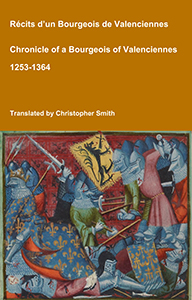
Chronicle of a Bourgeois of Valenciennes
Récits d’un bourgeois de Valenciennes aka The Chronicle of a Bourgeois of Valenciennes is a vivid 14th-century vernacular chronicle written by an anonymous urban chronicler from Valenciennes in the County of Hainaut. It survives in a manuscript that describes local and regional history from about 1253 to 1366, blending chronology, narrative episodes, and eyewitness-style accounts of political, military, and social events in medieval France, Flanders, and the Low Countries. The work begins with a chronological framework of events affecting Valenciennes and its region under rulers such as King Philip VI of France and the shifting allegiances of local nobility. It includes accounts of conflicts, sieges, diplomatic manoeuvres, and the impact of broader struggles like the Hundred Years’ War on urban life in Hainaut. Written from the perspective of a burgher (bourgeois) rather than a monastery or royal court, the chronicle offers a rare lay viewpoint on high politics and warfare, reflecting how merchants, townspeople, and civic institutions experienced the turbulence of the 13th and 14th centuries. Its narrative style combines straightforward reporting of events with moral and civic observations, making it a valuable source for readers interested in medieval urban society, regional politics, and the lived experience of war and governance in pre-modern Europe.
Available at Amazon in eBook and Paperback format.
In 1832 Sarah Eliza Hackett was born. Daughter of a farmer in Diseworth, Leicestershire, where she spent her formative years.
Around 1851 in an undated letter, Charles Allston Collins (age 22) wrote to Holman Hunt: "I have been very much occupied lately having taken the trouble of persuading a young lady [Sarah Eliza Hackett] to sit, who struck both Millais and myself as having possessed a very beautiful head – she was a friend of a friend of mine so after some trouble I managed to secure her, but I have been obliged to hurry very much as her time was limited. I had to pursue her to her own house and take sittings there, getting up very early for this purpose."
In 1851 Sarah Eliza Hackett is recorded in the census as residing in Lambeth as a visitor. Her uncle, Dr. John Thompson, lived in the Marylebone district and he was not only the family doctor to the Collins household for over twenty years but he and his family were also close friends of the Collins family.
On 15th January 1851 Millais wrote to Mrs. Combe: "I saw Carlo last night, who has been very lucky in persuading a very beautiful young lady [Sarah Eliza Hackett] to sit for the head of 'The Nun'. She was at his house when I called, and I also endeavoured to obtain a sitting, but was unfortunate, as she leaves London next Saturday."
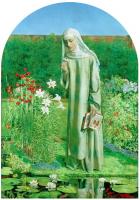
In or after June 1851. Charles Allston Collins (age 23). "Convent Thoughts". The passion flower symbolising the Passion of Christ. The missal in her left hand shows the Annunciation and Crucifixion. The model probably Sarah Eliza Hackett. The artist had borrowed the same costume fot the nun that William Holman Hunt (age 24) has used for Claudio and Isabella. The flowers were all painted from nature in the garden of Thomas Combe's home in the quadrangle of the Clarendon Press in Oxford.
In or after 1852 Reverend Frederick Nash and Sarah Eliza Hackett were married.