

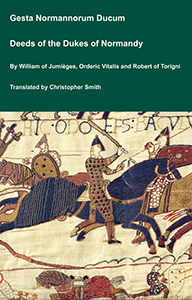
The Deeds of the Dukes of Normandy
The Gesta Normannorum Ducum [The Deeds of the Dukes of Normandy] is a landmark medieval chronicle tracing the rise and fall of the Norman dynasty from its early roots through the pivotal events surrounding the Norman Conquest of England. Originally penned in Latin by the monk William of Jumièges shortly before 1060 and later expanded at the behest of William the Conqueror, the work chronicles the deeds, politics, battles, and leadership of the Norman dukes, especially William’s own claim to the English throne. The narrative combines earlier historical sources with firsthand information and oral testimony to present an authoritative account of Normandy’s transformation from a Viking settlement into one of medieval Europe’s most powerful realms. William’s history emphasizes the legitimacy, military prowess, and governance of the Norman line, framing their expansion, including the conquest of England, as both divinely sanctioned and noble in purpose. Later chroniclers such as Orderic Vitalis and Robert of Torigni continued the history, extending the coverage into the 12th century, providing broader context on ducal rule and its impact. Today this classic work remains a foundational source for understanding Norman identity, medieval statesmanship, and the historical forces that reshaped England and Western Europe between 800AD and 1100AD.
Available at Amazon in eBook and Paperback format.
Paternal Family Tree: Batemans of Middleton
Thomas Bateman is in Antiquaries.
On or before 8th November 1821, the date he was baptised, Thomas Bateman was born to [his father] William Bateman (age 34) in Rowsley, Derbyshire [Map].
In 1835 [his father] William Bateman (age 48) died.
Vestiges of the Antiquities of Derbyshire. Section I Barrows Opened by Mr Thomas Bateman (age 21) in 1843.
Vestiges of the Antiquities of Derbyshire. Section I Barrows Opened by Mr Thomas Bateman (age 22) in 1844.
Thomas Bateman 1845. Section I Barrows Opened by Mr Thomas Bateman (age 23) in 1845.
Thomas Bateman 1846. Section I Barrows Opened by Mr Thomas Bateman (age 24) in 1846.
On 2nd August 1847 Thomas Bateman (age 25) and Sarah Parker (age 23) were married at All Saint's Church, Bakewell, Derbyshire [Map]. He the son of William Bateman.
Vestiges of the Antiquities of Derbyshire. Vestiges of the Antiquities of Derbyshire, and the Sepuchral Usages of its Inhabitants, from the Most Remote Ages to the Reformation. By Thomas Bateman (age 26). Member of the British Archæological Association; Assisted by Stephen Glover, Author of the 'History of Derbyshire', etc.
What want these outlaws (conquerors should have),
But History's purchased page to call them great,
A wider space, an ornamental grave?
Their hopes were not less warm, their souls were full as brave.
LONDON. John Russell Smith. 4, Old Compton Street, Soho Square, MDCCCXLVIII.
Journal of the British Archaeological Association Volume 7 1851. Remarks on Barrows opened near Bakewell by Thomas Bateman (age 29)
In 1859 [his daughter] Clara Theodora Bateman was born to Thomas Bateman (age 37) and [his wife] Sarah Parker (age 35). She married in or before 1885 Harcourt Clare.
Ten Years' Digging. Ten Years' Diggings In Celtic & Saxon Grave Hills, In The Counties Of Derby, Stafford, And York, From 1848 To 1868. With Notices Of Some Former Discoveries Hitherto Unpublished, And Remarks On The Crania And Pottery From The Mounds. Thomas Bateman (age 39), Local Secretary For Derbyshire Of The Society Of Antiquaries; Fellow Of The Ethnnological Society, Etc. London: George Allen 4; Sons, 44 4; 45, Rathbone Place, W. Published 1861.
To Lady Adeliza Elizabeth Gertrude Norman (age 50), Whose Liberal And Enlightened Assistance Has Encouraged Our Researches, This Volume Is Gratefully And Respectfully Inscribed By The Author.
The Deeds of the Dukes of Normandy
The Gesta Normannorum Ducum [The Deeds of the Dukes of Normandy] is a landmark medieval chronicle tracing the rise and fall of the Norman dynasty from its early roots through the pivotal events surrounding the Norman Conquest of England. Originally penned in Latin by the monk William of Jumièges shortly before 1060 and later expanded at the behest of William the Conqueror, the work chronicles the deeds, politics, battles, and leadership of the Norman dukes, especially William’s own claim to the English throne. The narrative combines earlier historical sources with firsthand information and oral testimony to present an authoritative account of Normandy’s transformation from a Viking settlement into one of medieval Europe’s most powerful realms. William’s history emphasizes the legitimacy, military prowess, and governance of the Norman line, framing their expansion, including the conquest of England, as both divinely sanctioned and noble in purpose. Later chroniclers such as Orderic Vitalis and Robert of Torigni continued the history, extending the coverage into the 12th century, providing broader context on ducal rule and its impact. Today this classic work remains a foundational source for understanding Norman identity, medieval statesmanship, and the historical forces that reshaped England and Western Europe between 800AD and 1100AD.
Available at Amazon in eBook and Paperback format.
On 28th August 1861 Thomas Bateman (age 39) died. He was buried in unconsecrated ground at his request at Middleton-by-Youlgreave [Map].


In 1866 [his former wife] Sarah Parker (age 42) died.
Nænia Cornubiæ by William Borlase Lanyon Cromlech. Coming further South the combined researches of Sir R. C. Hoare and Thomas Bateman, Esq., tabulated by Sir John Lubbock (age 37), show that out of some 500 interments explored with care, only thirty-seven were extended, while 112 were contracted, the rest being burnt.


Transactions of the British Archaeological Association August 1845 Pages 192-195. Primeval Antiquities of Stanton And Hart-Hill Moors, near Bakewell, Derbyshire. By Thomas Bateman, Jun.
Great x 2 Grandfather: Richard Bateman
Great x 1 Grandfather: Richard Bateman
GrandFather: Thomas Bateman
Great x 2 Grandfather: Ralph Leek of Heath House, Cheddleton
Great x 1 Grandmother: Elizabeth Leek
Father: William Bateman
Great x 1 Grandfather: Arthur Clegg of Manchester
GrandMother: Rebekah Clegg