

William of Worcester's Chronicle of England
William of Worcester, born around 1415, and died around 1482 was secretary to John Fastolf, the renowned soldier of the Hundred Years War, during which time he collected documents, letters, and wrote a record of events. Following their return to England in 1440 William was witness to major events. Twice in his chronicle he uses the first person: 1. when writing about the murder of Thomas, 7th Baron Scales, in 1460, he writes '… and I saw him lying naked in the cemetery near the porch of the church of St. Mary Overie in Southwark …' and 2. describing King Edward IV's entry into London in 1461 he writes '… proclaimed that all the people themselves were to recognize and acknowledge Edward as king. I was present and heard this, and immediately went down with them into the city'. William’s Chronicle is rich in detail. It is the source of much information about the Wars of the Roses, including the term 'Diabolical Marriage' to describe the marriage of Queen Elizabeth Woodville’s brother John’s marriage to Katherine, Dowager Duchess of Norfolk, he aged twenty, she sixty-five or more, and the story about a paper crown being placed in mockery on the severed head of Richard, 3rd Duke of York.
Available at Amazon in eBook and Paperback format.
In 1569 Thomas Richardson was born.
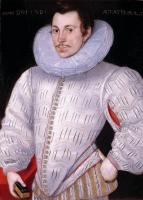
On 27th November 1594 John Ashburnham (age 22) and [his future wife] Elizabeth Beaumont (age 17) were married at the Church of St Mary and All Saints, Stoughton [Map]. They had ten children.
In 1621 Thomas Richardson (age 52) was elected MP St Albans.
Before 13th June 1624 Thomas Richardson (age 55) and Ursula Southwell were married.
On or before 13th June 1624, the date she was buried at St Andrew's Church, Holborn [Map], [his wife] Ursula Southwell died.
On 20th February 1625 Thomas Richardson (age 56) was appointed King's Serjeant.
On 28th November 1626 Thomas Richardson (age 57) succeeded Sir Henry Hobart as Chief Justice of the Common Pleas, after a vacancy of nearly a year.
On 14th December 1626 Thomas Richardson (age 57) and Elizabeth Beaumont (age 49) were married at St Giles' in the Fields Church [Map]. There was no issue from the marriage.
On or before 17th April 1628 [his step-daughter] Anne Ashburnham Lady Dering (age 23) died. She was buried on 17th April 1628.
On 13th November 1628 Thomas Richardson (age 59) ruled that it was illegal to use the rack to elicit confession from John Felton (age 33), the murderer of Duke of Buckingham. His opinion had the concurrence of his colleagues and marks a significant point in the history of English criminal jurisprudence.


In January 1631 Frederick Cornwallis 1st Baron Cornwallis (age 19) and [his step-daughter] Elizabeth Ashburnham (age 18) were married. After the wedding King Charles I (age 30), Henrietta Maria (age 21) and Susan Feilding, Countess of Denbigh (age 48) wrote to congratulate his mother Jane, Baroness Cornwallis Bacon (age 50), and ask her to forgive him for his disobedience and return him to her favour. Denbigh said Ashburnham was her cousin "though her family be unfortunate".


On 4th February 1633 [his step-daughter] Elizabeth Ashburnham (age 20) died.
Annals of the six Kings of England by Nicholas Trivet
Translation of the Annals of the Six Kings of England by that traces the rise and rule of the Angevin aka Plantagenet dynasty from the mid-12th to early 14th century. Written by the Dominican scholar Nicholas Trivet, the work offers a vivid account of English history from the reign of King Stephen through to the death of King Edward I, blending political narrative with moral reflection. Covering the reigns of six monarchs—from Stephen to Edward I—the chronicle explores royal authority, rebellion, war, and the shifting balance between crown, church, and nobility. Trivet provides detailed insight into defining moments such as baronial conflicts, Anglo-French rivalry, and the consolidation of royal power under Edward I, whose reign he describes with particular immediacy. The Annals combines careful year-by-year reporting with thoughtful interpretation, presenting history not merely as a sequence of events but as a moral and political lesson. Ideal for readers interested in medieval history, kingship, and the origins of the English state, this chronicle remains a valuable and accessible window into the turbulent world of the Plantagenet kings.
Available at Amazon in eBook and Paperback format.
John Evelyn's Diary. 3rd November 1633. This year my father (age 46) was appointed Sheriff, the last, as I think, who served in that honorable office for Surrey and Sussex, before they were disjoined. He had 116 servants in liveries, every one liveried in green satin doublets; divers gentlemen and persons of quality waited on him in the same garb and habit, which at that time (when thirty or forty was the usual retinue of the High Sheriff) was esteemed a great matter. Nor was this out of the least vanity that my father exceeded (who was one of the greatest decliners of it); but because he could not refuse the civility of his friends and relations, who voluntarily came themselves, or sent in their servants. But my father was afterward most unjustly and spitefully molested by that jeering judge, Richardson (age 64)1, for reprieving the execution of a woman, to gratify my Lord of Lindsey, then Admiral: but out of this he emerged with as much honor as trouble. The king made this year his progress into Scotland, and Duke James was born.
Note 1. He was made a Chief Justice of the Common Pleas in 1626, and of the King's Bench in 1631. There is a monument for him in Westminster Abbey. Fuller says lie hved too near the time to speak fully of him. He took on him to issue an order against keeping wakes on Sundays, which Laud, then Bishop of Bath and Wells, took up as an infringement of the rights of bishops, and got him severely reprimanded at the Council-table. He was owner of Starborough Castle, in Lingiield, in Surrey. — Manning and Bray's Mistory of Surrey,-vol. ii. p. 345.
On 4th February 1635 Thomas Richardson (age 66) died.
In 1651 [his former wife] Elizabeth Beaumont (age 74) died.