

Abbot John Whethamstede’s Chronicle of the Abbey of St Albans
Abbot John Whethamstede's Register aka Chronicle of his second term at the Abbey of St Albans, 1451-1461, is a remarkable text that describes his first-hand experience of the beginning of the Wars of the Roses including the First and Second Battles of St Albans, 1455 and 1461, respectively, their cause, and their consequences, not least on the Abbey itself. His text also includes Loveday, Blore Heath, Northampton, the Act of Accord, Wakefield, and Towton, and ends with the Coronation of King Edward IV. In addition to the events of the Wars of the Roses, Abbot John, or his scribes who wrote the Chronicle, include details in the life of the Abbey such as charters, letters, land exchanges, visits by legates, and disputes, which provide a rich insight into the day-to-day life of the Abbey, and the challenges faced by its Abbot.
Available at Amazon in eBook and Paperback format.
On 17th August 1755 Thomas Stothard was born. His parent's only child.
In 1778 Thomas Stothard [aged 22] became a student at the Royal Academy.
In 1783 Thomas Stothard [aged 27] and Rebecca Watkins were married. They had eleven children, of whom six – five sons and one daughter – survived infancy.

1785. Thomas Stothard [aged 29]. Engraving of General, future President, George Washington [aged 52].
On 5th July 1786 [his son] Charles Alfred Stothard was born to Thomas Stothard [aged 30] and [his wife] Rebecca Watkins. He married February 1818 Anna Eliza Kempe.
In 1792 Thomas Stothard [aged 36] was elected Associate of the Royal Academy.
In 1794 Thomas Stothard [aged 38] was elected Fellow of the Royal Academy.
In 1797 [his son] Robert Thomas Stothard was born to Thomas Stothard [aged 41] and [his wife] Rebecca Watkins.
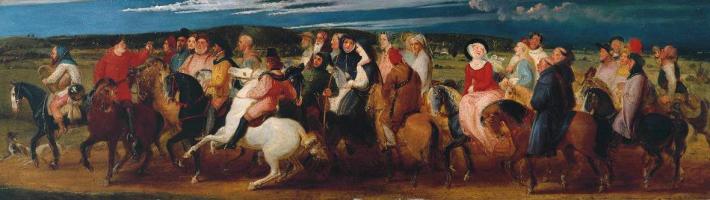
1806 to 1807. Thomas Stothard [aged 50]. The Pilgrimage to Canterbury.
Georgian Memoirs. In 1810, he painted a picture of the death of Richard the Second in Pomfret Castle [Map], in which the costume of the period was strictly adhered to, and the portrait of Richard taken from his effigy in Westminster Abbey. It was received with unanimous approbation upon its exhibition at Somerset House, and indicated superior talents, in the artist, for historical painting. This branch of his art, however, he was also induced to forego, in consequence of an attachment he had formed with a [his future daughter-in-law] Miss Kempe [aged 19], to whom he was subsequently married. A more lucrative mode of occupation than that of historical portrait painting, had suggested itself to him as far back as the year 1802, when he accompanied his father to Burleigh House, the seat of the Marquess of Exeter. Mr. Stothard, senior [aged 54], was employed to decorate the staircase of this mansion; and, whilst thus occupied, observed to his son, it would be to his future advantage, to fill up his time, by making drawings from the monuments in the neighbouring churches, as useful authorities for costume. His son followed his advice, and thus received the first bias of his mind towards a subject which he now resolved to make his pursuit. The hint for the design, which he afterwards carried into effect, was first given him by a sight of some very clever unpublished etchings, by the Rev. P. Kerrich, of Cambridge, from monuments in the Dominicans and other churches in Paris. This suggested to him the idea of a work on The Monumental Effigies of Great Britain, of which the first number appeared in June, 1811, accompanied by an advertisement, stating that the objects of the undertaking were to afford the historical painter a complete knowledge of the costume adopted in England, from an early period of history to the reign of Henry the Eighth; to illustrate, at the same time, history and biography; and, lastly, to assist the stage in selecting its costume with propriety, for the plays of our great dramatic bard. Such a work was, undoubtedly, a great desideratum; for, whatever information is to be derived from Mr. Gough's writings, in his voluminous publication of the same kind, the delineating part, as Mr. Stothard observes, in an essay found after his death, is so extremely incorrect and full of errors, that, at a future period, when the originals no longer exist, it will be impossible to form any correct idea of what they really were.
Chronicle of a Bourgeois of Valenciennes
Récits d’un bourgeois de Valenciennes aka The Chronicle of a Bourgeois of Valenciennes is a vivid 14th-century vernacular chronicle written by an anonymous urban chronicler from Valenciennes in the County of Hainaut. It survives in a manuscript that describes local and regional history from about 1253 to 1366, blending chronology, narrative episodes, and eyewitness-style accounts of political, military, and social events in medieval France, Flanders, and the Low Countries. The work begins with a chronological framework of events affecting Valenciennes and its region under rulers such as King Philip VI of France and the shifting allegiances of local nobility. It includes accounts of conflicts, sieges, diplomatic manoeuvres, and the impact of broader struggles like the Hundred Years’ War on urban life in Hainaut. Written from the perspective of a burgher (bourgeois) rather than a monastery or royal court, the chronicle offers a rare lay viewpoint on high politics and warfare, reflecting how merchants, townspeople, and civic institutions experienced the turbulence of the 13th and 14th centuries. Its narrative style combines straightforward reporting of events with moral and civic observations, making it a valuable source for readers interested in medieval urban society, regional politics, and the lived experience of war and governance in pre-modern Europe.
Available at Amazon in eBook and Paperback format.
In 1810 Thomas Stothard [aged 54] was appointed Deputy Librarian to the Royal Academy.
In February 1818 Charles Alfred Stothard [aged 31] and Anna Eliza Kempe [aged 27] were married. He the son of Thomas Stothard [aged 62] and Rebecca Watkins.
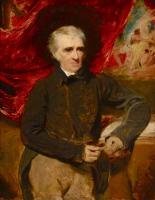
1819. George Henry Harlow [aged 31]. Portrait of Thomas Stothard [aged 63].
On 28th May 1821 [his son] Charles Alfred Stothard [aged 34] died as a consequence of falling off a ladder while tracing a portrait from one of the windows at St Andrew's Church, Bere Ferrers [Map] in which churchyard he was subsequently buried.
In 1825 [his wife] Rebecca Watkins died.
On 27th April 1834 Thomas Stothard [aged 78] died.
Life of Thomas Stothard RA with Personal Reminiscences by Mrs Bray. LIFE OF THOMAS STOTHARD, R.A WITH PERSONAL REMINISCENCES By [his former daughter-in-law] MRS. BRAY [aged 60], Author of "The Borders of the Tamar and the Tary", "Memoirs of Charles A. Stothard, F.S.A", "Trelawny", "Trials of the Heart," &c.,&c.
[his son] Alfred Stothard was born to Thomas Stothard and Rebecca Watkins.