

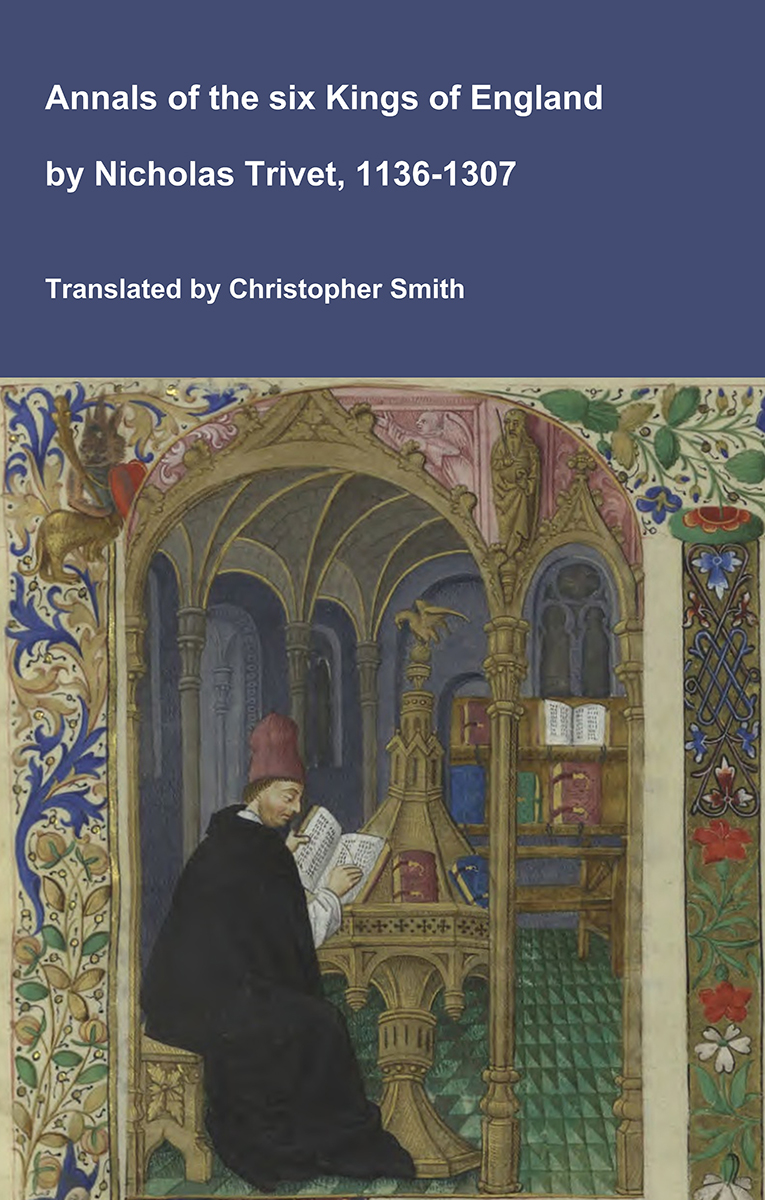
Annals of the six Kings of England by Nicholas Trivet
Translation of the Annals of the Six Kings of England by that traces the rise and rule of the Angevin aka Plantagenet dynasty from the mid-12th to early 14th century. Written by the Dominican scholar Nicholas Trivet, the work offers a vivid account of English history from the reign of King Stephen through to the death of King Edward I, blending political narrative with moral reflection. Covering the reigns of six monarchs—from Stephen to Edward I—the chronicle explores royal authority, rebellion, war, and the shifting balance between crown, church, and nobility. Trivet provides detailed insight into defining moments such as baronial conflicts, Anglo-French rivalry, and the consolidation of royal power under Edward I, whose reign he describes with particular immediacy. The Annals combines careful year-by-year reporting with thoughtful interpretation, presenting history not merely as a sequence of events but as a moral and political lesson. Ideal for readers interested in medieval history, kingship, and the origins of the English state, this chronicle remains a valuable and accessible window into the turbulent world of the Plantagenet kings.
Available at Amazon in eBook and Paperback format.
Around 1344 Thomas Wendesley was born.
In 1382 Thomas Wendesley [aged 38] was elected MP Derbyshire.
Around 1383 Thomas Wendesley [aged 39] was knighted.
In 1384 Thomas Wendesley [aged 40] was elected MP Derbyshire.
In December 1384 Thomas Wendesley [aged 40] was retained for life by John of Gaunt 1st Duke Lancaster [aged 44] in peace and war at an annual fee of 20 marks, charged upon the township of Bensall in Derbyshire [Note. Possibly Bonsall, Derbyshire [Map]]. The benefits were certainly not all one-sided, for Wensley was expected to use his own influence as a member of the local bench and crown commissioner on the duke's behalf when the occasion demanded.
In 1386 Thomas Wendesley [aged 42] was elected MP Derbyshire.
In February 1388 Thomas Wendesley [aged 44] was commissioned to arrest persons charged with damaging John of Gaunt's [aged 47] property.
In 1390 Thomas Wendesley [aged 46] was elected MP Derbyshire.
In 1394 Thomas Wendesley [aged 50] was elected MP Derbyshire.
The History of William Marshal was commissioned by his son shortly after William’s death in 1219 to celebrate the Marshal’s remarkable life; it is an authentic, contemporary voice. The manuscript was discovered in 1861 by French historian Paul Meyer. Meyer published the manuscript in its original Anglo-French in 1891 in two books. This book is a line by line translation of the first of Meyer’s books; lines 1-10152. Book 1 of the History begins in 1139 and ends in 1194. It describes the events of the Anarchy, the role of William’s father John, John’s marriages, William’s childhood, his role as a hostage at the siege of Newbury, his injury and imprisonment in Poitou where he met Eleanor of Aquitaine and his life as a knight errant. It continues with the accusation against him of an improper relationship with Margaret, wife of Henry the Young King, his exile, and return, the death of Henry the Young King, the rebellion of Richard, the future King Richard I, war with France, the death of King Henry II, and the capture of King Richard, and the rebellion of John, the future King John. It ends with the release of King Richard and the death of John Marshal.
Available at Amazon in eBook and Paperback format.

In August 1399 Thomas Wendesley [aged 55], following the success of King Henry IV of England [aged 32] received a grant for life of land worth £24 a year in the High Peak, and within the next few months three lucrative stewardships of Macclesfield, Cheshire [Map], the High Peak and Chesterfield, Derbyshire [Map] were in his hands.
In August 1401 Thomas Wendesley [aged 57] was summoned to attend a great council as a representative for Derbyshire, where he continued to serve on various royal commissions. At least one local figure was, even so, prepared to risk his displeasure, and in 1402 an esquire named Godfrey Rowland petitioned Parliament for redress against a blatant act of terrorism on Wensley's part. He alleged that in May 1399 the latter, abetted by a large gang of thugs and ruffians, had robbed him of goods worth 200 marks, kept him prisoner in the castle of the High Peak without food or drink for almost a week and, as a final act of brutality, had cut off his right hand.
On 21st July 1403 King Henry IV of England [aged 36], with his son the future King Henry V of England [aged 16], defeated the rebel army of Henry "Hotspur" Percy [aged 39] at the Battle of Shrewsbury at the site now known as Battlefield, Shrewsbury [Map]. King Henry V of England took an arrow to the side of his face. John Stanley [aged 53] was wounded in the throat. Thomas Strickland [aged 36] fought and was awarded £38 and two of the rebel Henry's horses. Richard Beauchamp 13th Earl Warwick [aged 21] fought for the King. Walter Blount [aged 55], the King's Standard Bearer, was killed by Archibald Douglas 1st Duke Touraine [aged 31].
Thomas Wendesley [aged 59], Edmund Cockayne [aged 47] and Robert Goushill were killed.
Edmund Stafford 5th Earl Stafford [aged 25] was killed. His son Humphrey Stafford succeeded 6th Earl Stafford, 7th Baron Stafford.
Hugh Shirley [aged 52] was killed; he was one of four knights dressed as King Henry IV of England.
Of the rebels, Henry "Hotspur" Percy, Madog Kynaston [aged 43] and John Clifton were killed.
Thomas Percy 1st Earl of Worcester [aged 60] was beheaded after the battle. Earl Worcester extinct.
Richard Vernon 11th Baron Shipbrook [aged 48] was hanged. Baron Shipbrook forfeit.
John Rossall was killed. His sister Eleanor Rossall [aged 26] inherited a half-share in the Rossall Shrewsbury [Map] estates.
John Massey [aged 65] was killed.
After 21st July 1403 Thomas Wendesley [deceased] was buried at All Saint's Church, Bakewell, Derbyshire [Map]. Camail and Jupon Period armour. IHC NASARE Lettering. His Coat of Arms just visible. Lancastrian Esses Collar.


