

Abbot John Whethamstede’s Chronicle of the Abbey of St Albans
Abbot John Whethamstede's Register aka Chronicle of his second term at the Abbey of St Albans, 1451-1461, is a remarkable text that describes his first-hand experience of the beginning of the Wars of the Roses including the First and Second Battles of St Albans, 1455 and 1461, respectively, their cause, and their consequences, not least on the Abbey itself. His text also includes Loveday, Blore Heath, Northampton, the Act of Accord, Wakefield, and Towton, and ends with the Coronation of King Edward IV. In addition to the events of the Wars of the Roses, Abbot John, or his scribes who wrote the Chronicle, include details in the life of the Abbey such as charters, letters, land exchanges, visits by legates, and disputes, which provide a rich insight into the day-to-day life of the Abbey, and the challenges faced by its Abbot.
Available at Amazon in eBook and Paperback format.
Walter Williams is in Painters.
On 29th November 1834 Walter Williams was born; his given name George Walter Williams. He was baptised with his sister Caroline and his brother Francis on June 26, 1837 at the St. Pancras Church in Camden, London.
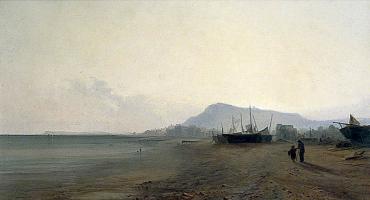
1856. Walter Williams [aged 21]. "Hastings Beach, East Sussex".
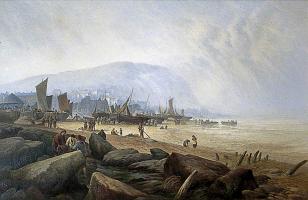
1856. Walter Williams [aged 21]. "Misty Morning, Old Hastings, East Sussex".
On 27th June 1857 Walter Williams [aged 22] and Jane Caroline Pearcy [aged 25] were married at St George's Church, Hanover Square. They had two children.
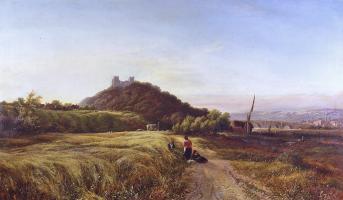
1869. Walter Williams [aged 34]. "A Surrey Cornfield".
On 20th October 1872 [his wife] Jane Caroline Pearcy [aged 40] died in Barnes, Surrey.

1873. Walter Williams [aged 38]. "Harvesting".

1873. Walter Williams [aged 38]. "Haymaking".

1874. Walter Williams [aged 39]. "On the Lledr".
In 1905 Walter Williams [aged 70] transferred from the Croydon Workhouse to the Richmond Union Workhouse.
Chronicle of Walter of Guisborough
A canon regular of the Augustinian Guisborough Priory, Yorkshire, formerly known as The Chronicle of Walter of Hemingburgh, describes the period from 1066 to 1346. Before 1274 the Chronicle is based on other works. Thereafter, the Chronicle is original, and a remarkable source for the events of the time. This book provides a translation of the Chronicle from that date. The Latin source for our translation is the 1849 work edited by Hans Claude Hamilton. Hamilton, in his preface, says: 'In the present work we behold perhaps one of the finest samples of our early chronicles, both as regards the value of the events recorded, and the correctness with which they are detailed; Nor will the pleasing style of composition be lightly passed over by those capable of seeing reflected from it the tokens of a vigorous and cultivated mind, and a favourable specimen of the learning and taste of the age in which it was framed.'
Available at Amazon in eBook and Paperback format.

Before 1906. Walter Williams [aged 71]. "Stonehenge in Winter".
On 14th April 1906 Walter Williams [aged 71] died in a poorhouse in Richmond, Surrey and was buried in a pauper's grave.