

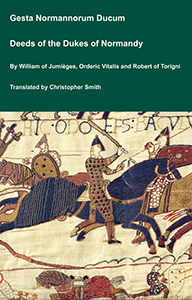
The Deeds of the Dukes of Normandy
The Gesta Normannorum Ducum [The Deeds of the Dukes of Normandy] is a landmark medieval chronicle tracing the rise and fall of the Norman dynasty from its early roots through the pivotal events surrounding the Norman Conquest of England. Originally penned in Latin by the monk William of Jumièges shortly before 1060 and later expanded at the behest of William the Conqueror, the work chronicles the deeds, politics, battles, and leadership of the Norman dukes, especially William’s own claim to the English throne. The narrative combines earlier historical sources with firsthand information and oral testimony to present an authoritative account of Normandy’s transformation from a Viking settlement into one of medieval Europe’s most powerful realms. William’s history emphasizes the legitimacy, military prowess, and governance of the Norman line, framing their expansion, including the conquest of England, as both divinely sanctioned and noble in purpose. Later chroniclers such as Orderic Vitalis and Robert of Torigni continued the history, extending the coverage into the 12th century, providing broader context on ducal rule and its impact. Today this classic work remains a foundational source for understanding Norman identity, medieval statesmanship, and the historical forces that reshaped England and Western Europe between 800AD and 1100AD.
Available at Amazon in eBook and Paperback format.
Paternal Family Tree: Garrard
Around 1507 William Garrard was born.

Around 1546 [his son] John Garrard was born to William Garrard [aged 39].
In 1552 William Garrard [aged 45] was elected Sheriff of London.
Henry Machyn's Diary. 11th July 1553. The xj day of July, at viij of the cloke in the mornyng, the yonge man for spykyng was sett on the pelere [pillory], and boyth ys heres cutt off; for ther was a harold, and a trompeter blohyng; and [in-] contenent he was taken downe, and cared to the [Counter]; and the same day was the yong man('s) master dwellyng [at] saint John('s) hed, ys nam was Sandur Onyone, and a-nodur, master Owen a gone-maker at Lundun bryge, drounyd, dwellyng at Ludgatt.
Note. Drowning of Ninion Saunders. Stowe has noticed more particularly the two incidents which happened to the young man and his master. "The 11. of July, Gilbert Pot, drawer to Ninion Saunders, vintner, dwelling at S. John's head within Ludgate, who was accused by the said Saunders his maister, was set on the pillory in Cheape with both his eares nailed and cleane cut off, for words-speaking at the tyme of the proclamation of ladie June; at which execution was a trumpet blowne, and a herault in his coat of armes read his offence, in presence of William Garrard [aged 46], one of the sheriffes of London. About 5. of the clocke the same day, in the afternoone, Ninion Saunders, master to the sayd Gilbert Pot, and John Owen, a gunmaker, both gunners of the Tower, comming from the Tower of London by water in a whirrie, and shooting London bridge towards the Blacke Fryers, were drowned at S. Mary Lock, and the whirrymen saved by their ores."
In 1555 William Garrard [aged 48] was elected Lord Mayor of London.
Henry Machyn's Diary. 29th October 1555. The xxix day of October ther wher ij goodly pennes [pinnaces] deckyd with gones and flages and stremars, and a m. penselles, the penes pentyd, on whyt and bluw, and the thodur yelow and red, and the oars and gowne [guns] lyke coler; and with trumpets and drumes, and alle the craftes in barges and stremars; and at the ix of the cloke my nuw lord mayre and the shreyffes and the althermen toke barge at the iij Cranes with trumpets and shalmes, and the whetes playhyng; and so rod to Westmynster, and toke ys othe in the cheyker, and all the way the penoys shutyng of gones and playhyng up and done; and so after cam backe to Powlles warffe, and landyd with gret shutyng of gownes and playng; and so in Powlles cherche-yerde ther mett the bachelars and a goody pagyant, and a lxvi. men in blue gownes, and with goodly targates and gaffelynes and a duwlle, and iiij talle men lyke wodys alle in gren, and trumpets playing a-for the mare-the iij yere of Quen Mare.
Note. P. 96. The lord mayor's pageant. The new mayor was "sir William Garrard [aged 48], haberdasher, a grave, sober, wise, and discreet citizen, equall with the best and inferior to none of our time, deceased 1571, in the parish of St. Christopher, but was buried in this church of St. Magnus [Map], as in the parish where he was borne. A faire monument is there raised on him. This monument is lately re-edified and new fenced by sir John Garrard [aged 9], his sonne, and L. Maior 1602." (Stowe's Survay.) "He dwelled at the pissing conduit in St. Xp'ofer's parish." Arms, Argent, on a fess sable a lion passant of the first. (Wm. Smith, Rouge-dragon.)
Henry Machyn's Diary. 10th May 1556. The x day of May was bered Annes [Heth], the wyff of John Heth, penter stayner, Anno M.v lvj. the iij yere of quen Mare, ser Wylliam Garrard [aged 49] being mayre of London, and master John Machyll and master Thomas [Leigh] shreyffes of London, and bered at Allalowes-staynyng Fanchurche-strett.
On 20th November 1558 Bishop Maurice Griffith [aged 51] died. He was buried at St Magnus the Martyr Church [Map]. His executors were William Petre [aged 53], William Garrard [aged 51] and Simon Lowe aka Fyfield.
Henry Machyn's Diary. 30th November 1558. The xxx day of November, was sant Andrewes day, the bysshope of Rochestur [deceased] was cared from the plasse in Sowthwarke unto sant Mangnus [Map] in London; for he was parsun ther; and he had a herse of wax, and a v dosen pensels, and the qwyre hangyd with blake and armes; and he had ij whyt branchys and ij dosen torchys; and he had ij haroldes of armes, ser Wylliam Peter [aged 53] cheyff morner, and ser Wylliam Garrett [aged 51], master Low, master Catter, and dyvers odur, and mony morners; and xij pore men had blake gownes, and xij of ys men bare torchys; and after my lord of Wynchester dyd pryche; and after he was bered they whent to ys plasse to dener, for ther was a grett dener, and he had a gret baner of armes and iiij baners of santes and viij dosen of skochyons.
Henry Machyn's Diary. 5th June 1560. The v day of June was bered master Husse [deceased] sqwyre, and a grett marchand-ventorer and of Muskovea and haburdassher, and with a C. mornars of men and vomen; hand he had v pennons of armes, and a cotte armur, and ij haroldes of armes master Clarenshux [aged 50] and master Somersett; and ther was Powlles qwyre and the clarkes of London, and bered at sant Martens at Ludgatt by ys sun; and all the cherche hangyd and ys plasse with blake and armes, and a vj dosen and d' of skochyons of armes; and master Alley the redere of Powlles prychyd boyth days; ser Wylliam Garrett [aged 53], ser Wylliam Chester [aged 51], master Loge the shreyf, master Argalle, master Bulle, and master Husse (his) sune, and dyver odur mornars, and after to the plasse to dener, a godly plasse.... Barwyke by captayn .... mantyll frys jerkens all gunners.
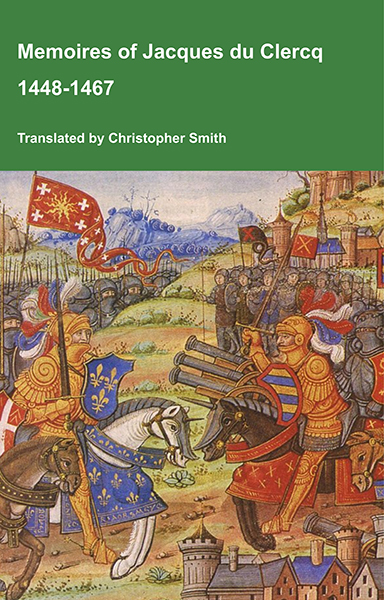
This is a translation of the 'Memoires of Jacques du Clercq', published in 1823 in two volumes, edited by Frederic, Baron de Reissenberg. In his introduction Reissenberg writes: 'Jacques du Clercq tells us that he was born in 1424, and that he was a licentiate in law and a counsellor to Philip the Good, Duke of Burgundy, in the castellany of Douai, Lille, and Orchies. It appears that he established his residence at Arras. In 1446, he married the daughter of Baldwin de la Lacherie, a gentleman who lived in Lille. We read in the fifth book of his Memoirs that his father, also named Jacques du Clercq, had married a lady of the Le Camelin family, from Compiègne. His ancestors, always attached to the counts of Flanders, had constantly served them, whether in their councils or in their armies.' The Memoires cover a period of nineteen years beginning in in 1448, ending in in 1467. It appears that the author had intended to extend the Memoirs beyond that date; no doubt illness or death prevented him from carrying out this plan. As Reissenberg writes the 'merit of this work lies in the simplicity of its narrative, in its tone of good faith, and in a certain air of frankness which naturally wins the reader’s confidence.' Du Clercq ranges from events of national and international importance, including events of the Wars of the Roses in England, to simple, everyday local events such as marriages, robberies, murders, trials and deaths, including that of his own father in Book 5; one of his last entries.
Available at Amazon in eBook and Paperback format.
On 27th September 1571 William Garrard [aged 64] died. He was buried at St Magnus the Martyr Church [Map].