

The History of William Marshal was commissioned by his son shortly after William’s death in 1219 to celebrate the Marshal’s remarkable life; it is an authentic, contemporary voice. The manuscript was discovered in 1861 by French historian Paul Meyer. Meyer published the manuscript in its original Anglo-French in 1891 in two books. This book is a line by line translation of the first of Meyer’s books; lines 1-10152. Book 1 of the History begins in 1139 and ends in 1194. It describes the events of the Anarchy, the role of William’s father John, John’s marriages, William’s childhood, his role as a hostage at the siege of Newbury, his injury and imprisonment in Poitou where he met Eleanor of Aquitaine and his life as a knight errant. It continues with the accusation against him of an improper relationship with Margaret, wife of Henry the Young King, his exile, and return, the death of Henry the Young King, the rebellion of Richard, the future King Richard I, war with France, the death of King Henry II, and the capture of King Richard, and the rebellion of John, the future King John. It ends with the release of King Richard and the death of John Marshal.
Available at Amazon in eBook and Paperback format.
William Larkin is in Painters.
Around 1582 William Larkin was born.
On 7th July 1606 William Larkin [aged 24] became a freeman of the Worshipful Company of Stainers.

On 7th July 1606 William Larkin [aged 24] became a Freeman of Worshipful Company of Stainers under the patronage of Arabella Stewart [aged 31] and Edward Seymour 1st Earl Hertford [aged 67].

Around 1610 William Larkin [aged 28]; possibly a follower. Portrait of Mary Radclyffe Lady Gell [aged 5].
Mary Radclyffe Lady Gell: Around 1605 she was born to John Radclyffe of Ordsall. On 20th June 1622 John Stanhope and she were married in Castle Donington, Leicestershire. In December 1647 John Gell 1st Baronet and she were married. She by marriage Lady Gell of Hopton in Derbyshire. Around April 1653 Mary Radclyffe Lady Gell died.

In 1613 William Larkin [aged 31]. Portrait of Edward Sackville 4th Earl Dorset [aged 22].

Around 1613 William Larkin [aged 31]. Portrait of Richard Sackville 3rd Earl Dorset [aged 23].

Around 1615 William Larkin [aged 33]. Portrait of Lucy Harrington Countess Bedford [aged 35].

Around 1615 William Larkin [aged 33]. Portrait of Grey Brydges 5th Baron Chandos [aged 35].
Grey Brydges 5th Baron Chandos: Around 1580 he was born to William Brydges 4th Baron Chandos and Mary Hopton Baroness Chandos. In 1602 William Brydges 4th Baron Chandos died. His son Grey succeeded 5th Baron Chandos of Sudeley. Anne Stanley Countess Castlehaven by marriage Baroness Chandos of Sudeley. On 28th February 1607 Grey Brydges 5th Baron Chandos and Anne Stanley Countess Castlehaven were married. She the daughter of Ferdinando Stanley 5th Earl of Derby and Alice Spencer Countess Derby. They were half fourth cousin twice removed. She a great x 3 granddaughter of King Henry VII of England and Ireland. On 10th August 1621 Grey Brydges 5th Baron Chandos died. His son George succeeded 6th Baron Chandos of Sudeley.

Around 1615 William Larkin [aged 33]. Portrait of Diana Cecil Countess of Oxford and Elgin [aged 19].
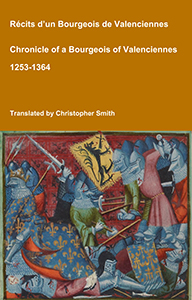
Chronicle of a Bourgeois of Valenciennes
Récits d’un bourgeois de Valenciennes aka The Chronicle of a Bourgeois of Valenciennes is a vivid 14th-century vernacular chronicle written by an anonymous urban chronicler from Valenciennes in the County of Hainaut. It survives in a manuscript that describes local and regional history from about 1253 to 1366, blending chronology, narrative episodes, and eyewitness-style accounts of political, military, and social events in medieval France, Flanders, and the Low Countries. The work begins with a chronological framework of events affecting Valenciennes and its region under rulers such as King Philip VI of France and the shifting allegiances of local nobility. It includes accounts of conflicts, sieges, diplomatic manoeuvres, and the impact of broader struggles like the Hundred Years’ War on urban life in Hainaut. Written from the perspective of a burgher (bourgeois) rather than a monastery or royal court, the chronicle offers a rare lay viewpoint on high politics and warfare, reflecting how merchants, townspeople, and civic institutions experienced the turbulence of the 13th and 14th centuries. Its narrative style combines straightforward reporting of events with moral and civic observations, making it a valuable source for readers interested in medieval urban society, regional politics, and the lived experience of war and governance in pre-modern Europe.
Available at Amazon in eBook and Paperback format.

Around 1615 William Larkin [aged 33]. Portrait of Philip Herbert 4th Earl Pembroke 1st Earl Montgomery [aged 30].

Around 1615 William Larkin [aged 33]. Portrait of Frances Howard Countess Essex and Somerset [aged 24].

Around 1616 William Larkin [aged 34]. Portrait of Catherine Knyvet Countess Suffolk [aged 52].

In 1616 William Larkin [aged 34]. Portrait of Mary Curzon Countess Dorset [aged 26].
Mary Curzon Countess Dorset: In 1590 she was born to George Curzon. In 1612 Edward Sackville 4th Earl Dorset and she were married. He the son of Robert Sackville 2nd Earl Dorset and Margaret Howard. On 28th March 1624 Richard Sackville 3rd Earl Dorset died at Dorset House. He was buried in the Sackville Chapel St Michael's Church Withyham East Sussex. His brother Edward succeeded 4th Earl Dorset, 4th Baron Buckhurst. She by marriage Countess Dorset. On 16th May 1645 she died.

Around 1616 William Larkin [aged 34]. Portrait of Elizabeth Tanfield Duchess Bridgewater [aged 31].
Elizabeth Tanfield Duchess Bridgewater: In 1585 she was born to Lawrence Tanfield. In 1602 Henry Carey 1st Viscount Falkland and she were married. They were fifth cousins. In 1620 Henry Carey 1st Viscount Falkland was created 1st Viscount Falkland. She by marriage Viscountess Falkland. In 1639 she died.

Around 1616 William Larkin [aged 34]. Portrait of Isabella Rich [aged 23].
Isabella Rich: John Smythe and she were married. She the daughter of Robert Rich 1st Earl Warwick and Penelope Devereux Countess Devonshire. They were fifth cousin once removed. Around 1593 she was born to Robert Rich 1st Earl Warwick and Penelope Devereux Countess Devonshire.

Around 1616 William Larkin [aged 34]. Portrait of Anne Clifford Countess Dorset and Pembroke [aged 25].

Around 1616 William Larkin [aged 34]. Portrait of Elizabeth Drury Countess Exeter [aged 37].
Elizabeth Drury Countess Exeter: On 4th January 1578 she was born to William Drury and Elizabeth Stafford. After 1591 William Cecil 2nd Earl Exeter and she were married. He the son of Thomas Cecil 1st Earl Exeter and Dorothy Neville Countess Exeter. They were third cousin once removed. On 8th February 1623 Thomas Cecil 1st Earl Exeter died. He was buried at Chapel of St John the Baptist, Westminster Abbey [Map]. His son William succeeded 2nd Earl Exeter, 3rd Baron Burghley. She by marriage Countess Exeter. On 26th February 1658 Elizabeth Drury Countess Exeter died.

Around 1616 William Larkin [aged 34]. Portrait of Elizabeth Bassett Countess Newcastle upon Tyne [aged 24].

In 1616 William Larkin [aged 34]. Portrait of George Villiers 1st Duke of Buckingham [aged 23] wearing his Garter Robes and Leg Garter.

Before 1619 William Larkin [aged 36]; possibly a follower. Portrait of Susan Villiers Countess Denbigh [aged 35].
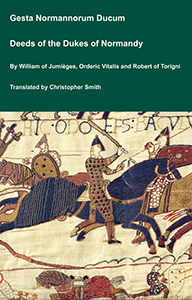
The Deeds of the Dukes of Normandy
The Gesta Normannorum Ducum [The Deeds of the Dukes of Normandy] is a landmark medieval chronicle tracing the rise and fall of the Norman dynasty from its early roots through the pivotal events surrounding the Norman Conquest of England. Originally penned in Latin by the monk William of Jumièges shortly before 1060 and later expanded at the behest of William the Conqueror, the work chronicles the deeds, politics, battles, and leadership of the Norman dukes, especially William’s own claim to the English throne. The narrative combines earlier historical sources with firsthand information and oral testimony to present an authoritative account of Normandy’s transformation from a Viking settlement into one of medieval Europe’s most powerful realms. William’s history emphasizes the legitimacy, military prowess, and governance of the Norman line, framing their expansion, including the conquest of England, as both divinely sanctioned and noble in purpose. Later chroniclers such as Orderic Vitalis and Robert of Torigni continued the history, extending the coverage into the 12th century, providing broader context on ducal rule and its impact. Today this classic work remains a foundational source for understanding Norman identity, medieval statesmanship, and the historical forces that reshaped England and Western Europe between 800AD and 1100AD.
Available at Amazon in eBook and Paperback format.

Before 1619 William Larkin [aged 36]. Portrait of Thomas Lucy of Charlecote Park [aged 23].
Thomas Lucy of Charlecote Park: In 1595 he was born to Thomas Lucy of Charlecote. In or before 1622 Thomas Lucy of Charlecote Park and Alice Spencer were married. In December 1640 Thomas Lucy of Charlecote Park died.
Between 10th April 1619 and 14th May 1619 William Larkin [aged 37] died. The earlier date being when his will was witnessed, the latter date when it was proved.