

Henrici Quinti, Angliæ Regis, Gesta, is a first-hand account of the Agincourt Campaign, and subsequent events to his death in 1422. The author of the first part was a Chaplain in King Henry's retinue who was present from King Henry's departure at Southampton in 1415, at the siege of Harfleur, the battle of Agincourt, and the celebrations on King Henry's return to London. The second part, by another writer, relates the events that took place including the negotiations at Troye, Henry's marriage and his death in 1422.
Available at Amazon in eBook and Paperback format.
1344 Creation of the Order of the Garter
1350 Creation of Garter Knights
1361 Marriage of Edward "The Black Prince" and Joan "The Fair Maid of Kent"
Around 1320 [his father] William Montagu 1st Earl Salisbury and [his mother] Catherine Grandison Countess of Salisbury were married. She by marriage Baroness Montagu.
On 25th June 1328 William Montagu 2nd Earl Salisbury was born to [his father] William Montagu 1st Earl Salisbury and [his mother] Catherine Grandison Countess of Salisbury.
Around March 1340 Thomas Holland 1st Earl Kent and [his future wife] Joan "Fair Maid of Kent" Princess Wales were married in secret. It isn't clear whether the marriage was canonical given the secrecy; there were no witnesses. She twelve years old. A subsequent investigation by papal commissioners confirmed it as valid. She the daughter of Edmund of Woodstock 1st Earl Kent and [his future mother-in-law] Margaret Wake Countess Kent.
Around November 1340 William Montagu 2nd Earl Salisbury and Joan "Fair Maid of Kent" Princess Wales were married. She was already married albeit secretly to Thomas Holland 1st Earl Kent. The subsequent investigation found her marriage to Thomas Holland 1st Earl Kent to be valid. She the daughter of Edmund of Woodstock 1st Earl Kent and Margaret Wake Countess Kent. He the son of William Montagu 1st Earl Salisbury and Catherine Grandison Countess of Salisbury.
Before 27th April 1341 [his brother-in-law] Hugh Despencer 1st Baron Despencer and [his sister] Elizabeth Montagu Baroness Badlesmere and Despencer were married. She by marriage Baroness Despencer. She the daughter of [his father] William Montagu 1st Earl Salisbury and [his mother] Catherine Grandison Countess of Salisbury.
On 23rd April 1344 King Edward III of England created the Order of the Garter. The date nominal as there are different accounts; some sources say 1348.
2 Henry of Grosmont 1st Duke Lancaster.
3 Thomas Beauchamp 11th Earl Warwick.
4 Jean Grailly.
5 Ralph Stafford 1st Earl Stafford.
6 William Montagu 2nd Earl Salisbury.
7 [his future brother-in-law] Roger Mortimer 2nd Earl March.
9 Bartholomew "The Younger" Burghesh 2nd Baron Burghesh.
10 John Beauchamp 1st Baron Beauchamp Warwick.
11 John Mohun 2nd Baron Mohun of Dunster.
12 Hugh Courtenay.
13 Thomas Holland 1st Earl Kent.
15 Richard Fitzsimon.
16 Miles Stapleton.
17 Thomas Wale.
18 Hugh Wrottesley.
19 Neil Loring.
20 John Chandos.
21 James Audley.
22 Otho Holland.
23 Henry Eam.
24 Sanchet Abrichecourt.
 Become a Member via our Buy Me a Coffee page to read more.
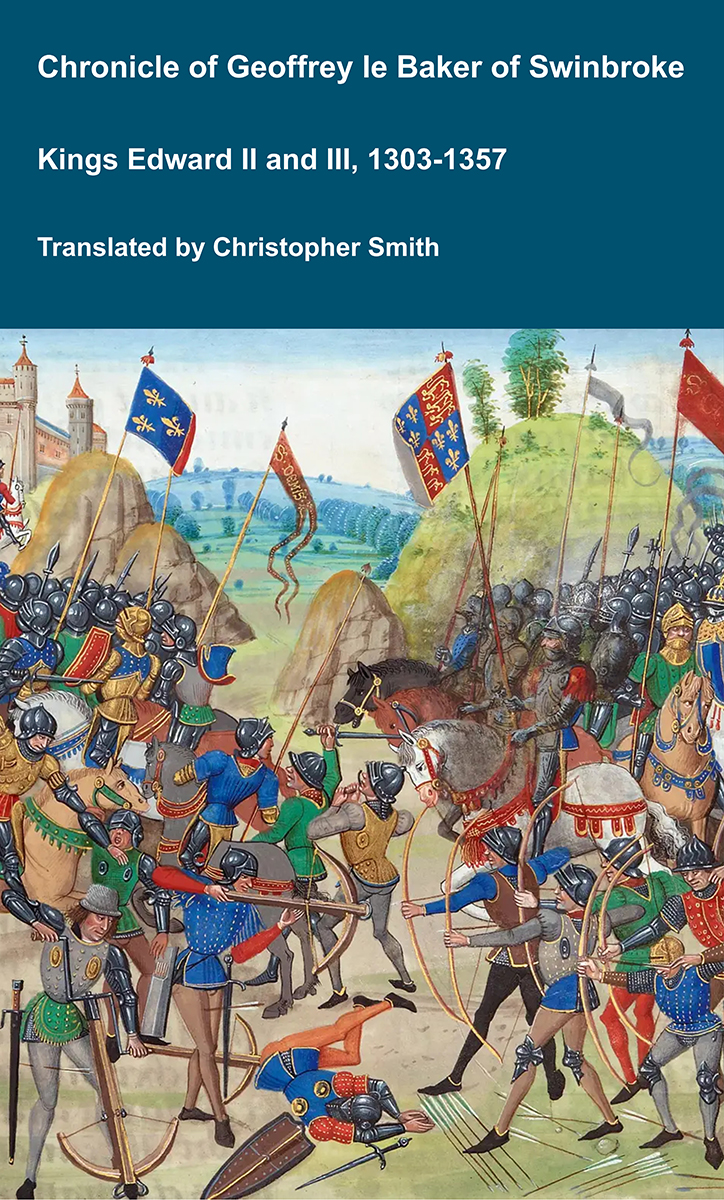 Chronicle of Geoffrey le Baker of Swinbroke. Finally, on the thirteenth day of the same month of July1 [1346], they arrived at the desired port. Upon landing, the king knighted his eldest son and created him Prince of Wales. Immediately, the prince in turn knighted2 the lords [his future brother-in-law] Mortimer, Montagu, and de Ros, and others were likewise promoted to the order of knighthood. For the rest of that day and the whole night, the king lodged in the town of Hogue, and the next day, Tuesday, the army burned the town and proceeded inland through the region of the Cotentin Peninsula. That night, the king lodged at Marcellins, where he remained for five days, during which the entire countryside, including the town of Barfleur, was burned and laid waste along the whole coastline.
Tandem die tertio decimo eiusdem mensis Iulii, ad portum desideratum applicuerunt, ubi, nacti terram, in littore suum primogenitum fecit militem et eum principem Wallie constituebat. Statim princeps fecit milites dominos de Mortimer, de Monte acuto, et de Ros; et cum illis eciam fuerunt alii consimiliter ad ordinem promoti militarem. Per residuum diei et totam noctem rex in villa de Hogges ospitabatur, et in crastino, die Tovis, per exercitum villa combusta, deinde per patriam Constantin profectus, nocte sequenti in Marcelins rex hospitabatur, ibi per quinque dies commoratus, in quibus tota patria cum villa de Barbeflete combusta fuerat, vastata cum tota illa costa marina.
Note 1. The route of Edward's march in the Crécy campaign, across the north of France, from La Hougue to Calais, is here traced with great fullness, and there is no difficulty in identifying almost every place that is named. There is, however, a lack of dates, so that, were there no other means of checking the daily advance of the army, it would be hard, if not impossible, to make out the successive stages with perfect accuracy. Fortunately there is extant the journal of the king's kitchen, kept during the expedition, in which are recorded the names of the places where the king lodged, generally with accompanying dates. This document is quoted in 'Proofs of the early use of Gunpowder in the English Army,' by Mr. Joseph Hunter, printed in Archaeologia, 32: "The king landed at 'Hok,' or 'Hogges,' in Normandy, meaning the port of La Hogue, on Wednesday, the 12th July 1346, and the daily operations of his kitchen proceed at the same place till the Tuesday following, when they are transferred to Valognes. The day's stages of the King's march were now. Saint Come du Mount, Carenton, Pount Herbert, and Saint Lo. He then appears to have changed his purpose, and to have directed his march towards Caen, arriving there on Wednesday the 26th, the intermediate stages having been Sevance, Torteval, and Funtenay Paynel. He remained five days at Caen, and he left the place on the last day of July for Lisieux, at which place he arrived on the second of August, having passed through Treward and Leoperty. He was two days at Lisieux: on the 4th of August he was at Durenvile, on the 5th at Limburgh, the 7th at Oil de Boef, and the 8th at Pount Vadreel. The daily stages were now, Longvile, Frenose, Appone, Ferelaguillon, and Poissy, where he arrived on the 13th of August. He was then about 12 miles from Paris. He remained at Poissy till the 16th, on which day he had begun his march northward. The first day's march was to Grisy, the next to Anty, the next to Trussereux, then to Somerreux, Causeamyneux, and Asshen, where he arrived on the 21st of August. He spent the 22nd and 23rd at Asshen.
We then find him in this humble but authentic chronicle:
Thursday, August 24, 'sub foresta de Cressy.'
Friday, August 25, 'in foresta de Cressy.'
Saturday, August 26, 'adhuc sub foresta de Cressy.'
Sunday, August 27, 'in campis sub foresta de Cressy.'"
There is also a contemporary itinerary, copied in a hand of the 15th century, in the Cotton MS. Cleopatra D. 7. f. 179. From these two documents and Baker's route a perfect itinerary can be constructed.
There are extant also several letters written during the campaign, which enter more or less into details. These are the letters of Edward to sir Thomas Lucy (Coxe, The Black Prince, by Chandos Herald, Roxburghe Club, 1842, p. 351.
To the archbishop of Canterbury (Lettenhove's Froissart 18.285.
To the archbishop of York (Chronicle of Lanercost 342.
Bartholomew Burghersh to the archbishop of York; Murimuth 200.
Bartholomew Burghersh to the archbishop of York; Murimuth 202.
Letter of Thomas Bradwardine, chancellor of St. Paul's; Murimuth 201.
Letter of Michael Northburgh; Murimuth 212, 367, Avesbury 358.
Letter of Michael Northburgh; Avesbury 367.
Letter of Richard Wynkeley, the king's confessor; Murimuth 215; Avesbury 362.
I here give the stages as they appear in the Kitchen Journal (see also Brit. Mus., Add. MS. 25461, f. II); and also print the itinerary from the Cotton MS:
Kitchen Journal
12 July (Wednesday). Hok.
18 July (Tuesday). Valognes.
19 July (Wednesday). Saint Comb du Mont.
20 July (Thursday). Carentan.
21 July (Friday). Pount [Hébert].
22 July (Saturday). Saint Lo.
23 July (Sunday). Sevaunce.
24 July (Monday). Torteval.
25 July (7uesday). Funtenay Paynel.
26 July (Wednesday). Caen.
31 July (Monday). Treward.
1 August (Zuesday). Leoperty.
2 August (Wednesday). Lisieux.
4 August (Friday). Durenvile.
5 August (Saturday). Limburgh.
7 August (Monday). Oil de Boef.
8 August (Tuesday). Pount Vadreel.
9 August (Wednesday). Longville.
10 August (Thursday). Frenose.
11 August (Friday). Appone.
12 August (Saturday). Ferelaguillon.
13 August (Sunday). Poissy.
16 August (Wednesday). Grisy.
17 August (Thursday). Auty.
18 August (Friday). Trussereux.
19 August (Saturday). Somerreux.
20 August (Sunday). Canseamyneux.
21 August (Monday). Assheu.
24 August (Thursday). Sub foresta de Cressy.
25 August (Friday). In foresta de Cressy.
26 August (Saturday). Adhuc sub foresta de Cressy.
27 August (Sunday). Incampissub foresta de Cressy.
28 August (Monday). Valoles.
29 August (Twuesday). Mauntenay.
30 August (Wednesday). Saint Joce in Pountif.
31 August (Thursday). Chastelnoef.
2 September (Saturday). Vintevill.
3 September (Sunday). Vintevill.
4 September (Monday). Coram Calais.
Cotton MS. Cleopatra D. 7, f. 179
On comparing these two itineraries with that given in the text, it will be seen that there are certain discrepancies. In some instances these are no doubt due to mere blundering; but others may be accounted for as variations of three different statements written independently by persons marching with different battles of the army. Putting the three itineraries together, we can lay down the following route:
12 July, Wednesday. Landing at Saint-Vaast-de-la-Hougue. Baker has inadvertently dated this event the 13th July; but, as he speaks of the next day as Thursday, he is only wrong in the day of the month.
13 July, Thursday. Headquarters at Morsalines, only two or three miles from St. Vaast. The Kitchen Journal does not notice the removal. Halt of five days. The country wasted, and Barfleur burnt [on Friday, 14th July].
18 July, Tuesday. To Valognes, 9 miles S.W.
19 July, Wednesday. To Saint-Côme-du-Mont, just north of the river Douve, 14 miles S. by E. Cott. MS. fixes the halt at 'Caueny,' no doubt Coigny, 5 miles W. of Saint-Côme-du-Mont. Probably one of the battles lay there.
20 July, Thursday. Across the Douve to Carentan, only two or three miles.
21 July, Friday. The K. J. and Cott. MS. name Pont-Hébert, a town lying 11 miles S.E. of Carentan and about 4 miles N.W. of Saint-Lo, as the halting place for this day. Baker records the march to 'Serins,' Saint-Lo, and Torigni, and their destruction, and then gives Cormolain as the king's headquarters for the night. He has clearly compressed the events of two days into one. 'Serins' is probably a clerical error for Sevins, Sept-Vents or Sevans, the place which K. J. calls 'Sevance.' If 'Serins' were the correct reading, it might mean Ceérisy-la-Forêt or Cérisy-l'Abbaye, which however lies too much off the route.
22 July, Saturday. To Saint-Lo (K. J. and Cott. MS.)
23 July, Sunday. To Sept-Vents (K. J.) about 12 miles S.E. of Saint-Lo. Cormolain, mentioned by Baker and Cott MS., is not far from Sept-Vents, and may be reckoned as the halting-place of some part of the army.
24 July, Monday. To Torteval (K. J. and Cott. MS.), only about 5 miles E. of Cormolain. Baker makes this day's halt at 'Gerin,' a monastic cell, which may be identical with Cairon or le Quéron, a little S. of Fontenay-le-Pesnel.
25 July, Tuesday. To Fontenay-le-Pesnel (K. J.), 7 or 8 miles E. According to Cott. MS., only to Mauperthuis, just past Torteval.
26 July, Wednesday. To Caen; taken by assault. Halt of five days. Baker dates the capture of Caen on the day before, and makes the halt to last six days.
31 July, Monday. To 'Troward ' (Troarn), 8 miles E.; and Argences, 4 miles S. of Troarn.
I August, Tuesday. To Rumesnil, 9 miles E. K.J. fixes the stage at Leaupartie, which is quite close to Rumesnil; Cott MS. on the other hand, at Saint-Pierredu-Jonque on the left of the Dives, only about 5 miles E. by S. of Troarn.
2, 3 August, Wednesday and Thursday. To Lisieux, 9 miles E. by S. Halt of two days. Baker makes it three days.
4 August, Friday. To 'Lestintnoland' (Le Teil-Nollent), 14 miles E., or to Duranville (K. J.) adjoining Le Teil-Nollent.
5 August, Saturday. Through Brionne, 9 miles, to Le Neubourg, 9 miles further E. The latter place appears as 'Limburgh' in K.J. Cott. MS. makes a halt on both the 4th and 5th at Le Teil-Nollent.
6 August, Sunday. Apparently a halt.
7 August, Monday. To Elbeuf on the Seine, 11 miles N.E. 'Celebeef,' in Baker; 'Oil de Boef," in K. J. Cott. MS. makes the march to Elbeuf fall on Sunday, and continues a day in advance down to the 11th.
8 August, Tuesday. Passing Pont-de-l'Arche, to Léry, said to be on the Seine, but really on the Eure, 9 miles E. K. J. makes this stage halt at 'Pount Vadreel,' no doubt St-Cyr-de-Vaudreuil, a little S. of Léry.
9 August, Wednesday. Through Gaillon to Longueville, near Vernon. Longueville does not appear in the maps. Perhaps it was a suburb of Vernon; 17 miles S.E.
10 August, Thursday? Capture of the castle of Roche-blanche (not in the maps). This seems to be the 'chastel de la Roche,' of Cott. MS., there stated to have been captured on the 7th. Advance to Freneuse, 9 miles up the Seine, incorrectly called 'Frevile' by Baker.
11 August, Friday. Through Mantes, to Epone, 12 miles S.E.
12 August, Saturday. To Fresnes, 5 or 6 miles E. K. J. has 'Ferelaguillon,' which is no doubt a corruption of Fresnes-Ecquevilly.
13 August, Sunday. To Poissy, 6 miles E. According to Baker, the march to Fresnes was on Friday, and the arrival at Poissy on Saturday. Skirmish with a detachment from Amiens.
14, 15 August, Monday and Tuesday. Halt.
16 August, Wednesday. To Grisy, 14 miles N. Baker calls this place 'Gersile.'
17 August, Thursday. To Auteuil, 15 miles N.
18 August, Friday. To Troissereux, 10 miles N.W.
19 August, Saturday. To Sommereux, 15 miles N. In these last marches Baker still continues a day in advance, making the stage of Auteuil on Wednesday, and from thence to Sommereux on Thursday and Friday.
20 August, Sunday. Poissy taken. Then to Camps-en-Amienois (K. J. and Cott. MS.), 8 miles N. Baker refers the capture of Poissy alone to Sunday.
21, 22 August, Monday and Tuesday. To Airaines, 6 miles N. of Camps-enAmienois. Halt. K. J. has 'Assheu ' (Acheux) under date of the 21st; the king's kitchen must have been sent on far in advance.
23 August, Wednesday. To Acheux, 13 miles N.W.
24 August, Thursday. Passage of the Somme. Skirmish at Noyelle-sur-Mer, 8 miles N. Le Crotoy taken. Camp 'sub foresta de Cressy ' (K. J.).
25 August, Friday. Pass through the forest (Cott. MS.). 'In foresta' (K. J.). Attempt by the French to cross the river.
26 August, Saturday. In the open field before Crécy (Cott. MS.), about 8 miles N.E. of Noyelle. 'Adhuc sub foresta' (K. J.). The battle fought.
27 August, Sunday. On the field of battle. 'In campis sub foresta' (K. J.).
28 August, Monday. To 'Abbeville' (Cott. MS.) or 'Valoles' (K. J.), evidently Valloire-Abbaye, on the road to Maintenay.
29 August, Tuesday. To Maintenay, 8 or 9 miles N. of Crécy.
30 August, Wednesday. To Saint-Josse, 10. miles N.W.
31 August, 1 September, Thursday and Friday. To Neufchatel, 10 miles N. Halt. 2, 3 September (Saturday and Sunday). To Wissant (Cott. MS.), 18 miles N. K. J. says 'Vintevill,' i.e. Wimille, 10 miles N. Halt,
4 September (Monday). To Calais.
Note 2. Of the three here mentioned, Roger Mortimer was born about the year 1327, was restored to the earldom of March in April 1354, and died in 1360; William de Montacute, the young earl of Salisbury, was born in 1328, and died in 1397; and William de Roos was summoned to parliament in 1350, and died in the Holy Land in 1352.
On 3rd April 1348 [his brother-in-law] John Plantagenet 3rd Earl Kent and Isabella aka Elizabeth Julich Countess Kent were married. She by marriage Countess Kent. She the daughter of William Jülich V Duke Jülich and Joanna Hainaut Duchess Guelders. He the son of Edmund of Woodstock 1st Earl Kent and [his mother-in-law] Margaret Wake Countess Kent.
On 11th June 1349 [his father] William Montagu 1st Earl Salisbury died. William Montagu 2nd Earl Salisbury succeeded 2nd Earl Salisbury, 4th Baron Montagu. [his wife] Joan "Fair Maid of Kent" Princess Wales by marriage Countess Salisbury.
On 29th September 1349 [his mother-in-law] Margaret Wake Countess Kent died of plague. [his brother-in-law] John Plantagenet 3rd Earl Kent succeeded 4th Baron Wake of Liddell and inherited her dower lands and the estates she had inherited from her brother Thomas Wake 2nd Baron Wake of Liddell.
On 23rd November 1349 [his mother] Catherine Grandison Countess of Salisbury died at Bisham Abbey.
Before 1350 [his brother] John Montagu 1st Baron Montagu, Baron Monthermer and [his sister-in-law] Margaret Monthermer Baroness Montagu 3rd Baroness Monthermer were married. She by marriage Baroness Montagu. He by marriage Baron Monthermer. He the son of [his father] William Montagu 1st Earl Salisbury and [his mother] Catherine Grandison Countess of Salisbury.
Chronicle of Geoffrey le Baker of Swinbroke. In this year,1 on the feast day of Saint George [23rd April 1350], the king held a great banquet at Windsor Castle, where he established a chantry of twelve priests, and founded a hospital, in which impoverished knights, whose means were insufficient, could, in the service of the Lord, receive suitable support from the perpetual alms of the founders of that college. Besides the king, other nobles contributed to the foundation of this hospital, namely: the king's eldest son, the Earl of Northampton, the Earl of Warwick, the Earl of Suffolk, the Earl of Salisbury, and other barons. Also included were simple knights, such as: [his future brother-in-law] Roger de Mortimer, now Earl of March, Lord Walter de Mauny, Lord William FitzWarin, John de Lisle, John de Mohun, John de Beauchamp, Walter de Pavely, Thomas Wale and Hugh de Wrottesley. Men whose proven virtue ranked them among the wealthiest earls. Together with the king, all these men were clothed in robes of powdered russet, with garters of Indian colour, also wearing garters on their right legs, and mantles of blue, adorned with the shield of Saint George. In such attire, bareheaded, they devoutly attended a solemn Mass, sung by the bishops of Canterbury, Winchester, and Exeter. They then sat together at a common table, in honour of the holy martyr, to whom they dedicated this noble brotherhood, calling their company "The Knights of Saint George of the Garter."
Isto anno, in die sancti Georgii, rex celebravit grande convivium apud Wyndesore in castro, ubi instituit cantariam xij. sacerdotum, et fundavit zenodochium, in quo milites depauperati, quibus sua non sufficerent, possent in Domini servitute de perpetuis elemosinis fundatorum illius collegii sustentacionem competentem habere. Preter regem fuerunt alii compromittentes in fundacionem istius zenodochii, scilicet regis primogenitus, comes Norhamptonie, comes Warewici, comes Suthfolchie, comes Salisbiriensis, et alii barones; simplices quoque milites, scilicet Rogerus de Mortuo mari, nunc comes Marchie, dominus Walterus de Magne, dominus Willelmus filius Garini, Iohannes de Insula, Iohannes de Mohun, Iohannes de Bealchampe, Walterus de Pavely, Thomas Wale, et Hughe de Wrotesley, quos probitas experta ditissimis comitibus associavit. Una cum rege fuerunt omnes isti vestiti togis de russeto pulverizato cum garteriis Indie coloris, habentes eciam tales garterias in tibiis dextris, et mantella de blueto cum scutulis armorum sancti Georgii. Tali apparatu nudi capita audierunt devote missam celebrem per antistites Cantuariensem, Wintoniensem, et Exoniensem decantatam, et conformiter sederunt in mensa communi ob honourem sancti martiris, cui tam nobilem fraternitatem specialiter intitularunt, appellantes istorum comitivam sancti Georgii de la gartiere.
Note 1. Stow Annales 390: "This yeere, on Saint Georges day [23rd April 1350], the king held a great and solemne feast at his castle of Windsor, where he had augmented the chappel which Henry the first and other his progenitors, kings of England, had before erected, of eight chanons. He added to those eight chanons a deane and fifteene chanons more, and 24 poore and impotent knights, with other ministers and servants, as appeareth in his charter dated the two and twentieth of his reigne. Besides the king, there were other also that were contributors to the foundation of this colledge, as followeth: i. The sovereigne king Edward the third, 2. Edward, his eldest sonne, prince of Wales, 3. Henry, duke of Lancaster, 4. the earle of Warwicke, 5. Captaine de Bouch, 6. Ralph, earle of Stafford, 7. William Montacute, earle of Salisburie, 8. Roger, lorde Mortimer, earle of March, 9. sir John de Lisle, 10. sir .
It will be seen that Stow here alters the names to tally with the list of the original knights or First Founders of the order of the Garter. Baker seems to be anticipating. William Bohun, 1st earl of Northampton, and Robert Ufford, 1st earl of Suffolk, and sir William Fitz-Warine became knights of the order at an early date; but Roger Mortimer, here styled 'now Earl of March,' did not have that title before 1352, and sir Walter Manny did not receive the garter till the end of 1359.
The date of the foundation of the order of the Garter has never been exactly determined. Froissart 203.
The Brute chronicle (Egerton MS. 650) has this description, although under a wrong year: "And in the XIX yere of his regne, anone aftre, in Jannuere, before Lenten, the same kyng Edward lete make fulle noble iustice and grete festes in the place of hys byrth, at Wyndsore, that ther were never none suche seyne before that tyme, ne I trowe sythene. At whech iustice, festis and ryalte weryn II kinges, II quenys, and the prince of Wales and the duke of Cornewale, ten erles, nine countesse, many barons, knyghttes, and worthy burgesse, the whech myght not lyghtly be nombrede; and also of dyverse londes as byyonde the see were many strangers. And at that tyme, whene the iustes had done, the kyng Edward made a grete souper, in the wheche he begone fyrst hys round table, and ordayned stedfastly the day of the forsayd table to be holde ther at Wyndessore in the Whytesonwyke evermore yerely."
Relying on the date given in the statutes of the order and on this passage in Baker, writers on the subject have adopted 1349 or 1350 as the year of foundation. But an entry in the household-book of the Black Prince affords a reason for dating the event a year earlier, payment having been made on the 18th November 1348, for twenty-four garters which were given by the prince "militibus de societate garterias" i.e. "garters [were given] to the knights of the society"; Beltz, Memorials of the Order of the Garter, pp. XXXII, 385. Proof however is not conclusive, as the ministers' accounts in the household-book were rendered between 1352 and 1365, and there is therefore room for error; moreover, the garters in question may have been prepared in anticipation. The date of 1349, which is given in the preamble to the earliest copies of the statutes, although it is true that those copies are not contemporary, is not to be lightly set aside. It is, indeed, most probable that the order was never solemnly instituted at an early period, but that it was gradually taking shape during the years following the foundation of the Round Table. Edward's patent, bearing date of 22nd August 1348, whereby he instituted a chapel at Windsor, with a fraternity of eight secular canons and a warden, fifteen other canons, and four-and-twenty poor knights, appears to be the first formal document which can be quoted as a foundation-deed of the order. After this there is no direct reference to it until 1350, when robes were issued for the King against the coming Feast of St. George, together with a Garter containing the King's motto, "Hony soyt qui mal y pense!" Nicolas, History of Orders of Knighthood, 1.24.
Annales of England by John Stow. This yeere, on Saint Georges day [23rd April 1350], the king held a great and solemne feast at his castle of Windsor, where he had augmented the chappel which Henry the first and other his progenitors, kings of England, had before erected, of eight chanons. He added to those eight chanons a deane and fifteene chanons more, and 24 poore and impotent knights, with other ministers and servants, as appeareth in his charter dated the two and twentieth of his reigne. Besides the king, there were other also that were contributors to the foundation of this colledge, as followeth: i. The sovereigne king Edward the third, 2. Edward, his eldest sonne, prince of Wales, 3. Henry, duke of Lancaster, 4. the earle of Warwicke, 5. Captaine de Bouch, 6. Ralph, earle of Stafford, 7. William Montacute, earle of Salisburie, 8. [his future brother-in-law] Roger, lorde Mortimer, earle of March, 9. sir John de Lisle, 10. sir Bartholomew Burwash, 11. sir John Beauchampe, 12. sir John Mahune, 13. sir Hugh Courtney, 14. sir Thomas Holland, 15. sir John Grey, 16. sir Richard Fitz Simon, 17. sir Miles Stapleton, 18. sir Thomas Walle, 19. sir Hugh Wrothesley, 20. sir Nele Loring, 21. sir John Chandos, 22. sir James de Audley, 23. sir Othes Holland, 24. sir Henry Eme, 25. sir Sechet Dabridgecourt, 26. sir Wiliam Panell. All these, together with the king, were clothed in gownes of russet, poudered with garters blew, wearing the like garters also on their right legges, and mantels of blew with scutcheons of S. George. In this sort of apparell they, being bare-headed, heard masse, which was celebrated by Simon Islip, archbishop of Canterbury, and the bishops of Winchester and Excester, and afterwards they went to the feast, setting themselves orderly at the table, for the honor of the feast, which they named to be of S. George the martyr and the choosing of the knights of the Garter.
Before 10th July 1350 [his brother-in-law] Guy de Bryan and [his sister] Elizabeth Montagu Baroness Badlesmere and Despencer were married. She the daughter of [his father] William Montagu 1st Earl Salisbury and [his mother] Catherine Grandison Countess of Salisbury.
Before 1352 [his brother-in-law] Roger Mortimer 2nd Earl March and [his sister] Philippa Montagu Countess March were married. She by marriage Countess March. She the daughter of [his father] William Montagu 1st Earl Salisbury and [his mother] Catherine Grandison Countess of Salisbury. He the son of Edmund Mortimer and Elizabeth Badlesmere Countess Northampton.
On 26th December 1352 [his brother-in-law] John Plantagenet 3rd Earl Kent died. He was buried at Greyfriars Church, Winchester. Earl Kent extinct. [his wife] Joan "Fair Maid of Kent" Princess Wales succeeded 5th Baroness Wake of Liddell. Some source suggest she also succeeded as 4th Countess of Kent but this is inconsistent with 1. her husband being created Earl of Kent as a new creation, and 2. her son not succeeding to the original Earldom?
On 19th September 1356 the army of Edward "Black Prince" defeated the French and Scottish army led by King John "The Good" II of France at the Battle of Poitiers
King John "The Good" II of France was captured by three captains including Ivon aka John Fane.
The the English army included: Bernard Brocas, Thomas Felton, James Audley, Thomas Beauchamp 11th Earl Warwick, Bartholomew "The Younger" Burghesh 2nd Baron Burghesh, Reginald Cobham 1st Baron Cobham, Edward Despencer 1st Baron Despencer, Baron Burghesh, Ralph Ferrers, William Scrope, William Montagu 2nd Earl Salisbury, Walter Paveley 4th Baron Burghesh, Robert Ufford 1st Earl Suffolk, William Ufford 2nd Earl Suffolk, John de Vere 7th Earl of Oxford, John Willoughby 3rd Baron Willoughby, Thomas Arderne, Enion Sais Brecon, John Chandos, Richard Pembridge, Jean Grailly, Robert de Fouleshurst and John Sully
John Savile of Shelley and Golcar probably fought having received letters of protection to travel overseas.
Hugh Courtenay 2nd or 10th Earl Devon protected the baggage train.
The French and Scottish army included: King John "The Good" II of France, Philip "Bold" Valois II Duke Burgundy, Jean Bourbon I Count La Marche, Archibald "Grim" Douglas 3rd Earl Douglas, John "Sans Terre" Artois 1st Count of Eu; all captured.
Guichard d'Angle 1st Earl Huntingdon and William Douglas 1st Earl Douglas fought.
Peter Bourbon Duke Bourbon was killed. Louis Bourbon II Duke Bourbon succeeded II Duke Bourbon.
Gauthier VI Comte de Brienne was killed.
Become a Member via our Buy Me a Coffee page to read more.
In 1357 [his brother] John Montagu 1st Baron Montagu, Baron Monthermer was created 1st Baron Montagu.
Archaeologia Volume 35 1853 XXXIII. On the 28th of November [1357], and two following days, the Queen entertained the Earl of Tancarville, a member of the royal family of France, and at this time in England, as one of the captives of Poitiers; and with him the Earl of Salisbury. Of this latter nobleman, William de Montacute, second Earl, it is noticeable that he too was connected with the Mortimers, being, as we have already stated, brother-in-law to the existing Earl of March2, although his father had personally acted a principal part in arresting Isabella's paramour in Nottingham Castle.
Note 1. Possibly John Melun 1st Count Tancarville although he not a member of the royal family of France?
Note 2. Roger Mortimer 2nd Earl March had married William's sister Philippa Montagu Countess March.

On 31st May 1359 [his sister] Elizabeth Montagu Baroness Badlesmere and Despencer died. Monument in Tewkesbury Abbey.
On 10th October 1361 Edward "Black Prince" and Joan "Fair Maid of Kent" Princess Wales were married at Windsor Castle. She by marriage Princess of Wales. His first wife, her second (or third depending on how you count them) husband. She had four children already. They had known each other since childhood. Thirty-one and thirty-three respectively. A curious choice for the heir to the throne; foreign princesses were usual. They were married nearly fifteen years and had two children. She the daughter of Edmund of Woodstock 1st Earl Kent and Margaret Wake Countess Kent. He the son of King Edward III of England and Philippa of Hainaut Queen Consort England.
On 15th September 1375 John Mohun 2nd Baron Mohun of Dunster died. Since he had no male issue the title Baron Mohun of Dunster went into abeyance between his three daughters. [his future wife] Elizabeth Mohun Countess of Salisbury had one child who died in 1397. [his future sister-in-law] Philippa Mohun Duchess York didn't have issue. Maud Mohun Baroness Strange Knockin had one son Richard Strange 3rd Baron Dunster 7th Baron Strange Knockin who succeeded as 3rd Baron Mohun of Dunster on the death of his aunt Philippa Mohun Duchess York.
After 24th June 1380 John Hastings 3rd Earl Pembroke and Elizabeth Lancaster Duchess Exeter marriage annulled since she had become pregnant by John Holland 1st Duke Exeter whom she subsequently married. It isn't clear whether John Holland was punished; he was half-brother to King Richard II of England through their mother [his wife] Joan "Fair Maid of Kent" Princess Wales.


In 1381 [his sister] Philippa Montagu Countess March died.
On 11th June 1381 King Richard II of England held council with his mother [his wife] Joan "Fair Maid of Kent" Princess Wales, Thomas Beauchamp 12th Earl Warwick, William Montagu 2nd Earl Salisbury, Richard Fitzalan 9th Earl of Surrey 4th or 11th Earl of Arundel, Archbishop Simon Sudbury and Robert Hales at the Tower of London.

On 14th June 1381 the mob gained access to the Tower of London capturing [his wife] Joan "Fair Maid of Kent" Princess Wales, the future King Henry IV of England, Joan Holland Duchess York and Archbishop Simon Sudbury.
Archbishop Simon Sudbury was beheaded at Tower Hill. He was buried at Canterbury Cathedral.
Lord Treasurer Robert Hales, who had only been appointed on the 1st February 1381, was beheaded at Tower Hill.
Patent Rolls. 1st March 1382. Coinmission to Robert Tresilian, Robert Bealknap, William Skipwyth, Nicholas Brembre, William Gunthorp, Adapı de Bury and William Spaigné to examine the record and process and correct any error therein, or in the judgment rendered, in the suit before the mayor of Cales between William de Montagu, Earl of Salisbury, proctor and attorney of John Buterleigh and Alesia his wife, executrix of the will of William Teynturer the younger, late citizen of Salisbury, William Warmwell and William Loerde, her co-executors, and one William Gilbert called Salesbury,' touching a debt of 3291. which the earl demanded from the said Gilbert, and to do justice therein according to the law and custom obtaining in Cales.
In or before 1383 William Montagu and Elizabeth Fitzalan Duchess Norfolk were married. She the daughter of Richard Fitzalan 9th Earl of Surrey 4th or 11th Earl of Arundel and Elizabeth Bohun Countess Arundel and Surrey. He the son of William Montagu 2nd Earl Salisbury and Elizabeth Mohun Countess of Salisbury.
In 1383 [his son] William Montagu was killed in a tournament.
On 7th August 1385 [his wife] Joan "Fair Maid of Kent" Princess Wales died at Wallingford Castle. She was buried at Blackfriars Friary, Stamford beside her first husband Thomas Holland 1st Earl Kent. Thomas Holland 2nd Earl Kent succeeded 6th Baron Wake of Liddell.
After 7th August 1385 William Montagu 2nd Earl Salisbury and Elizabeth Mohun Countess of Salisbury were married. She by marriage Countess Salisbury. He the son of William Montagu 1st Earl Salisbury and Catherine Grandison Countess of Salisbury.
In 1389 [his brother] John Montagu 1st Baron Montagu, Baron Monthermer died. [his nephew] John Montagu 3rd Earl Salisbury succeeded 2nd Baron Montagu.
On 3rd June 1397 William Montagu 2nd Earl Salisbury died. [his nephew] John Montagu 3rd Earl Salisbury succeeded 3rd Earl Salisbury, 5th Baron Montagu. Maud Francis Countess of Salisbury by marriage Countess Salisbury.
On 14th January 1415 [his former wife] Elizabeth Mohun Countess of Salisbury died in Salisbury.
[his son] William Montagu was born to William Montagu 2nd Earl Salisbury and Elizabeth Mohun Countess of Salisbury. He married in or before 1383 Elizabeth Fitzalan Duchess Norfolk, daughter of Richard Fitzalan 9th Earl of Surrey 4th or 11th Earl of Arundel and Elizabeth Bohun Countess Arundel and Surrey.
Parliament Rolls Richard II. 26. William Montague, Earl of Salisbury, submitted a petition in parliament, the tenor of which follows:
To our lord the king his liege William Montague, Earl of Salisbury, prays: whereas the most noble King Edward [III], your grandfather, by his letters patent gave and granted to William Montague, Earl of Salisbury and father of the said supplicant, whose heir he is, and to the heirs issuing from his body, with the clause of warranty of the said very noble King Edward [III] and his heirs, the castle, town and honour of Denbigh, and the cantreds of Rhos, Rhufiniog, and Cymeirch and the commote of Dinmael with their appurtenances in Wales, as plainly appears from the said letters patent: which castle, town, and honour, cantreds and commote, with their appurtenances, Roger Mortimer, late Earl of March, by the name of the land of Denbigh, in Trinity term, in the twenty-eighth year of the reign of the said most noble King Edward [III] [18 June 1354-9 July 1354], before William Shareshull and his fellow justices assigned to hold the pleas before the said very noble King Edward [III], against the aforesaid supplicant, by erroneous judgment, recovered by a writ of scire facias, founded on a judgment given in the parliament held at Westminster on the Monday after the feast of St Mark the Evangelist in the twenty-eighth year of the reign of the said very noble King Edward [III], for the aforesaid Roger, on a petition showed by him to the said very noble King Edward [III] then, in the name of Roger Mortimer of Wigmore, son and heir of Edmund Mortimer, son and heir of Roger Mortimer; in which record and judgment on the said writ of scire facias there are patent errors.
May it please you of your gracious lordship to cause the full record to be brought before you, with all attachments to the same concerning the said writ of scire facias, in the present parliament, that they may be inspected and examined for error, and to forewarn Roger Mortimer, Earl of March, cousin and heir of the aforesaid Roger son of Edmund, and others who are to be forewarned in the matter, to be before you at the next parliament to hear the said errors; and if they know of anything to say wherefor the aforesaid judgment on the said writ of scire facias should not be reversed, and the aforesaid supplicant restored to his said possession with the issues and profits in the meantime since the said loss, and also to do right and justice to the parties in the aforesaid manner. Whereupon, the said petition having been read before the king and lords of parliament, the king ordered Sir Walter Clopton, his chief justice, to bring before the king and lords in parliament the record of which the said petition made mention above. Which record, on the king's command, was later brought to parliament before the king and lords, and there it was read in part, and certain errors therein were pointed out and alleged by the said Earl of Salisbury. Whereupon the king, by the assent and advice of the lords of parliament, the justices of the king there present, granted and ordered that the said earl have a writ of scire facias on the matter of the said petition, returnable at the next parliament, as the same petition mentions.
Become a Member via our Buy Me a Coffee page to read more.