

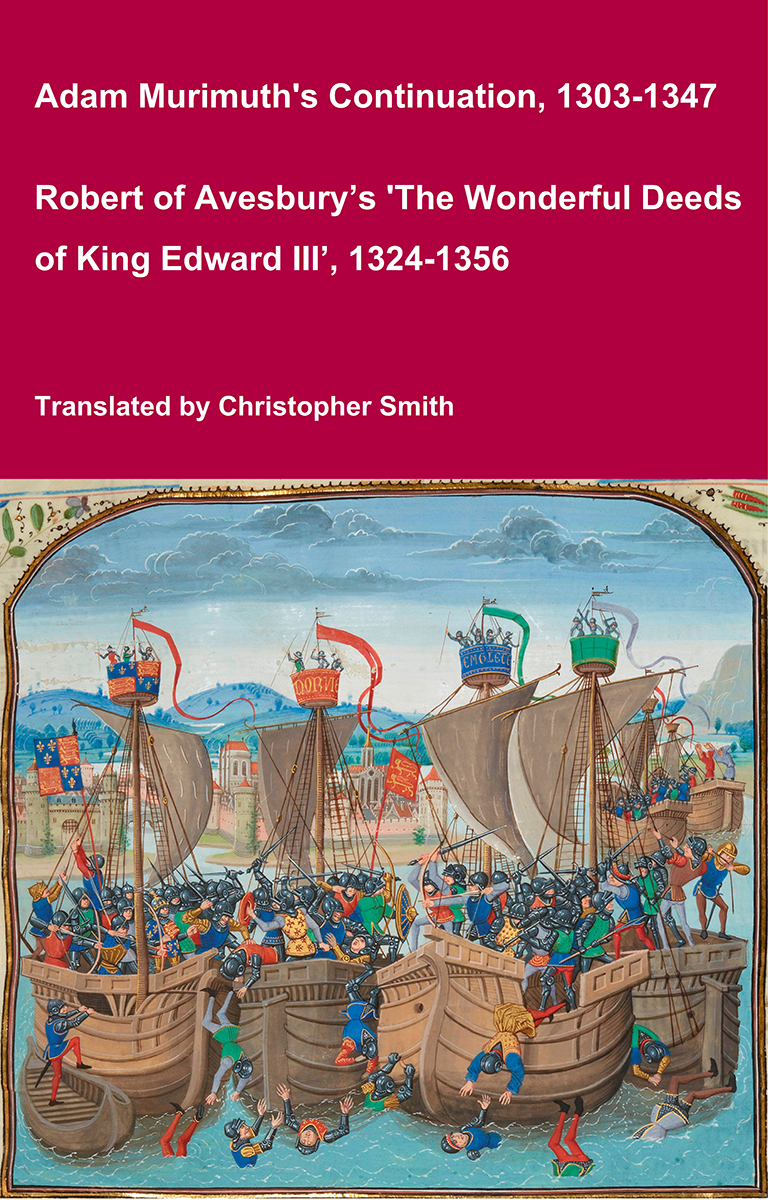
Adam Murimuth's Continuation and Robert of Avesbury’s 'The Wonderful Deeds of King Edward III'
This volume brings together two of the most important contemporary chronicles for the reign of Edward III and the opening phases of the Hundred Years’ War. Written in Latin by English clerical observers, these texts provide a vivid and authoritative window into the political, diplomatic, and military history of fourteenth-century England and its continental ambitions. Adam Murimuth Continuatio's Chronicarum continues an earlier chronicle into the mid-fourteenth century, offering concise but valuable notices on royal policy, foreign relations, and ecclesiastical affairs. Its annalistic structure makes it especially useful for establishing chronology and tracing the development of events year by year. Complementing it, Robert of Avesbury’s De gestis mirabilibus regis Edwardi tertii is a rich documentary chronicle preserving letters, treaties, and official records alongside narrative passages. It is an indispensable source for understanding Edward III’s claim to the French crown, the conduct of war, and the mechanisms of medieval diplomacy. Together, these works offer scholars, students, and enthusiasts a reliable and unembellished account of a transformative period in English and European history. Essential for anyone interested in medieval chronicles, the Hundred Years’ War, or the reign of Edward III.
Available at Amazon in eBook and Paperback format.
Paternal Family Tree: Pulteney
On 25th March 1624 William Pulteney was born to [his father] Michael Poultney of Bray in Berkshire.
On 23rd April 1655 William Pulteney (age 31) and Grace Corbet were married.
Samuel Pepys' Diary. 10th January 1660. Tuesday. Went out early, and in my way met with Greatorex (age 35), and at an alehouse he showed me the first sphere of wire that ever he made, and indeed it was very pleasant; thence to Mr. Crew's (age 62), and borrowed £10, and so to my office, and was able to pay my money. Thence into the Hall, and meeting the Quarter Master, Jenings, and Captain Rider, we four went to a cook's to dinner. Thence Jenings and I into London (it being through heat of the sun a great thaw and dirty) to show our bills of return, and coming back drank a pint of wine at the Star Tavern in Cheapside. So to Westminster, overtaking Captain Okeshott in his silk cloak, whose sword got hold of many people in walking. Thence to the Coffee-house [Map], where were a great confluence of gentlemen; viz. Mr. Harrington (age 49), Poultny (age 35), chairman, Gold, Dr. Petty (age 36); &c., where admirable discourse till at night. Thence with Doling to Mother Lams, who told me how this day Scott was made Intelligencer, and that the rest of the members that were objected against last night, their business was to be heard this day se'nnight. Thence I went home and wrote a letter, and went to Harper's, and staid there till Tom carried it to the postboy at Whitehall. So home to bed.
On 4th June 1660 William Pulteney (age 36) was knighted.
On 25th November 1663 [his daughter] Anne Pulteney Duchess Southampton Duchess of Cleveland was born to William Pulteney (age 39) and [his wife] Grace Corbet. She married 1694 Charles Fitzroy 1st Duke Southampton 2nd Duke Cleveland, son of King Charles II of England Scotland and Ireland and Barbara Villiers 1st Duchess of Cleveland, and had issue.
Before 1668 [his son] John Pulteney was born to William Pulteney (age 43) and [his wife] Grace Corbet.
John Evelyn's Diary. 10th June 1669. Came my Lord Cornbury, Sir William Pulteney (age 45), and others to visit me. I went this evening to London, to carry Mr. Pepys (age 36) to my brother Richard (age 46), now exceedingly afflicted with the stone, who had been successfully cut, and carried the stone as big as a tennis ball to show him, and encourage his resolution to go through the operation.


In January 1679 William Pulteney (age 54) was elected MP Westminster which seat he held until his death in Sep 1691.
In February 1679 William Pulteney (age 54) was elected MP Westminster which seat he held until Mar 1681.
On 6th September 1691 William Pulteney (age 67) died.
Abbot John Whethamstede’s Chronicle of the Abbey of St Albans
Abbot John Whethamstede's Register aka Chronicle of his second term at the Abbey of St Albans, 1451-1461, is a remarkable text that describes his first-hand experience of the beginning of the Wars of the Roses including the First and Second Battles of St Albans, 1455 and 1461, respectively, their cause, and their consequences, not least on the Abbey itself. His text also includes Loveday, Blore Heath, Northampton, the Act of Accord, Wakefield, and Towton, and ends with the Coronation of King Edward IV. In addition to the events of the Wars of the Roses, Abbot John, or his scribes who wrote the Chronicle, include details in the life of the Abbey such as charters, letters, land exchanges, visits by legates, and disputes, which provide a rich insight into the day-to-day life of the Abbey, and the challenges faced by its Abbot.
Available at Amazon in eBook and Paperback format.
In 1702 [his former wife] Grace Corbet died.
[his son] William Pulteney was born to William Pulteney and Grace Corbet.