

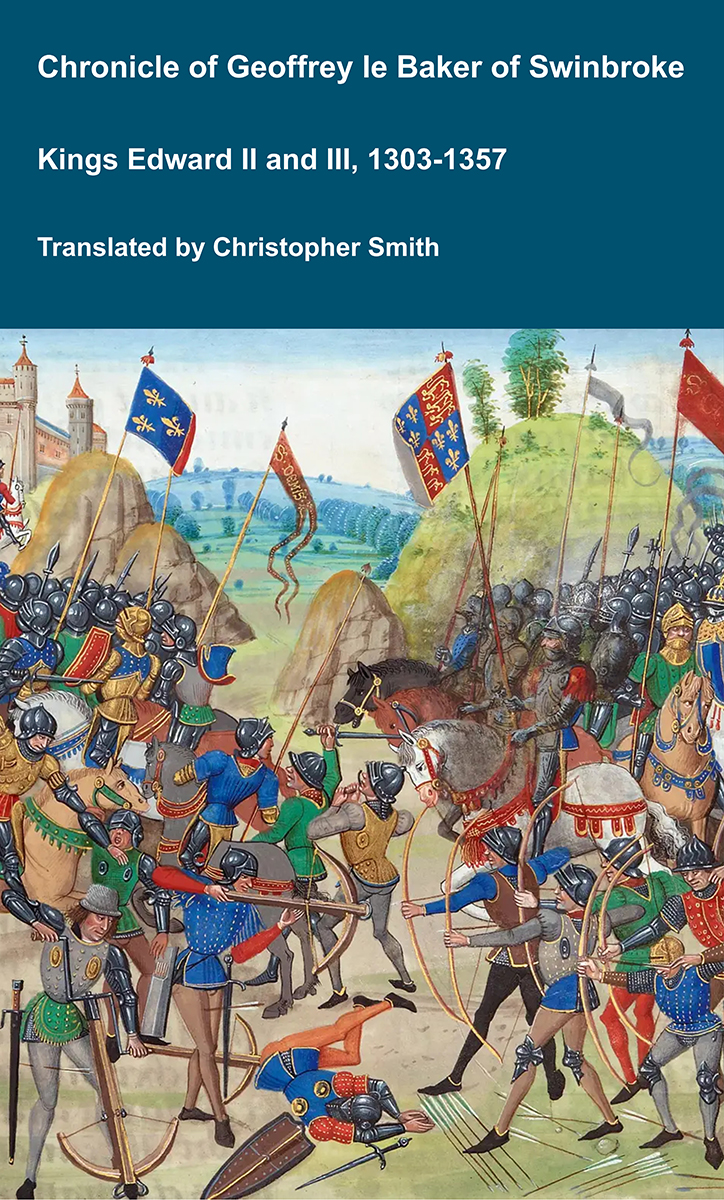
Chronicle of Geoffrey le Baker of Swinbroke
Baker was a secular clerk from Swinbroke, now Swinbrook, an Oxfordshire village two miles east of Burford. His Chronicle describes the events of the period 1303-1356: Gaveston, Bannockburn, Boroughbridge, the murder of King Edward II, the Scottish Wars, Sluys, Crécy, the Black Death, Winchelsea and Poitiers. To quote Herbert Bruce 'it possesses a vigorous and characteristic style, and its value for particular events between 1303 and 1356 has been recognised by its editor and by subsequent writers'. The book provides remarkable detail about the events it describes. Baker's text has been augmented with hundreds of notes, including extracts from other contemporary chronicles, such as the Annales Londonienses, Annales Paulini, Murimuth, Lanercost, Avesbury, Guisborough and Froissart to enrich the reader's understanding. The translation takes as its source the 'Chronicon Galfridi le Baker de Swynebroke' published in 1889, edited by Edward Maunde Thompson.
Available at Amazon in eBook and Paperback format.
Before 30th April 1399 William Sawtry aka Salter was a priest at two Norfolk churches, St Margaret's in Lynn and Tilney.
On 30th April 1399 William Sawtry aka Salter was taken to Henry le Despenser (age 58), Bishop of Norwich, ordered he be examined. The examination lasted for two days, held at the Bishop's palace, South Elmham Hall. He charged with heresy and held in an episcopal prison.
On 25th May 1399 William Sawtry aka Salter publicly abjured Lollardy in King's Lynn.
On 26th May 1399 William Sawtry aka Salter appeared before Bishop Henry le Despenser (age 58) in St John's Hospital, King's Lynn, the next day, and swore on the Gospels that he would never again preach Lollardy. He also promised to never hear confession without a license from le Despenser. His abjuration was repeated in the Bishop's Chapel, South Elmham several days later.
In 1401 William Sawtry aka Salter moved to London and began working as a parish-priest at St Osyth's, where he preached Lollard beliefs.
On 12th February 1401 William Sawtry aka Salter appeared before ArchbIshop Thomas Arundel (age 48) at St Paul's Cathedral. He was charged with heresy.
On 26th February 1401 William Sawtry aka Salter was sentenced to death.
On 2nd March 1401 William Sawtry aka Salter was burned at the stake for heresy at Smithfield [Map]. He was the first follower of Lollardy to die for his beliefs.

On 10th March 1401. Henry IV's (age 33) Royal Assent was given to "De heretico comburendo", by which heretics were to be burned at the stake in reaction to the Lollard movement.
The request "... the said church would be injured or gravely oppressed or even perturbed by certain perverse doctrines, or wicked, heretical or erroneous opinions; nevertheless, various perfidious and perverse people of a certain new sect, believing damnable things of the said faith, the sacrament of the church, and its authority, rashly usurping the office of preacher, contrary to divine and ecclesiastical law, perversely and maliciously preach and teach these days, publicly and secretly, under simulation of the colour of sanctity, various new doctrines and wicked, heretical and erroneous opinions, contrary to this same faith and the holy decrees of the sacrosanct church ...".
The answer: "and they shall cause these same persons to be publicly burnt in a high place; and may punishment of this sort strike fear into the minds of others.".
On 2nd March 1401 William Sawtrey was the first heretic to be burned although his burning pre-dated the statute.