

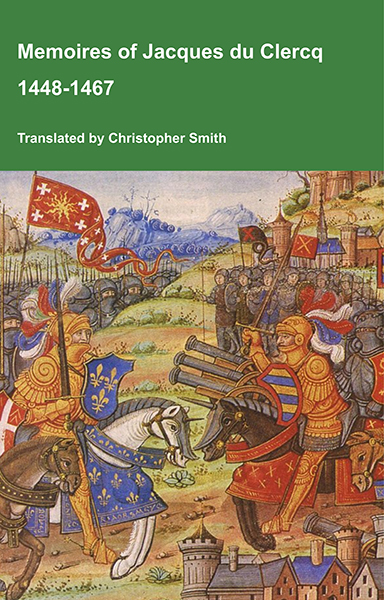
This is a translation of the 'Memoires of Jacques du Clercq', published in 1823 in two volumes, edited by Frederic, Baron de Reissenberg. In his introduction Reissenberg writes: 'Jacques du Clercq tells us that he was born in 1424, and that he was a licentiate in law and a counsellor to Philip the Good, Duke of Burgundy, in the castellany of Douai, Lille, and Orchies. It appears that he established his residence at Arras. In 1446, he married the daughter of Baldwin de la Lacherie, a gentleman who lived in Lille. We read in the fifth book of his Memoirs that his father, also named Jacques du Clercq, had married a lady of the Le Camelin family, from Compiègne. His ancestors, always attached to the counts of Flanders, had constantly served them, whether in their councils or in their armies.' The Memoires cover a period of nineteen years beginning in in 1448, ending in in 1467. It appears that the author had intended to extend the Memoirs beyond that date; no doubt illness or death prevented him from carrying out this plan. As Reissenberg writes the 'merit of this work lies in the simplicity of its narrative, in its tone of good faith, and in a certain air of frankness which naturally wins the reader’s confidence.' Du Clercq ranges from events of national and international importance, including events of the Wars of the Roses in England, to simple, everyday local events such as marriages, robberies, murders, trials and deaths, including that of his own father in Book 5; one of his last entries.
Available at Amazon in eBook and Paperback format.
 Britford, Wiltshire
 Clarendon Palace, Wiltshire
 Figsbury Rings
 Laverstock, Wiltshire
 Salisbury, Wiltshire
 West Dean, Wiltshire
 West Gomeldon, Wiltshire
 Winterslow, Wiltshire
Alderbury Hundred, Wiltshire is in Wiltshire.
On 16th November 1739 Mary Clarke died. She was buried at Britford, Wiltshire [Map].
St Peter's Church, Britford is also in Churches in Wiltshire.
On 17th May 1521 Edward Stafford 3rd Duke of Buckingham [aged 43] was beheaded at Tower Hill [Map]. Duke of Buckingham, Earl Stafford and Baron Stafford forfeit.
He was executed for no specific reason other than his having a significant amount of Plantagenet blood and was, therefore, considered a threat by Henry VIII [aged 29]. He was posthumously attainted by Act of Parliament on 31 July 1523, disinheriting his children. He was buried at St Peter's Church, Britford [Map].


On 3rd January 1721 Mary Smyth Lady Bouverie died. She was buried at St Peter's Church, Britford [Map].
On 21st November 1736 Edward des Bouverie 2nd Baronet [aged 46] died at Aix in France. He was buried at St Peter's Church, Britford [Map]. His brother Jacob [aged 42] succeeded 3rd Baronet Bouverie of St Catherine Cree Church in London.
Chronicle of William of Worcester. 1453. This year, at Clarendon [Map], King Henry VI suddenly fell into a severe illness of the head, so much so that he appeared to be devoid of reason.
Hoc anno apud Claryngtone rex Henricus VI. subito cecidit in gravem infirmitatem capitis, ita quod extractus a mente videbatur.
Chronicle of Robert Fabyan [-1512]. August 1453. And this yere the kyng laye longe syke at Claryngdowne [Map], & was in great ieopardye of his lyfe.
Samuel Pepys' Diary. 14th July 1664. Thence to my Lord's again, and my Lord being up, was sent for up, and he and I alone. He did begin with a most solemn profession of the same confidence in and love for me that he ever had, and then told me what a misfortune was fallen upon me and him: in me, by a displeasure which my Chancellor [aged 55] did show to him last night against me, in the highest and most passionate manner that ever any man did speak, even to the not hearing of any thing to be said to him: but he told me, that he did say all that could be said for a man as to my faithfullnesse and duty to his Lordship, and did me the greatest right imaginable. And what should the business be, but that I should be forward to have the trees in Clarendon Park [Map] marked and cut down, which he, it seems, hath bought of my Lord Albemarle [aged 55]; when, God knows! I am the most innocent man in the world in it, and did nothing of myself, nor knew of his concernment therein, but barely obeyed my Lord Treasurer's [aged 57] warrant for the doing thereof. And said that I did most ungentlemanlike with him, and had justified the rogues in cutting down a tree of his; and that I had sent the veriest Fanatique [Deane [aged 30]] that is in England to mark them, on purpose to nose [provoke] him. All which, I did assure my Lord, was most properly false, and nothing like it true; and told my Lord the whole passage. My Lord do seem most nearly affected; he is partly, I believe, for me, and partly for himself. So he advised me to wait presently upon my Lord, and clear myself in the most perfect manner I could, with all submission and assurance that I am his creature both in this and all other things; and that I do owne that all I have, is derived through my Lord Sandwich [aged 38] from his Lordship. So, full of horror, I went, and found him busy in tryals of law in his great room; and it being Sitting-day, durst not stay, but went to my Lord and told him so: whereupon he directed me to take him after dinner; and so away I home, leaving my Lord mightily concerned for me. I to the office, and there sat busy all the morning.


Samuel Pepys' Diary. 20th July 1664. Up, and a while to my office, and then home with Deane [aged 30] till dinner, discoursing upon the business of my Chancellor's [aged 55] timber in Clarendon Parke [Map], and how to make a report therein without offending him; which at last I drew up, and hope it will please him. But I would to God neither I nor he ever had had any thing to have done with it! Dined together with a good pig, and then out by coach to White Hall, to the Committee for Fishing; but nothing done, it being a great day to-day there upon drawing at the Lottery of Sir Arthur Slingsby [aged 41]. I got in and stood by the two Queenes [Note. Catherine of Braganza Queen Consort England [aged 25] and Henrietta Maria Bourbon Queen Consort England [aged 54] ] and the Duchesse of Yorke [aged 27], and just behind my Baroness Castlemayne [aged 23], whom I do heartily adore; and good sport it was to see how most that did give their ten pounds did go away with a pair of globes only for their lot, and one gentlewoman, one Mrs. Fish, with the only blanke. And one I staid to see drew a suit of hangings valued at £430, and they say are well worth the money, or near it. One other suit there is better than that; but very many lots of three and fourscore pounds. I observed the King [aged 34] and Queenes did get but as poor lots as any else. But the wisest man I met with was Mr. Cholmley [aged 31], who insured as many as would, from drawing of the one blank for 12d.; in which case there was the whole number of persons to one, which I think was three or four hundred. And so he insured about 200 for 200 shillings, so that he could not have lost if one of them had drawn it, for there was enough to pay the £10; but it happened another drew it, and so he got all the money he took.
Figsbury Rings is also in South England Henges, Iron Age Hill Forts Wiltshire.
The earthworks of Figsbury Ring [Map] are sub-circular and enclose 6.4 hectares of grassland on a chalk ridge to the north east of Salisbury. The site is unusual for having an outer bank and ditch, the usual form of a henge monument in addition it has an inner ditch which separates the centre from the rest of the monument. It may have been a Causewayed Enclosure, or a Henge, or both, with further modifications taking place at the start of the Iron Age when it may have been changed to a hill fort.
Colt Hoare 1812. CHLORLIS'S CAMP [Map], but in Mr. Aubrey's Monumenta Britannica, as well as in Mr. Camden's Britannia, it is noticed under the title of FRIPSBURY [Map]. What, the origin of the latter name is, I am at a loss to conjecture. The former may be derived from the British General CONSTANTIUS CHLORES, to whom, perhaps, the construction of this camp may be attributed. In Kennet's Parochial Antiquities, I find this earthen work alluded to, and some history given of its supposed founder. "After the death of Carausius, in the year 297, the Emperors Dioclesian and Maximian succeeded to the government of the empire, and in order to withstand the rebellions that broke out in divers parts of it, elected Galerius Maximus and Constantius Chlorus as their generals. The latter having defeated the usurper Allectus, got a good footing in Britain, and a good governor he was, and was come forwards upon the downs as far as New Sarum2, where, upon the side of the downs he built a fortification, the rampers whereof still appear very apparently, and is called CHLOREN, after the name that the Britons gave him, by reason of his long train carried up after him; it standeth in Wiltshire, upon the north corner of CHLORENDON Park, now called CLARENDON, which taketh is name thereof; a park of that largeness and bigness that it excecdeth any park in the kingdom; it hadi a church covered over with ivy in the north pan thereof next CHLOREN, which thereupon is now called Ivy Church: and if we give credit to a late poet, the park had twenty groves in it, each of them of a mile compass, and without any sophistication, it had a house of kings within, but long since dilapidated; it cloth now belong to the Right Honourable William Earl of Pembroke, Lord Chamberlain to his Majestie, whose heart is as large and liberal as the park is wide. This CONSTANTIUS embraced the Christian faith, and married Helena, daughter to King Coyl that built ColChester, by whom he had Constantine the Great, that removed the empire to the east, and built Constantinople."
Note 1. The following minutes Were sent to me Mr. Cunnington, respecting his researches on these barrows. "August 6, 1807. Aboüt a mile and a half south of Wilbary House, in a shallow vale, immediately under the hills to the is a group of five barrows; three bowl-shaped, and two of the Druid they stand nearly in a straight line, and owing to the ground being in tillage, have been repeatedly over, therefore much reduced in height. No. 1 is a bowl shaped barrow, 74 feet in its base diameter, and 3 feet 9 inches in elevation. It contained within an oblong cist, an interment of burned bones. over which was a brass pin. In making the sections, our men found at the depth of two feet the skeleton of a dog, which had been deposited immediately over the cist. No. 2, a bowl-shaped barrow, 69 feet in diameter, and feet in elevation, produced a little pile of burned bones, unaccompanied by any arms [?] or trinkets. No. 3, a fine Druid barrow, of the second class, contained a deposit of burned bones; but Mr. Cunnington thinks he may have missed the primary interment, or it may have been disturbed by a prior opening, No. 4 and 5 had both been examined before,
"From hence we proceeded to a group of eight barrows on Idmiston Downs, two of which are shaped, four bowl-shaped, and two Druid; all situated on a piece fine maide down. One of the bell-shaped barrows produced a simple interment of burned bones; and in the other, the sepulchral deposit was not discovered.
The fine Druid barrow contained within its area, which measured 194 feet in diameter, two raised mounds, in one of which, immediately under the turf, were discovered three large urns within few inches of each other; they were inverted, and covered the burned bones of three Britons. From being placed so near the surface, two of the urns were broken, but the third is preserved entire in our Museum at Heytesbury. They were all of rude pottery, and without any ornament. Beneath these three urns, in a shallow cist, were the burned bones of another Briton, piled up in R little heap. In the other within the same barrow, was another interment of burned bones, accompanied by the following articles, viz. a small cup similar size to the very diminutive one discovered at Everley, and engraved in Tumuli Plate XXII but without ornament; a brass pin, and a considerable quantity of amber beads." In one of the bowl-shaped barrows Mr. Cunnington railed in finding the interment, and the others he did not open.
Note 1. For New, we must read Old Sarum, as the former dates its origin only from the year 1220, and this transaction must have taken place soon after the accession of Dioclesian and Maximian to the empire in the year 304.
Wiltshire Archaeological Magazine 1925 V43 Pages 48-58. Figsbury Rings [Map]. An Account Of Excavations In 19241. By Mrs. M. E. Cunnington [aged 55].

On 6th October 1899 John Villiers Stuart Townshend 5th Marquess Townshend [aged 68] died at his home in Laverstock, Wiltshire [Map]. His son John [aged 32] succeeded 6th Marquess Townshend, 9th Viscount Townsend, 9th Baron Townshend of Lynn Regis in Norfolk, 11th Baronet Townshend.
The River Bourne rises at West Grafton, Wiltshire [Map] from where it flows past Collingbourne Kingston, Wiltshire [Map], Collingbourne Ducis, Wiltshire [Map], Tidworth, Wiltshire [Map], Shipton Bellinger, Hampshire [Map], Cholderton, Wiltshire [Map], Newton Tony, Wiltshire [Map], Allington, Wiltshire [Map], Boscombe, Wiltshire [Map], West Gomeldon, Wiltshire [Map], Laverstock, Wiltshire [Map] after which it joins the Wiltshire River Avon at Salisbury.
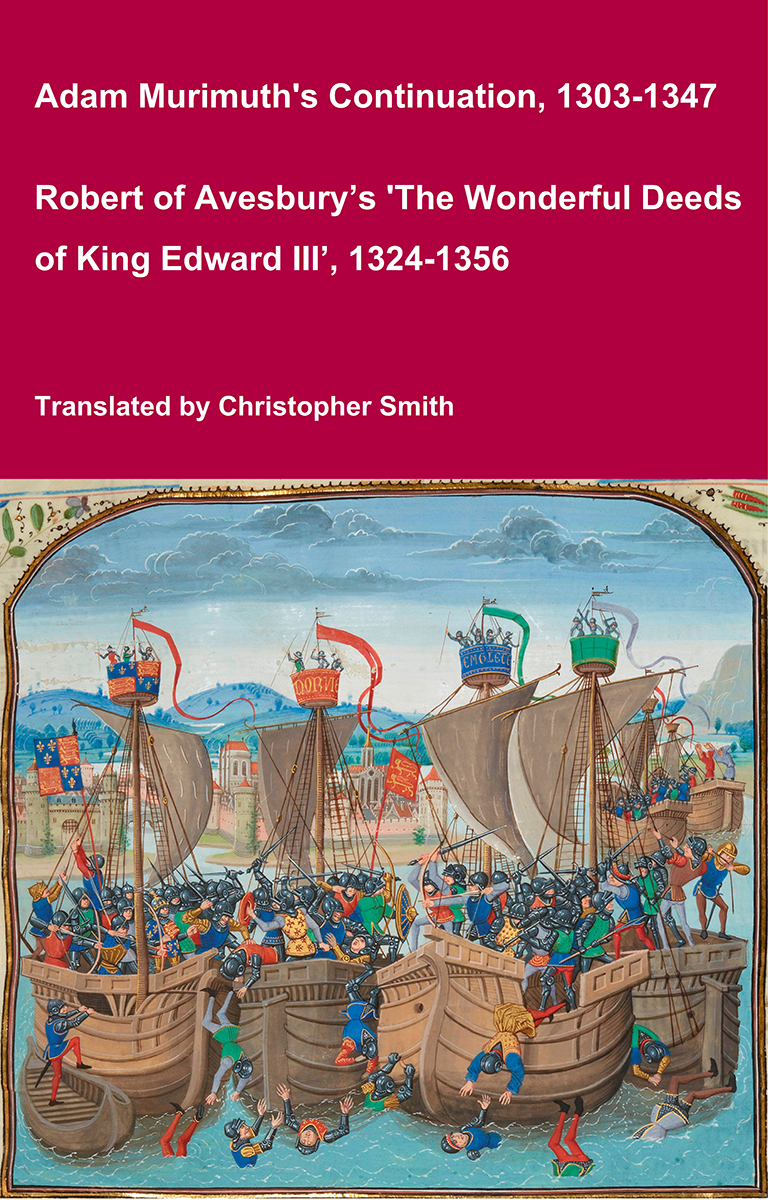
Adam Murimuth's Continuation and Robert of Avesbury’s 'The Wonderful Deeds of King Edward III'
This volume brings together two of the most important contemporary chronicles for the reign of Edward III and the opening phases of the Hundred Years’ War. Written in Latin by English clerical observers, these texts provide a vivid and authoritative window into the political, diplomatic, and military history of fourteenth-century England and its continental ambitions. Adam Murimuth Continuatio's Chronicarum continues an earlier chronicle into the mid-fourteenth century, offering concise but valuable notices on royal policy, foreign relations, and ecclesiastical affairs. Its annalistic structure makes it especially useful for establishing chronology and tracing the development of events year by year. Complementing it, Robert of Avesbury’s De gestis mirabilibus regis Edwardi tertii is a rich documentary chronicle preserving letters, treaties, and official records alongside narrative passages. It is an indispensable source for understanding Edward III’s claim to the French crown, the conduct of war, and the mechanisms of medieval diplomacy. Together, these works offer scholars, students, and enthusiasts a reliable and unembellished account of a transformative period in English and European history. Essential for anyone interested in medieval chronicles, the Hundred Years’ War, or the reign of Edward III.
Available at Amazon in eBook and Paperback format.
On 17th April 1627 John Evelyn of Godstone [aged 72] died at West Dean, Wiltshire [Map]. On 21st May 1627 he was buried in the Chancel of St Mary's Church, West Dean [Map].
Around 1662 William Pierrepont 4th Earl Kingston was born to Robert Pierrepont and Elizabeth Evelyn at West Dean, Wiltshire [Map]. He married 1685 Anne, daughter of Robert Greville 4th Baron Brooke and Ann Dodington Baroness Brooke.
St Mary's Church, West Dean is also in Churches in Wiltshire.
On 17th April 1627 John Evelyn of Godstone [aged 72] died at West Dean, Wiltshire [Map]. On 21st May 1627 he was buried in the Chancel of St Mary's Church, West Dean [Map].
On 27th June 1754 Robert Thistlethwayte [aged 34] and Ann Bathurst [aged 24] were married at St Mary's Church, West Dean [Map].
The River Bourne rises at West Grafton, Wiltshire [Map] from where it flows past Collingbourne Kingston, Wiltshire [Map], Collingbourne Ducis, Wiltshire [Map], Tidworth, Wiltshire [Map], Shipton Bellinger, Hampshire [Map], Cholderton, Wiltshire [Map], Newton Tony, Wiltshire [Map], Allington, Wiltshire [Map], Boscombe, Wiltshire [Map], West Gomeldon, Wiltshire [Map], Laverstock, Wiltshire [Map] after which it joins the Wiltshire River Avon at Salisbury.
Margery 45a travels from Old Sarum [Map] to Winchester, Hampshire [Map], then known as Venta Belgarum, by way of Winterslow [Map] and Bossington [Map].