

Abbot John Whethamstede’s Chronicle of the Abbey of St Albans
Abbot John Whethamstede's Register aka Chronicle of his second term at the Abbey of St Albans, 1451-1461, is a remarkable text that describes his first-hand experience of the beginning of the Wars of the Roses including the First and Second Battles of St Albans, 1455 and 1461, respectively, their cause, and their consequences, not least on the Abbey itself. His text also includes Loveday, Blore Heath, Northampton, the Act of Accord, Wakefield, and Towton, and ends with the Coronation of King Edward IV. In addition to the events of the Wars of the Roses, Abbot John, or his scribes who wrote the Chronicle, include details in the life of the Abbey such as charters, letters, land exchanges, visits by legates, and disputes, which provide a rich insight into the day-to-day life of the Abbey, and the challenges faced by its Abbot.
Available at Amazon in eBook and Paperback format.
All Saints Church, Narborough is in Narborough, Norfolk, Churches in Norfolk.

Stained Glass Window at All Saints Church, Narborough [Map]. Early Medieval.
Exterior of All Saints Church, Narborough [Map].


Memorial at All Saints Church, Narborough [Map] to the pilots who died in training at RFC Narborough.


On 18th September 1496 Henry Spelman [aged 66] died. He and his wife Ela Narborough were buried at All Saints Church, Narborough [Map].
Henry Spelman: In 1430 he was born to John Spelman of Stow Bekerton. In 1465 Henry Spelman and Ela Narborough were married. She the coheiress of her father brought Narborough to the Spelman family.
Ela Narborough: she was born to William Narborough. In or before 1472 Thomas Shouldham of Marham and she were married.

On 27th December 1545 John Spelman of died. He was buried at All Saints Church, Narborough [Map].
John Spelman of: he was born to John Spelman and Elizabeth Frowick. Before 27th December 1545 John Spelman of and Margaret Blennerhasset were married.
On 26th January 1546 John Spelman [aged 66] died. On 5th November 1556 Elizabeth Frowick died. They were buried at All Saints Church, Narborough [Map].
Elizabeth Frowick: John Coningsby of North Mimms and she were married. she was born to Henry Frowick of South Mimms and Anne Knollys. In 1498 John Spelman and she were married. They had thirteen sons and seven daughters.


On 20th May 1561 John Eyre died. On 15th December 1558 Margaret Blennerhasset died. They were buried in All Saints Church, Narborough [Map]. Brass. The inscription on the brass says "Here do lye John Eyer Esquire late Receyvor Generale to Elizabeth the Quenes Majestie, in the counties of Norf., Suff., Cantabridge, and Huntyngton, and one of the Masters of her High Court of Chancerye and Margaret his wyfe, one of the daughters of Sir Thomas Blenerhaiset of Frens Knight late Wyfe of John, Spelman Esquire, son and heyre apparent of Sir John Spelman, Knyght." Armorials top left and middle Quartered  Eyre Arms and
  Townshend Arms with a crescent difference, top right Quartered Eyre Arms and Townshend Arms impaled with 1&6
  Blennerhassett Arms, 2, Argent, three Escutcheons Sable: LOWDHAM 3 Gules a Pall reversed Ermine: KELVEDON or KELDON 4 Azure a Lion rampant Argent crowned Or: ORTON: 5 Azure a Fess between three Fleurs-de-lis Or: SKELTON.
John Eyre: After 27th December 1545 he and Margaret Blennerhasset were married. Her second husband.
Margaret Blennerhasset: she was born to Thomas Blennerhassett of Frens.


Engravings of Sepulchral Brasses Volume 1. Plate LXXII. John Eyer, Esq. And Wife, at Narburgh [Map], 1561.
Blomefield's Norf. vi, 159.
Another civilian in armour, and another mural monument, in its general features much resembling the last. On the desk, covered with a cloth, having a gold fringe, lie his gauntlets beside his prayer-book. Between them is Eyer quartering Townsend, and behind her the same shield impales Blenerhasset and his quarterings, described in p. 35. This John Eyer was a great purchaser of religious houses that were dissolved by Henry VIII. and bought of that king four monasteries at Lynn. He was possessed also of Bury Abbey, and died without issue.
On 24th September 1607 Clement Spelman of Narborough died. In 1647 Ursula Willoughby [aged 14] died. They were buried at All Saints Church, Narborough [Map]. Elbow Reclining Figure. Stuart Hooded Monument. Possibly Cornelius Cure.
Clement Spelman of Narborough: he was born to John Spelman of and Margaret Blennerhasset. The mother assumed based on his father having married Margaret but not certain she is his only wife. In 1602 Clement Spelman of Narborough and Anne Carvill were married. Before 12th September 1606 Clement Spelman of Narborough and Ursula Willoughby were married.
Ursula Willoughby: Around 1593 she was born to John Willoughby of Risley.


On 31st January 1663 John Spelman [aged 56] died. On 12th June 1649 Anne Heveningham died. They were buried in All Saints Church, Narborough [Map].
Anne Heveningham: she was born to John Heveningham of Ketteringham and Alice Shelton. Before 1st August 1640 John Spelman and she were married.


On 30th January 1680 Clement Spelman [aged 72] died. He was buried at All Saints Church, Narborough [Map] apparently having requested to be buried upright.
Clement Spelman: Around 1608 he was born to Clement Spelman of Narborough and Ursula Willoughby.


On 28th September 1691 Anna Walpole [aged 35] died. She was buried at All Saints Church, Narborough [Map].
Anna Walpole: On 18th April 1656 she was born to Edward Walpole of Houghton and Susan Crane. Before 28th September 1691 Mundeford Spelman and she were married.
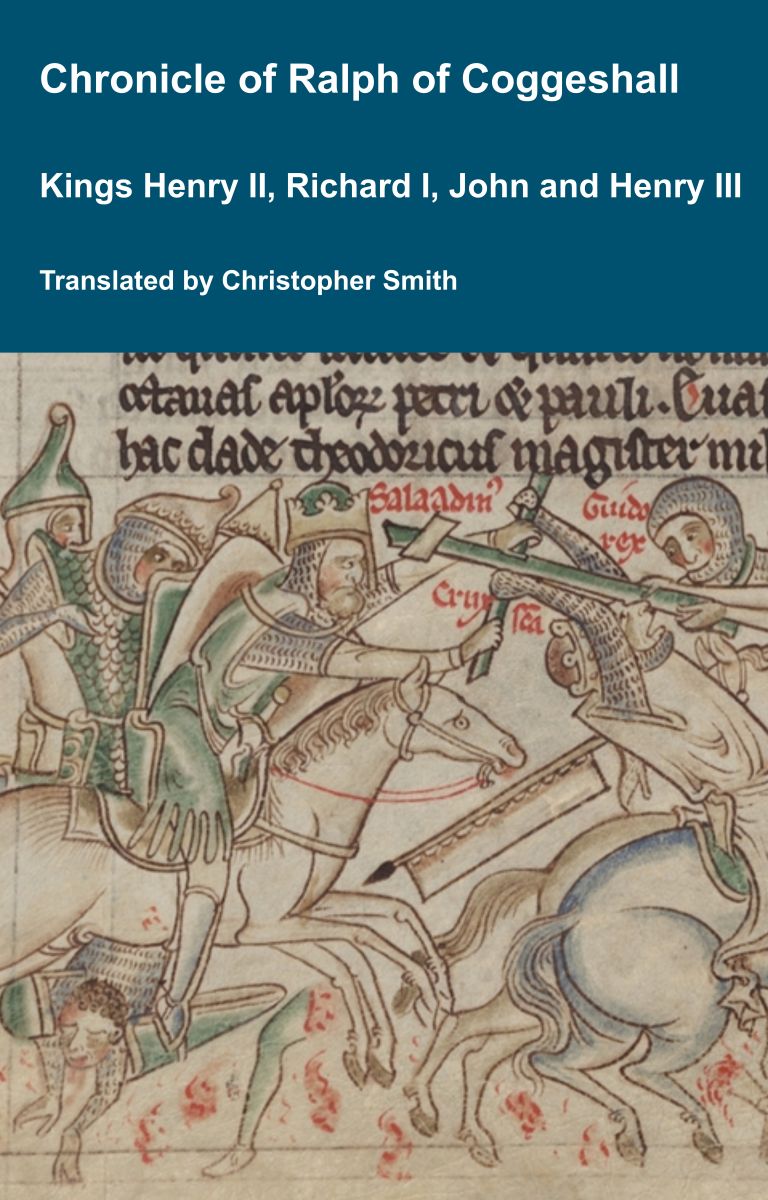
Chronicle of Abbot Ralph of Coggeshall
The Chronicle of Abbot Ralph of Coggeshall (Chronicon Anglicanum) is an indispensable medieval history that brings to life centuries of English and European affairs through the eyes of a learned Cistercian monk. Ralph of Coggeshall, abbot of the Abbey of Coggeshall in Essex in the early 13th century, continued and expanded his community’s chronicle, documenting events from the Norman Conquest of 1066 into the tumultuous reign of King Henry III. Blending eyewitness testimony, careful compilation, and the monastic commitment to record-keeping, this chronicle offers a rare narrative of political intrigue, royal power struggles, and social upheaval in England and beyond. Ralph’s work captures the reigns of pivotal figures such as Richard I and King John, providing invaluable insights into their characters, decisions, and the forces that shaped medieval rule. More than a simple annal, Chronicon Anglicanum conveys the texture of medieval life and governance, making it a rich source for scholars and readers fascinated by English history, monastic authorship, and the shaping of the medieval world.
Available at Amazon in eBook and Paperback format.

On 30th January 1723 Mundeford Spelman [aged 82] died. He was buried at All Saints Church, Narborough [Map].
Mundeford Spelman: On 1st August 1640 he was born to John Spelman and Anne Heveningham.
On 14th October 1736 Charles Le Gros of Croftwight [aged 85] died. On 4th February 1758 Elizabeth Turner [aged 63] died. They were buried at All Saints Church, Narborough [Map].
Charles Le Gros of Croftwight: Around 1651 he was born. Before 14th October 1736 he and Elizabeth Turner were married. The difference in their ages was 22 years.
Elizabeth Turner: Around 1673 she was born to William Turner of North Elmham.


On 10th April 1782 Amy Goodwin [aged 82] died. She was buried at All Saints Church, Narborough [Map].
Amy Goodwin: Edmund Harwick and she were married. On 30th October 1699 she was born to John Goodwin at Narborough Hall.
On 28th December 1795 Briggs Cary died at Hot Wells, Bristol. He was buried at All Saints Church, Narborough [Map].

After 28th December 1795. All Saints Church, Narborough [Map]. Memorial to Briggs Cary.
Briggs Cary: he was born to John Cary and Elizabeth Harwick. On 28th December 1795 he died at Hot Wells, Bristol. He was buried at All Saints Church, Narborough [Map].

On 30th August 1810 Reverend Henry Spelman [aged 82] died. On 13th January 1795 Ann Harwick died. They were buried at All Saints Church, Narborough [Map].
Reverend Henry Spelman: Around 1728 he was born to John Spelman. Before 13th January 1795 Reverend Henry Spelman and Ann Harwick were married.
Ann Harwick: she was born to Edmund Harwick and Amy Goodwin.
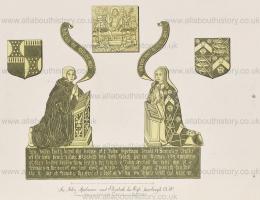
Engravings of Sepulchral Brasses Volume 1. Prate LXIX. Sir John Spelman And Lady, at Narburgh [Map], 1545.
Blomefield's Norf. vi. 162.
Sir John Spelman was third son of Henry Spelman, whose monument has been given under 1496. He was second justice of the king's bench, and before that one of the most eminent barristers of his time. His wife was Elizabeth, daughter and coheir of Sir Henry Frowick, or Frouyk, of Gunnersbury, in Middlesex, who bore Azure, a chevron between three leopard's faces or, quartering Sturgeon, Azure, three sturgeons naiant in pale or, fretty gules. This is not only the first monument which represents the persons as kneeling at a prayer-desk, or prie-dieu, but is singular, in that the lines of the folds of his robe, and of the armorial bearings on hers, are not engraven, but relieved, as are the letters also of the inscription. It is our only example too of a judge in his robe and coif, and is executed in a style superior to most of its contemporaries. Above them is represented the resurrection of our Saviour, indicative of their hope, that in like manner they should be raised from the dead.