

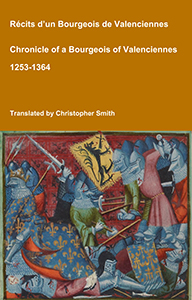
Chronicle of a Bourgeois of Valenciennes
Récits d’un bourgeois de Valenciennes aka The Chronicle of a Bourgeois of Valenciennes is a vivid 14th-century vernacular chronicle written by an anonymous urban chronicler from Valenciennes in the County of Hainaut. It survives in a manuscript that describes local and regional history from about 1253 to 1366, blending chronology, narrative episodes, and eyewitness-style accounts of political, military, and social events in medieval France, Flanders, and the Low Countries. The work begins with a chronological framework of events affecting Valenciennes and its region under rulers such as King Philip VI of France and the shifting allegiances of local nobility. It includes accounts of conflicts, sieges, diplomatic manoeuvres, and the impact of broader struggles like the Hundred Years’ War on urban life in Hainaut. Written from the perspective of a burgher (bourgeois) rather than a monastery or royal court, the chronicle offers a rare lay viewpoint on high politics and warfare, reflecting how merchants, townspeople, and civic institutions experienced the turbulence of the 13th and 14th centuries. Its narrative style combines straightforward reporting of events with moral and civic observations, making it a valuable source for readers interested in medieval urban society, regional politics, and the lived experience of war and governance in pre-modern Europe.
Available at Amazon in eBook and Paperback format.
Ashville Trading Estate Iron Age Settlement, Abingdon is in Berkshire.
Carbon Date. 1360BC. Late Bronze Age Carbon Dates
Report: grain; from house gully 13, which enclosed an Iron Age structure.
ID: 15036, C14 ID: HAR 1248 Date BP: 3360 +/- 130, Start Date BP: 3490, End BP: 3230
Abstract: Abingdon: Ashville Trading Estate [Map]; 1975-76
Reference Name: Jordan, D, Haddon-Reece, D, Bayliss, A 1994 'Radiocarbon dates: from samples funded by English Heritage and dated before 1981', London: English Heritage
Council for British Archaeology (2012) Archaeological Site Index to Radiocarbon Dates from Great Britain and Ireland [data-set]. York: Archaeology Data Service [distributor] https://doi.org/10.5284/1017767
Carbon Date. 970BC. Early Iron Age Carbon Dates
Report: grain; from ditch 73, enclosing an Iron Age structure.
ID: 15037, C14 ID: HAR 1249 Date BP: 2970 +/- 80, Start Date BP: 3050, End BP: 2890
Abstract: Abingdon: Ashville Trading Estate [Map]; 1975-76
Reference Name: Jordan, D, Haddon-Reece, D, Bayliss, A 1994 'Radiocarbon dates: from samples funded by English Heritage and dated before 1981', London: English Heritage
Council for British Archaeology (2012) Archaeological Site Index to Radiocarbon Dates from Great Britain and Ireland [data-set]. York: Archaeology Data Service [distributor] https://doi.org/10.5284/1017767
Carbon Date. 970BC. Early Iron Age Carbon Dates
Report: Carbonised grain and charcoal from Feature 73, ditch at Ashville Trading Estate [Map], Abingdon, Oxfordshire, England.
ID: 150, C14 ID: HAR-1249 Date BP: 2970 +/- 80, Start Date BP: 2890, End BP: 3050
OS Letter: SU, OS East: 483, OS North: 973
Archaeologist Name: M Parrington
Reference Name: Counc Brit Archaeol Res Rep, 28, 1978, 39
Council for British Archaeology (2012) Archaeological Site Index to Radiocarbon Dates from Great Britain and Ireland [data-set]. York: Archaeology Data Service [distributor] https://doi.org/10.5284/1017767
Carbon Date. 470BC. Middle Iron Age Carbon Dates
Report: grain; from pit 60 (Iron Age).
ID: 15035, C14 ID: HAR 1247 Date BP: 2470 +/- 70, Start Date BP: 2540, End BP: 2400
Abstract: Abingdon: Ashville Trading Estate [Map]; 1975-76
Reference Name: Jordan, D, Haddon-Reece, D, Bayliss, A 1994 'Radiocarbon dates: from samples funded by English Heritage and dated before 1981', London: English Heritage
Council for British Archaeology (2012) Archaeological Site Index to Radiocarbon Dates from Great Britain and Ireland [data-set]. York: Archaeology Data Service [distributor] https://doi.org/10.5284/1017767
Carbon Date. 470BC. Middle Iron Age Carbon Dates
Report: Carbonised grain and charcoal from Feature 60, pit at Ashville Trading Estate [Map], Abingdon, Oxfordshire, England.
ID: 151, C14 ID: HAR-1247 Date BP: 2470 +/- 70, Start Date BP: 2400, End BP: 2540
OS Letter: SU, OS East: 483, OS North: 973
Archaeologist Name: M Parrington
Reference Name: Counc Brit Archaeol Res Rep, 28, 1978, 39
Council for British Archaeology (2012) Archaeological Site Index to Radiocarbon Dates from Great Britain and Ireland [data-set]. York: Archaeology Data Service [distributor] https://doi.org/10.5284/1017767
Carbon Date. 170BC. Middle Iron Age Carbon Dates
Report: grain; from pit 37 which was Iron Age and the earliest stratigraphic feature on the site, cut by feature 13 (HAR-1248 and HAR-1333).
ID: 15034, C14 ID: HAR 1100 Date BP: 2170 +/- 70, Start Date BP: 2240, End BP: 2100
Abstract: Abingdon: Ashville Trading Estate [Map]; 1975-76
Reference Name: Jordan, D, Haddon-Reece, D, Bayliss, A 1994 'Radiocarbon dates: from samples funded by English Heritage and dated before 1981', London: English Heritage
Council for British Archaeology (2012) Archaeological Site Index to Radiocarbon Dates from Great Britain and Ireland [data-set]. York: Archaeology Data Service [distributor] https://doi.org/10.5284/1017767
Carbon Date. 170BC. Middle Iron Age Carbon Dates
Report: Carbonised grain from Feature 37, pit at Ashville Trading Estate [Map], Abingdon, Oxfordshire, England.
ID: 152, C14 ID: HAR-1100 Date BP: 2170 +/- 70, Start Date BP: 2100, End BP: 2240
OS Letter: SU, OS East: 483, OS North: 973
Archaeologist Name: M Parrington
Reference Name: Counc Brit Archaeol Res Rep, 28, 1978, 39
Council for British Archaeology (2012) Archaeological Site Index to Radiocarbon Dates from Great Britain and Ireland [data-set]. York: Archaeology Data Service [distributor] https://doi.org/10.5284/1017767
Carbon Date. 50BC. Middle Iron Age Carbon Dates
Report: animal bone; from ditch 32 (Iron Age).
ID: 15038, C14 ID: HAR 1332 Date BP: 2050 +/- 70, Start Date BP: 2120, End BP: 1980
Abstract: Abingdon: Ashville Trading Estate [Map]; 1975-76
Reference Name: Jordan, D, Haddon-Reece, D, Bayliss, A 1994 'Radiocarbon dates: from samples funded by English Heritage and dated before 1981', London: English Heritage
Council for British Archaeology (2012) Archaeological Site Index to Radiocarbon Dates from Great Britain and Ireland [data-set]. York: Archaeology Data Service [distributor] https://doi.org/10.5284/1017767
Carbon Date. 50BC. Middle Iron Age Carbon Dates
Report: Animal bone from Feature 32, house gully at Ashville Trading Estate [Map], Abingdon, Oxfordshire, England.
ID: 153, C14 ID: HAR-1332 Date BP: 2050 +/- 70, Start Date BP: 1980, End BP: 2120
OS Letter: SU, OS East: 483, OS North: 973
Archaeologist Name: M Parrington
Reference Name: Counc Brit Archaeol Res Rep, 28, 1978, 39
Council for British Archaeology (2012) Archaeological Site Index to Radiocarbon Dates from Great Britain and Ireland [data-set]. York: Archaeology Data Service [distributor] https://doi.org/10.5284/1017767
Abbot John Whethamstede’s Chronicle of the Abbey of St Albans
Abbot John Whethamstede's Register aka Chronicle of his second term at the Abbey of St Albans, 1451-1461, is a remarkable text that describes his first-hand experience of the beginning of the Wars of the Roses including the First and Second Battles of St Albans, 1455 and 1461, respectively, their cause, and their consequences, not least on the Abbey itself. His text also includes Loveday, Blore Heath, Northampton, the Act of Accord, Wakefield, and Towton, and ends with the Coronation of King Edward IV. In addition to the events of the Wars of the Roses, Abbot John, or his scribes who wrote the Chronicle, include details in the life of the Abbey such as charters, letters, land exchanges, visits by legates, and disputes, which provide a rich insight into the day-to-day life of the Abbey, and the challenges faced by its Abbot.
Available at Amazon in eBook and Paperback format.
Carbon Date. 100. Late Iron Age Carbon Dates
Report: Animal bone from Feature 392, ditch at Ashville Trading Estate [Map], Abingdon, Oxfordshire, England.
ID: 154, C14 ID: HAR-1334 Date BP: 1900 +/- 90, Start Date BP: 1810, End BP: 1990
OS Letter: SU, OS East: 483, OS North: 973
Archaeologist Name: M Parrington
Reference Name: Counc Brit Archaeol Res Rep, 28, 1978, 39
Council for British Archaeology (2012) Archaeological Site Index to Radiocarbon Dates from Great Britain and Ireland [data-set]. York: Archaeology Data Service [distributor] https://doi.org/10.5284/1017767
Carbon Date. 100. Late Iron Age Carbon Dates
Report: animal bone; from Iron Age ditch 392, which is stratigraphically later than house gully 13 (HAR-1248 and HAR-1333).
ID: 15040, C14 ID: HAR 1334 Date BP: 1900 +/- 90, Start Date BP: 1990, End BP: 1810
Abstract: Abingdon: Ashville Trading Estate [Map]; 1975-76
Reference Name: Jordan, D, Haddon-Reece, D, Bayliss, A 1994 'Radiocarbon dates: from samples funded by English Heritage and dated before 1981', London: English Heritage
Council for British Archaeology (2012) Archaeological Site Index to Radiocarbon Dates from Great Britain and Ireland [data-set]. York: Archaeology Data Service [distributor] https://doi.org/10.5284/1017767
Carbon Date. 130. Late Iron Age Carbon Dates
Report: Animal bone from Feature 13A, house gully at Ashville Trading Estate [Map], Abingdon, Oxfordshire, England.
ID: 155, C14 ID: HAR-1333 Date BP: 1870 +/- 80, Start Date BP: 1790, End BP: 1950
OS Letter: SU, OS East: 483, OS North: 973
Archaeologist Name: M Parrington
Reference Name: Counc Brit Archaeol Res Rep, 28, 1978, 39
Council for British Archaeology (2012) Archaeological Site Index to Radiocarbon Dates from Great Britain and Ireland [data-set]. York: Archaeology Data Service [distributor] https://doi.org/10.5284/1017767
Carbon Date. 130. Late Iron Age Carbon Dates
Report: animal bone; from house gully 13 (sample submitted as a check on HAR-1248); this feature cuts pit 37 (HAR-1100), but is stratigraphically earlier than ditch 392 (HAR-1334).
ID: 15039, C14 ID: HAR 1333 Date BP: 1870 +/- 80, Start Date BP: 1950, End BP: 1790
Abstract: Abingdon: Ashville Trading Estate [Map]; 1975-76
Reference Name: Jordan, D, Haddon-Reece, D, Bayliss, A 1994 'Radiocarbon dates: from samples funded by English Heritage and dated before 1981', London: English Heritage
Council for British Archaeology (2012) Archaeological Site Index to Radiocarbon Dates from Great Britain and Ireland [data-set]. York: Archaeology Data Service [distributor] https://doi.org/10.5284/1017767
On 26th October 1878 Theresa Stourton Baroness Arundel Wardour (age 66) died at North Court House, Abingdon.
On 20th November 1174 Archbishop Edmund Rich was born at St Edmund's Lane, Abingdon.