

Abbot John Whethamstede’s Chronicle of the Abbey of St Albans
Abbot John Whethamstede's Register aka Chronicle of his second term at the Abbey of St Albans, 1451-1461, is a remarkable text that describes his first-hand experience of the beginning of the Wars of the Roses including the First and Second Battles of St Albans, 1455 and 1461, respectively, their cause, and their consequences, not least on the Abbey itself. His text also includes Loveday, Blore Heath, Northampton, the Act of Accord, Wakefield, and Towton, and ends with the Coronation of King Edward IV. In addition to the events of the Wars of the Roses, Abbot John, or his scribes who wrote the Chronicle, include details in the life of the Abbey such as charters, letters, land exchanges, visits by legates, and disputes, which provide a rich insight into the day-to-day life of the Abbey, and the challenges faced by its Abbot.
Available at Amazon in eBook and Paperback format.
Bath Abbey is in Bath, Somerset [Map], Abbeys in England.
On 31st August 1166 Bishop Robert of Lewes died. He was buried at Bath Abbey [Map] before the high altar.
On 20th July 1618 Bishop James Montagu [aged 50] died. He was buried at Bath Abbey [Map].
In 1639 Jane Whitmore [aged 52] died. She was buried at Bath Abbey [Map].
On or before 10th April 1644, the date he was buried at Bath Abbey [Map], where he has a monument, John Malet [aged 50] died.
John Evelyn's Diary. 27th June 1654. The facciáta of this cathedral [Map] is remarkable for its historical carving. the King's Bath is esteemed the fairest in Europe. The town is entirely built of stone, but the streets narrow, uneven and unpleasant. Here, we trifled and bathed, and intervisited with the company who frequent the place for health, till the 30th, and then went to Bristol, a city emulating London, not for its large extent, but manner of building, shops, bridge, traffic, exchange, market-place, etc. The Governor of showed us the castle, of no great concernment. The city wholly mercantile, as standing near the famous Severn, commodiously for Ireland, and the Western world. Here I first saw the manner of refining sugar and casting it into loaves, where we had a collection of eggs fried in the sugar furnace, together with excellent Spanish wine. But, what appeared most stupendous to me, was the rock of St. Vincent, a little distance from the town, the precipice whereof is equal to anything of that nature I have seen in the most confragose cataracts of the Alps, the river gliding between them at an extraordinary depth. Here, we went searching for diamonds, and to the Hot Wells, at its foot. There is also on the side of this horrid Alp a very romantic seat: and so we returned to Bath in the evening, and July 1st to Cadenham.
Samuel Pepys' Diary. 14th June 1668. Sunday. Up, and walked up and down the town [Map], and saw a pretty good market-place, and many good streets, and very fair stone-houses. And so to the great Church [Map], and there saw Bishop Montagu's tomb1 and, when placed, did there see many brave people come, and, among others, two men brought in, in litters, and set down in the chancel to hear: but I did not know one face. Here a good organ; but a vain, pragmatical fellow preached a ridiculous, affected sermon, that made me angry, and some gentlemen that sat next me, and sang well.
Note 1. James Montagu, Bishop of Bath and Wells in 1608, and of Winchester in 1616-died 1618. He was uncle to the Earl of Sandwich, whose mother was Pepys's aunt. Hence Pepys's curiosity respecting the tomb. B.
On 23rd February 1714 Charles Godfrey [aged 68] died in Bath, Somerset [Map]. He was buried in Bath Abbey [Map].
On 16th April 1717 Granville Pyper [aged 38] died. He was buried at Bath Abbey [Map] where he has a monument with the inscription:
Underneath here lies Granville Pyper, lately of Madford near Launceston in the Cornish countryside, armsbearer, the youngest son of Philip Pyper, armsbearer and grandson of Hugo Pyper, soldier. Not so long ago the governor of the defence of Plymouth and the adjacent island was his grandfather; a man of striking intelligence as well as elegance, of a kind and lovely disposition, accomplished in graciousness,all accompanied in a most pleasing mixture that had to be respected, bound with ties of friendship,faithful and true.Who when trying to get well,finding satisfaction in work, In his prime, was struck down with a very bad fever and having been worn down in a short time he succumbed to death.He died on the sixteenth day of April, in the year of redemption 1717. Richard Wise willingly and in sadness placed this monument, sacred to the memory of his most dear friend.
On 27th July 1726 Richard Wise [aged 66] died. He was buried at Bath Abbey [Map].
Abbot John Whethamstede’s Chronicle of the Abbey of St Albans
Abbot John Whethamstede's Register aka Chronicle of his second term at the Abbey of St Albans, 1451-1461, is a remarkable text that describes his first-hand experience of the beginning of the Wars of the Roses including the First and Second Battles of St Albans, 1455 and 1461, respectively, their cause, and their consequences, not least on the Abbey itself. His text also includes Loveday, Blore Heath, Northampton, the Act of Accord, Wakefield, and Towton, and ends with the Coronation of King Edward IV. In addition to the events of the Wars of the Roses, Abbot John, or his scribes who wrote the Chronicle, include details in the life of the Abbey such as charters, letters, land exchanges, visits by legates, and disputes, which provide a rich insight into the day-to-day life of the Abbey, and the challenges faced by its Abbot.
Available at Amazon in eBook and Paperback format.
In 1728 Thomas Chicot was appointed organist at Bath Abbey [Map] until his death in 1766 some thirty-eight years later.
On 14th May 1752 Miles Stapylton 4th Baronet [aged 44] died. He was buried at Bath Abbey [Map] on 18 May 1752. His brother Brian [aged 40] succeeded 5th Baronet Stapylton Stapleton of Myton in Yorkshire.
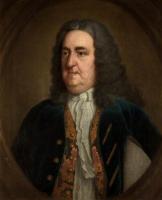
On 12th February 1761 Richard "Beau King of Bath" Nash [aged 86] died in Bath, Somerset [Map]. He was buried in Bath Abbey [Map].
On or before 23rd July 1767 Alice Lucy Whitefoord Baroness Vernon was born to John Whitefoord 3rd Baronet [aged 33]. She was baptised on 23rd July 1767 at Bath Abbey [Map]. She married 29th November 1795 Henry Venables-Vernon 3rd Baron Vernon, son of George Venables-Vernon 1st Baron Vernon and Martha Harcourt Baroness Vernon of Kinderton, and had issue.
On 2nd March 1774 Marmaduke Asty Wyvill 7th Baronet [deceased] was buried at Bath Abbey [Map]. Baronet Wyvill of Constable Burton in Yorkshire dormant. There aappear to have been heirs in America descended from Darcy Wyvill.
On 15th November 1786 Richard Temple 7th Baronet [aged 55] died. His third cousin John [aged 55] succeeded 8th Baronet Temple of Stowe. He was buried at Bath Abbey [Map] where his Wall Memorial reads: "In Memory of Sir RICHARD TEMPLE Baronet; Son of Sir PETER TEMPLE Baronet: who was many years a Comissioner of His Majesty's Navy. He married ANN SOPHIA Daughter of Sir WILLIAM TEMPLE Baronet of Kempsey in the County of Worcester: by whom he left no surviving Issue. As the last token of Conjugal affection and regard She hath caused this marble to be erected March 20th. 1787." Below on the floor is "Underneath are deposited the Remains of Sir Richard Temple Baronet of Kempsey in the County of Worcester who died November the 15th 1786 in the 55th Year of his Age."
There is some disagreement as to whether he was legally the 8th Baronet, with some sources, including Cracroft stating:
Following the death of Sir Richard Temple the Baronetcy of Temple of Stow was claimed by his third cousin, John Temple, British Consul-General in Washington 1786-98, a great-grandson of Mary Temple and her husband Robert Nelson. In spite of a letter of support from his kinsman, George [Grenville later Nugent-Temple-Grenville] [aged 33], 1st Marquess of Buckingham, the heir general of the 1st Baronet, Mr John Temple's claim to the Baronetcy cannot be through his mother, as the succession to the baronetcy was restricted to male heirs of the body of the 1st Baronet. His claim must, therefore, be through his father, Capt Robert Temple, of Boston, Massachusetts, British North America (and indeed the Marquess of Buckingham describes him as the "heir male" of the 1st Baronet in his letter from Stowe dated 3 Dec 1786). Without further information it is difficult to see Mr John Temple's placing amongst the male line descendants of the 1st Baronet and the nature of the kinship between his parents, unless he descends, as has been suggested, from the Rev Thomas Temple, Rector of Burton-on-the-Water, and third son of the 1st Baronet.
In addition to Mr John Temple's claim it is possible that there are living male line descendants of Col Edmund Temple, of Sulby Priory, co. Northampton, through his third son, Edmund Temple, of Leicester, and it is for this reason that the Baronetcy of Temple of Stowe is regarded as being dormant rather than extinct.
On 17th April 1787 Nigel Gresley 6th Baronet [aged 60] died. He was buried on 21st April 1787 in Bath Abbey [Map]. His son Nigel [aged 34] succeeded 7th Baronet Gresley of Drakelow in Derbyshire.
On or before 22nd May 1793 Elizabeth Wynn Lady Gresley. She was buried in Bath Abbey [Map] on 22nd May 1793.
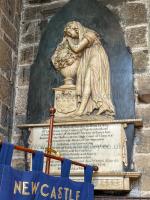
On 1st January 1805 Nicholas Ridley of Link House, Blyth [aged 55] died. He was buried at Bath Abbey [Map]. Memorial at Cathedral Church St Nicholas, Newcastle upon Tyne [Map]
Nicholas Ridley of Link House, Blyth: On 5th March 1749 he was born to Matthew Ridley and Elizabeth White. On 23rd November 1790 Nicholas Ridley of Link House, Blyth and Letitia Atkins were married.
On 11th August 1809 Elizabeth Dormer Countess Shrewsbury and Waterford [aged 85] died. She was buried at Bath Abbey [Map].
Henrici Quinti, Angliæ Regis, Gesta, is a first-hand account of the Agincourt Campaign, and subsequent events to his death in 1422. The author of the first part was a Chaplain in King Henry's retinue who was present from King Henry's departure at Southampton in 1415, at the siege of Harfleur, the battle of Agincourt, and the celebrations on King Henry's return to London. The second part, by another writer, relates the events that took place including the negotiations at Troye, Henry's marriage and his death in 1422.
Available at Amazon in eBook and Paperback format.
On 1st June 1821 John Campbell 1st Baron Cawdor [aged 68] died at Bath, Somerset [Map]. He was buried at Bath Abbey [Map]. His son John [aged 30] succeeded 2nd Baron Cawdor of Castlemartin in Pembrokeshire. Elizabeth Thynne Countess Cawdor [aged 26] by marriage Baroness Cawdor of Castlemartin in Pembrokeshire.
On 27th April 1827 Henry Forster Mills [aged 58] died. He was buried at Bath Abbey [Map].