

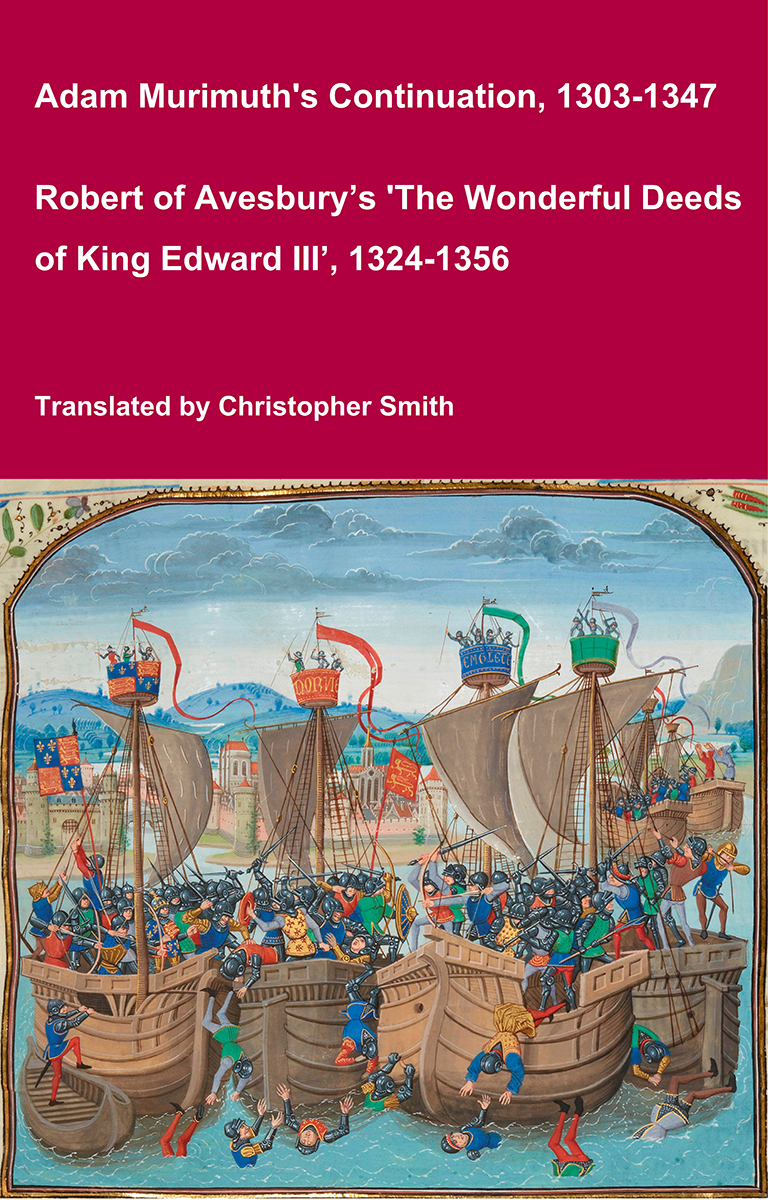
Adam Murimuth's Continuation and Robert of Avesbury’s 'The Wonderful Deeds of King Edward III'
This volume brings together two of the most important contemporary chronicles for the reign of Edward III and the opening phases of the Hundred Years’ War. Written in Latin by English clerical observers, these texts provide a vivid and authoritative window into the political, diplomatic, and military history of fourteenth-century England and its continental ambitions. Adam Murimuth Continuatio's Chronicarum continues an earlier chronicle into the mid-fourteenth century, offering concise but valuable notices on royal policy, foreign relations, and ecclesiastical affairs. Its annalistic structure makes it especially useful for establishing chronology and tracing the development of events year by year. Complementing it, Robert of Avesbury’s De gestis mirabilibus regis Edwardi tertii is a rich documentary chronicle preserving letters, treaties, and official records alongside narrative passages. It is an indispensable source for understanding Edward III’s claim to the French crown, the conduct of war, and the mechanisms of medieval diplomacy. Together, these works offer scholars, students, and enthusiasts a reliable and unembellished account of a transformative period in English and European history. Essential for anyone interested in medieval chronicles, the Hundred Years’ War, or the reign of Edward III.
Available at Amazon in eBook and Paperback format.
Bradford Cathedral is in Bradford, Cathedrals in England.
Interior of Bradford Cathedral [Map].
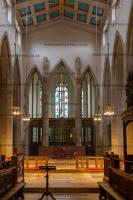
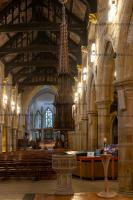
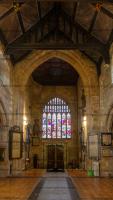
The Cathedra i.e. Bishop's Throne, at Bradford Cathedral [Map].
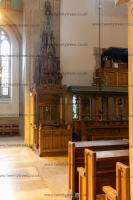
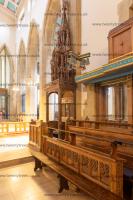
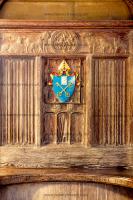
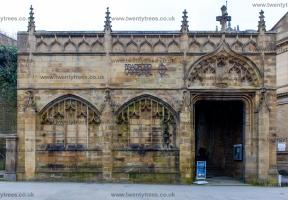
. Entrance to Bradford Cathedral [Map]. The site has been used for Christian worship since the 7th century, when missionaries based in Dewsbury evangelised the area. For many centuries it was the parish church of St Peter and achieved cathedral status in 1919.

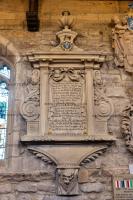
After 1693. Bradford Cathedral [Map]. Monument to Faith Sharp, wife of Thomas Sharp of Little Horton.
After 1742. Bradford Cathedral [Map]. Monument to Abraham Sharp died 1742 sculpted by Peter Scheemakers [age 51]
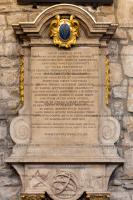

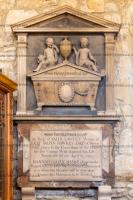
Around 1780. Bradford Cathedral [Map]. Monument to Faith Sawrey died 1767 sculpted by John Francis Moore [age 35].
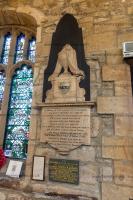
1787. Memorial at Bradford Cathedral [Map] to John Lister, died 1734, Phebe his wife, died 1745, and their family.

After 1788. Bradford Cathedral [Map]. Monument to William Northrop died 1800 sculpted by John "The Younger" Bacon [age 11].
After 1796 . Memorial at Bradford Cathedral [Map] to Abraham Balme main promoter of the Bradford Canal, sculpted by John Flaxman [age 40].


The History of William Marshal was commissioned by his son shortly after William’s death in 1219 to celebrate the Marshal’s remarkable life; it is an authentic, contemporary voice. The manuscript was discovered in 1861 by French historian Paul Meyer. Meyer published the manuscript in its original Anglo-French in 1891 in two books. This book is a line by line translation of the first of Meyer’s books; lines 1-10152. Book 1 of the History begins in 1139 and ends in 1194. It describes the events of the Anarchy, the role of William’s father John, John’s marriages, William’s childhood, his role as a hostage at the siege of Newbury, his injury and imprisonment in Poitou where he met Eleanor of Aquitaine and his life as a knight errant. It continues with the accusation against him of an improper relationship with Margaret, wife of Henry the Young King, his exile, and return, the death of Henry the Young King, the rebellion of Richard, the future King Richard I, war with France, the death of King Henry II, and the capture of King Richard, and the rebellion of John, the future King John. It ends with the release of King Richard and the death of John Marshal.
Available at Amazon in eBook and Paperback format.
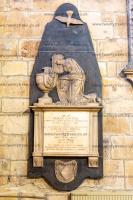
After 1809. Bradford Cathedral [Map]. Monument to Maria Lister died 1809. Signed WS&R Fisher of York.
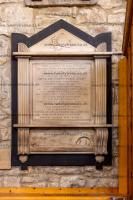
After 1817. Bradford Cathedral [Map]. Memorial to Joseph Priestley.
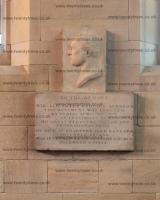
After 1833. Bradford Cathedral [Map]. Memorial to Dr William Sharp, surgeon (d.1833) by Joseph Gott [age 47].
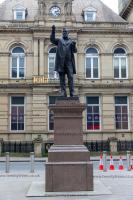
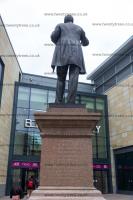
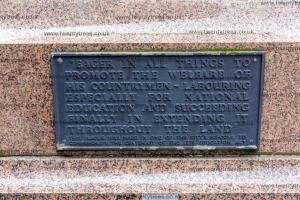
After 1890. Statue of William Forster below the entrance to Bradford Cathedral [Map] sculpted by J Harvard. The cost was raised by public subscriptions. The statue was unveiled by the George Frederick Samuel Robinson 1st Marquess Ripon [age 62] in 1890 and the occasion was marked by a procession led by the Black Dyke Mills Band to Forster Square where a crowd of over 10,000 watched the unveiling. Forster's statue was moved to a different positon in Forster square in 1967 as part of the redevelopment of the City Centre and removed from Forster Square in 2004 to make space for the building of the Broadway Shopping Centre. After the shopping centre was completed in 2015 the statue was erected outside an entrance.
William Forster: On 11th July 1818 he was born. On 5th April 1886 he died.

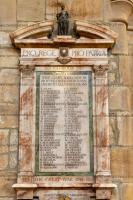
After 1919. Memorial at Bradford Cathedral [Map] to those who died in WWI.

After 31st July 1945. Commemoration at Bradford Cathedral [Map] of James Jospeh Magennis [age 25] VC.
James Jospeh Magennis: On 27th October 1919 he was born. The London Gazette 37346. [13th November 1945]. Temporary Acting Leading Seaman James Joseph Magennis, D/JX. 144907. Leading Seaman Magennis served as Diver in His Majesty's Midget Submarine XE-3 for her attack on 31st July, 1945, on a Japanese cruiser of the Atago class. Owing to the fact that XE-3 was tightly jammed under the target the diver's hatch could not be fully opened, and Magennis had to squeeze himself through the narrow space available. He experienced great difficulty in placing his limpets on the bottom of the cruiser owing both to the foul state of the bottom and to the pronounced slope upon which the limpets would not hold. Before a limpet could be placed therefore Magennis had thoroughly to scrape the area clear of barnacles, and in order to secure the limpets he had to tie them in pah's by a line passing under the cruiser keel. This was very tiring work for a diver, and he was moreover handicapped by a steady leakage of oxygen which was ascending in bubbles to the surface. A lesser man would have been content to place a few limpets and then to return to the craft. .Magennis, however, persisted until he had placed his full outfit before returning to the craft in an exhausted condition. Shortly after withdrawing Lieutenant Fraser endeav oured to jettison his limpet carriers, but one of these would not release itself and fall clear of the craft. Despite his exhaustion, his oxygen leak and the fact that there was every probability of his being sighted, Magennis at once volunteered to leave the craft and free the carrier rather than allow a less experi enced diver to undertake the job. After seven minutes of nerve-racKing work he succeeded in releasing the carrier. Magennis displayed very great courage and devotion to duty and complete disregard for his own safety. On 12th February 1986 he died.
On 16th May 1953 the Princess Royal, Princess Mary Windsor Countess Harewood [age 56], attended a ceremony marking the redevelopment and extension of Bradford Cathedral [Map]. The east end of the cathedral is by Edward Maufe work, as well as the two west wings which contain the Song Room and Cathedral offices.


After 11th May 1985. Memorial at Bradford Cathedral [Map] to the Bradford City Football Ground Disaster.

After 1990. Memorial at Bradford Cathedral [Map] to pioneers of the use of Chemotherapy, Robert Lowry Turner and George Whyte Watson.
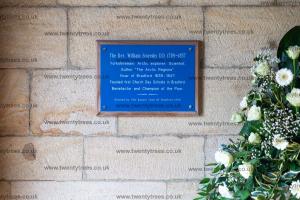
1996 . Bradford Cathedral [Map]. Memorial to William Scoresby.
27th March 1997. Plaque commemorating the Maundy Thursday Alms Giving by Quen Elizabeth II [age 70]at Bradford Cathedral [Map].


