

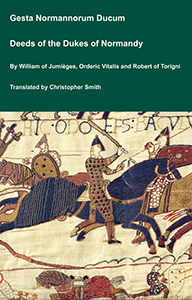
The Deeds of the Dukes of Normandy
The Gesta Normannorum Ducum [The Deeds of the Dukes of Normandy] is a landmark medieval chronicle tracing the rise and fall of the Norman dynasty from its early roots through the pivotal events surrounding the Norman Conquest of England. Originally penned in Latin by the monk William of Jumièges shortly before 1060 and later expanded at the behest of William the Conqueror, the work chronicles the deeds, politics, battles, and leadership of the Norman dukes, especially William’s own claim to the English throne. The narrative combines earlier historical sources with firsthand information and oral testimony to present an authoritative account of Normandy’s transformation from a Viking settlement into one of medieval Europe’s most powerful realms. William’s history emphasizes the legitimacy, military prowess, and governance of the Norman line, framing their expansion, including the conquest of England, as both divinely sanctioned and noble in purpose. Later chroniclers such as Orderic Vitalis and Robert of Torigni continued the history, extending the coverage into the 12th century, providing broader context on ducal rule and its impact. Today this classic work remains a foundational source for understanding Norman identity, medieval statesmanship, and the historical forces that reshaped England and Western Europe between 800AD and 1100AD.
Available at Amazon in eBook and Paperback format.
Bridgwater, Somerset is in Somerset.
See: Burrow Bridge, Somerset [Map], Dunball, Somerset [Map], Somerset Bridge [Map], Stathe, Somerset [Map], Westonzoyland Bridgwater, Somerset.
On 17th August 1469 Humphrey Stafford 1st Earl Devon (age 30), having escaped after the Battle of Edgecote Moor, was captured and executed by a mob at Bridgwater, Somerset [Map]. He was buried at Glastonbury Abbey [Map]. Earl Devon, Baron Stafford of Southwick forfeit.
Chronicle of Edward Hall [1496-1548]. [17th August 1469] When king Edward was advertised of this unfortunate chances, he wrote in all haste to the Sheriffs of Somerset and Devon, that if they could by any mean take the lord Stafford of Southwick (age 30), that they upon pain of their lives, should without delay put him in execution, which accordingly to the kynges commandment, after long exploration made, found him hid in a village in Brentmarche [Map], called.... where he was taken & brought to Bridgwater [Map], & there cut shorter by the head.
In 1483 William Hody (age 42) was elected MP Bridgwater.

Diary of Edward VI. August 1549. After that thei gathered at Launston, to whom the lord Prevy scale (age 64) and sir William Herbert (age 48)2 went, and overthrue them, taking their chief heades and executing them. Nevertheles some sayled to Brigewater [Map] and went about sedicion, but were quikely repressed. Hitherto of Devonshire.
Note 2. Sir William Herbert, then master of the King's horses, and afterwards earl of Pembroke, brought a thousand Welshmen, who, says Hooker, though they came too late to the fray, were yet soon enough to the play; for the whole country was then put to the spoil.
In 1625 Arthur Lake (age 27) was elected MP Bridgwater.
In 1626 Arthur Lake (age 28) was elected MP Bridgwater.
In 1673 Ralph Stawell 1st Baron Stawell (age 32) was elected MP Bridgwater.
In 1679 Halswell Tynte 1st Baronet (age 29) was elected MP Bridgwater. He was re-elected in Oct 1679, 1681 and 1685.
In 1701 Thomas Wroth 3rd Baronet (age 27) was elected MP Bridgwater.
In 1727 Halswell Tynte 3rd Baronet (age 21) was elected MP Bridgwater.
On 28th March 1761 Edward Southwell 20th Baron Clifford (age 22) was elected MP Bridgwater.
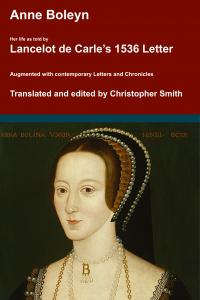
Anne Boleyn. Her Life as told by Lancelot de Carle's 1536 Letter.
In 1536, two weeks after the execution of Anne Boleyn, her brother George and four others, Lancelot du Carle, wrote an extraordinary letter that described Anne's life, and her trial and execution, to which he was a witness. This book presents a new translation of that letter, with additional material from other contemporary sources such as Letters, Hall's and Wriothesley's Chronicles, the pamphlets of Wynkyn the Worde, the Memorial of George Constantyne, the Portuguese Letter and the Baga de Secrets, all of which are provided in Appendices.
Available at Amazon in eBook and Paperback format.
In 1762 John Perceval 3rd Earl Egmont (age 23) was elected MP Bridgwater which seat he held until 1768.
Peregrine Paulett was elected MP Bridgwater.
The River Parrett rises in the hills around Chedington, Dorset [Map] after which it flows broadly north past Kingsbury Episcopi, Somerset [Map], Muchelney, Somerset [Map], through Langport, Somerset [Map], Stathe, Somerset [Map], Burrow Bridge, Somerset [Map], then under Somerset Bridge [Map], through Bridgwater, Somerset [Map], past Dunball, Somerset [Map] and Combwich, Somerset [Map] before joining the Severn Estuary two kilometres south of Burnham-on-Sea, Somerset [Map].
The River Parrett rises in the hills around Chedington, Dorset [Map] after which it flows broadly north past Kingsbury Episcopi, Somerset [Map], Muchelney, Somerset [Map], through Langport, Somerset [Map], Stathe, Somerset [Map], Burrow Bridge, Somerset [Map], then under Somerset Bridge [Map], through Bridgwater, Somerset [Map], past Dunball, Somerset [Map] and Combwich, Somerset [Map] before joining the Severn Estuary two kilometres south of Burnham-on-Sea, Somerset [Map].
The River Parrett rises in the hills around Chedington, Dorset [Map] after which it flows broadly north past Kingsbury Episcopi, Somerset [Map], Muchelney, Somerset [Map], through Langport, Somerset [Map], Stathe, Somerset [Map], Burrow Bridge, Somerset [Map], then under Somerset Bridge [Map], through Bridgwater, Somerset [Map], past Dunball, Somerset [Map] and Combwich, Somerset [Map] before joining the Severn Estuary two kilometres south of Burnham-on-Sea, Somerset [Map].
The River Parrett rises in the hills around Chedington, Dorset [Map] after which it flows broadly north past Kingsbury Episcopi, Somerset [Map], Muchelney, Somerset [Map], through Langport, Somerset [Map], Stathe, Somerset [Map], Burrow Bridge, Somerset [Map], then under Somerset Bridge [Map], through Bridgwater, Somerset [Map], past Dunball, Somerset [Map] and Combwich, Somerset [Map] before joining the Severn Estuary two kilometres south of Burnham-on-Sea, Somerset [Map].
The River Parrett rises in the hills around Chedington, Dorset [Map] after which it flows broadly north past Kingsbury Episcopi, Somerset [Map], Muchelney, Somerset [Map], through Langport, Somerset [Map], Stathe, Somerset [Map], Burrow Bridge, Somerset [Map], then under Somerset Bridge [Map], through Bridgwater, Somerset [Map], past Dunball, Somerset [Map] and Combwich, Somerset [Map] before joining the Severn Estuary two kilometres south of Burnham-on-Sea, Somerset [Map].
On 6th July 1685 John Berkeley 4th Viscount Fitzhardinge (age 35) fought at Westonzoyland Bridgwater, Somerset during the Battle of Sedgemoor.
Francis Compton (age 56) was wounded.
Sharington Talbot (age 29) "behaved himself very handsomely".