

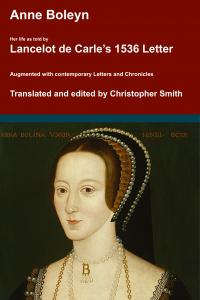
Anne Boleyn. Her Life as told by Lancelot de Carle's 1536 Letter.
In 1536, two weeks after the execution of Anne Boleyn, her brother George and four others, Lancelot du Carle, wrote an extraordinary letter that described Anne's life, and her trial and execution, to which he was a witness. This book presents a new translation of that letter, with additional material from other contemporary sources such as Letters, Hall's and Wriothesley's Chronicles, the pamphlets of Wynkyn the Worde, the Memorial of George Constantyne, the Portuguese Letter and the Baga de Secrets, all of which are provided in Appendices.
Available at Amazon in eBook and Paperback format.
Bristol Castle, Gloucestershire is in Bristol, Gloucestershire [Map], Castles in Gloucestershire.
In 1184 Eleanor "Fair Maid of Britanny" 4th Countess of Richmond was born to Geoffrey Plantagenet 2nd Duke Brittany [aged 25] and Constance Penthièvre Duchess Brittany [aged 23] at Bristol Castle, Gloucestershire [Map]. She a granddaughter of King Henry "Curtmantle" II of England.
In June 1224 Eleanor Fair Maid of Brittany [aged 40] was moved to Bristol Castle, Gloucestershire [Map].
On 10th August 1241 Eleanor "Fair Maid of Britanny" 4th Countess of Richmond [aged 57] died at Bristol Castle, Gloucestershire [Map]. She was initially buried at St James Priory, Bristol [Map] then reburied at Amesbury Abbey, Wiltshire [Map].
In 1287 Llewellyn ap Dafydd Aberffraw [aged 20] died at Bristol Castle, Gloucestershire [Map].
In January 1297 Ralph Monthermer 1st Earl of Gloucester and Hertford [aged 27] and Joan of Acre Countess Gloucester and Hertford [aged 24] were married in secret greatly offending her father King Edward I of England [aged 57] who had been planning to marry her to Amadeus V "Great" Savoy [aged 47] in March. Ralph Monthermer 1st Earl of Gloucester and Hertford was imprisoned at Bristol Castle, Gloucestershire [Map]; he was released in August 1297. She the daughter of King Edward I of England and Eleanor of Castile Queen Consort England.
Close Rolls Edward I. 20th October 1305. To Nicholas Fermbaud, constable of Bristol castle [Map]. As the king wills that Owen [aged 30] (Audoenus) son of David ap Griffyn, who is in the constable's custody in that castle, shall be kept henceforth more securely than he has been heretofore, he orders the constable to cause a strong house within the castle to be repaired as speedily as possible, and to make a wooden cage (cageam) bound with iron in that house in which Owen can be enclosed at night.
Pro quadam cagea lignea ferro ligata in quadam domo facienda pro artiori et securiori custodia Audoeni filii David ab Griffyn in prisona castri videlicet ad ipsum Audoenum in ipsa cagea noctibus includendum.
In 1307 Bartholomew Badlesmere 1st Baron Badlesmere [aged 31] was appointed Governor of Bristol Castle.
Froissart Book 1: 1307-1340. 15. After this execution had taken place, as you have heard, the king and Sir Hugh Despenser [aged 40], who found themselves besieged in such anguish and peril, and saw no hope of comfort or rescue from anywhere, set out one morning, the two of them with only a small company, in a small boat, by sea, from behind the castle, intending to flee to the kingdom of Wales, if they could for they would gladly have escaped. But God did not will to allow it, for their sins weighed against them. And what happened was a great wonder and a great miracle: for they spent eleven full days in that little boat, trying as hard as they could to row, but no matter how far they tried to go, every day the wind, by God's will, blew against them and carried them back, once or twice each day, to within barely a quarter-league of the same castle [Map] from which they had departed. So every day, they were clearly seen by those in the queen's army.
15. Apriès ce que ceste justice fu faite, si com vous avés oy, li rois et messires Hues li Despensiers, qui se veoient assegiet à tèle angousse et à tel meschief, et ne savoient nul confort qui leur peuist là endroit de nulle part venir, se misent à une matinée, entre yaus deus, à peu de mesnie, en un petit batiel, en mer, par derrière le chastiel, pour aler ou royaume de Galles, s'il peuissent, comme cil qui volentiers se fuissent sauvé. Mais Diex ne le volt mies souffrir, car leurs pechiés les encombra. Si lor avint grant merveille et grant miracle, car il furent onze jours tous plains en ce batelet, et s'efforçoient de nagier tant qu'il pooient, mais il ne pooient si lonch nagier que tous les jours li vens, qui leur estoit contraires par le volenté de Dieu, les ramenoit çascun jour, une fois ou deus, à mains de le quarte partie d'une liewe priès dou dit chastiel dont il estoient parti; si ques tous les jours les veoient bien cil de l'ost le royne.
In 1387 Bishop Richard Mitford was arrested by Lords Appellant and imprisoned in Bristol Castle, Gloucestershire [Map]. He was then imprisoned in the Tower of London [Map]. Thereafter he was released without charge.
On 28th July 1399 William Scrope 1st Earl Wiltshire [aged 49], Henry Green [aged 52] and John Bussy were captured at Bristol Castle, Gloucestershire [Map].
On 29th July 1399 William Scrope 1st Earl Wiltshire [aged 49], Henry Green [aged 52] and John Bussy were beheaded at Bristol Castle, Gloucestershire [Map]. Earl Wiltshire forfeit.
On 1st April 1616 George Chaworth 1st Viscount Chaworth [aged 62] was appointed Constable of Bristol Castle.
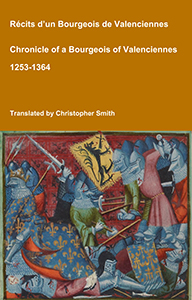
Chronicle of a Bourgeois of Valenciennes
Récits d’un bourgeois de Valenciennes aka The Chronicle of a Bourgeois of Valenciennes is a vivid 14th-century vernacular chronicle written by an anonymous urban chronicler from Valenciennes in the County of Hainaut. It survives in a manuscript that describes local and regional history from about 1253 to 1366, blending chronology, narrative episodes, and eyewitness-style accounts of political, military, and social events in medieval France, Flanders, and the Low Countries. The work begins with a chronological framework of events affecting Valenciennes and its region under rulers such as King Philip VI of France and the shifting allegiances of local nobility. It includes accounts of conflicts, sieges, diplomatic manoeuvres, and the impact of broader struggles like the Hundred Years’ War on urban life in Hainaut. Written from the perspective of a burgher (bourgeois) rather than a monastery or royal court, the chronicle offers a rare lay viewpoint on high politics and warfare, reflecting how merchants, townspeople, and civic institutions experienced the turbulence of the 13th and 14th centuries. Its narrative style combines straightforward reporting of events with moral and civic observations, making it a valuable source for readers interested in medieval urban society, regional politics, and the lived experience of war and governance in pre-modern Europe.
Available at Amazon in eBook and Paperback format.
On 3rd August 1643 Chichester Wrey 3rd Baronet [aged 15] was knighted by King Charles I of England, Scotland and Ireland [aged 42] at Bristol Castle, Gloucestershire [Map].
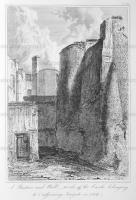
Bristol Castle, Gloucestershire [Map] adjoining Newgate. Skelton's Antiquities of Bristol, 1819.
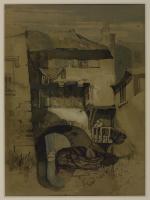
1831-1833. William James Müller [aged 18]. "Castle Ditch, Bristoj Castle [Map]".
Llewellyn ap Dafydd Aberffraw was imprisoned at Bristol Castle, Gloucestershire [Map].
Owain ap Dafydd Aberffraw was imprisoned at Bristol Castle, Gloucestershire [Map]. He was buried in the nearby Dominican church (now known as Quakers Friars). His burial was paid for by King Edward I.