

Chronicle of Walter of Guisborough
A canon regular of the Augustinian Guisborough Priory, Yorkshire, formerly known as The Chronicle of Walter of Hemingburgh, describes the period from 1066 to 1346. Before 1274 the Chronicle is based on other works. Thereafter, the Chronicle is original, and a remarkable source for the events of the time. This book provides a translation of the Chronicle from that date. The Latin source for our translation is the 1849 work edited by Hans Claude Hamilton. Hamilton, in his preface, says: 'In the present work we behold perhaps one of the finest samples of our early chronicles, both as regards the value of the events recorded, and the correctness with which they are detailed; Nor will the pleasing style of composition be lightly passed over by those capable of seeing reflected from it the tokens of a vigorous and cultivated mind, and a favourable specimen of the learning and taste of the age in which it was framed.'
Available at Amazon in eBook and Paperback format.
Bristol, Gloucestershire is in Gloucestershire.
Anglo-Saxon Chronicle. 1051. This year came Archbishop Robert hither over sea with his pall from Rome, one day before St. Peter's eve: and he took his archiepiscopal seat at Christ-church on St. Peter's day, and soon after this went to the king. Then came Abbot Sparhawk to him with the king's writ and seal, to the intent that he should consecrate him Bishop o[oe] London; but the archbishop refused, saying that the pope had forbidden him. Then went the abbot to the archbishop again for the same purpose, and there demanded episcopal consecration; but the archbishop obstinately refused, repeating that the pope had forbidden him. Then went the abbot to London, and sat at the bishopric which the king had before given him, with his full leave, all the summer and the autumn. Then during the same year came Eustace [aged 36], who had the sister of King Edward [aged 48] to wife, from beyond sea, soon after the bishop, and went to the king; and having spoken with him whatever he chose, he then went homeward. When he came to Canterbury eastward, there took he a repast, and his men; whence he proceeded to Dover, Kent [Map]. When he was about a mile or more on this side Dover, Kent [Map], he put on his breast-plate; and so did all his companions: and they proceeded to Dover. When they came thither, they resolved to quarter themselves wherever they lived. Then came one of his men, and would lodge at the house of a master of a family against his will; but having wounded the master of the house, he was slain by the other. Then was Eustace quickly upon his horse, and his companions upon theirs; and having gone to the master of the family, they slew him on his own hearth; then going up to the boroughward, they slew both within and without more than twenty men. The townsmen slew nineteen men on the other side, and wounded more, but they knew not how many. Eustace escaped with a few men, and went again to the king, telling him partially how they had fared. The king was very wroth with the townsmen, and sent off Earl Godwin [aged 50], bidding him go into Kent with hostility to Dover, Kent [Map]. For Eustace had told the king that the guilt of the townsmen was greater than his. But it was not so: and the earl would not consent to the expedition, because he was loth to destroy his own people. Then sent the king after all his council, and bade them come to Gloucester nigh the after-mass of St. Mary. Meanwhile Godwin took it much to heart, that in his earldom such a thing should happen. Whereupon be began to gather forces over all his earldom, and Earl Sweyne [aged 30], his son, over his; and Harold [aged 29], his other son, over his earldom: and they assembled all in Gloucestershire, at Langtree, Gloucestershire, a large and innumerable army, all ready for battle against the king; unless Eustace and his men were delivered to them handcuffed, and also the Frenchmen that were in the castle. This was done seven nights before the latter mass of St. Mary, when King Edward was sitting at Gloucester. Whereupon he sent after Earl Leofric, and north after Earl Siward [aged 41], and summoned their retinues. At first they came to him with moderate aid; but when they found how it was in the south, then sent they north over all their earldom, and ordered a large force to the help of their lord. So did Ralph also over his earldom. Then came they all to Gloucester to the aid of the king, though it was late. So unanimous were they all in defence of the king, that they would seek Godwin's army if the king desired it. But some prevented that; because it was very unwise that they should come together; for in the two armies was there almost all that was noblest in England. They therefore prevented this, that they might not leave the land at the mercy of our foes, whilst engaged in a destructive conflict betwixt ourselves. Then it was advised that they should exchange hostages between them. And they issued proclamations throughout to London, whither all the people were summoned over all this north end in Siward's earldom, and in Leofric's, and also elsewhere; and Earl Godwin was to come thither with his sons to a conference; They came as far as Southwark, Surrey [Map], and very many with them from Wessex; but his army continually diminished more and more; for they bound over to the king all the thanes that belonged to Earl Harold his son, and outlawed Earl Sweyne his other son. When therefore it could not serve his purpose to come to a conference against the king and against the army that was with him, he went in the night away. In the morning the king held a council, and proclaimed him an outlaw, with his whole army; himself and his wife, and all his three sons - Sweyne and Tosty [aged 25] and Grith [aged 19]. And he went south to Thorney67, with his wife, and Sweyne his son, and Tosty and his wife [aged 18], a cousin of Baldwin of Bruges [aged 38] [Note. Judith Flanders Duchess Bavaria was a sister of Baldwin "The Good" V Count Flanders], and his son Grith. Earl Harold with Leofwine [aged 16] went to Bristol, Gloucestershire [Map] in the ship that Earl Sweyne had before prepared and provisioned for himself; and the king sent Bishop Aldred from London with his retinue, with orders to overtake him ere he came to ship. But they either could not or would not: and he then went out from the mouth of the Avon; but he encountered such adverse weather, that he got off with difficulty, and suffered great loss. He then went forth to Ireland, as soon as the weather permitted. In the meantime the Welshmen had wrought a castle in Herefordshire, in the territory of Earl Sweyne, and brought as much injury and disgrace on the king's men thereabout as they could. Then came Earl Godwin, and Earl Sweyne, and Earl Harold, together at Beverstone [Map], and many men with them; to the intent that they might go to their natural lord, and to all the peers that were assembled with him; to have the king's counsel and assistance, and that of all the peers, how they might avenge the insult offered to the king, and to all the nation. But the Welshmen were before with the king, and betrayed the earls, so that they were not permitted to come within the sight of his eyes; for they declared that they intended to come thither to betray the king. There was now assembled before the king68 Earl Siward, and Earl Leofric, and much people with them from the north: and it was told Earl Godwin and his sons, that the king and the men who were with him would take counsel against them; but they prepared themselves firmly to resist, though they were loth to proceed against their natural lord. Then advised the peers on either side, that they should abstain from all hostility: and the king gave God's peace and his full friendship to each party. Then advised the king and his council, that there should be a second time a general assembly of all the nobles in London, at the autumnal equinox: and the king ordered out an army both south and north of the Thames, the best that ever was. Then was Earl Sweyne proclaimed an outlaw; and Earl Godwin and Earl Harold were summoned to the council as early as they could come. When they came thither and were cited to the council, then required they security and hostages, that they might come into the council and go out without treachery. The king then demanded all the thanes that the earls had; and they put them all into his hands. Then sent the king again to them, and commanded them to come with twelve men to the king's council. Then desired the earl again security and hostages, that he might answer singly to each of the things that were laid to his charge. But the hostages were refused; and a truce of five nights was allowed him to depart from the land. Then went Earl Godwin and Earl Sweyne to Bosham [Map], and drew out their ships, and went beyond sea, seeking the protection of Baldwin; and there they abode all the winter. Earl Harold went westward to Ireland, and was there all the winter on the king's security.
It was from Thorney69 that Godwin and those that were with him went to Bruges [Map], to Baldwin's land, in one ship, with as much treasure as they could lodge therein for each man. Wonderful would it have been thought by every man that was then in England, if any person had said before this that it would end thus! For he was before raised to such a height, that he ruled the king and all England; his sons were earls, and the king's darlings; and his daughter [aged 25] wedded and united to the king. Soon after this took place, the king dismissed the lady who had been consecrated his queen, and ordered to be taken from her all that she had in land, and in gold, and in silver, and in all things; and committed her to the care of his sister [aged 60] at Wherwell [Map]. Soon after came Earl William [aged 23] from beyond sea with a large retinue of Frenchmen; and the king entertained him and as many of his companions as were convenient to him, and let him depart again. Then was Abbot Sparhawk driven from his bishopric at London; and William the king's priest was invested therewith. Then was Oddy appointed earl over Devonshire, and over Somerset, and over Dorset, and over Wales; and Algar, the son of Earl Leofric, was promoted to the earldom which Harold before possessed.
Note 67. The ancient name of Westminster; which came into disuse because there was another Thorney in Cambridgeshire.
Note 68. i.e. at Gloucester, according to the printed Chronicle; which omits all that took place in the meantime at London and Southwark.
Note 69. Now Westminster.
Chronicon ex Chronicis by Florence and John of Worcester. 8th September 1051. Meanwhile, Godwin [aged 50] and his sons [Note. Sweyn [aged 30], Harold [aged 29], Tostig [aged 25], Gyrth [aged 19], Leofwine [aged 16] and Wulfnoth [aged 11]; it isn't clear whether all were present?], with their respective armies, entered Gloucestershire after the feast of the nativity of St. Mary [8th September], and encamping at a place called Langtreo, sent envoys to the king at Gloucester, demanding the surrender of count Eustace [aged 36] and his followers, as well as of the Normans and men of Boulogne, who were in possession of the castle on the cliff at Dover, Kent [Map], on pain of hostilities. The king, alarmed for a time at this message, was in great distress, and in the utmost perplexity what to do. But when he found that the troops of the earls Leofric, Siward [aged 41], and Ralph were on their march, he replied with firmness that he would by no means consent to give up Eustace and the rest who were demanded. On hearing this, the envoys returned from their bootless errand. As they were departing, the army entered Gloucester, so exasperated, and unanimously ready to fight, that, if the king had given permission, they would have instantly engaged earl Godwin's army. But earl Leofric considering that all the men of greatest note in England were assembled either on his side or the other, it appeared to him and some others a great folly to fight with their own countrymen, and he proposed that, hostages having been given by both parties, the king and Godwin should meet at London on a day appointed, and settle their controversy in a legal way. This advice being approved, and after the exchange of messages, hostages having been given and received, the earl returned into Wessex; and the king assembled a more powerful army from the whole of Mercia and Northumbria, and led it to London. Meanwhile, Godwin and his sons came to Southwark with a vast multitude of the people of Wessex; but his army gradually dwindling away and deserting him, he did not venture to abide the judgment of the king's court, but fled, under cover of night. When, therefore, the morning came, the king, in his witan, with the unanimous consent of the whole army, made a decree that Godwin and his five sons should be banished. Thereupon he and his wife Githa, and Tosti and his wife Judith [aged 18], the daughter of Baldwin, count of Flanders, and two of his. other sons, namely, Sweyn and Gurth, went, without loss of time, to Thorney, where a ship had been got ready for them. They quickly laded her with as much gold, silver, and other valuable articles as she could hold, and, embarking in great haste, directed her course towards Flanders and Baldwin [aged 39] the count. His sons Harold and Leofwine, making their way to Brycgstowe [Map], went on board a ship which their brother Sweyn had prepared for them, and crossed over to Ireland. The king [aged 48] repudiated the queen Edgitha [aged 25], on account of his wrath against her father Godwin, and sent her in disgrace, with only a single handmaid, to Wherwell [Map], where she was committed to the custody of the abbess [aged 60].67
Note 67. She was a sister of the king.
Around 1125 Harding Fitzharding [aged 77] died at Bristol, Gloucestershire [Map].
On 5th February 1171 Robert Fitzharding 1st Baron Berkeley [aged 75] died at Bristol, Gloucestershire [Map]. His son Maurice [aged 51] succeeded 2nd Baron Berkeley Feudal. Alice Berkeley Baroness Berkeley [aged 36] by marriage Baroness Berkeley Feudal.
On 27th October 1326 Hugh "Elder" Despencer 1st Earl Winchester [aged 65] was hanged, drawn and quartered at Bristol, Gloucestershire [Map]. Earl Winchester, Baron Despencer forfeit as a result of attainder.
On 13th January 1400 Thomas Despencer 1st Earl Gloucester [aged 26] was beheaded at Bristol, Gloucestershire [Map].
On 9th September 1461 Baldwin Fulford [aged 46] was beheaded at Bristol, Gloucestershire [Map] on the orders of King Edward IV of England [aged 19] for having supported King Henry VI of England and II of France [aged 39].
Around 1495 Jane Carew [aged 35] died at Bristol, Gloucestershire [Map].
In 1606 William Child was born at Bristol, Gloucestershire [Map].
John Evelyn's Diary. 20th May 1639. Accompanied with one Mr. J. Crafford (who afterward being my fellow-traveler in Italy, there changed his religion), I took a journey of pleasure to see the Somersetshire baths [Map], Bristol, Gloucestershire [Map], Cirencester, Gloucestershire [Map], Malmesbury, Wiltshire [Map], Abington, and divers other towns of lesser note; and returned the 25th.
John Evelyn's Diary. 2nd December 1688. Dr. Tenison [aged 52] preached at St. Martin's [Map] on Psalm xxxvi. 5, 6, 7, concerning Providence. I received the blessed Sacrament. Afterward, visited my Lord Godolphin [aged 43], then going with the Marquis of Halifax [aged 55] and Earl of Nottingham [aged 41] as Commissioners to the Prince of Orange [aged 38]; he told me they had little power. Plymouth, Devon [Map] declared for the Prince. Bath, Somerset [Map], York [Map], Hull [Map], Bristol, Gloucestershire [Map], and all the eminent nobility and persons of quality through England, declare for the Protestant religion and laws, and go to meet the Prince, who every day sets forth new Declarations against the Papists. The great favorites at Court, Priests and Jesuits, fly or abscond. Everything, till now concealed, flies abroad in public print, and is cried about the streets. Expectation of the Prince coming to Oxford, Oxfordshire [Map]. The Prince of Wales and great treasure sent privily to Portsmouth, Hampshire [Map], the Earl of Dover [aged 52] being Governor. Address from the Fleet not grateful to his Majesty [aged 55]. The Papists in offices lay down their commissions, and fly. Universal consternation among them; it looks like a revolution.


On 18th May 1710 Charles Willing was born to Thomas Willing and Anne Harrison [aged 26] at Bristol, Gloucestershire [Map]. He married 21st January 1730 Anne Shippen and had issue.
On 5th September 1724 William Daines [aged 77] died in Bristol, Gloucestershire [Map].

On 13th April 1769 Thomas Lawrence was born in Bristol, Gloucestershire [Map].
Henrici Quinti, Angliæ Regis, Gesta, is a first-hand account of the Agincourt Campaign, and subsequent events to his death in 1422. The author of the first part was a Chaplain in King Henry's retinue who was present from King Henry's departure at Southampton in 1415, at the siege of Harfleur, the battle of Agincourt, and the celebrations on King Henry's return to London. The second part, by another writer, relates the events that took place including the negotiations at Troye, Henry's marriage and his death in 1422.
Available at Amazon in eBook and Paperback format.
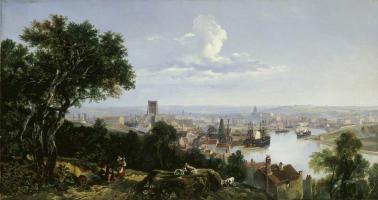
1837. William James Müller [aged 24]. "View of Bristol, Gloucestershire [Map] from Clifton Wood".
In 1844 Edward Clifford was born at Bristol, Gloucestershire [Map].
Anglo-Saxon Chronicle. Then it was told the king, that the people in the North had gathered themselves together, and would stand against him if he came. Whereupon he went to Nottingham, Nottinghamshire [Map], and wrought there a castle; and so advanced to York [Map], and there wrought two castles; and the same at Lincoln, Lincolnshire [Map], and everywhere in that quarter. Then Earl Gospatric and the best men went into Scotland. Amidst this came one of Harold's sons from Ireland with a naval force into the mouth of the Avon unawares, and plundered soon over all that quarter; whence they went to Bristol, Gloucestershire [Map], and would have stormed the town; but the people bravely withstood them. When they could gain nothing from the town, they went to their ships with the booty which they had acquired by plunder; and then they advanced upon Somersetshire, and there went up; and Ednoth, master of the horse, fought with them; but he was there slain, and many good men on either side; and those that were left departed thence.
On 27th April 1798 Clara "Claire" Mary Jane Clairmont was born illegitimately to John Lethbridge 1st Baronet [aged 52] and Mary Jane de Vial [aged 30] at Brislington, Bristol.
The River Frome, Gloucestershire rises in Dodington Park, Gloucestershire [Map] after which it flows past Chipping Sodbury, Gloucestershire [Map], Yate, Gloucestershire [Map], Iron Acton, Gloucestershire [Map], Frampton Cotterel, Gloucestershire [Map], Winterbourne Down, Goucestershire [Map], Frenchay, Bristol [Map] and Eastville, Bristol [Map] after which it is covered for a long stretch emerging into Bristol Floating Harbour [Map] before joining the Gloucestershire River Avon.
Around 1767 Benjamin Hobhouse 1st Baronet [aged 10] educated at Bristol Grammar School Bristol, Gloucestershire.
The Gloucestershire River Avon rises near Acton Turville, Gloucestershire [Map] after which it flows past Luckington, Wiltshire [Map], Sherston, Wiltshire [Map], Easton Grey, Wiltshire [Map], Malmesbury, Wiltshire [Map], Great Somerford, Wiltshire [Map], Christian Malford, Wiltshire [Map], Chippenham, Wiltshire [Map], Melksham, Wiltshire [Map], Bradford on Avon [Map], under the Dundas Aquaduct, Wiltshire [Map], through Bath, Somerset [Map], past Keynsham, Gloucestershire [Map], through Bristol [Map] under the Clifton Suspension Bridge [Map] to Avonmouth, Gloucestershire [Map] where it joins the Severn Estuary.
On 10th October 1794 Archbishop Richard Robinson 1st Baron Rokeby [aged 86] died at Clifton Bristol, Gloucestershire. His third cousin Matthew [aged 81] succeeded 2nd Baron Rokeby.
On 6th May 1861 Charles Michael Edgeworth Brinkley was born at Knockmaroon. He was educated at Clifton College Bristol, Jesus College, Cambridge University and the Royal Military College, Sandhurst.
In 1864 the Clifton Suspension Bridge [Map] over the Gloucestershire River Avon opened.
The Gloucestershire River Avon rises near Acton Turville, Gloucestershire [Map] after which it flows past Luckington, Wiltshire [Map], Sherston, Wiltshire [Map], Easton Grey, Wiltshire [Map], Malmesbury, Wiltshire [Map], Great Somerford, Wiltshire [Map], Christian Malford, Wiltshire [Map], Chippenham, Wiltshire [Map], Melksham, Wiltshire [Map], Bradford on Avon [Map], under the Dundas Aquaduct, Wiltshire [Map], through Bath, Somerset [Map], past Keynsham, Gloucestershire [Map], through Bristol [Map] under the Clifton Suspension Bridge [Map] to Avonmouth, Gloucestershire [Map] where it joins the Severn Estuary.
Chronicle of Abbot Ralph of Coggeshall
The Chronicle of Abbot Ralph of Coggeshall (Chronicon Anglicanum) is an indispensable medieval history that brings to life centuries of English and European affairs through the eyes of a learned Cistercian monk. Ralph of Coggeshall, abbot of the Abbey of Coggeshall in Essex in the early 13th century, continued and expanded his community’s chronicle, documenting events from the Norman Conquest of 1066 into the tumultuous reign of King Henry III. Blending eyewitness testimony, careful compilation, and the monastic commitment to record-keeping, this chronicle offers a rare narrative of political intrigue, royal power struggles, and social upheaval in England and beyond. Ralph’s work captures the reigns of pivotal figures such as Richard I and King John, providing invaluable insights into their characters, decisions, and the forces that shaped medieval rule. More than a simple annal, Chronicon Anglicanum conveys the texture of medieval life and governance, making it a rich source for scholars and readers fascinated by English history, monastic authorship, and the shaping of the medieval world.
Available at Amazon in eBook and Paperback format.
10 Sion Row, Clifton is now 20 Sion Row.
On 2nd May 1821 Hester Lynch Salusbury [aged 81] died at 10 Sion Row, Clifton of complications after a fall. She was buried with her second husband Gabriel Mario Piozzi at the Church of Corpus Christi, Tremeirchion [Map].
Hester Lynch Piozzi. "Doctor Johnson's Mrs Thrale". Born 1741. Died 1821. Witty. Vivacious and Charming. In an Age of Genius She Ever Held a Foremost Place This Tablet is Erected by Orlando Butler Fellowes Grand-Son of Sir James Fellowes. The Intimate Friend of Mrs. Piozzi and her Executor. Assisted by Subscriptions. 28th April 1909.


St Werburgh's Church, Bristol is also in Churches in Gloucestershire.
In November 1685 Robert Cann 1st Baronet [aged 64] died. He was buried at St Werburgh's Church, Bristol [Map] in November 1685. His son William [aged 36] succeeded 2nd Baronet Cann of Compton Green in Gloucestershire.
Before 4th July 1698, the dat ehe buried at St Werburgh's Church, Bristol [Map], William Cann 2nd Baronet [aged 49] died. His son William [aged 4] succeeded 3rd Baronet Cann of Compton Green in Gloucestershire.
In 1758 St Werburgh's Church, Bristol [Map] was re-built by James Bridges.

1829. Printed engraving from 1829 of the view westwards along Corn Street, Bristol, showing the original position of St Werburgh's [Map] church on the north side of the road beyond the Register Office
An act of parliament was obtained enabling the closure of St Werburgh's Church, Bristol [Map], with the last service being held on 12 August 1877. It was then demolished and the stones numbered before being transported to the new site approximately 3.2 km away in Mina Road. During the removal of the church 100 coffins and 40 chests of human remains were uncovered.
In 1879 St Werburgh's Church, Bristol [Map] was moved from Corn Street to an area in north-east central Bristol now known as St Werburghs.
Four Stars Inn, Counterslip. On the corner with Hawkins Lane this 17th century inn was pulled down in 1857 to make way for Finzel's sugar factory. When Courage's Brewery was extended in 1967 a fermenting block was opened on this site. The Bristol Brewery closed down a few years ago and the site has since been re-developed. Hawkins Lane led down to the original Countess Slip (Counterslip) opposite St.Peters Church and the ferry to Bristol Castle
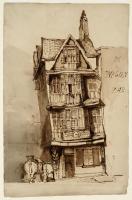
1831-1833. William James Müller [aged 18]. "Four Stars Inn, Counterslip, Bristol".
The River Frome, Gloucestershire rises in Dodington Park, Gloucestershire [Map] after which it flows past Chipping Sodbury, Gloucestershire [Map], Yate, Gloucestershire [Map], Iron Acton, Gloucestershire [Map], Frampton Cotterel, Gloucestershire [Map], Winterbourne Down, Goucestershire [Map], Frenchay, Bristol [Map] and Eastville, Bristol [Map] after which it is covered for a long stretch emerging into Bristol Floating Harbour [Map] before joining the Gloucestershire River Avon.
The River Frome, Gloucestershire rises in Dodington Park, Gloucestershire [Map] after which it flows past Chipping Sodbury, Gloucestershire [Map], Yate, Gloucestershire [Map], Iron Acton, Gloucestershire [Map], Frampton Cotterel, Gloucestershire [Map], Winterbourne Down, Goucestershire [Map], Frenchay, Bristol [Map] and Eastville, Bristol [Map] after which it is covered for a long stretch emerging into Bristol Floating Harbour [Map] before joining the Gloucestershire River Avon.
The History of William Marshal was commissioned by his son shortly after William’s death in 1219 to celebrate the Marshal’s remarkable life; it is an authentic, contemporary voice. The manuscript was discovered in 1861 by French historian Paul Meyer. Meyer published the manuscript in its original Anglo-French in 1891 in two books. This book is a line by line translation of the first of Meyer’s books; lines 1-10152. Book 1 of the History begins in 1139 and ends in 1194. It describes the events of the Anarchy, the role of William’s father John, John’s marriages, William’s childhood, his role as a hostage at the siege of Newbury, his injury and imprisonment in Poitou where he met Eleanor of Aquitaine and his life as a knight errant. It continues with the accusation against him of an improper relationship with Margaret, wife of Henry the Young King, his exile, and return, the death of Henry the Young King, the rebellion of Richard, the future King Richard I, war with France, the death of King Henry II, and the capture of King Richard, and the rebellion of John, the future King John. It ends with the release of King Richard and the death of John Marshal.
Available at Amazon in eBook and Paperback format.
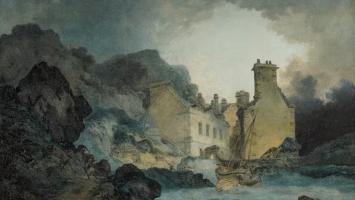
1792. Joseph Mallord William Turner [aged 16]. "The Rising Squall, Hot Wells, from St Vincent's Rock, Bristol".
On 28th December 1795 Briggs Cary died at Hot Wells, Bristol. He was buried at All Saints Church, Narborough [Map].
On 7th July 1800 Captain John Granville [aged 21] died of rapid consumption at Hot Wells, Bristol. He was buried at St Peter's Church, Ellastone on 19th July 1800. His nephew Court D'Ewes aka Granville [aged 21] inherited Calwich Abbey, Staffordshire [Map] and changed his surname from D'Ewes to Granville.
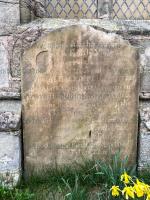
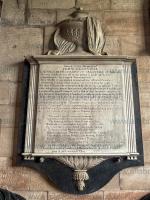
Underneath this Stone In the Family Vault Lies Interred the Body of John Granville, only son of John and Harriett Granville of Calwich and late Captain in the Staffordshire Regiment of Militia who was suddenly cut off in the Prime of his Life, to the inexpressible Grief of his Parents and Sorrow of All who knew him July the 7th 1800 in the 21st Year of his Age. In the same vault are deposited the remains of their infant daughter. Also the remains of the above named Harriet Joan Granville Died at Calwich 25th March 1825, aged 71.
Captain John Granville: Around 1779 he was born to Reverend John D'Ewes aka Granville and Harriet de la Bere.
Court D'Ewes aka Granville: In 1779 he was born to Bernard D'Ewes. In 1848 Court D'Ewes aka Granville died.
St James Priory, Bristol is also in Priories in England.
In 1129 St James Priory, Bristol [Map] was founded by Robert Normandy 1st Earl Gloucester [aged 30].
On 10th August 1241 Eleanor "Fair Maid of Britanny" 4th Countess of Richmond [aged 57] died at Bristol Castle, Gloucestershire [Map]. She was initially buried at St James Priory, Bristol [Map] then reburied at Amesbury Abbey, Wiltshire [Map].

Monumental Effigies. Robert Consul, Earl of Gloucester in St James Priory, Bristol [Map].
St John the Baptist Church, Bristol is also in Churches in Gloucestershire.
On or before 28th March 1621, the date he was baptised at St John the Baptist Church, Bristol [Map], Robert Cann 1st Baronet was born.

Before 1845. William James Müller [aged 32]. Bristol Harbour with St Mary Redcliffe Church, Bristol.
St Stephen's Church, Bristol is also in Churches in Gloucestershire.
Around 1350 St Stephen's Church, Bristol [Map] was built, on the site of an 11th-century church. The site was on the banks of the River Frome, which was diverted in the 1240s to create Bristol Harbour.
On or before 28th April 1608, the date he was baptised at St Stephen's Church, Bristol [Map], Thomas Hooke was born to Humphrey Hooke [aged 28].
On 3rd September 1620 Cecily Hooke was born to Humphrey Hooke [aged 40]. She was baptised at St Stephen's Church, Bristol [Map]. She married on or after 17th July 1642 Robert Cann 1st Baronet and had issue.
Before 6th August 1629, the date he was baptised at St Stephen's Church, Bristol [Map], Humphrey Hooke was born to Thomas Hooke [aged 21]. He married 27th June 1653 Florence Smyth aka Smith.
Abbot John Whethamstede’s Chronicle of the Abbey of St Albans
Abbot John Whethamstede's Register aka Chronicle of his second term at the Abbey of St Albans, 1451-1461, is a remarkable text that describes his first-hand experience of the beginning of the Wars of the Roses including the First and Second Battles of St Albans, 1455 and 1461, respectively, their cause, and their consequences, not least on the Abbey itself. His text also includes Loveday, Blore Heath, Northampton, the Act of Accord, Wakefield, and Towton, and ends with the Coronation of King Edward IV. In addition to the events of the Wars of the Roses, Abbot John, or his scribes who wrote the Chronicle, include details in the life of the Abbey such as charters, letters, land exchanges, visits by legates, and disputes, which provide a rich insight into the day-to-day life of the Abbey, and the challenges faced by its Abbot.
Available at Amazon in eBook and Paperback format.
Before 22nd April 1637, the date she was baptised at St Stephen's Church, Bristol [Map], Mary Hooke was born to Thomas Hooke [aged 28]. She married 20th October 1661 Thomas Scrope and had issue.
On or after 17th July 1642, the date of the licence, Robert Cann 1st Baronet [aged 21] and Cecily Hooke [aged 21] were married at St Stephen's Church, Bristol [Map].
On or before 12th August 1643, the date she was buried at St Stephen's Church, Bristol [Map], Cecily Hooke [aged 22] died.
On or before 21st March 1683, the date she was buried at St Stephen's Church, Bristol [Map], Florence Smyth aka Smith [aged 48] died.

Around 1838. Black and white engraving of St Stephen's Church, Bristol [Map]. The view is from the south east of the church, showing the body of the church on the right of the image and the distinctive tall, thin tower in the centre. In front of the church can be seen two horses and carts. From 1240 to 1892 the Bristol Harbour was on the opposite side of the church when it was filled in.

On 23rd April 1621 Admiral William Penn was born to Captain Giles Penn [aged 49] and Joan Gilbert in St Thomas Parish Bristol. He married 6th June 1643 Margaret Jasper and had issue.

Samuel Pepys' Diary. 13th June 1668. So to the Three Crowns Tavern I was directed; but, when I come in, the master told me that he had newly given over the selling of wine; it seems, grown rich; and so went to the Sun; and there Deb. going with W. Hewer [aged 26] and Betty Turner [aged 15] to see her uncle [Butts], and leaving my wife with the mistress of the house, I to see the quay, which is a most large and noble place; and to see the new ship building by Bally, neither he nor Furzer being in town. It will be a fine ship. Spoke with the foreman, and did give the boys that kept the cabin 2s. Walked back to the Sun, where I find Deb. come back, and with her, her uncle, a sober merchant, very good company, and so like one of our sober, wealthy, London merchants, as pleased me mightily. Here we dined, and much good talk with him, 7s. 6d.: a messenger to Sir John Knight, who was not at home, 6d. Then walked with him [Butts] and my wife and company round the quay, and to the ship; and he shewed me the Custom-house, and made me understand many things of the place, and led us through Marsh Street, where our girl was born. But, Lord! the joy that was among the old poor people of the place, to see Mrs. Willet's daughter, it seems her mother being a brave woman and mightily beloved! And so brought us a back way by surprize to his house, where a substantial good house, and well furnished; and did give us good entertainment of strawberries, a whole venison-pasty, cold, and plenty of brave wine, and above all Bristoll milk1, where comes in another poor woman, who, hearing that Deb. was here, did come running hither, and with her eyes so lull of tears, and heart so full of joy, that she could not speak when she come in, that it made me weep too: I protest that I was not able to speak to her, which I would have done, to have diverted her tears. His wife a good woman, and so sober and substantiall as I was never more pleased anywhere. Servant-maid, 2s. So thence took leave, and he with us through the city, where in walking I find the city pay him great respect, and he the like to the meanest, which pleased me mightily. He shewed us the place where the merchants meet here, and a fine Cross yet standing, like Cheapside. And so to the Horseshoe, where paid the reckoning, 2s. 6d. We back, and by moonshine to the Bath [Map] again, about ten-o'clock: bad way; and giving the coachman 1s., went all of us to bed.
Note 1. A sort of rum punch (milk punch), which, and turtle, were products of the trade of Bristol with the West Indies. So Byron says in the first edition of his "English Bards and Scotch Reviewers" "Too much in turtle Bristol's sons delight, Too much oer bowls of rack prolong the night". These lines will not be found in the modern editions; but the following are substituted: "Four turtle feeder's verse must needs he flat, Though Bristol bloat him with the verdant fat". Lord Macaulay says of the collations with which the sugar-refiners of Bristol regaled their visitors: "The repast was dressed in the furnace, And was accompanied by a rich brewage made of the best Spanish wine, and celebrated over the whole kingdom as Bristol milk" ("Hist. of England", vol. i., p. 335) B.
Samuel Pepys' Diary. 13th June 1668. So to the Three Crowns Tavern I was directed; but, when I come in, the master told me that he had newly given over the selling of wine; it seems, grown rich; and so went to the Sun; and there Deb. going with W. Hewer [aged 26] and Betty Turner [aged 15] to see her uncle [Butts], and leaving my wife with the mistress of the house, I to see the quay, which is a most large and noble place; and to see the new ship building by Bally, neither he nor Furzer being in town. It will be a fine ship. Spoke with the foreman, and did give the boys that kept the cabin 2s. Walked back to the Sun, where I find Deb. come back, and with her, her uncle, a sober merchant, very good company, and so like one of our sober, wealthy, London merchants, as pleased me mightily. Here we dined, and much good talk with him, 7s. 6d.: a messenger to Sir John Knight, who was not at home, 6d. Then walked with him [Butts] and my wife and company round the quay, and to the ship; and he shewed me the Custom-house, and made me understand many things of the place, and led us through Marsh Street, where our girl was born. But, Lord! the joy that was among the old poor people of the place, to see Mrs. Willet's daughter, it seems her mother being a brave woman and mightily beloved! And so brought us a back way by surprize to his house, where a substantial good house, and well furnished; and did give us good entertainment of strawberries, a whole venison-pasty, cold, and plenty of brave wine, and above all Bristoll milk1, where comes in another poor woman, who, hearing that Deb. was here, did come running hither, and with her eyes so lull of tears, and heart so full of joy, that she could not speak when she come in, that it made me weep too: I protest that I was not able to speak to her, which I would have done, to have diverted her tears. His wife a good woman, and so sober and substantiall as I was never more pleased anywhere. Servant-maid, 2s. So thence took leave, and he with us through the city, where in walking I find the city pay him great respect, and he the like to the meanest, which pleased me mightily. He shewed us the place where the merchants meet here, and a fine Cross yet standing, like Cheapside. And so to the Horseshoe, where paid the reckoning, 2s. 6d. We back, and by moonshine to the Bath [Map] again, about ten-o'clock: bad way; and giving the coachman 1s., went all of us to bed.
Note 1. A sort of rum punch (milk punch), which, and turtle, were products of the trade of Bristol with the West Indies. So Byron says in the first edition of his "English Bards and Scotch Reviewers" "Too much in turtle Bristol's sons delight, Too much oer bowls of rack prolong the night". These lines will not be found in the modern editions; but the following are substituted: "Four turtle feeder's verse must needs he flat, Though Bristol bloat him with the verdant fat". Lord Macaulay says of the collations with which the sugar-refiners of Bristol regaled their visitors: "The repast was dressed in the furnace, And was accompanied by a rich brewage made of the best Spanish wine, and celebrated over the whole kingdom as Bristol milk" ("Hist. of England", vol. i., p. 335) B.