

The History of William Marshal was commissioned by his son shortly after William’s death in 1219 to celebrate the Marshal’s remarkable life; it is an authentic, contemporary voice. The manuscript was discovered in 1861 by French historian Paul Meyer. Meyer published the manuscript in its original Anglo-French in 1891 in two books. This book is a line by line translation of the first of Meyer’s books; lines 1-10152. Book 1 of the History begins in 1139 and ends in 1194. It describes the events of the Anarchy, the role of William’s father John, John’s marriages, William’s childhood, his role as a hostage at the siege of Newbury, his injury and imprisonment in Poitou where he met Eleanor of Aquitaine and his life as a knight errant. It continues with the accusation against him of an improper relationship with Margaret, wife of Henry the Young King, his exile, and return, the death of Henry the Young King, the rebellion of Richard, the future King Richard I, war with France, the death of King Henry II, and the capture of King Richard, and the rebellion of John, the future King John. It ends with the release of King Richard and the death of John Marshal.
Available at Amazon in eBook and Paperback format.
Castle Baynard is in City of London.
Henry Machyn's Diary. 25th May 1562. The sam day was a yonge man dyd hang ym-seylff at the Polles hed, the in Carter lane.
The Diary of George Price Boyce 1852. 30th December 1852. Went down to Dante G [aged 24]. and William Rossetti's chambers at 14 Chatham Place, Blackfriars Bridge. Met there Wells [aged 24], J. P. Seddon [aged 25], Clayton [aged 25], and Mr. Munro [aged 27], Mr. Stephens [aged 25] and Mr. Hughes [aged 20]. Rossetti showed me his studio but none of his works (which is his way). He had for our entertainment a series of anastatic drawings designed and coloured by the Hon. Mrs. Boyle, some of which as beautiful in feeling, natural simplicity, and colour, and in poetical treatment as almost anything I have seen. They illustrate a nursery rhyme. Also a quantity of Gavarni's works, and a grand and most striking mask of Dante taken from a caste of his face in death; a tracing of his head in Giotto's fresco with the eye imperfect; a pen and ink sketch by Millais from Keats' "Isabella." In the physical way, roast chestnuts and coffee, honey, and hot spirits. His room has a jolly balcony overhanging the river, the reflection of the lights on the bridge and quays, etc., were charming. Conversation throughout delightful, resulting methought from the happy and gentlemanly freedom of the company generally. There was only one of D. G. Rossetti's works to be seen in the room, and that was a sketch, study of a man, back view. Gabriel Rossetti invited me to his studio next Thursday.

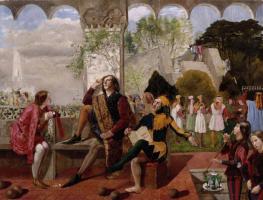


On 11th February 1862 at twenty past seven in the morning Elizabeth Siddal [aged 32] overdosed on laudanum at 14 Chatham Place. Possibly suicide - there may have been a note that said "look after Harry (her invalid brother)" which Ford Madox Brown [aged 40] persuaded Dante Gabriel Rossetti [aged 33] to burn. Shortly after her death Sarah Cox aka Fanny Cornforth [aged 27] moved into the family home to become housekeeper to Dante Gabriel Rossetti.
Samuel Pepys' Diary. 1st June 1665. Up and to the office, where sat all the morning, at noon to the 'Change [Map], and there did some business, and home to dinner, whither Creed comes, and after dinner I put on my new silke camelott sute; the best that ever I wore in my life, the sute costing me above £24. In this I went with Creed to Goldsmiths' Hall, to the burial of Sir Thomas Viner [deceased]; which Hall, and Haberdashers also, was so full of people, that we were fain for ease and coolness to go forth to Pater Noster Row [Map], to choose a silke to make me a plain ordinary suit.
Henry Machyn's Diary. 24th August 1559. [The xxiiij day of August, the lord] mare [aged 50] and the althermen and the [sheriffs? w]her at the wrastelyng at Clarke-in-well [Map], and it was the fayre day of thynges kept in Smyth-feld [Map], [being] sant Bathellmuw (day), and the same day my lord [mayor] came home thrugh Chepe, and a-gaynst Yrmonger [lane] and a-gaynst sant Thomas of Acurs ij [2] gret [bonfires] of rodes and of Mares and Johns [sculptures of Saint Marys and Saint Johns] and odur emages [images], ther thay wher bornyd [burned] with gret wondur.
Henry Machyn's Diary. 22nd May 1551. The xxij day of Maij was bered my lade Mores, wyff of sir Crystoffer Mores knyght, and the M. of [the Ordnance] by kyng Henry the viijth, the wyche he ded of the h .. at Bullayn [Map], and she ded in saynt Peters in Cornhyll ... in saynt Towlles in the Oll' Jury, and ther she ... her first husband, with ij harolds; and she gayff ... men and women vijxx mantylls, fryse gownes, and o[ther] gownes and cotts a iiijxx, and then cam the corse [with banners] of armes borne abowt her, with iiij morners .... dyd pryche the Skott the curett, and a gret dolle and a gret [dinner] as I have sene off fysse and odur thynges.
Note. Funeral of lady Morice. Stowe mentions the interment at St. Peter's Cornhill of sir Christopher Morice, master gunner of England, temp. Henry VIII. His lady appears to have had a previous husband, and, though she lived and died in that parish, was removed to the church of St. Olave's to be laid by his side. There was a family connection between sir Christopher Morice and Arthur Plantagenet, viscount Lisle: see Miss Wood's Letters of Royal and Illustrious Ladies, ii. 76, iii. 35. "The Skott the curate" was of St. Peter's in Cornhill; see p. 13, and note hereafter.
In 1602 Elizabeth Duncombe was born to William Duncombe [aged 37] and Anne Bennett [aged 25]. She was baptised at St Olave's Church, Old Jewry. She married 1624 William Brownlow 1st Baronet and had issue.
On 29th May 1634 William Bowyer 1st Baronet [aged 21] and Margaret Weld Lady Bowyer [aged 17] were married at St Olave's Church, Old Jewry.
On 24th May 1678 Elizabeth Herne Lady Blackwell was born to Joseph Herne of London and Elizabeth Frederick. She was baptised on 11th June 1678 at St Olave's Church, Old Jewry. She married before February 1698 Lambert Blackwell 1st Baronet and had issue.
In January 1467 William Gregory [aged 67] died. He was buried at St Anne and St Agnes Church, Gresham Street.
The Deeds of the Dukes of Normandy
The Gesta Normannorum Ducum [The Deeds of the Dukes of Normandy] is a landmark medieval chronicle tracing the rise and fall of the Norman dynasty from its early roots through the pivotal events surrounding the Norman Conquest of England. Originally penned in Latin by the monk William of Jumièges shortly before 1060 and later expanded at the behest of William the Conqueror, the work chronicles the deeds, politics, battles, and leadership of the Norman dukes, especially William’s own claim to the English throne. The narrative combines earlier historical sources with firsthand information and oral testimony to present an authoritative account of Normandy’s transformation from a Viking settlement into one of medieval Europe’s most powerful realms. William’s history emphasizes the legitimacy, military prowess, and governance of the Norman line, framing their expansion, including the conquest of England, as both divinely sanctioned and noble in purpose. Later chroniclers such as Orderic Vitalis and Robert of Torigni continued the history, extending the coverage into the 12th century, providing broader context on ducal rule and its impact. Today this classic work remains a foundational source for understanding Norman identity, medieval statesmanship, and the historical forces that reshaped England and Western Europe between 800AD and 1100AD.
Available at Amazon in eBook and Paperback format.
On 4th August 1681 William Chiffinch [aged 79] was present at the famous loyal feast of the apprentices at Saddler's Hall Gutter Lane.

Henry Machyn's Diary. 10th February 1557. The x day of Feybruary was slayne in Nugatt market, on Robartt Lentall, odur-wyse callyd Robart (blank), servant unto my lord tresorer the marques of Wynchester [aged 74], by a servand unto the duke of Norffoke, and ys fottman, the wyche was ys on sekyng [seeking].... and iij women.
Samuel Pepys' Diary. 9th December 1663. So to her, and found her in great pain.... So by and by to my office again, and then abroad to look out a cradle to burn charcoal in at my office, and I found one to my mind in Newgate Market, and so meeting Hoby's man in the street, I spoke to him to serve it in to the office for the King [aged 33].
Samuel Pepys' Diary. 6th September 1664. So going home, and my coach stopping in Newgate Market over against a poulterer's shop, I took occasion to buy a rabbit, but it proved a deadly old one when I came to eat it, as I did do after an hour being at my office, and after supper again there till past 11 at night.
Samuel Pepys' Diary. 4th September 1666. Thence homeward, having passed through Cheapside and Newgate Market, all burned, and seen Anthony Joyce's House in fire. And took up (which I keep by me) a piece of glasse of Mercers' Chappell in the streete, where much more was, so melted and buckled with the heat of the fire like parchment. I also did see a poor cat taken out of a hole in the chimney, joyning to the wall of the Exchange [Map]; with, the hair all burned off the body, and yet alive.
Samuel Pepys' Diary. 27th July 1668. Busy all the morning at my office. At noon dined, and then I out of doors to my bookseller in Duck Lane [Map], but su moher not at home, and it was pretty here to see a pretty woman pass by with a little wanton look, and je did sequi her round about the street from Duck Lane [Map] to Newgate Market, and then elle did turn back, and je did lose her. And so to see my Lord Crew [aged 70], whom I find up; and did wait on him; but his face sore, but in hopes to do now very well again.
Henry Machyn's Diary. 10th January 1560. The x day of January in the mornyng was a nuwe payre of galows sett up with-owtt the west dore of Powlles [Map], and be-twyne ix and x of the cloke a-for none wher Wylliam North and ys man browth thether by the ij shreyffes, and ther hangyd boyth tyll iiij at after-non; and so the hangman cutt them downe, and cared (them) in-to sant Gregore chyrche-yerd, and ther was a grayff [grave] mad, and so they wher strypyd of all, and tumbelyd nakyd in-to the grayff, in the corner of the est syd of the chyrche-yerde.... ... abowt a xij of the [clock] .... gentyll-man with-in the Whyt frers ...
Henry Machyn's Diary. 30th April 1560. The xxx day of Aprell was bered in sant Gregore chyrche in Powlles chyrche-yerd master Payne skynner, and gayff armes, and ther was the masturs of compene of the Skynners in ther (livery,) he had a sermon, and the clarkes ....
Henry Machyn's Diary. 23rd June 1561. The xxiij day of June, was Mydsomer evyn, the serves at sant Gregore chyrche be-syd Powlles (by) the Powlles quer tyll Powlles be rede mad.
On 3rd July 1569 Robert Honywood [aged 23] and Dorothy Crooke [aged 22] were married at St Gregory by St Paul's.
On 29th April 1609 Richard Barrow and Temperance Flowerdew [aged 19] were married at St Gregory by St Paul's.
On 11th March 1803 George Warde [aged 77] died. He was buried at St Mary Abchurch.
Henry Machyn's Diary. 24th November 1553. The xxiiij day of November dyd ryd in a c[art] Cheken, parsun of sant Necolas Coldabbay [Map], [round] a-bowt London, for he sold ys wyff to a bowcher.
Note. P. 48. Parson Chicken. "Another priest called sir Tho. Snowdel, whom they nicknamed Parson Chicken, was carted through Cheapside, for assoiling an old acquaintance of his in a ditch in Finsbury field; and was at that riding saluted with chamber-pots and rotten eggs." (Strype, Mem. iii. 113.) His real name, however, seems to have been Sowdley. Thomas Sowdley clerk was instituted to the rectory of St. Nicholas Coleabbey 25 July 1547, and to that of St. Mary Mounthaw 23 March following. He was deprived of both in 1554, but restored to the former after the return of the Protestant ministers, and died in 1564. (Newcourt, i. pp. 450, 507.)
On or before 12th January 1694, the date he was baptised at St Nicholas Cole Abbey Church [Map], William Cann 3rd Baronet was born to William Cann 2nd Baronet [aged 45] and Elizabeth Langton [aged 21]. He married 16th August 1716 Elizabeth Chester.
Around 1515 Anthony Denny [aged 13] educated at St Paul's School.

Around 1518 William Paget 1st Baron Paget Beaudasert [aged 12] educated at St Paul's School.
William of Worcester's Chronicle of England
William of Worcester, born around 1415, and died around 1482 was secretary to John Fastolf, the renowned soldier of the Hundred Years War, during which time he collected documents, letters, and wrote a record of events. Following their return to England in 1440 William was witness to major events. Twice in his chronicle he uses the first person: 1. when writing about the murder of Thomas, 7th Baron Scales, in 1460, he writes '… and I saw him lying naked in the cemetery near the porch of the church of St. Mary Overie in Southwark …' and 2. describing King Edward IV's entry into London in 1461 he writes '… proclaimed that all the people themselves were to recognize and acknowledge Edward as king. I was present and heard this, and immediately went down with them into the city'. William’s Chronicle is rich in detail. It is the source of much information about the Wars of the Roses, including the term 'Diabolical Marriage' to describe the marriage of Queen Elizabeth Woodville’s brother John’s marriage to Katherine, Dowager Duchess of Norfolk, he aged twenty, she sixty-five or more, and the story about a paper crown being placed in mockery on the severed head of Richard, 3rd Duke of York.
Available at Amazon in eBook and Paperback format.
Samuel Pepys' Diary. 7th February 1660. Tuesday. In the morning I went early to give Mr. Hawly notice of my being forced to go into London, but he having also business we left our office business to Mr. Spicer and he and I walked as far as the Temple [Map], where I halted a little and then went to Paul's School, but it being too soon, went and drank my morning draft with my cozen Tom Pepys the turner, and saw his house and shop, thence to school, where he that made the speech for the seventh form in praise of the founder, did show a book which Mr. Crumlum [aged 42] had lately got, which is believed to be of the Founder's own writing. After all the speeches, in which my brother John [aged 19] came off as well as any of the rest, I went straight home and dined, then to the Hall, where in the Palace I saw Monk's [aged 51] soldiers abuse Billing [aged 37] and all the Quakers, that were at a meeting-place there, and indeed the soldiers did use them very roughly and were to blame.1.
Note 1. "Fox [aged 35], or some other 'weighty' friend, on hearing of this, complained to Monk, who issued the following order, dated March 9th: 'I do require all officers and soldiers to forbear to disturb peaceable meetings of the Quakers, they doing nothing prejudicial to the Parliament or the Commonwealth of England. George Monk.' This order, we are told, had an excellent effect on the soldiers".-A. C. Bickley's 'George Fox and the Early Quakers, London, 1884, p. 179. The Quakers were at this time just coming into notice. The first preaching of George Fox, the founder, was in 1648, and in 1655 the preachers of the sect numbered seventy-three. Fox computed that there were seldom less than a thousand quakers in prison. The statute 13 and 14 Car. II cap. i. (1662) was "An act for preventing the mischiefs and dangers that may arise by certain persons called quakers and others, refusing to take lawful oaths". Billing is mentioned again on July 22nd, 1667, when he addressed Pepys in Westminster Hall.


 Become a Member via our Buy Me a Coffee page to read more.
Around 1685 Spencer Compton 1st Earl Wilmington [aged 12] educated at St Paul's School.

Thomas Wriothesley 1st Earl of Southampton educated at St Paul's School.
Henry Machyn's Diary. 19th September 1559. The sam day was bered in sant Fosters on [one] Oswold See, goldsmyth, with a dosen of skochyons of armes, and prestes and clarkes syngyng.
Henry Machyn's Diary. 13th December 1555. The xiij day of Desember was bered at sant Androwes in the Warderobe master Recherd Stokdun, gentyllman of the warderobe, with ij goodly whyt branchys and xiij stayffes-torchys, and xiij pore men, and thay had gownes of mantell frysse, and iiij grett tapurs, and money mornars; and the strett hangyd with blake and armes; and money prestes syngyng; and the morowe masse and alffe a trentall of masses, and after the offeryng a sermon (by) a doctur callyd master Sydnam, a gray frere of Grenwyche.
Henry Machyn's Diary. 29th May 1559. The xxj day of May was bered at sant [Andrew's] in the Warderobe mastores Boswell, the wyff [of ... ] Boswell clarke of the wardes, with ij whytt branchys .., the wyche she ded with chyld, and a dosen and (unfinished)
Henry Machyn's Diary. 2nd September 1561. The ij day of September was bered at sant Andrews parryche in the Warderob, master Wast, bere-bruar, with a iij dosen of skochyons of armes, and the howse and the chyrche hangyd with blake and armes, and ther was the compene of the Clarkes syngyng, and (unfinished)
Henry Machyn's Diary. 20th July 1562. The sam day was bered mastores Wast in sant Andrew's in the Warderobe, with alff a dosen skochyons of armes, now the wyff of (blank)
Henry Machyn's Diary. February 1563. The (blank) day of Feybruary was crystened at sant Androwes in the warderobe Gorge Bacun the sune of master Bacun sqwyre, sum-tyme serjant of the catre [Acatry] by quen Mare days; ys god-fathers wher yonge master Gorge Blakewelle and master Walpolle; godmodur mastores Sens Draper of Cammerell [Camberwell] be-yond Nuwhyngtun; and after grett chere.
Henry Machyn's Diary. 8th March 1563. The sam (day) mastores Bacun was chyrched at sant Androw's in warderobe, the wyff of master Bacun sergantt of the catre unto quen Mare, and after she whent home unto here father's howse master Blakwelle, and so she and a grett compene of gentyll women had a grett dener as cold be had as for lentt, as for fysse.
Samuel Pepys' Diary. 20th January 1664. So to Mr. Commander's in Warwick Lane, to speak to him about drawing up my will, which he will meet me about in a day or two.
Samuel Pepys' Diary. 25th January 1664. Up and by coach to Whitehall to my Lord's lodgings, and seeing that knowing that I was in the house, my Lord did not nevertheless send for me up, I did go to the Duke's lodgings, and there staid while he was making ready, in which time my Lord Sandwich [aged 38] came, and so all into his closet and did our common business, and so broke up, and I homeward by coach with Sir W. Batten [aged 63], and staid at Warwick Lane and there called upon Mr. Commander and did give him my last will and testament to write over in form, and so to the 'Change [Map], where I did several businesses.


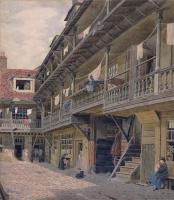
1868. George Price Boyce [aged 41]. "The Oxford Arms [Map], Warwick Lane, City of London".
1869. "Book of Days". The other galleried inn of Warwick-lane is the Oxford Arms [Map], within a recess on the west side, and nearly adjoining to the residentiary houses of St Paul's in Amen-corner. It is one of the best specimens of the old London inns remaining in the metropolis. As you advance you observe a red brick pedimented facade of the time of Charles II, beneath which you enter the inn-yard, which has, on three of its sides, two stories of balustraded wooden galleries, with exterior staircases leading to the chambers on each floor: the fourth side being occupied by stabling, built against part of old London Wall.
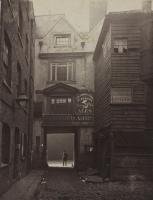
1875. The Oxford Arms, Warwick Lane [Map]. Picture taken by Alfred & John Bool of the Society for Photographing Relics of Old London.