

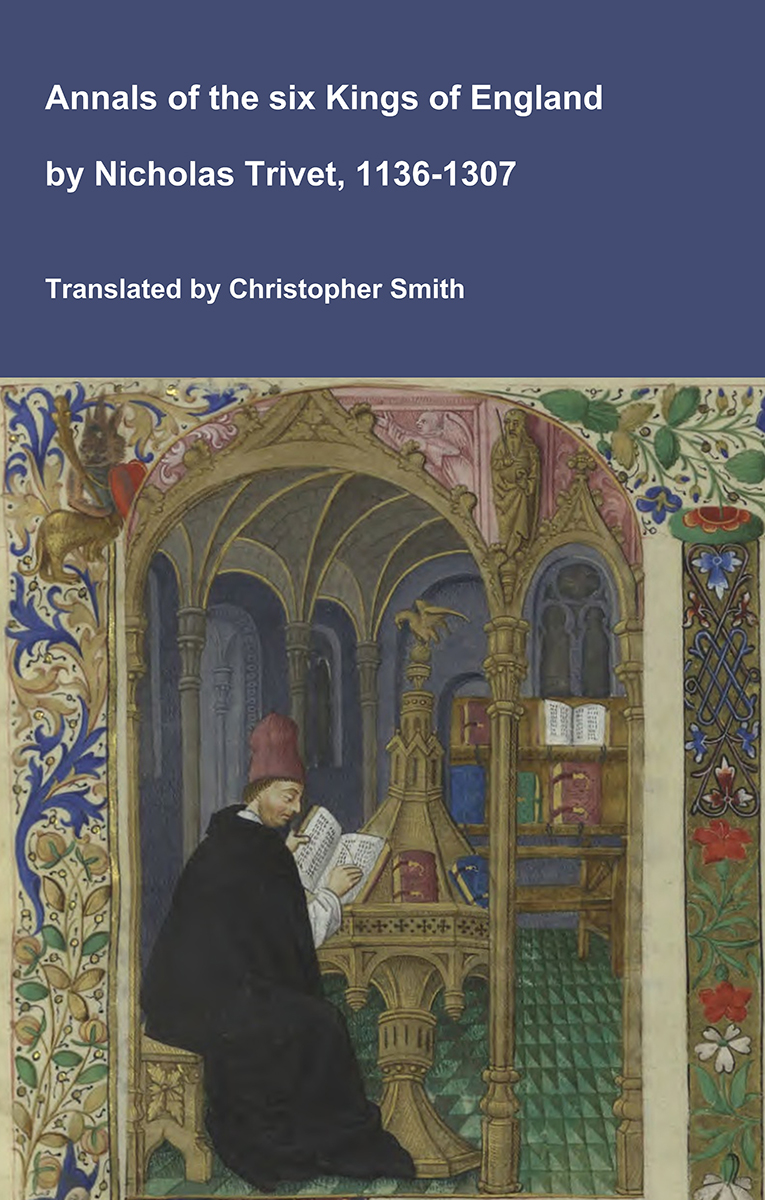
Annals of the six Kings of England by Nicholas Trivet
Translation of the Annals of the Six Kings of England by that traces the rise and rule of the Angevin aka Plantagenet dynasty from the mid-12th to early 14th century. Written by the Dominican scholar Nicholas Trivet, the work offers a vivid account of English history from the reign of King Stephen through to the death of King Edward I, blending political narrative with moral reflection. Covering the reigns of six monarchs—from Stephen to Edward I—the chronicle explores royal authority, rebellion, war, and the shifting balance between crown, church, and nobility. Trivet provides detailed insight into defining moments such as baronial conflicts, Anglo-French rivalry, and the consolidation of royal power under Edward I, whose reign he describes with particular immediacy. The Annals combines careful year-by-year reporting with thoughtful interpretation, presenting history not merely as a sequence of events but as a moral and political lesson. Ideal for readers interested in medieval history, kingship, and the origins of the English state, this chronicle remains a valuable and accessible window into the turbulent world of the Plantagenet kings.
Available at Amazon in eBook and Paperback format.
Charterhouse is in Smithfield [Map].
Henry Machyn's Diary. 23rd November 1558. The xxiij day of November the quen Elsabeth('s) (age 25) grace toke here gorney from Hadley be-yond Barnett toward London, unto my lord North('s) plase [Map], with a M. and mor of lordes, knyghtes, and gentyllmen, lades and gentyllwomen; and ther lay v days.... cote armur and pennon of armes and .... with ij whytt branchys and xij torchys and iiij gret tapurs.
Note. P. 179. The queen's coming to London. See a note by Mr. Bruce on this subject in Hayward's Annals of Elizabeth, p. 9.


Henry Machyn's Diary. 4th July 1559. The abbott of Westmynster [Map] and the monkes was reprevyd.
Henry Machyn's Diary. 13th July 1559. The xiij [Note. Possibly 16th July 1559.] day of July whent the frers blake in Smythfeld [Map] went a-way.

On 18th March 1589 Richard Sackville 3rd Earl Dorset was born to Robert Sackville 2nd Earl Dorset (age 28) and Margaret Howard (age 27) at Charterhouse [Map]. He married 27th February 1609 his fourth cousin once removed Anne Clifford Countess Dorset and Pembroke, daughter of George Clifford 3rd Earl of Cumberland and Margaret Russell Countess Cumberland, and had issue.
On 11th May 1603 Edward Tyrrell (age 52) was knighted at Charterhouse [Map].
On 11th May 1615 William Cope 2nd Baronet (age 38) was knighted by King James I of England and Ireland and VI of Scotland (age 48) at Charterhouse [Map].

John Evelyn's Diary. 21st April 1657. Came Sir Thomas Hanmer (age 45), of Hamner, in Wales, to see me. I then waited on my Lord Hatton (age 51), with whom I dined: at my return, I stepped into Bedlam, where I saw several poor, miserable creatures in chains; one of them was mad with making verses. I also visited the Charter House [Map], formerly belonging to the Carthusians, now an old, neat, fresh, solitary college for decayed gentlemen. It has a grove, bowling green, garden, chapel, and a hall where they eat in common. I likewise saw Christ Church and Hospital, a very good Gothic building; the hall, school, and lodgings in great order for bringing up many hundreds of poor children of both sexes; it is an exemplary charity. There is a large picture at one end of the hall, representing the governors, founders, and the institution.
Samuel Pepys' Diary. 23rd March 1661. All the morning at home putting papers in order, dined at home, and then out to the Red Bull (where I had not been since plays come up again), but coming too soon I went out again and walked all up and down the Charterhouse yard [Map] and Aldersgate street. At last came back again and went in, where I was led by a seaman that knew me, but is here as a servant, up to the tireing-room, where strange the confusion and disorder that there is among them in fitting themselves, especially here, where the clothes are very poor, and the actors but common fellows.
The Pardon Churchyard, Charterhouse was used for felons and suicides, and "the priory cart" used for carrying them. It belonged to Clerkenwell Priory [Map].
Chronicle of Greyfriars. 25th March 1537. Also this yere the 25th day of March the Lincolnshire men that was with Bishop Makerell was brought out of Newgate unto the Guild-hall in ropes, and there had their judgment to be drawn, hanged, and headed and quartered, and so was the 29th of March after, the which was on Maundy Thursday, and all their quarters with their heads was buried at Pardon church yard in the friary.