

Jean de Waurin's Chronicle of England Volume 6 Books 3-6: The Wars of the Roses
Jean de Waurin was a French Chronicler, from the Artois region, who was born around 1400, and died around 1474. Waurin’s Chronicle of England, Volume 6, covering the period 1450 to 1471, from which we have selected and translated Chapters relating to the Wars of the Roses, provides a vivid, original, contemporary description of key events some of which he witnessed first-hand, some of which he was told by the key people involved with whom Waurin had a personal relationship.
Available at Amazon in eBook and Paperback format.
Cheyne Walk is in Chelsea.
Cheyne Walk was named after William Cheyne 2nd Viscount Newhaven.
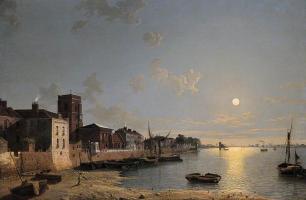
Around 1850. Henry Pether [aged 50]. Cheyne Walk in Chelsea, London, by Moonlight.
Around July 1969 Keith Richards [aged 25] and Anita Pallenburg [aged 27] moved to 3 Cheyne Walk, Chelsea.
On 22nd December 1880 Mary Anne Evans aka George Eliot [aged 61] died at her house 4 Cheyne Walk, Chelsea
David Lloyd George lived at 10 Cheyne Walk, Chelsea.
David Lloyd George lived at 10 Cheyne Walk, Chelsea.
Letters of Dante Gabriel Rossetti 1863. 2nd January 1863. Friday. 16 Cheyne Walk, Chelsea.
My dear Rose [aged 43]
I have asked Whistler to dinner Thursday next at 6. Will you meet him?
Your
D G Rossetti [aged 34]
Next Wednesday will do well for the Deed of Partnership


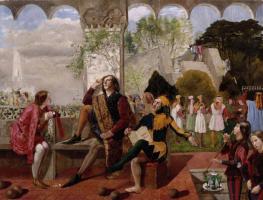


Letters of Dante Gabriel Rossetti 1863. 9th December 1863. 16 Cheyne Walk, Chelsea.
My dear Leathart [aged 43],
The picture of Whistler's [aged 29] which I mentioned was the unfinished Chinese one, since bought by Gambart [aged 49] & which was, as I thought, the one about which you wished to know.
The Thames picture is still unsold, and on enquiring of Whistler I find its price is 300 guineas. It is the noblest of all the pictures he has done hitherto, and is the one for your collection.
regards Legros' works, I yesterday saw for the first time a picture he is doing now, of Hamlet in his mother's chamber, where he kills Polonius, about 20 inches by 15 I suppose in size, it may be rather more, and a truly admirable work, the finest he has done in London as yet. He intends to ask 45 guineas for it. It is so very cheap proportionately to the other that I am induced to mention it to you, since it is a work which will stand the proximity of anything whatever, being most full & luminous in colour, though, like all his work, low in tone.
With kind remembrances to Mrs. Leathart[8].
I remain my dear Leathart
Yours ever truly
D G Rossetti [aged 35]

Dante Gabriel Rossetti lived at 16 Cheyne Walk, Chelsea.
19 to 26 Cheyne Walk, Chelsea cover the site of the original Chelsea Palace afterwards the residence of Hans Sloane 1st Baronet.
Ian Fleming lived at 24 Cheyne Walk, Chelsea.
Bram Stoker lived at 27 Cheyne Walk, Chelsea.
During the 1960s Mick Jagger [aged 16] and Marianne Faithfull [aged 13] lived at 48 Cheyne Walk, Chelsea.
After the death of her husband in April 1877, Anne Lea aka Merritt [aged 32] lived the rest of her life at 95 Cheyne Walk, Chelsea. She made frequent trips between her home in England and the United States; she had exhibitions, garnered awards in both countries, and become a celebrated artist.
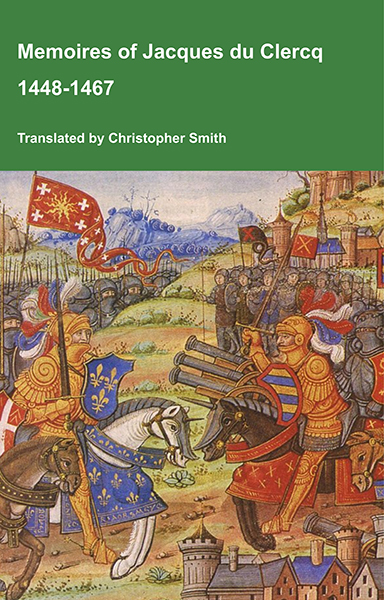
This is a translation of the 'Memoires of Jacques du Clercq', published in 1823 in two volumes, edited by Frederic, Baron de Reissenberg. In his introduction Reissenberg writes: 'Jacques du Clercq tells us that he was born in 1424, and that he was a licentiate in law and a counsellor to Philip the Good, Duke of Burgundy, in the castellany of Douai, Lille, and Orchies. It appears that he established his residence at Arras. In 1446, he married the daughter of Baldwin de la Lacherie, a gentleman who lived in Lille. We read in the fifth book of his Memoirs that his father, also named Jacques du Clercq, had married a lady of the Le Camelin family, from Compiègne. His ancestors, always attached to the counts of Flanders, had constantly served them, whether in their councils or in their armies.' The Memoires cover a period of nineteen years beginning in in 1448, ending in in 1467. It appears that the author had intended to extend the Memoirs beyond that date; no doubt illness or death prevented him from carrying out this plan. As Reissenberg writes the 'merit of this work lies in the simplicity of its narrative, in its tone of good faith, and in a certain air of frankness which naturally wins the reader’s confidence.' Du Clercq ranges from events of national and international importance, including events of the Wars of the Roses in England, to simple, everyday local events such as marriages, robberies, murders, trials and deaths, including that of his own father in Book 5; one of his last entries.
Available at Amazon in eBook and Paperback format.
In 1895 John Tweed [aged 25] moved to 108 Cheyne Walk, Chelsea with his wife Edith Clinton, secretary to the National Society for Women's Suffrage. They lived there for rest of his life.

On 19th December 1851 Joseph Mallord William Turner [aged 76] died of 'natural decay' at the home of Sophia Caroline Booth at his cottage 119 Cheyne Walk, Chelsea aka Davis Place, Cremorne Road. He was buried in St Paul's Cathedral.
Around 1771 Belle Vue House 92 Cheyne Walk, Chelsea was constructed.
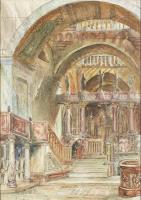
1873. Alice Boyd 14th of Penkill [aged 48]. Cappella di S. Clemente [Chapel of San Clemente/S Marks, Venice]. On a label attached to the reverse "Painted by Alice Boyd Bellevue House, Chelsea".
Lindsey House Cheyne Walk, Chelsea was subsequently divided into 96-101 Cheyne Walk.
On 1st May 1729 Brownlow Bertie 5th Duke Ancaster and Kesteven was born to Peregrine Bertie 2nd Duke Ancaster and Kesteven [aged 43] and Jane Brownlow Duchess Ancaster and Kesteven at Lindsey House Cheyne Walk, Chelsea. He married (1) 11th November 1762 Harriot Pitt (2) 2nd January 1769 Mary Anne Layard and had issue.
98 Cheyne Walk, Chelsea was the home of Marc Isambard Brunel and also his son Isambard Kingdom Brunel.