

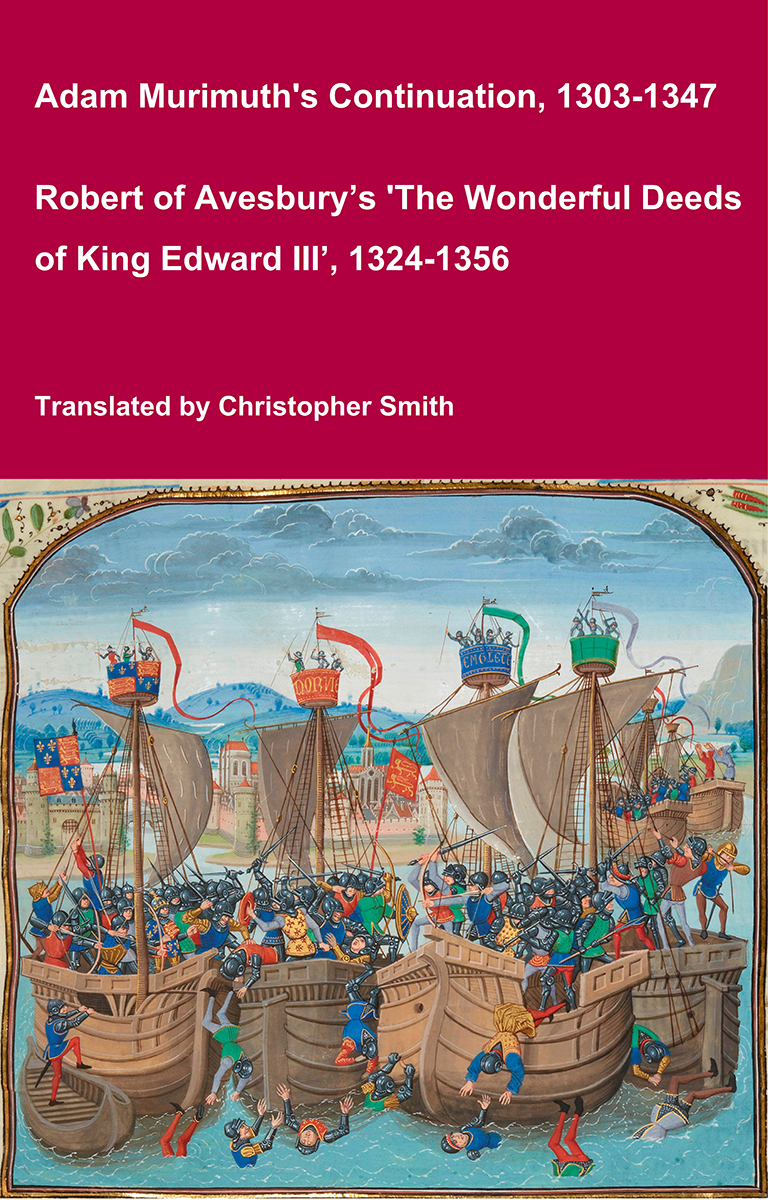
Adam Murimuth's Continuation and Robert of Avesbury’s 'The Wonderful Deeds of King Edward III'
This volume brings together two of the most important contemporary chronicles for the reign of Edward III and the opening phases of the Hundred Years’ War. Written in Latin by English clerical observers, these texts provide a vivid and authoritative window into the political, diplomatic, and military history of fourteenth-century England and its continental ambitions. Adam Murimuth Continuatio's Chronicarum continues an earlier chronicle into the mid-fourteenth century, offering concise but valuable notices on royal policy, foreign relations, and ecclesiastical affairs. Its annalistic structure makes it especially useful for establishing chronology and tracing the development of events year by year. Complementing it, Robert of Avesbury’s De gestis mirabilibus regis Edwardi tertii is a rich documentary chronicle preserving letters, treaties, and official records alongside narrative passages. It is an indispensable source for understanding Edward III’s claim to the French crown, the conduct of war, and the mechanisms of medieval diplomacy. Together, these works offer scholars, students, and enthusiasts a reliable and unembellished account of a transformative period in English and European history. Essential for anyone interested in medieval chronicles, the Hundred Years’ War, or the reign of Edward III.
Available at Amazon in eBook and Paperback format.
Christ's College, Cambridge University is in Cambridge University.
Around 1513 Archbishop Nicholas Heath [aged 12] educated at Christ's College, Cambridge University [Map].
Around 1521 Walter Mildmay was born to Thomas Mildmay [aged 36] and Agnes Read at Moulsham, Essex. He was educated at Christ's College, Cambridge University [Map]. He married before 1571 Mary Walsingham and had issue.
Around 1534 Bishop John Still was born at Grantham [Map]. He was educated at the The King's School, Grantham [Map] and Christ's College, Cambridge University [Map].
On 18th March 1558 Bishop Richard Howand [aged 17] was admitted pensioner at Christ's College, Cambridge University [Map], but he migrated to St John's College, Cambridge University [Map], where he graduated B.A. in 1561.
Around 1573 Henry Montagu 1st Earl Manchester [aged 10] educated at Christ's College, Cambridge University [Map].
In 1579 John Holles 1st Earl de Clare [aged 14] educated at Christ's College, Cambridge University [Map].
In 1598 Geoffrey Palmer 1st Baronet was born to Thomas Palmer of Carlton [aged 28]. In 1616 he was awarded BA by Christ's College, Cambridge University [Map]. In 1619 an MA.
On 18th April 1627 Justinian Isham 2nd Baronet [aged 17] admitted at Christ's College, Cambridge University [Map].
On 3rd July 1628 Herbert Springet 1st Baronet [aged 15] was admitted to Christ's College, Cambridge University [Map].
Around 1640 Adam Browne 2nd Baronet [aged 14] educated at Christ's College, Cambridge University [Map].
Jean de Waurin's Chronicle of England Volume 6 Books 3-6: The Wars of the Roses
Jean de Waurin was a French Chronicler, from the Artois region, who was born around 1400, and died around 1474. Waurin’s Chronicle of England, Volume 6, covering the period 1450 to 1471, from which we have selected and translated Chapters relating to the Wars of the Roses, provides a vivid, original, contemporary description of key events some of which he witnessed first-hand, some of which he was told by the key people involved with whom Waurin had a personal relationship.
Available at Amazon in eBook and Paperback format.
On 12th April 1646 John Bernard 2nd Baronet [aged 15] was admitted to Christ's College, Cambridge University [Map].
John Evelyn's Diary. 31st August 1654. Jesus College, Cambridge University, one of the best built, but in a melancholy situation. Next to Christ-College [Map], a very noble erection, especially the modern part, built without the quadrangle toward the gardens, of exact architecture.
Samuel Pepys' Diary. 25th February 1660. Saturday. To the Falcon [Map], in the Petty Cury1, where we found my father [aged 59] and brother [aged 19] very well. After dressing myself, about ten o'clock, my father, brother, and I to Mr. Widdririgton, at Christ's College [Map], who received us very civilly, and caused my brother to be admitted, while my father, he, and I, sat talking. After that done, we take leave. My father and brother went to visit some friends, Pepys's, scholars in Cambridge, while I went to Magdalene College, to Mr. Hill, with whom I found Mr. Zanchy, Burton, and Hollins, and was exceeding civilly received by them. I took leave on promise to sup with them, and to my Inn again, where I dined with some others that were there at an ordinary. After dinner my brother to the College, and my father and I to my Cozen Angier's, to see them, where Mr. Fairbrother came to us. Here we sat a while talking. My father he went to look after his things at the carrier's, and my brother's chamber, while Mr. Fairbrother, my Cozen Angier, and Mr. Zanchy, whom I met at Mr. Merton's shop (where I bought 'Elenchus Motuum', having given my former to Mr Downing [aged 35] when he was here), to the Three Tuns [Map], where we drank pretty hard and many healths to the King [aged 29], &c., till it began to be darkish: then we broke up and I and Mr. Zanchy went to Magdalene College, where a very handsome supper at Mr. Hill's chambers, I suppose upon a club among them, where in their discourse I could find that there was nothing at all left of the old preciseness in their discourse, specially on Saturday nights. And Mr. Zanchy told me that there was no such thing now-a-days among them at any time. After supper and some discourse then to my Inn, where I found my father in his chamber, and after some discourse, and he well satisfied with this day's work, we went to bed, my brother lying with me, his things not being come by the carrier that he could not lie in the College.
Note 1. The old Falcon Inn [Map] is on the south side of Petty Cury. It is now divided into three houses, one of which is the present Falcon Inn, the other two being houses with shops. The Falcon yard is but little changed. From the size of the whole building it must have been the principal inn of the town. The room said to have been used by Queen Elizabeth for receptions retains its original form.-M. B. The Petty Cury. The derivation of the name of his street, so well known to all Cambridge men, is a matter of much dispute among antiquaries. (See "Notes and Queries".) The most probable meaning of it is the Parva Cokeria, or little cury, where the cooks of the town lived, just as "The Poultry", where the Poulters (now Poulterers) had their shops. "The Forme of Cury", a Roll of Antient English Cookery, was compiled by the principal cooks of that "best and royalest viander of all Christian Kings", Richard the Second, and edited with a copious Index and Glossary by Dr. Samuel Pegge, 1780.-M. B.
On 2nd October 1695 Brian Broughton 3rd Baronet [aged 18] was admitted to Christ's College, Cambridge University [Map].
Around 1700 John Robartes 4th Earl Radnor [aged 14] admitted at Christ's College, Cambridge University [Map].
On 9th January 1730 John Turner 3rd Baronet [aged 17] was admitted to Christ's College, Cambridge University [Map].
Around 1739 John Hobart 2nd Earl Buckinghamshire [aged 15] educated at Christ's College, Cambridge University [Map].


In 1813 William Robert Kemp 10th Baronet [aged 21] was awarded MA by Christ's College, Cambridge University [Map].
In 1820 Reverend Edward Royds [aged 29] was awarded BA by Christ's College, Cambridge University [Map].
In 1822 Reverend Charles Smith Royds [aged 22] was awarded BA by Christ's College, Cambridge University [Map]; in 1825 MA.
In 1823 Reverend Edward Royds [aged 32] was awarded MA by Christ's College, Cambridge University [Map].
Chronicle of Walter of Guisborough
A canon regular of the Augustinian Guisborough Priory, Yorkshire, formerly known as The Chronicle of Walter of Hemingburgh, describes the period from 1066 to 1346. Before 1274 the Chronicle is based on other works. Thereafter, the Chronicle is original, and a remarkable source for the events of the time. This book provides a translation of the Chronicle from that date. The Latin source for our translation is the 1849 work edited by Hans Claude Hamilton. Hamilton, in his preface, says: 'In the present work we behold perhaps one of the finest samples of our early chronicles, both as regards the value of the events recorded, and the correctness with which they are detailed; Nor will the pleasing style of composition be lightly passed over by those capable of seeing reflected from it the tokens of a vigorous and cultivated mind, and a favourable specimen of the learning and taste of the age in which it was framed.'
Available at Amazon in eBook and Paperback format.
In 1837 Harry Mengden Scarth [aged 22] graduated B.A. from Christ's College, Cambridge University [Map]. He proceeded M.A. in 1841.
On 14th April 1876 Cecil Herbert Edward Chubb 1st Baronet was born to Alfred Chubb at Shrewton, Wiltshire [Map]. He attended Christ's College, Cambridge University [Map] where he was awarded a double first in Science and Law, leaving with Master of Arts and Bachelor of Law degrees. He married 1902 Mary Bella Alice Finch Lady Chubb and had issue.