

Jean de Waurin's Chronicle of England Volume 6 Books 3-6: The Wars of the Roses
Jean de Waurin was a French Chronicler, from the Artois region, who was born around 1400, and died around 1474. Waurin’s Chronicle of England, Volume 6, covering the period 1450 to 1471, from which we have selected and translated Chapters relating to the Wars of the Roses, provides a vivid, original, contemporary description of key events some of which he witnessed first-hand, some of which he was told by the key people involved with whom Waurin had a personal relationship.
Available at Amazon in eBook and Paperback format.
Dorchester Abbey, Oxfordshire is in Dorchester on Thames, Oxfordshire [Map], Abbeys in England.
General Photos of Dorchester Abbey, Oxfordshire [Map].
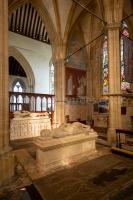
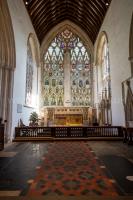
In 634 Dorchester Abbey, Oxfordshire [Map] was the seat of a Saxon Bishopric when Pope Honorius I had sent Saint Birinus, its first bishop, to found it.
Anglo-Saxon Chronicle. 635. This year King Cynegils was baptized by Bishop Birinus at Dorchester [Map]; and Oswald [aged 31], king of the Northumbrians, was his sponsor.
In 635 Bishop Birinus of Dorchester was given permission to preach by King Cynegils of Wessex. He baptised King Cynegils of Wessex who then gave him Dorchester Abbey, Oxfordshire [Map] for his episcopal see.
Anglo-Saxon Chronicle. 636. This year King Cwichelm was baptized at Dorchester [Map], and died the same year. Bishop Felix also preached to the East-Angles the belief of Christ.
Anglo-Saxon Chronicle. 639. This year Birinus baptized King Cuthred at Dorchester [Map], and received him as his son.
Anglo-Saxon Chronicle. 954. This year the Northumbrians expelled Eric; and King Edred took to the government of the Northumbrians. This year also Archbishop Wulfstan received a bishopric again at Dorchester [Map].
Chronicon ex Chronicis by Florence and John of Worcester. 1067. Wulfwi, bishop of Dorchester, died at Winchester, but was buried at Dorchester [Map].
Anglo-Saxon Chronicle. 1067. This year came the king [aged 39] back again to England on St. Nicholas's day; and the same day was burned the church of Christ at Canterbury [Map]. Bishop Wulfwy also died, and is buried at his see in Dorchester [Map].
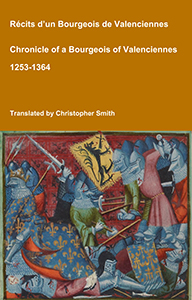
Chronicle of a Bourgeois of Valenciennes
Récits d’un bourgeois de Valenciennes aka The Chronicle of a Bourgeois of Valenciennes is a vivid 14th-century vernacular chronicle written by an anonymous urban chronicler from Valenciennes in the County of Hainaut. It survives in a manuscript that describes local and regional history from about 1253 to 1366, blending chronology, narrative episodes, and eyewitness-style accounts of political, military, and social events in medieval France, Flanders, and the Low Countries. The work begins with a chronological framework of events affecting Valenciennes and its region under rulers such as King Philip VI of France and the shifting allegiances of local nobility. It includes accounts of conflicts, sieges, diplomatic manoeuvres, and the impact of broader struggles like the Hundred Years’ War on urban life in Hainaut. Written from the perspective of a burgher (bourgeois) rather than a monastery or royal court, the chronicle offers a rare lay viewpoint on high politics and warfare, reflecting how merchants, townspeople, and civic institutions experienced the turbulence of the 13th and 14th centuries. Its narrative style combines straightforward reporting of events with moral and civic observations, making it a valuable source for readers interested in medieval urban society, regional politics, and the lived experience of war and governance in pre-modern Europe.
Available at Amazon in eBook and Paperback format.
Chronicon ex Chronicis by Florence and John of Worcester. On Monday the nones [5th April 1092] of April, Osmund, bishop of Salisbury, assisted by Walkelin, bishop of Winchester, and John, bishop of Bath, consecrated the church which he had built in the castle of Sarum. Remi, who by license from William the Elder had transferred the seat of his bishopric from Dorchester [Map] to Lincoln, was desirous of consecrating the church which he had built at Lincoln, worthy indeed to be the cathedral of a bishop's see1, because he felt that the day of his death was at hand; but Thomas, archbishop of York, opposed him, asserting that the church was built within his diocese. However, king William the younger, for a sum of money paid to him by Remi, summoned nearly all the bishops of England to assemble together on the twentieth of the ides [the 9th] of May, and dedicate the church; but two days before the time fixed, by the mysterious providence of God, bishop Remi himself departed from the world, and in consequence the consecration of the church was deferred. After this the king went into Northumbria, and restored the city which is called in the British tongue Cairleii, and in Latin Lugubalia (Carlisle [Map]), and built a castle there; for this city, like some others in that quarter, had been laid in ruins by the heathen Danes two hundred years before, and had been uninhabited up to this time.
Note 1. Cf. Henry of Huntingdon, pp. 219, 220, Antiq. Lib.
After 17th June 1282 William "The Younger" Valence was buried at Dorchester Abbey, Oxfordshire [Map]. His. Monument Early Medieval Period with Right Leg over Left. A particularly fine effigy with some remnants of its original colouring.
William "The Younger" Valence: he was born to William de Valence 1st Earl Pembroke and Joan Munchensi Countess Pembroke.


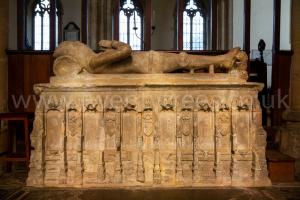
Around 1387 Hugh Segrave [aged 91] was buried at Dorchester Abbey, Oxfordshire [Map]. His. Monument of the Camail and Jupon Period.
On 29th January 1622 Francis Norreys 1st Earl Berkshire [aged 42] shot himself with a crossbow at Rycote, Oxfordshire [Map]; probably deliberately in view of his having a year before been imprisoned for attaching Emmanuel Scrope [aged 37] at the House of Lords in front of the future King Charles. He died two days later.. He was buried at Dorchester Abbey, Oxfordshire [Map]. His daughter Elizabeth [aged 19] succeeded 3rd Baroness Norreys of Rycote. Earl Berkshire and Viscount Thame extinct. Francis Rose [aged 13] inherited the manors of Weston-on-the-Green and Yattendon. Elizabeth Norreys 3rd Baroness Norreys Rycote inherited the Rycote and Wytham estates.
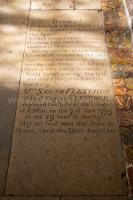
After 1799. The sad story of Sarah Fletcher. Having waited years for her husband to return from sea she discovered him in the process of marrying another woman, bigamously, driving her to suicide. The church agreed she had 'Died a Martyr to Excessive Sensibility' allowing her to be buried in consecrated ground. Her ghost is said to haunt their family home Courtiers House, Clifton Hampden near Oxford. Dorchester Abbey, Oxfordshire [Map].