

Henrici Quinti, Angliæ Regis, Gesta, is a first-hand account of the Agincourt Campaign, and subsequent events to his death in 1422. The author of the first part was a Chaplain in King Henry's retinue who was present from King Henry's departure at Southampton in 1415, at the siege of Harfleur, the battle of Agincourt, and the celebrations on King Henry's return to London. The second part, by another writer, relates the events that took place including the negotiations at Troye, Henry's marriage and his death in 1422.
Available at Amazon in eBook and Paperback format.
Dorchester on Thames, Oxfordshire is in Oxfordshire.
See: Big Rings Henge [Map], Dorchester Abbey, Oxfordshire [Map], Queensford Farm, Dorchester on Thames [Map].
In 634 Bishop Birinus of Dorchester came to England landing at Hamwic where he founded St Mary's Church, Southampton. He was appointed Bishop of Dorchester.
In 650 Bishop Egelbert [aged 25] was appointed Bishop of Dorchester.
Anglo-Saxon Chronicle. 650. This year Egelbert [aged 25], from Gaul, after Birinus the Romish bishop, obtained the bishopric of the West-Saxons.
Anglo-Saxon Chronicle. 660. This year Bishop Egelbert [aged 35] departed from Kenwal; and Wina held the bishopric three years. And Egbert accepted the bishopric of Paris, in Gaul, by the Seine.
In 660 Bishop Wine of London was translated to Bishop of Dorchester. Possibly.
Anglo-Saxon Chronicle. 670. This year died Oswy [aged 58], King of Northumberland, on the fifteenth day before the calends of March; and Egferth [aged 25] his son reigned after him. Lothere, the nephew of Bishop Egelbert [aged 45], succeeded to the bishopric over the land of the West-Saxons, and held it seven years. He was consecrated by Archbishop Theodore [aged 68]. Oswy was the son of Ethelfrith, Ethelfrith of Ethelric, Ethelric of Ida, Ida of Eoppa.
In 670 Bishop Lothere was appointed Bishop of Dorchester.
After 934 Archbishop Oscytel was elected Bishop of Dorchester.
In 1016 Bishop Æthelric was consecrated Bishop of Dorchester.
In 1034 Bishop Eadnoth was consecrated Bishop of Dorchester.
In 1049 Bishop Ulf aka Ulfus Normanus was consecrated Bishop of Dorchester.
In 1053 Bishop Wulfwy was elected Bishop of Dorchester.
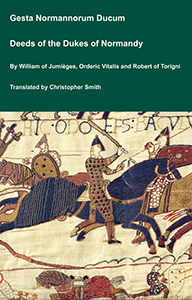
The Deeds of the Dukes of Normandy
The Gesta Normannorum Ducum [The Deeds of the Dukes of Normandy] is a landmark medieval chronicle tracing the rise and fall of the Norman dynasty from its early roots through the pivotal events surrounding the Norman Conquest of England. Originally penned in Latin by the monk William of Jumièges shortly before 1060 and later expanded at the behest of William the Conqueror, the work chronicles the deeds, politics, battles, and leadership of the Norman dukes, especially William’s own claim to the English throne. The narrative combines earlier historical sources with firsthand information and oral testimony to present an authoritative account of Normandy’s transformation from a Viking settlement into one of medieval Europe’s most powerful realms. William’s history emphasizes the legitimacy, military prowess, and governance of the Norman line, framing their expansion, including the conquest of England, as both divinely sanctioned and noble in purpose. Later chroniclers such as Orderic Vitalis and Robert of Torigni continued the history, extending the coverage into the 12th century, providing broader context on ducal rule and its impact. Today this classic work remains a foundational source for understanding Norman identity, medieval statesmanship, and the historical forces that reshaped England and Western Europe between 800AD and 1100AD.
Available at Amazon in eBook and Paperback format.
Anglo-Saxon Chronicle. 15th April 1053. In this year was the king [aged 50] at Winchester, Hampshire [Map], at Easter; and Earl Godwin [aged 52] with him, and Earl Harold [aged 31] his son, and Tosty [aged 27]. On the day after Easter sat he with the king at table; when he suddenly sunk beneath against the foot-rail, deprived of speech and of all his strength. He was brought into the king's chamber; and they supposed that it would pass over: but it was not so. He continued thus speechless and helpless till the Thursday; when he resigned his life, on the seventeenth before the calends of May; and he was buried at Winchester in the old minster. Earl Harold, his son, took to the earldom that his father had before, and to all that his father possessed; whilst Earl Elgar took to the earldom that Harold had before. The Welshmen this year slew a great many of the warders of the English people at Westbury, Wiltshire [Map]. This year there was no archbishop in this land: but Bishop Stigand held the see of Canterbury at Christ church, and Kinsey that of York. Leofwine and Wulfwy went over sea, and had themselves consecrated bishops there. Wulfwy took to the bishopric which Ulf had whilst he was living and in exile.
On 6th June 1241 John Gifford [aged 61] died at Dorchester on Thames, Oxfordshire [Map].
In 1257 John Gifford [aged 55] died at Dorchester on Thames, Oxfordshire [Map].
Bede. In short, we afterwards saw five bishops taken out of that monastery, and all of them men of singular merit and sanctity, whose names were Bosa, Eda, Oftfor, John, and Wilfrid. We have above taken notice, that the first of them was consecrated bishop at York; of the second, it is to be observed that he was appointed bishop of Dorchester. Of the two last we shall speak hereafter, as they were consecrated: the first was bishop of Hagulstad [Map], the second of the church of York; of the third we will here take notice, that having applied himself to the reading and observation of the Scriptures, in both the monasteries of Hilda, at length being desirous to attain to greater perfection, he went into Kent, to Archbishop Theodore, of blessed memory; where having spent some more time in sacred studies, he also resolved to go to Rome, which, in those days, was reckoned of great moment: returning thence into Britain, he took his way into the province of the Wiccii, where King Osric then ruled, and continued there a long time, preaching the word of faith, and making himself an example of ofood life to all that saw and heard him. At that time, Bosel, the bishop of that province, laboured under such weakness of body, that he could not himself perform the episcopal functions; for which reason, this Oftfor was, by universal consent, chosen bishop in his stead, and by order of King Ethelred, consecrated by Bishop Wilfrid, of blessed memory, who was then bishop of the Midland Angles, because Archbishop Theodore was dead, and no other bishop ordained in his place. Before the aforesaid man of God, Bosel, Tatfrid, a most learned and indus- trious man, and of excellent ability, had been chosen bishop there, from the same abbess's monastery, but had been snatched away by an untimely death, before he could be ordained.
Big Rings Henge is also in South England Henges.
Carbon Date. 2510BC. Late Neolithic Carbon Dates
Report: Collagen, id as antler, red deer beam and tine (Annie Grant), Ref. 79a, from lowest silt of cursus ditch, at Dorchester Site VIII [Map], Oxfordshire, England. Subm R Bradley. Comment (subm): Confirms chronological context of cursus monuments (cf Dorset Cursus, BM-2438).
ID: 1874, C14 ID: BM-2443 Date BP: 4510 +/- 100, Start Date BP: 4410, End BP: 4610
OS Letter: SU, OS East: 582, OS North: 948
Archaeologist Name: R J C Atkinson 1949
Reference Name: Radiocarbon, 31, 1989, 18; Oxford J Archaeol, 7, 1988, 271-89; Proc Prehist Soc, 58, 1992, 143-201
Council for British Archaeology (2012) Archaeological Site Index to Radiocarbon Dates from Great Britain and Ireland [data-set]. York: Archaeology Data Service [distributor] https://doi.org/10.5284/1017767
Carbon Date. 2320BC. Early Bronze Age Carbon Dates
Report: Collagen, id as antler, red deer brow tine (Annie Grant), Ref. 87, from bottom of Ditch 1 (last ditch) at Dorchester Site XI 'Big Rings [Map]', Oxfordshire, England. Subm R Bradley 1984. Comment (subm): Confirms Neo attribution but comes from secondary phase.
ID: 1873, C14 ID: BM-2442 Date BP: 4320 +/- 50, Start Date BP: 4270, End BP: 4370
Abstract: triple-ditched enclosure
Archaeologist Name: R J C Atkinson 1949
Reference Name: Radiocarbon, 31, 1989, 18; Oxford J Archaeol, 7, 1988, 271-89 [where s.d. given as 70]; Proc Prehist Soc, 58, 1992, 143-201
Council for British Archaeology (2012) Archaeological Site Index to Radiocarbon Dates from Great Britain and Ireland [data-set]. York: Archaeology Data Service [distributor] https://doi.org/10.5284/1017767
Carbon Date. 2320BC. Early Bronze Age Carbon Dates
Report: Collagen, id as antler, red deer tines (Annie Grant), Ref. 33, from bottom of Ditch 1 (last ditch) at Dorchester Site XI 'Big Rings [Map]', Oxfordshire, England. Subm R Bradley 1984. Comment (subm): Confirms Neo attribution but comes from secondary phase.
ID: 1872, C14 ID: BM-2440 Date BP: 4320 +/- 90, Start Date BP: 4230, End BP: 4410
Abstract: triple-ditched enclosure
Archaeologist Name: R J C Atkinson 1949
Reference Name: Radiocarbon, 31, 1989, 18; Oxford J Archaeol, 7, 1988, 271-89; Proc Prehist Soc, 58, 1992, 143-201
Council for British Archaeology (2012) Archaeological Site Index to Radiocarbon Dates from Great Britain and Ireland [data-set]. York: Archaeology Data Service [distributor] https://doi.org/10.5284/1017767
Carbon Date. 2230BC. Early Bronze Age Carbon Dates
Report: Antler, id as probably red deer (R Wilson), from top of primary fill of ditch (Site I F81) at Dorchester-on-Thames Site I [Map], Oxfordshire, England. Coll R Chambers. Subm R Bradley. Comments (lab): Is new determination on material previously dated erroneously as BM-2268; (subm): Measured to establish TAQ for cremation burials cut into uppermost filling of ditch.
ID: 1923, C14 ID: BM-4225N Date BP: 4230 +/- 50, Start Date BP: 4180, End BP: 4280
Abstract: sited within E terminal of Dorchester Cursus
Archaeologist Name: R Chambers
Reference Name: Radiocarbon, 27, 1985, 509-10 (original determination Radiocarbon, 32, 1990, 65 (revision Oxford J Archaeol, 1988, 7, 271-89; Proc Prehist Soc, 58, 1992, 143-201
Council for British Archaeology (2012) Archaeological Site Index to Radiocarbon Dates from Great Britain and Ireland [data-set]. York: Archaeology Data Service [distributor] https://doi.org/10.5284/1017767
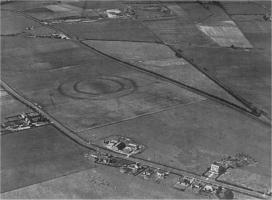
1938. Major George Allen [aged 46]. Photo of Big Rings Henge [Map].
Antiquity 2022 Volume 96.2: Stonehenge: the Aubrey Holes. The sequence represented by the Aubrey Holes, in which a post circle is followed by a pit circle, is matched at other contemporaneous sites in Wessex and beyond; examples near Stonehenge include the Durrington Walls Southern Circle and Woodhenge (see Darvill 2006: 161–64). Further afield, a similar pattern is documented for the circles inside the cursus at Dorchester on Thames [Map], Oxfordshire (Bradley & Chambers 1988: 283). The presence of numerous cremation deposits in the secondary fills of the Aubrey Holes also finds parallels at other sites across Britain in the early third millennium BC (Darvill 2010: 147–52), although Parker Pearson and colleagues are correct to highlight the extraordinary scale of the Stonehenge cemetery in terms of the number of individuals buried there (Parker Pearson et al. 2020: 180).
Carbon Date. 450. Late Iron Age Carbon Dates
Report: Bone, id as human, from F75, grave 250 at Queenford Farm or Queensford Mill [Map], Dorchester-on-Thames, Oxfordshire, England. Subm R A Chambers. Comment (subm): No stratigraphic relationship between graves.
ID: 1601, C14 ID: HAR-5351 Date BP: 1550 +/- 80, Start Date BP: 1470, End BP: 1630
Abstract: Site I along route of Dorchester bypass, and to NE of Roman town
Archaeologist Name: R A Chambers
Reference Name: Radiocarbon, 30, 1988, 337; Oxoniensia, 52, 1987, 35-69
Council for British Archaeology (2012) Archaeological Site Index to Radiocarbon Dates from Great Britain and Ireland [data-set]. York: Archaeology Data Service [distributor] https://doi.org/10.5284/1017767
Hampshire (MARC 3 Site R27)' (= Hampshire Fld Club Archaeol Soc Monogr
5)
1987
59-60""
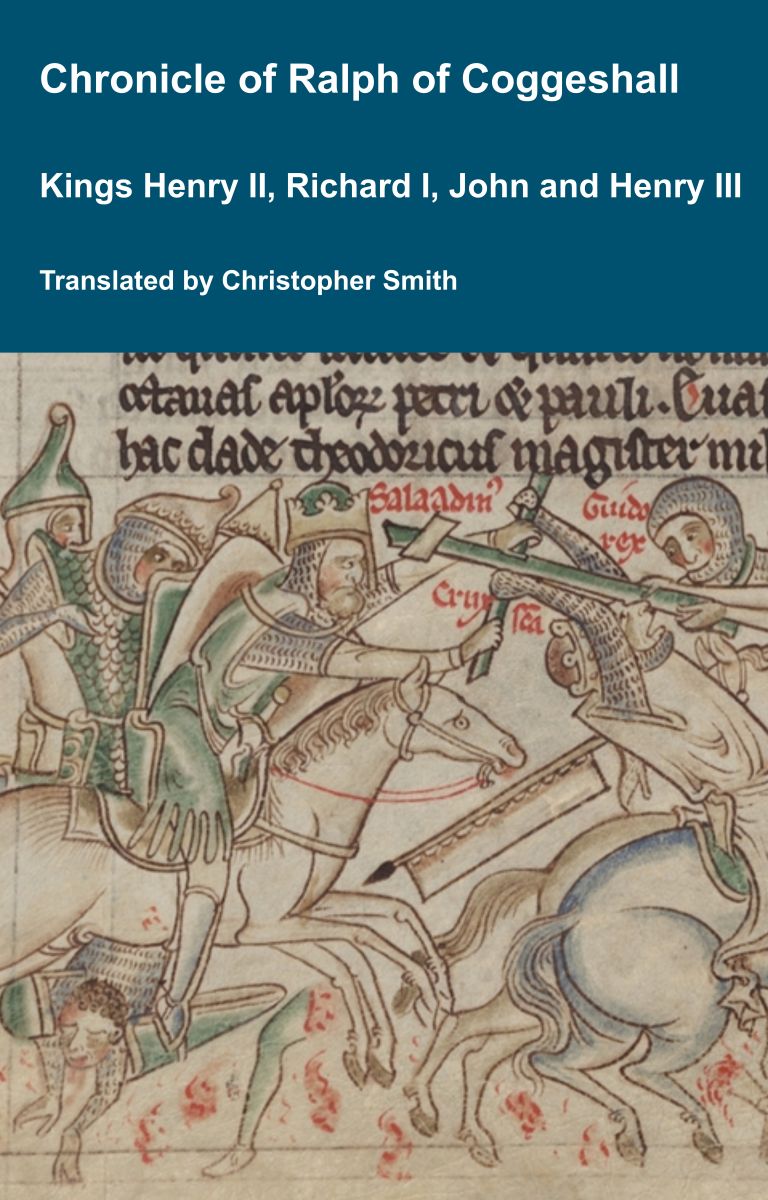
Chronicle of Abbot Ralph of Coggeshall
The Chronicle of Abbot Ralph of Coggeshall (Chronicon Anglicanum) is an indispensable medieval history that brings to life centuries of English and European affairs through the eyes of a learned Cistercian monk. Ralph of Coggeshall, abbot of the Abbey of Coggeshall in Essex in the early 13th century, continued and expanded his community’s chronicle, documenting events from the Norman Conquest of 1066 into the tumultuous reign of King Henry III. Blending eyewitness testimony, careful compilation, and the monastic commitment to record-keeping, this chronicle offers a rare narrative of political intrigue, royal power struggles, and social upheaval in England and beyond. Ralph’s work captures the reigns of pivotal figures such as Richard I and King John, providing invaluable insights into their characters, decisions, and the forces that shaped medieval rule. More than a simple annal, Chronicon Anglicanum conveys the texture of medieval life and governance, making it a rich source for scholars and readers fascinated by English history, monastic authorship, and the shaping of the medieval world.
Available at Amazon in eBook and Paperback format.
Carbon Date. 450. Late Iron Age Carbon Dates
Report: Bone, id as human, from F48, grave 229 at Queenford Farm or Queensford Mill [Map], Dorchester-on-Thames, Oxfordshire, England. Subm R A Chambers. Comment (subm): No stratigraphic relationship between graves.
ID: 1600, C14 ID: HAR-5350 Date BP: 1550 +/- 70, Start Date BP: 1480, End BP: 1620
Abstract: Site I along route of Dorchester bypass, and to NE of Roman town
Archaeologist Name: R A Chambers
Reference Name: Radiocarbon, 30, 1988, 337; Oxoniensia, 52, 1987, 35-69
Council for British Archaeology (2012) Archaeological Site Index to Radiocarbon Dates from Great Britain and Ireland [data-set]. York: Archaeology Data Service [distributor] https://doi.org/10.5284/1017767
Carbon Date. 520. Early Medieval
Report: Bone, id as human, from F34, grave 216 at Queenford Farm or Queensford Mill [Map], Dorchester-on-Thames, Oxfordshire, England. Subm R A Chambers. Comment (subm): No stratigraphic relationship between graves.
ID: 1598, C14 ID: HAR-5325 Date BP: 1480 +/- 70, Start Date BP: 1410, End BP: 1550
Abstract: Site I along route of Dorchester bypass, and to NE of Roman town
Archaeologist Name: R A Chambers
Reference Name: Radiocarbon, 30, 1988, 337; Oxoniensia, 52, 1987, 35-69
Council for British Archaeology (2012) Archaeological Site Index to Radiocarbon Dates from Great Britain and Ireland [data-set]. York: Archaeology Data Service [distributor] https://doi.org/10.5284/1017767
Carbon Date. 570. Early Medieval
Report: Bone, id as human, from F64, grave 244 at Queenford Farm or Queensford Mill [Map], Dorchester-on-Thames, Oxfordshire, England. Subm R A Chambers. Comment (subm): No stratigraphic relationship between graves.
ID: 1599, C14 ID: HAR-5324 Date BP: 1430 +/- 70, Start Date BP: 1360, End BP: 1500
Abstract: Site I along route of Dorchester bypass, and to NE of Roman town
Archaeologist Name: R A Chambers
Reference Name: Radiocarbon, 30, 1988, 337; Oxoniensia, 52, 1987, 35-69
Council for British Archaeology (2012) Archaeological Site Index to Radiocarbon Dates from Great Britain and Ireland [data-set]. York: Archaeology Data Service [distributor] https://doi.org/10.5284/1017767