William of Worcester's Chronicle of England
William of Worcester, born around 1415, and died around 1482 was secretary to John Fastolf, the renowned soldier of the Hundred Years War, during which time he collected documents, letters, and wrote a record of events. Following their return to England in 1440 William was witness to major events. Twice in his chronicle he uses the first person: 1. when writing about the murder of Thomas, 7th Baron Scales, in 1460, he writes '… and I saw him lying naked in the cemetery near the porch of the church of St. Mary Overie in Southwark …' and 2. describing King Edward IV's entry into London in 1461 he writes '… proclaimed that all the people themselves were to recognize and acknowledge Edward as king. I was present and heard this, and immediately went down with them into the city'. William’s Chronicle is rich in detail. It is the source of much information about the Wars of the Roses, including the term 'Diabolical Marriage' to describe the marriage of Queen Elizabeth Woodville’s brother John’s marriage to Katherine, Dowager Duchess of Norfolk, he aged twenty, she sixty-five or more, and the story about a paper crown being placed in mockery on the severed head of Richard, 3rd Duke of York.
Available at Amazon in eBook and Paperback format.
Farringdon Within is in City of London.
On 28th February 1611 Edward Barkham [aged 41] was appointed Alderman of Farringdon Within.
In 1618 Maximilian Colt [aged 43] had a house in Farringdon Within when his name appears in a list of foreigners then resident in London, together with that of John Colt, probably his son, who was also a sculptor and a native of Arras.
In 1123 Church of St Bartholomew the Great was founded by Rahere, a prebendary of St Paul's Cathedral and an Augustinian canon regular as an Augustinian Priory.
Henry Machyn's Diary. 3rd April 1557. The sam day dyd pryche docthur Perryn the master of the blake frers in sant Bartholomuw in Smyth-feld, at Bowe [Map] in Chepesyd dyd pryche ...

Henry Machyn's Diary. 16th December 1558. The xvj day of December was cared in a charett from sant Baythelmuw the grett unto Essex to be bered, with baners and banerrolles abowt her, my lade Ryche [aged 48], and so to the plasse wher she dwelyd.
On 29th March 1629 Maximillian Colt's [aged 54] daughter Abigail was buried, at the age of sixteen, in the St. Bartholomew's Church, and his wife, Susan, in 1646.
On 18th December 1638 Henry Bourchier 5th Earl Bath [aged 51] and Rachael Fane Countess Bath and Middlesex [aged 25] were married at Church of St Bartholomew the Great. She by marriage Countess Bath, Countess Eu. The difference in their ages was 26 years. She the daughter of Francis Fane 1st Earl of Westmoreland and Mary Mildmay Countess of Westmoreland [aged 56]. They were second cousin twice removed.
On 4th July 1641 George Hastings [deceased] was buried at the Church of St Bartholomew the Great. Administration of his estate was granted to his widow Seymour Prynne on 10 August. His sons all died unmarried
On 21st November 1558 James Bassett [aged 32] died. On 26th November 1558 he was buried at St Ann Blackfriars Church.
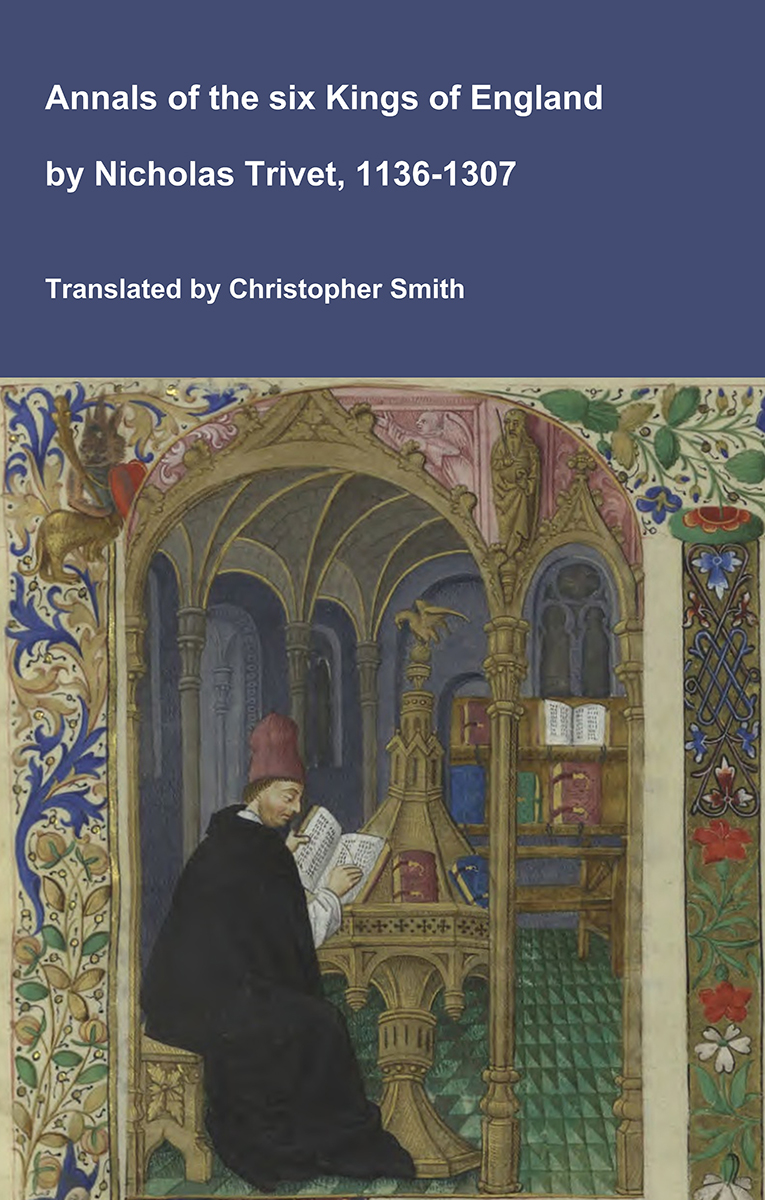
Annals of the six Kings of England by Nicholas Trivet
Translation of the Annals of the Six Kings of England by that traces the rise and rule of the Angevin aka Plantagenet dynasty from the mid-12th to early 14th century. Written by the Dominican scholar Nicholas Trivet, the work offers a vivid account of English history from the reign of King Stephen through to the death of King Edward I, blending political narrative with moral reflection. Covering the reigns of six monarchs—from Stephen to Edward I—the chronicle explores royal authority, rebellion, war, and the shifting balance between crown, church, and nobility. Trivet provides detailed insight into defining moments such as baronial conflicts, Anglo-French rivalry, and the consolidation of royal power under Edward I, whose reign he describes with particular immediacy. The Annals combines careful year-by-year reporting with thoughtful interpretation, presenting history not merely as a sequence of events but as a moral and political lesson. Ideal for readers interested in medieval history, kingship, and the origins of the English state, this chronicle remains a valuable and accessible window into the turbulent world of the Plantagenet kings.
Available at Amazon in eBook and Paperback format.
Henry Machyn's Diary. 26th November 1558. The xxvj day of November was bered at the Blake Frers in Smythfeld master Bassett [deceased] sqwyre, on of the [privy] chambur with quen Mare; and he had ij whyt branchys, and xij torchys, and iiij gret tapurs, and a harold ... a cote armur, a penon of armes, and ij dosen of [shocheons.]

On 17th March 1609 Elizabeth Hobart was born to Henry Hobart 1st Baronet [aged 49] and Dorothy Bell Lady Hobart. She was baptised at St Ann Blackfriars Church on 21st March 1609. She married 15th February 1632 John Lisle.
On 23rd October 1615 Allen Apsley [aged 48] and Lucy St John [aged 22] were married at St Ann Blackfriars Church. The difference in their ages was 26 years.
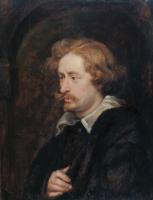
On 1st December 1641 Justina Van Dyck was born to Anthony Van Dyck [aged 42] and Mary Ruthven [aged 21]. Her father died eight days after her birth. She was baptised on the same day as her father's death, 9th December 1641 at St Ann Blackfriars Church. She married 1653 John Stepney 4th Baronet and had issue.
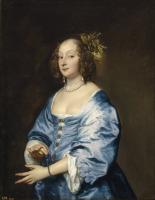
On 20th September 1650 Weston Ridgeway 3rd Earl Londonderry and Frances Temple were married at St Ann Blackfriars Church.
On 23rd August 1305 William Wallace was hanged, drawn and quartered at the Elms in Smithfield [Map]. His head being displayed on London Bridge [Map].
On 8th April 1956 a plaque was unveiled on the wall of St Bartholomew's Hospital near to the site of his execution the text of which reads...
To the immortal memory of Sir William Wallace Scottish patriot born at Elderslie Renfrewshire circa 1270 A.D. Who from the year 1296 fought dauntlessly in defence of his country's liberty and independence in the face of fearful odds and great hardship being eventually betrayed and captured brought to London and put to death near this spot on the 23rd August 1305.
His example heroism and devotion inspired those who came after him to win victory from defeat and his memory remains for all time a source of pride, honour and inspiration to his Countrymen.
"Dico tibi verum libertas optima rerum nunquam servili sub nexu vivito fili"
Translation: I tell you the truth, son, freedom is the best condition, never live like a slave
"Bas Agus Buaidh" aka Death and Victory, a traditional Scottish battle cry.
In 1549 John White was appointed Treasurer of St Bartholomew's Hospital.
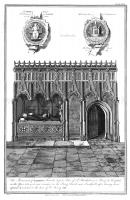
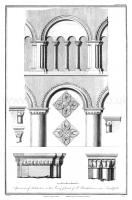
Vesta Monumenta. 1784. Plates 2.36 and 2.37. Monument to Rahere at St Bartholomew's Hospital.