

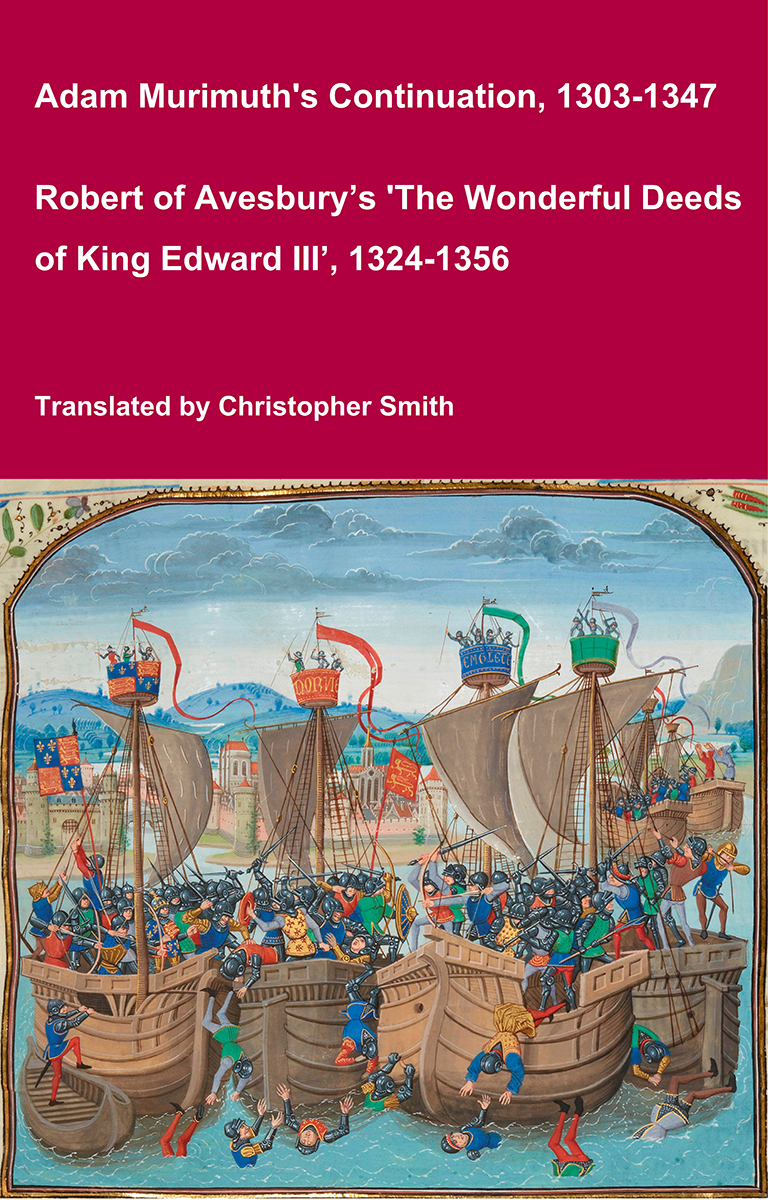
Adam Murimuth's Continuation and Robert of Avesbury’s 'The Wonderful Deeds of King Edward III'
This volume brings together two of the most important contemporary chronicles for the reign of Edward III and the opening phases of the Hundred Years’ War. Written in Latin by English clerical observers, these texts provide a vivid and authoritative window into the political, diplomatic, and military history of fourteenth-century England and its continental ambitions. Adam Murimuth Continuatio's Chronicarum continues an earlier chronicle into the mid-fourteenth century, offering concise but valuable notices on royal policy, foreign relations, and ecclesiastical affairs. Its annalistic structure makes it especially useful for establishing chronology and tracing the development of events year by year. Complementing it, Robert of Avesbury’s De gestis mirabilibus regis Edwardi tertii is a rich documentary chronicle preserving letters, treaties, and official records alongside narrative passages. It is an indispensable source for understanding Edward III’s claim to the French crown, the conduct of war, and the mechanisms of medieval diplomacy. Together, these works offer scholars, students, and enthusiasts a reliable and unembellished account of a transformative period in English and European history. Essential for anyone interested in medieval chronicles, the Hundred Years’ War, or the reign of Edward III.
Available at Amazon in eBook and Paperback format.
Grantham is in Lincolnshire.
See: Belton, Grantham [Map], , St Wulfram's Church, Grantham [Map], The King's School, Grantham [Map].
On 4th December 1290 Eleanor of Castile Queen Consort England [deceased] body rested at Grantham [Map].

Collectanea by John Leland [1502-1552]. [8th July 1503] From the seid Place of Colweston, the Quene [aged 13] touke hyr Way ryght to Grantham. Halfe Way before hyr came Sir Robert Dymock, Knight, Sheriff of the County of Lincoln, honestly accompayned of xxx Horses well arayd of his Liveray, and salved the Quene, holdyng a whyt Rod in his Haund, the wich hee bered before hyr, lastyng the sayd County of Lyncoln, as the other Sheriffs did here afterward in their Counties.
About foure Myles from Grauntham, the Alderman, accompanyed with the Burgesses and Inhabitants of Grantham [Map] in fayre Order, receyved hyr to the Number of iiijxx Horses honnestly appoynted, and conveyed her to the next Towne.
Without the sayd Towne, was in Processyon in fayr Order the Colledge of the sayd Place, and the Freres Mendicants, the wich received hyr in synging Laudes. And att the fayd Place lightyd of his Horse my Lord the Bishop of Norwich; the wich gaff her the Crossys for to kysse. And thus was doon continualiy, lastyng the said Veyage thorough the Reyme of Inglaund, in all the Places wher she cam.
This doon she was brought with the sayd Compayne in fayr Aray to hyr Lodgyngs, that was with a Gentylman called Mr. Hioli.
Through all the goode Towne and Villages wher she pass, all the Bells wer rong dayly. And by the Way cam the Habitants of the Countrey for to see the noble Company, bryngyng grette Vessells full of Drynk, and gyffing the same to them that Nedde had of it, saying, that if better they had had, better they should have brought.
Around 1534 Bishop John Still was born at Grantham [Map]. He was educated at the The King's School, Grantham [Map] and Christ's College, Cambridge University [Map].
On 23rd March 1643 Charles Cavendish [aged 22] was captured at Grantham [Map].
John Evelyn's Diary. 20th August 1654. From hence we had a most pleasant ride over a large heath open like Salisbury Plain, to Grantham [Map], a pretty town, so well situated on the side of a bottom which is large and at a distance environed with ascending grounds, that for pleasure I consider it comparable to most inland places of England; famous is the steeple for the exceeding height of the shaft, which is of stone.
The River Witham rises near South Witham, South Kesteven [Map] from where it flows past North Witham, South Kesteven [Map], Colsterworth, South Kesteven [Map], Easton, South Kesteven [Map] to Great Ponton, South Kesteven [Map] where it is joined by the Cringle Brook.
From Great Ponton, South Kesteven [Map] the River Witham flows through Grantham [Map], Belton, Grantham [Map], past Barkston, South Kesteven [Map], Marston, South Kesteven [Map] and Hougham, South Kesteven [Map], Westborough, South Kesteven [Map], Long Benington, South Kesteven [Map], Claypole, South Kesteven [Map], Beckingham, North Kesteven [Map], Norton Disney, North Kesteven [Map], Bassingham, North Kesteven [Map], Haddington, North Kesteven [Map], Aubourn, North Kesteven [Map] through the centre of Lincoln, Lincolnshire [Map] where it joined by the River Till.
From Lincoln, Lincolnshire [Map] it flows under Five Mile Bridge [Map], past Bardney Abbey [Map], Kirkstead [Map], under Tattershall Bridge [Map] after which it is joined by the River Bain
After Tattershall the River Witham flows through canalised sections under Lanrick Bridge [Map], past Anton's Gowt [Map] to Boston [Map] where it is joined by the South Forty Foot Drain. After Boston [Map] the River Witham flows into the The Wash around eight kilometres away.
Around 1229 Ralph Blount was born to Robert Blount [aged 32] and Isabel Odingsells [aged 27] at Belton, Grantham [Map].
Around 1231 Walter Blount was born to Robert Blount [aged 34] and Isabel Odingsells [aged 29] at Belton, Grantham [Map].
Around 1233 William Blount was born to Robert Blount [aged 36] and Isabel Odingsells [aged 31] at Belton, Grantham [Map]. He married before 1270 Isabel Beauchamp and had issue.
On 10th February 1247 Rohesia Verdun [aged 43] died at Belton, Grantham [Map].
In 1263 Thomas Blount 1st Baron Blount was born to Ralph Blount [aged 34] at Belton, Grantham [Map]. He married after 20th January 1325 Juliana Leybourne Countess Huntingdon.
Abbot John Whethamstede’s Chronicle of the Abbey of St Albans
Abbot John Whethamstede's Register aka Chronicle of his second term at the Abbey of St Albans, 1451-1461, is a remarkable text that describes his first-hand experience of the beginning of the Wars of the Roses including the First and Second Battles of St Albans, 1455 and 1461, respectively, their cause, and their consequences, not least on the Abbey itself. His text also includes Loveday, Blore Heath, Northampton, the Act of Accord, Wakefield, and Towton, and ends with the Coronation of King Edward IV. In addition to the events of the Wars of the Roses, Abbot John, or his scribes who wrote the Chronicle, include details in the life of the Abbey such as charters, letters, land exchanges, visits by legates, and disputes, which provide a rich insight into the day-to-day life of the Abbey, and the challenges faced by its Abbot.
Available at Amazon in eBook and Paperback format.
In 1288 Robert Blount [aged 91] died at Belton, Grantham [Map].
In 1295 William Blount was born to Thomas Blount 1st Baron Blount [aged 32] at Belton, Grantham [Map].
The River Witham rises near South Witham, South Kesteven [Map] from where it flows past North Witham, South Kesteven [Map], Colsterworth, South Kesteven [Map], Easton, South Kesteven [Map] to Great Ponton, South Kesteven [Map] where it is joined by the Cringle Brook.
From Great Ponton, South Kesteven [Map] the River Witham flows through Grantham [Map], Belton, Grantham [Map], past Barkston, South Kesteven [Map], Marston, South Kesteven [Map] and Hougham, South Kesteven [Map], Westborough, South Kesteven [Map], Long Benington, South Kesteven [Map], Claypole, South Kesteven [Map], Beckingham, North Kesteven [Map], Norton Disney, North Kesteven [Map], Bassingham, North Kesteven [Map], Haddington, North Kesteven [Map], Aubourn, North Kesteven [Map] through the centre of Lincoln, Lincolnshire [Map] where it joined by the River Till.
From Lincoln, Lincolnshire [Map] it flows under Five Mile Bridge [Map], past Bardney Abbey [Map], Kirkstead [Map], under Tattershall Bridge [Map] after which it is joined by the River Bain
After Tattershall the River Witham flows through canalised sections under Lanrick Bridge [Map], past Anton's Gowt [Map] to Boston [Map] where it is joined by the South Forty Foot Drain. After Boston [Map] the River Witham flows into the The Wash around eight kilometres away.