

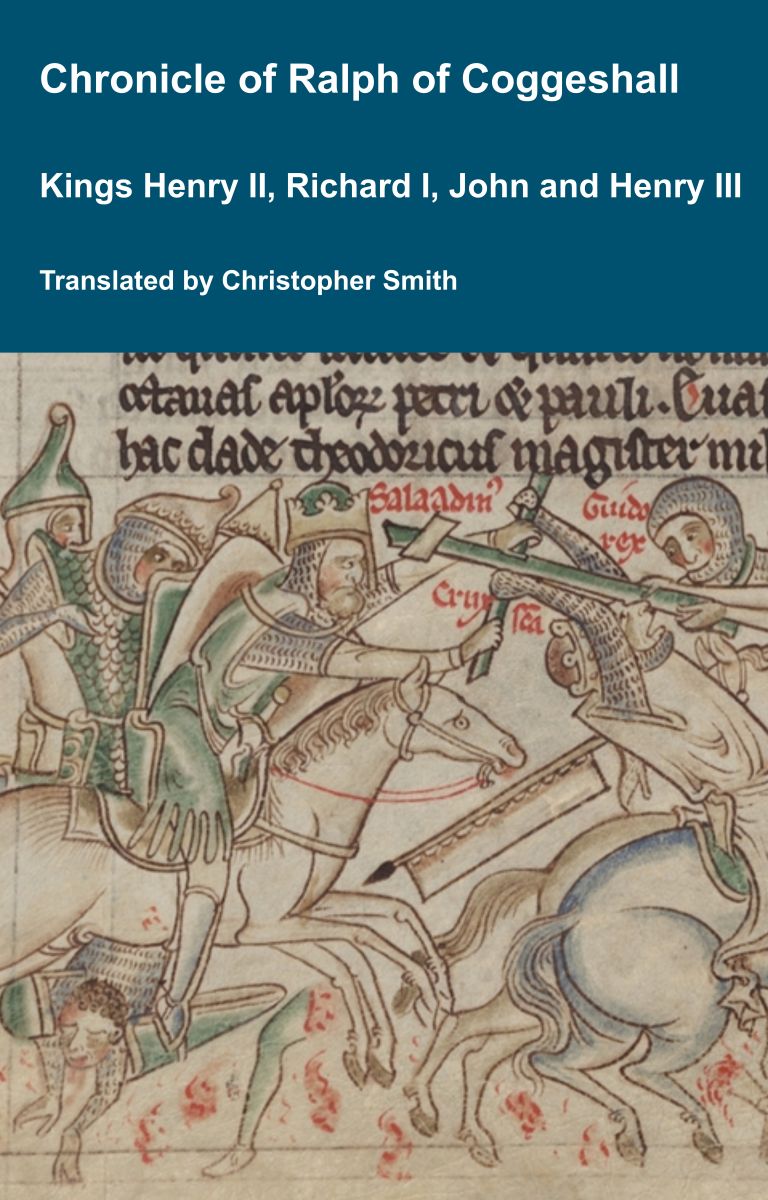
Chronicle of Abbot Ralph of Coggeshall
The Chronicle of Abbot Ralph of Coggeshall (Chronicon Anglicanum) is an indispensable medieval history that brings to life centuries of English and European affairs through the eyes of a learned Cistercian monk. Ralph of Coggeshall, abbot of the Abbey of Coggeshall in Essex in the early 13th century, continued and expanded his community’s chronicle, documenting events from the Norman Conquest of 1066 into the tumultuous reign of King Henry III. Blending eyewitness testimony, careful compilation, and the monastic commitment to record-keeping, this chronicle offers a rare narrative of political intrigue, royal power struggles, and social upheaval in England and beyond. Ralph’s work captures the reigns of pivotal figures such as Richard I and King John, providing invaluable insights into their characters, decisions, and the forces that shaped medieval rule. More than a simple annal, Chronicon Anglicanum conveys the texture of medieval life and governance, making it a rich source for scholars and readers fascinated by English history, monastic authorship, and the shaping of the medieval world.
Available at Amazon in eBook and Paperback format.
Great Piazza Covent Garden is in Covent Garden [Map].

Samuel Pepys' Diary. 17th January 1662. To Westminster with Mr. Moore, and there, after several walks up and down to hear news, I met with Lany, the Frenchman, who told me that he had a letter from France last night, that tells him that my Lord Hinchingbroke is dead, [proved false] and that he did die yesterday was se'nnight, which do surprise me exceedingly (though we know that he hath been sick these two months), so I hardly ever was in my life; but being fearfull that my Lady should come to hear it too suddenly, he and I went up to my Lord Crew's, and there I dined with him, and after dinner we told him, and the whole family is much disturbed by it: so we consulted what to do to tell my Lady of it; and at last we thought of my going first to Mr. George Montagu's (age 39) to hear whether he had any news of it, which I did, and there found all his house in great heaviness for the death of his son, Mr. George Montagu, who did go with our young gentlemen into France, and that they hear nothing at all of our young Lord; so believing that thence comes the mistake, I returned to my Lord Crew (in my way in the Piazza seeing a house on fire, and all the streets full of people to quench it), and told them of it, which they are much glad of, and conclude, and so I hope, that my Lord is well; and so I went to my Lady Sandwich (age 37), and told her all, and after much talk I parted thence with my wife, who had been there all the day, and so home to my musique, and then to bed.
Samuel Pepys' Diary. 2nd January 1665. Then to the Hall, and there agreed with Mrs. Martin, and to her lodgings which she has now taken to lie in, in Bow Streete, pitiful poor things, yet she thinks them pretty, and so they are for her condition I believe good enough. Here I did 'ce que je voudrais avec' her most freely, and it having cost 2s. in wine and cake upon her, I away sick of her impudence, and by coach to my Lord Bruncker's (age 45), by appointment, in the Piazza, in Covent-Guarding; where I occasioned much mirth with a ballet I brought with me, made from the seamen at sea to their ladies in town; saying Sir W. Pen (age 43), Sir G. Ascue (age 49), and Sir J. Lawson (age 50) made them. Here a most noble French dinner and banquet, the best I have seen this many a day and good discourse.


Samuel Pepys' Diary. 2nd August 1666. Thence to the office, and thither comes to me Creed, and he and I walked a good while, and then to the Victualling Office together, and there with Mr. Gawden I did much business, and so away with Creed again, and by coach to see my Lord Bruncker (age 46), who it seems was not well yesterday, but being come thither, I find his coach ready to carry him abroad, but Tom, his footman, whatever the matter was, was lothe to desire me to come in, but I walked a great while in the Piatza till I was going away, but by and by my Lord himself comes down and coldly received me.
Samuel Pepys' Diary. 21st January 1667. Up betimes, and with, Sir W. Batten (age 66), Sir W. Pen (age 45), Sir R. Ford (age 53), by coach to the Swede's Resident's in the Piatza, to discourse with him about two of our prizes, wherein he puts in his concernment as for his countrymen. We had no satisfaction, nor did give him any, but I find him a cunning fellow. He lives in one of the great houses there, but ill-furnished; and come to us out of bed in his furred mittens and furred cap.
Samuel Pepys' Diary. 9th April 1667. After the play was done, as I come so I went away alone, and had a mind to have taken out Knipp to have taken the ayre with her, and to that end sent a porter in to her that she should take a coach and come to me to the Piatza in Covent Garden, where I waited for her, but was doubtful I might have done ill in doing it if we should be visti ensemble, sed elle was gone out, and so I was eased of my care, and therefore away to Westminster to the Swan [Map], and there did baiser la little missa.... and drank, and then by water to the Old Swan [Map], and there found Betty Michell sitting at the door, it being darkish. I staid and talked a little with her, but no once baiser la, though she was to my thinking at this time une de plus pretty mohers that ever I did voir in my vida, and God forgive me my mind did run sobre elle all the vespre and night and la day suivante.
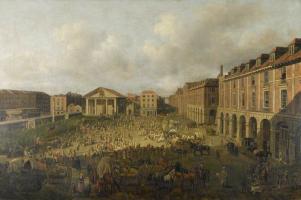
Around 1755 Samuel Scott (age 53). Covent Garden Piazza and Market, London.
From 1637 to 1641 Abbot Walter Montagu (age 34) lived at 1 Great Piazza Covent Garden.
Around 1650 to 1656 John Paulet 5th Marquess Winchester (age 52) lived at 1 Great Piazza Covent Garden.
Around 1660 to 1661 Charles Gerard 1st Earl Macclesfield (age 42) lived at 1 Great Piazza Covent Garden.
From 1639 to 1643 John Mordaunt 1st Earl Peterborough lived at 3 Great Piazza Covent Garden.

From 1692 to 1713 John Closterman (age 32) lived at 3 Great Piazza Covent Garden.
From 1640 to 1644 Henry Wallop (age 71) lived at 6 7 Great Piazza Covent Garden.
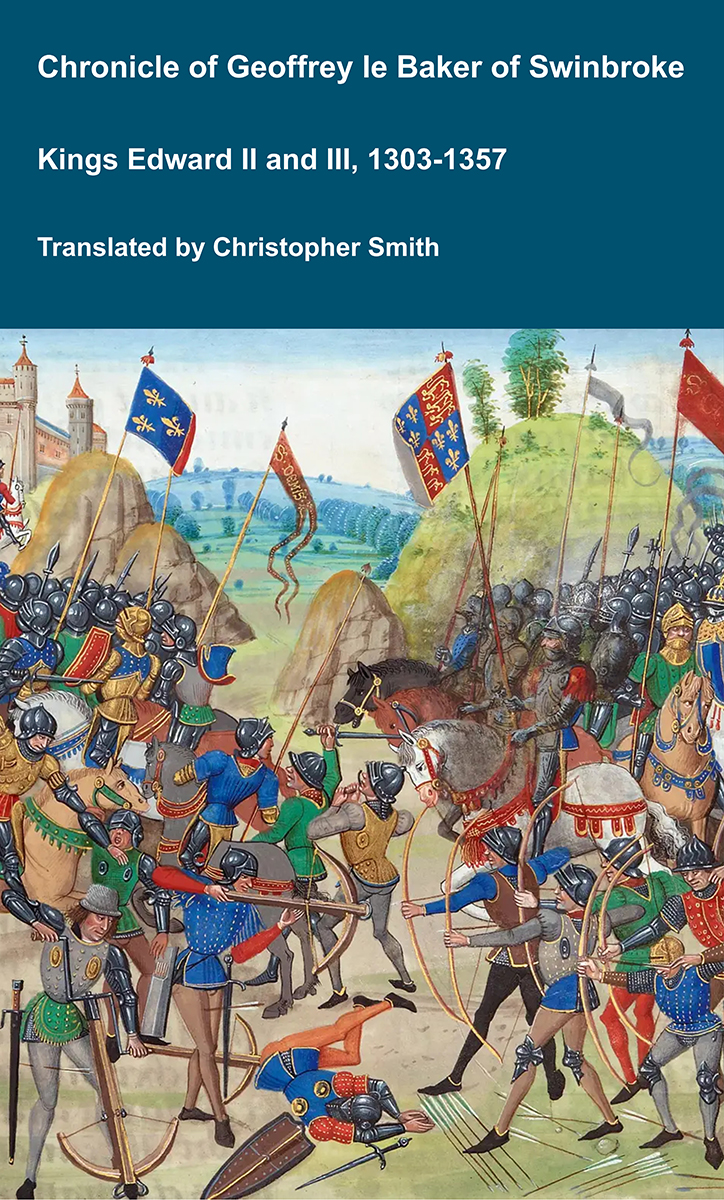
Chronicle of Geoffrey le Baker of Swinbroke
Baker was a secular clerk from Swinbroke, now Swinbrook, an Oxfordshire village two miles east of Burford. His Chronicle describes the events of the period 1303-1356: Gaveston, Bannockburn, Boroughbridge, the murder of King Edward II, the Scottish Wars, Sluys, Crécy, the Black Death, Winchelsea and Poitiers. To quote Herbert Bruce 'it possesses a vigorous and characteristic style, and its value for particular events between 1303 and 1356 has been recognised by its editor and by subsequent writers'. The book provides remarkable detail about the events it describes. Baker's text has been augmented with hundreds of notes, including extracts from other contemporary chronicles, such as the Annales Londonienses, Annales Paulini, Murimuth, Lanercost, Avesbury, Guisborough and Froissart to enrich the reader's understanding. The translation takes as its source the 'Chronicon Galfridi le Baker de Swynebroke' published in 1889, edited by Edward Maunde Thompson.
Available at Amazon in eBook and Paperback format.
From 1645 to 1647 Robert Wallop (age 43) lived at 6 7 Great Piazza Covent Garden.
From 1653 to 1654 Lionel Tollemache 3rd Baronet (age 28) lived at 6 7 Great Piazza Covent Garden.
From 1663 to 1690 Edward Russell (age 20) lived at 6 7 Great Piazza Covent Garden.
From 1636 to 1640 Thomas Killigrew (age 23) lived at 8 Great Piazza Covent Garden.


Around 1640 Henry Mordaunt 2nd Earl Peterborough (age 18) lived at 8 Great Piazza Covent Garden.

From 1640 to 1641 Philip Wharton 4th Baron Wharton (age 26) lived at 8 Great Piazza Covent Garden.
From 1661 to 1662 Thomas Killigrew (age 48) lived at 8 Great Piazza Covent Garden.

From 1663 to 1673 Aubrey de Vere 20th Earl of Oxford (age 35) lived at 8 Great Piazza Covent Garden.
From 1702 to 1726 Thomas Murray (age 39) lived at 8 Great Piazza Covent Garden.
From 1718 to 1720 Thomas Grey 2nd Earl Stamford (age 64) lived at 9 10 Great Piazza Covent Garden.
The Deeds of the Dukes of Normandy
The Gesta Normannorum Ducum [The Deeds of the Dukes of Normandy] is a landmark medieval chronicle tracing the rise and fall of the Norman dynasty from its early roots through the pivotal events surrounding the Norman Conquest of England. Originally penned in Latin by the monk William of Jumièges shortly before 1060 and later expanded at the behest of William the Conqueror, the work chronicles the deeds, politics, battles, and leadership of the Norman dukes, especially William’s own claim to the English throne. The narrative combines earlier historical sources with firsthand information and oral testimony to present an authoritative account of Normandy’s transformation from a Viking settlement into one of medieval Europe’s most powerful realms. William’s history emphasizes the legitimacy, military prowess, and governance of the Norman line, framing their expansion, including the conquest of England, as both divinely sanctioned and noble in purpose. Later chroniclers such as Orderic Vitalis and Robert of Torigni continued the history, extending the coverage into the 12th century, providing broader context on ducal rule and its impact. Today this classic work remains a foundational source for understanding Norman identity, medieval statesmanship, and the historical forces that reshaped England and Western Europe between 800AD and 1100AD.
Available at Amazon in eBook and Paperback format.

From 1720 to 1730 Edward Wortley-Montagu (age 41) lived at 9 10 Great Piazza Covent Garden.
From 1651 to 1680 Peter Lely (age 32) lived at 10 11 Great Piazza Covent Garden.


From 1722 to 1734 James Thornhill (age 47) lived at 12 Great Piazza Covent Garden.
From 1644 to 1652 Denzil Holles 1st Baron Holles (age 44) lived at 13 14 Great Piazza Covent Garden.
In 1656 Mildmay Fane 2nd Earl of Westmoreland (age 53) lived at 13 14 Great Piazza Covent Garden.

In 1664 Charles Stewart 6th Duke Lennox 3rd Duke Richmond (age 24) lived at 13 14 Great Piazza Covent Garden.
From 1664 to 1666 Mountjoy Blount 1st Earl Newport (age 67) lived at 16 17 Great Piazza Covent Garden.


In 1680 Bishop Nathaniel Crew 3rd Baron Crew (age 46) lived at 16 17 Great Piazza Covent Garden.


In 1682 Godfrey Kneller (age 35) lived at 16 17 Great Piazza Covent Garden.
From 1727 to 1734 Arthur Pond (age 22) lived at 16 17 Great Piazza Covent Garden.