

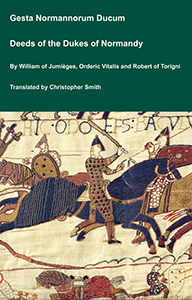
The Deeds of the Dukes of Normandy
The Gesta Normannorum Ducum [The Deeds of the Dukes of Normandy] is a landmark medieval chronicle tracing the rise and fall of the Norman dynasty from its early roots through the pivotal events surrounding the Norman Conquest of England. Originally penned in Latin by the monk William of Jumièges shortly before 1060 and later expanded at the behest of William the Conqueror, the work chronicles the deeds, politics, battles, and leadership of the Norman dukes, especially William’s own claim to the English throne. The narrative combines earlier historical sources with firsthand information and oral testimony to present an authoritative account of Normandy’s transformation from a Viking settlement into one of medieval Europe’s most powerful realms. William’s history emphasizes the legitimacy, military prowess, and governance of the Norman line, framing their expansion, including the conquest of England, as both divinely sanctioned and noble in purpose. Later chroniclers such as Orderic Vitalis and Robert of Torigni continued the history, extending the coverage into the 12th century, providing broader context on ducal rule and its impact. Today this classic work remains a foundational source for understanding Norman identity, medieval statesmanship, and the historical forces that reshaped England and Western Europe between 800AD and 1100AD.
Available at Amazon in eBook and Paperback format.
Hertford Castle is in Hertford, Hertfordshire [Map], Castles in Hertfordshire.
Archaeologia Volume 35 1853 XXXIII. Oct 1357. It appears, then, that at the beginning of October, when the Account opens, the Queen [aged 62] was residing at her Castle of Hertford [Map], having not very long before been at Rising. The first visitor we have mention of is the "Comitissa Garenniæ," who sups with her on the fourth. The lady thus designated was Joan [aged 61], daughter of Henry Earl of Barr [aged 98], and Eleanor, daughter of Edward I. of England; niece, therefore, to Queen Isabella. She was married to John Earl of Warren and Surrey, in the year 33 Edward I., but appears to have been divorced from her husband, on the plea, of a previous marriage on his part, in the year 1345; and, as Dugdale tells us, she had leave to go beyond sea, in the same year, on some special employment for the King. She was one of the ladies, according to Froissart, who accompanied Isabella to England when she sailed from Flanders to the English shore on the expedition so fatal to her husband; and the frequent mention of her in the Account shows that she was in the closest intimacy with Isabella at this time. She visited her constantly, and nursed her in her last illness.
Archaeologia Volume 35 1853 XXXIII. On the 16th of November [1357] after her return to Hertford Castle [Map], she was visited by the renowned Gascon warrior, the Captal de Buche [aged 26], cousin of the Comte de Foix. He had recently come over into England with the Prince of Wales, having taken part, on the English side, in the great battle of Poitiers.
Archaeologia Volume 35 1853 XXXIII. On the 19th [Aug 1358], the Countess of Pembroke [aged 41] spent the entire day at the castle [Map]; and Sir John de Wynewyk came to supper.
On 22nd August 1358 Isabella of France Queen Consort England [aged 63] died at Hertford Castle [Map]; see Archaeologia Vol. 35 XXXIII. She was buried in Christ Church, Greyfriars [Map].
The funeral was performed by Archbishop Simon Islip. She was buried in the mantle she had worn at her wedding and at her request, Edward's heart, placed into a casket thirty years before, was interred with her.
Archaeologia Volume 35 1853 XXXIII. On the 21st [Aug 1358] the Countess of Warren [aged 62] arrived at the Castle [Map], and remained during the following day, to attend at the death-bed of Queen Isabella [aged 63], who expired on the 22nd of August. Sir John de Wynewyk also supped at the castle on the day of the Queen's death.
Respecting Isabella's death, she is stated by chroniclers to have sunk, in the course of a single day, under the effect of a too powerful medicine, administered at her own desire. From several entries however in this account, it would appear that she had been in a state requiring medical treatment for some time previous to her decease.
As early as the 15th of February a payment had been made to a messenger going on three several occasions to London, for divers medicines for the Queen, and for the hire of a horse for Master Lawrence, the physician; and again for another journey by night to London. On the same day a second payment was made to the same messenger for two other journeys by night to London, and two to St. Alban's, to procure medicines for the Queen. On the 1st of August a payment was made to Nicholas Thomasyn apothecary, of London, for divers spices and ointment supplied for the Queen's use. On the 12th of August messengers were paid for several night journeys to London for medicines. On the 20th of August, two days only before the Queen's death, payment was made to a messenger who had been sent to London to fetch Master Simon de Bredon "ad videndum statum Reginæ1." Increased alarm for the Queen's health is now visible, for by a payment made on the 24th of August, two days after her death, it appears that a messenger had been sent to Canterbury "cum maxima festinatione2" with letters of the Queen, to bring Master Lawrence, the physician, to see the Queen's state. And another entry occurs of a payment made on the 12th of September to Master Lawrence, of forty shillings, for attendance on the Queen and the Queen of Scotland, at Hertford, for an entire month. Finally an allowance is made to the accountant, on the 6th of December, in terms which, as they are somewhat obscure, I prefer to quote in the original words, "Magistro Johanni Gateneys, de dono, in precio xv. florenorum de xl. denariis, sibi liberatorum in vita Reginæ, ad decoquend' cum medicinis pro corpore Reginæ3, l. s."
It is evident that the body of the Queen remained in the chapel of the Castle until the 23rd of November, as a payment is made to fourteen poor persons for watching the Queen's corpse there, day and night, from Saturday the 25th of August to that date, each of them receiving two pence daily, besides his food. The body was probably removed from Hertford Castle on the 24th of November, as we find, by the continuation of the Account of the expenses of the household, that on the 22nd and 23rd the Bishop of Lincoln, the Abbot of Waltham (? ), the Prior of Coventry, and "plures extranei4" were there for the performance of a solemn mass in the chapel; and the daily expenditure on those days, and on the 24th, rises from the average of six pounds to fifteen and twenty-five pounds. Moreover, from the 25th to the 28th of November the household is in London, after which it returns again to Hertford. The statement, therefore, of chroniclers that the Queen's funeral took place on the 27th is confirmed. She was interred in the choir of the church of the Grey Friars [Map], within Newgate, now Christ Church, the Archbishop of Canterbury officiating, and the King [aged 45] himself being present at the ceremony. Just twenty-eight years before, on nearly the same day, the body of her paramour Mortimer was consigned to its grave in the same building
Note 1. "to see the state of the Queen".
Note 2. "with the greatest haste".
Note 3. "to see the state of the Queen's Master John Gateneys, of the gift, at the price of xv. 40 florins denarii, which had been delivered to him during the Queen's lifetime, to be decoctioned together with the medicines for the Queen's body".
Note 4. "many strangers".
On 7th September 1362 Joan of the Tower Queen Consort Scotland [aged 41] died of plague at Hertford Castle [Map]. She was buried at either Christ Church, Greyfriars [Map] or Greyfriars Church Farringdon Within [Map].
On 31st March 1373 Catherine of Lancaster Queen Consort Castile was born to John of Gaunt 1st Duke Lancaster [aged 33] and Constance of Castile Duchess of Lancaster [aged 19] at Hertford Castle [Map]. She a granddaughter of King Edward III of England. She married before 17th September 1388 her half second cousin Henry III King Castile, son of John I King Castile and Eleanor Barcelona Queen Consort Castile, and had issue.
In 1518 Francis Bryan [aged 28] was appointed Constable of Hertford Castle which office he held until 1534.
In 1554 John Mordaunt 2nd Baron Mordaunt [aged 46] was appointed Constable of Hertford Castle.
Henry Machyn's Diary. 15th September 1561. The sam day the Quen('s) [aged 28] grace removyd from Hatford castyll [Map] in Hatford-shyre unto Enfeld [Map] within x mylle of London.


