

Abbot John Whethamstede’s Chronicle of the Abbey of St Albans
Abbot John Whethamstede's Register aka Chronicle of his second term at the Abbey of St Albans, 1451-1461, is a remarkable text that describes his first-hand experience of the beginning of the Wars of the Roses including the First and Second Battles of St Albans, 1455 and 1461, respectively, their cause, and their consequences, not least on the Abbey itself. His text also includes Loveday, Blore Heath, Northampton, the Act of Accord, Wakefield, and Towton, and ends with the Coronation of King Edward IV. In addition to the events of the Wars of the Roses, Abbot John, or his scribes who wrote the Chronicle, include details in the life of the Abbey such as charters, letters, land exchanges, visits by legates, and disputes, which provide a rich insight into the day-to-day life of the Abbey, and the challenges faced by its Abbot.
Available at Amazon in eBook and Paperback format.
Huntingdonshire is in East England.
Around 1346 Alice Cheddar was born at Chewton.
On 25th January 1431 Thomas "Baron Hydon" Carew [aged 69] died in Chewton.
In 1569 Thomas Cotton [aged 25] and Elizabeth Shirley [aged 29] were married in Conington.
Before 1579 Elizabeth Shirley [aged 38] died in Conington.

On 22nd January 1571 Robert Bruce Cotton 1st Baronet was born to Thomas Cotton [aged 27] and Elizabeth Shirley [aged 31] in Denton.
Around 652 Æthelthryth Wuffingas Queen Consort Deira and Northumbria [aged 16] received Ely [Map] as a gift from her husband as a dower.
In 1036 Ælfred Ætheling Wessex [aged 31] returned to England where he and his men were met by Godwin 1st Earl Kent and Wessex [aged 35] at Guildford, Surrey [Map]; ostensibly friendly. The following day, however, Godwin Godwinson 1st Earl Kent, Earl Wessex 1001-1053's men attacked Aelfred's men murdering most of them. Aelfred was taken to Ely [Map] where he was blinded and died shortly thereafter.
Chronicon ex Chronicis by Florence and John of Worcester. 1036. At the same time he dispersed some of his attendants, others he put in fetters and afterwards deprived of their sight, some he scalped and tortured, amputated their hands and feet and heavily mulcted [extracted money]: many he ordered to be sold, and put to death six hundred of them at Guildford, Surrey [Map] with various torments: but we trust that the souls of those, who, guilty of no crime, had their bodies so cruelly slaughtered in the fields, are now rejoicing with the saints in paradise. On hearing of this, queen Elgiva [aged 51] sent back her son Edward [aged 33], who had remained with her, in all haste to Normandy. Then, by order of Godwin [aged 35] and others, Alfred [aged 31] was conducted, heavily chained, to the Isle of Ely [Map]; but as soon as the ship touched the land, his eyes were most barbarously plucked out while he was on board, and in this state he was taken to the monastery [Map] and handed over to the custody of the monks. There he shortly afterwards died, and his body was buried, with due honours, in the south porch at the west end of the church [Map]; but his spirit is in the enjoyment of the delights of paradise.
Anglo-Saxon Chronicle. 1070. This year Earl Waltheof agreed with the king [aged 42]; but in the Lent of the same year the king ordered all the monasteries in England to be plundered. In the same year came King Sweyne [aged 51] from Denmark into the Humber; and the landsmen came to meet him, and made a treaty with him; thinking that he would overrun the land. Then came into Ely Christien, the Danish bishop, and Earl Osbern, and the Danish domestics with them; and the English people from all the fen-lands came to them; supposing that they should win all that land. Then the monks of Peterborough heard say, that their own men would plunder the minster; namely Hereward [aged 35] and his gang: because they understood that the king had given the abbacy to a French abbot, whose name was Thorold;-that he was a very stern man, and was then come into Stamford with all his Frenchmen. Now there was a churchwarden, whose name was Yware; who took away by night all that he could, testaments, mass-hackles, cantel-copes, and reefs, and such other small things, whatsoever he could; and went early, before day, to the Abbot Thorold [aged 40]; telling him that he sought his protection, and informing him how the outlaws were coming to Peterborough, and that he did all by advice of the monks. Early in the morning came all the outlaws with many ships, resolving to enter the minster; but the monks withstood, so that they could not come in. Then they laid on fire, and burned all the houses of the monks, and all the town except one house. Then came they in through fire at the Bull-hithe gate; where the monks met them, and besought peace of them. But they regarded nothing. They went into the minster [Map], climbed up to the holy rood, took away the diadem from our Lord's head, all of pure gold, and seized the bracket that was underneath his feet, which was all of red gold. They climbed up to the steeple, brought down the table that was hid there, which was all of gold and silver, seized two golden shrines, and nine of silver, and took away fifteen large crucifixes, of gold and of silver; in short, they seized there so much gold and silver, and so many treasures, in money, in raiment, and in books, as no man could tell another; and said, that they did it from their attachment to the minster. Afterwards they went to their ships, proceeded to Ely [Map], and deposited there all the treasure. The Danes, believing that they should overcome the Frenchmen, drove out all the monks; leaving there only one, whose name was Leofwine Lang, who lay sick in the infirmary. Then came Abbot Thorold and eight times twenty Frenchmen with him, all full-armed. When he came thither, he found all within and without consumed by fire, except the church alone; but the outlaws were all with the fleet, knowing that he would come thither. This was done on the fourth day before the nones of June. The two kings, William and Sweyne, were now reconciled; and the Danes went out of Ely with all the aforesaid treasure, and carried it away with them. But when they came into the middle of the sea, there came a violent storm, and dispersed all the ships wherein the treasures were. Some went to Norway, some to Ireland, some to Denmark. All that reached the latter, consisted of the table, and some shrines, and some crucifixes, and many of the other treasures; which they brought to a king's town, called --, and deposited it all there in the church. Afterwards through their own carelessness, and through their drunkenness, in one night the church and all that was therein was consumed by fire. Thus was the minster of Peterborough burned and plundered. Almighty God have mercy on it through his great goodness. Thus came the Abbot Thorold to Peterborough; and the monks too returned, and performed the service of Christ in the church, which had before stood a full week without any kind of rite. When Bishop Aylric heard it, he excommunicated all the men who that evil deed had done. There was a great famine this year: and in the summer came the fleet in the north from the Humber into the Thames, and lay there two nights, and made afterwards for Denmark.
Chronicon ex Chronicis by Florence and John of Worcester. 1071. Earls Edwin and Morcar escaped secretly from king William's [aged 43] court, finding that he intended to arrest them, and they were for some time in arms against him; but seeing that their enterprise was not successful, Edwin resolved to go to Malcolm [aged 39], king of the Scots, but, during the journey, he fell into an ambuscade laid by his own people, and was killed. Morcar and Ethelwine, bishop of Durham, Siward, surnamed Barn, and Hereward [aged 36], a man of great bravery, with many others, took ship and went to the Isle of Ely [Map], intending to winter there. The king, hearing of this, blocked up every outlet on the eastern side of the island by means of his boatmen, and caused a bridge, two miles long, to be constructed on the western side. When they saw that they were thus shut in, they resisted no longer, and all surrendered themselves to the king, except the brave Hereward, who escaped through the fens with a few others. The king immediately sent bishop Ethelwine to Abingdon, where he was imprisoned, and died the same winter. The earl and the rest were dispersed in various parts of England, some being placed in confinement, and others set at liberty with the loss of their hands or eyes.
On 28th October 1565 Elizabeth Steward was born to William Steward [aged 27] at Ely [Map]. She married Robert Cromwell and had issue.
Bede. Ely [Map] is in the province of the East Angles, a country of about six hundred families, in the nature of an island, enclosed, as has been said, either with marshes or waters, and therefore it has its name from the great plenty of eels taken in those marshes; there the aforesaid servant of Christ desired to have a monastery, because, as we have before observed, she waas descended from that same province of the East Angles.
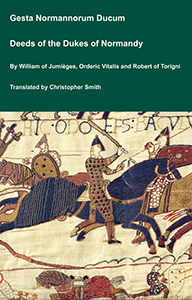
The Deeds of the Dukes of Normandy
The Gesta Normannorum Ducum [The Deeds of the Dukes of Normandy] is a landmark medieval chronicle tracing the rise and fall of the Norman dynasty from its early roots through the pivotal events surrounding the Norman Conquest of England. Originally penned in Latin by the monk William of Jumièges shortly before 1060 and later expanded at the behest of William the Conqueror, the work chronicles the deeds, politics, battles, and leadership of the Norman dukes, especially William’s own claim to the English throne. The narrative combines earlier historical sources with firsthand information and oral testimony to present an authoritative account of Normandy’s transformation from a Viking settlement into one of medieval Europe’s most powerful realms. William’s history emphasizes the legitimacy, military prowess, and governance of the Norman line, framing their expansion, including the conquest of England, as both divinely sanctioned and noble in purpose. Later chroniclers such as Orderic Vitalis and Robert of Torigni continued the history, extending the coverage into the 12th century, providing broader context on ducal rule and its impact. Today this classic work remains a foundational source for understanding Norman identity, medieval statesmanship, and the historical forces that reshaped England and Western Europe between 800AD and 1100AD.
Available at Amazon in eBook and Paperback format.
The River Great Ouse rises near Syresham, Northamptonshire [Map] from where it flows past Biddlesden, Buckinghamshire [Map], Brackley, Northamptonshire [Map], Westbury, Buckinghamshire [Map], Radclive, Buckinghamshire [Map], through the centre of Buckingham, Buckinghamshire [Map], Buckingham, Buckinghamshire [Map] after which it is joined by Padbury Brook.
The River Great Ouse continues past Thornton, Buckinghamshire [Map], Passenham, Northamptonshire [Map], Stony Stratford, Buckinghamshire [Map], around Newport Pagnell, Buckinghamshire [Map], past Gayhurst, Buckinghamshire [Map], Olney, Buckinghamshire [Map], Newton Blossomville, Buckinghamshire [Map], crossing into Bedfordshirem, past Harrold, Bedfordshire [Map], Sharnbrook, Bedfordshire [Map], Milton Ernest, Bedfordshire [Map], through the centre of Bedford, Bedfordshire [Map], under Great Barford Bridge, Bedfordshire [Map], past Tempsford, Bedfordshire [Map], Eaton Socon, Bedfordshire [Map], through St Neots, Bedfordshire [Map], past Offord D'Arcy, Bedfordshire [Map] and Offord Cluny, Bedfordshire [Map], through Godmanchester [Map] and Huntingdon [Map], under St Ives Bridge [Map], Earith [Map] after which it is separates into two.
Thereafter one section is canalised heading north-east to Downham Market, Norfolk [Map].
The other natural section flows past Little Thetford [Map], through Ely [Map], Littleport [Map], past to Downham Market, Norfolk [Map] where it joins the canalised section.
Thereafter to King's Lynn, Norfolk [Map] after which it joins the The Wash.
On 16th June 1286 Bishop Hugh de Balsham died at Doddington, Ely [Map]. He left 200 pounds in his will to Peterhouse College, Cambridge University [Map] which he had founded. He was buried at Ely Cathedral [Map] on 24th June 1286.
St Peter and St Paul's Church, Fenstanton is also in Churches in Huntingdonshire.
On 6th February 1783 Lancelot "Capability" Brown [aged 66] died. He collapsed on the doorstep of his daughter Bridget Holland's house, at 6 Hertford Street, Mayfair while returning after a night out at Lord Coventry's [aged 60]. He was buried at St Peter and St Paul's Church, Fenstanton [Map].


On 11th April 1806 George Richards Welstead was baptised at St Peter and St Paul's Church, Fenstanton [Map].
Ermine Street 2b Braughing to Durobrivae. From Braughing, Hertfordshire [Map] Ermine Street continues north through Buntingford, Hertfordshire [Map]. 1.6km north of Buntingford, Hertfordshire [Map] the road make a change of alignment before heading to Royston, Hertfordshire [Map] where it again changes aligment before passing through Caxton Gibbet [Map], Durovigutum [Map], Huntingdon [Map], Great Stukeley [Map], Alconbury [Map] and Sawtry [Map], Chesterton [Map] before reaching Durobrivae [Map].

On 15th August 1732 Maria Gunning Countess Coventry was born to John Barnaby Gunning [aged 29] and Bridget Bourke at Hemingford Grey. She married 5th March 1752 George Coventry 6th Earl Coventry, son of William Coventry 5th Earl Coventry and Elizabeth Allen Countess Coventry, and had issue.

On 6th December 1733 Elizabeth Gunning Duchess Hamilton and Argyll was born to John Barnaby Gunning [aged 30] and Bridget Bourke at Hemingford Grey. She married (1) James Hamilton 6th Duke Hamilton 3rd Duke Brandon, son of James Hamilton 5th Duke Hamilton 2nd Duke Brandon and Anne Cochrane Duchess Hamilton Duchess Brandon, and had issue (2) 3rd January 1759 John Campbell 5th Duke Argyll, son of John Campbell 4th Duke Argyll and Mary Drummond Bellenden, and had issue.
On 5th August 1575 Frances Cromwell was born to Henry Cromwell aka Williams [aged 40] and Joan Warren [aged 30] at Hinchinbrooke. She married July 1595 Richard Whalley of Kirton and had issue.
Before 1635 Richard Whalley of Kirton [aged 69] died at Hinchinbrooke.
On 3rd January 1648 Edward Montagu 2nd Earl Sandwich was born to Edward Montagu 1st Earl Sandwich [aged 22] and Jemima Crew Countess Sandwich [aged 23] at Hinchinbrooke. He married before 17th March 1668 his half fifth cousin once removed Mary Anne Boyle, daughter of Richard Boyle 2nd Earl Cork 1st Earl Burlington and Elizabeth Clifford Countess Burlington, and had issue.


Samuel Pepys' Diary. 12th January 1660. Thursday. I drink my morning at Harper's with Mr. Sheply and a seaman, and so to my office, where Captain Holland came to see me, and appointed a meeting in the afternoon. Then wrote letters to Hinchinbroke and sealed them at Will's, and after that went home, and thence to the Half Moon Tavern [Map], where I found the Captain and Mr. Billingsly and Newman, a barber, where we were very merry, and had the young man that plays so well on the Welsh harp. Billingsly paid for all. Thence home, and finding my letters this day not gone by the carrier I new sealed them, but my brother Tom [aged 26] coming we fell into discourse about my intention to feast the Joyces. I sent for a bit of meat for him from the cook's, and forgot to send my letters this night. So I went to bed, and in discourse broke to my wife [aged 19] what my thoughts were concerning my design of getting money by, &c.
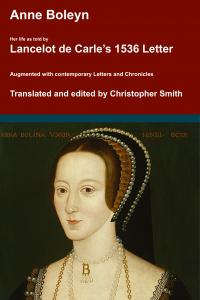
Anne Boleyn. Her Life as told by Lancelot de Carle's 1536 Letter.
In 1536, two weeks after the execution of Anne Boleyn, her brother George and four others, Lancelot du Carle, wrote an extraordinary letter that described Anne's life, and her trial and execution, to which he was a witness. This book presents a new translation of that letter, with additional material from other contemporary sources such as Letters, Hall's and Wriothesley's Chronicles, the pamphlets of Wynkyn the Worde, the Memorial of George Constantyne, the Portuguese Letter and the Baga de Secrets, all of which are provided in Appendices.
Available at Amazon in eBook and Paperback format.
Samuel Pepys' Diary. 14th January 1660. Saturday. Nothing to do at our office. Thence into the Hall, and just as I was going to dinner from Westminster Hall with Mr. Moore (with whom I had been in the lobby to hear news, and had spoke with Sir Anthony Ashley Cooper [aged 38] about my Lord's [aged 34] lodgings) to his house, I met with Captain Holland, who told me that he hath brought his wife to my house, so I posted home and got a dish of meat for them. They staid with me all the afternoon, and went hence in the evening. Then I went with my wife, and left her at market, and went myself to the Coffee-house, and heard exceeding good argument against Mr. Harrington's [aged 49] assertion, that overbalance of propriety [i.e., property] was the foundation of government. Home, and wrote to Hinchinbroke, and sent that and my other letter that missed of going on Thursday last. So to bed.


Samuel Pepys' Diary. 23rd May 1666. Thence to the Excise Office to the Commissioners to get a meeting between them and myself and others about our concernments in the Excise for Tangier [Map], and so to the 'Change [Map] awhile, and thence home with Creed, and find my wife at dinner with Mr. Cooke, who is going down to Hinchinbrooke.

In 1667 Archbishop Thomas Tenison [aged 30] was presented with the living of Holywell cum Needingworth by Edward Montagu 2nd Earl Manchester [aged 65] to whose son he had been tutor.
In 1548 Robert Tyrwhitt Master [aged 45] bought Leighton Bromswold.
On 10th May 1572 Robert Tyrwhitt Master [aged 69] died at Leighton Bromswold.
On 28th March 1765 Johnathan Cope 1st Baronet [aged 74] died at Orton Longueville predeceasing his father. His grandson Charles [aged 22] succeeded 2nd Baronet Cope of Bruern in Oxfordshire.
On 4th January 1792 Charles Gordon 10th Marquess Huntly was born to George Gordon 9th Marquess Huntly [aged 30] and Catherine Anne Cope [aged 21] in Orton Longueville. He married (1) 2nd March 1826 Elizabeth Conyngham, daughter of Henry Conyngham 1st Marquess Conyngham and Elizabeth Denison Marchioness Conyngham (2) 2nd April 1844 Maria Antoinetta Pegus Marchioness Huntly, daughter of Reverend William Peter Pegus and Charlotte Layard Countess Lindsey, and had issue.
On 30th November 1845 Captain Samuel Buckle was born to Samuel Buckle [aged 37] at Orton Longueville He married 18th August 1868 Frances Elizabeth Robinson Greig and had issue.
On 8th January 1601 Robert Pierrepont 1st Earl Kingston [aged 16] and Gertrude Talbot Baroness Pierrepont Holme Pierrepoint [aged 20] were married at Overton Longueville.
Ramsey Abbey is also in Abbeys in England.
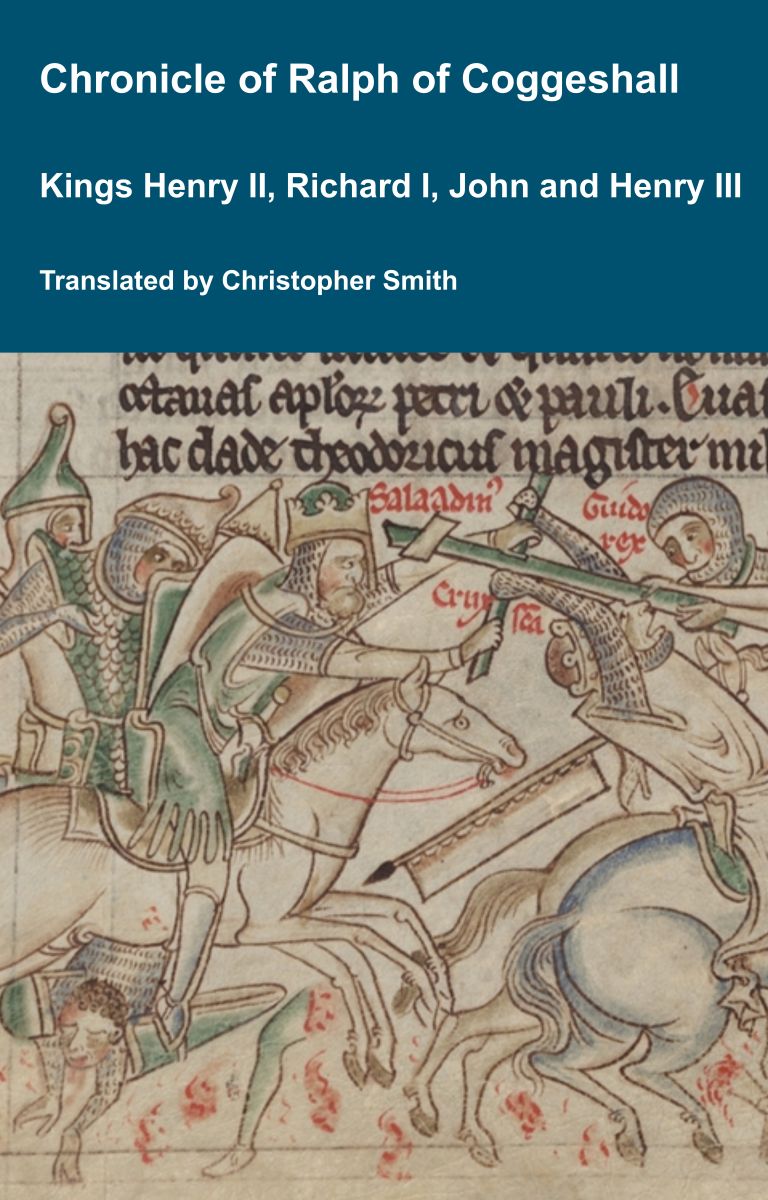 Chronicum Anglicanum by Ralph Coggeshall. 1143. Geoffrey de Mandeville violently seized Ramsey Abbey [Map], driving out the monks. However, he died there.
MCXLIII. Galfridus de Mandavilla per violentiam intravit in Rameseiam, et monachos fugavit, et ibidem obiit.
In 1267 Abbot William de Godmanchester aka Gurmecestre was elected, and confirmed by the Legate Ottobormes, Abbot of Ramsey Abbey.
Jean de Waurin's Chronicle of England Volume 6 Books 3-6: The Wars of the Roses
Jean de Waurin was a French Chronicler, from the Artois region, who was born around 1400, and died around 1474. Waurin’s Chronicle of England, Volume 6, covering the period 1450 to 1471, from which we have selected and translated Chapters relating to the Wars of the Roses, provides a vivid, original, contemporary description of key events some of which he witnessed first-hand, some of which he was told by the key people involved with whom Waurin had a personal relationship.
Available at Amazon in eBook and Paperback format.
Around 1331 John Ferrers 4th Baron Ferrers of Chartley was born to Robert Ferrers 3rd Baron Ferrers of Chartley [aged 21] and Margaret Unknown Baroness Ferrers Chartley at Southoe. He married before 1358 his fourth cousin once removed Elizabeth Stafford Baroness Cobham, Ferrers and Strange, daughter of Ralph Stafford 1st Earl Stafford and Margaret Audley Countess Stafford, and had issue.
Around 1450. St Ives Bridge [Map] is a 15th-century bridge spanning the River Great Ouse. It is noted for being one of only four bridges in England to incorporate a chapel the others being , Wakefield Bridge [Map] and .
The River Great Ouse rises near Syresham, Northamptonshire [Map] from where it flows past Biddlesden, Buckinghamshire [Map], Brackley, Northamptonshire [Map], Westbury, Buckinghamshire [Map], Radclive, Buckinghamshire [Map], through the centre of Buckingham, Buckinghamshire [Map], Buckingham, Buckinghamshire [Map] after which it is joined by Padbury Brook.
The River Great Ouse continues past Thornton, Buckinghamshire [Map], Passenham, Northamptonshire [Map], Stony Stratford, Buckinghamshire [Map], around Newport Pagnell, Buckinghamshire [Map], past Gayhurst, Buckinghamshire [Map], Olney, Buckinghamshire [Map], Newton Blossomville, Buckinghamshire [Map], crossing into Bedfordshirem, past Harrold, Bedfordshire [Map], Sharnbrook, Bedfordshire [Map], Milton Ernest, Bedfordshire [Map], through the centre of Bedford, Bedfordshire [Map], under Great Barford Bridge, Bedfordshire [Map], past Tempsford, Bedfordshire [Map], Eaton Socon, Bedfordshire [Map], through St Neots, Bedfordshire [Map], past Offord D'Arcy, Bedfordshire [Map] and Offord Cluny, Bedfordshire [Map], through Godmanchester [Map] and Huntingdon [Map], under St Ives Bridge [Map], Earith [Map] after which it is separates into two.
Thereafter one section is canalised heading north-east to Downham Market, Norfolk [Map].
The other natural section flows past Little Thetford [Map], through Ely [Map], Littleport [Map], past to Downham Market, Norfolk [Map] where it joins the canalised section.
Thereafter to King's Lynn, Norfolk [Map] after which it joins the The Wash.
On 9th July 1648 Henry Rich 1st Earl Holland [aged 57] entered St Neots with his army of approximately 400 men.


St Neots Priory is also in Priories in England.
St Neots Priory [Map] was a Benedictine Priory founded in 974 by Earl Aelric (or Leofric) and his wife Aelfleda (or Ethelfleda) who granted it two hides of land, part of the manor of Eynesbury, later called the manor of St. Neots. It is said that the relics of the Cornish saint, St. Neot, were obtained illicitly from Neotstoke (now St. Neot) in Cornwall and brought to the priory in order that it might have relics to attract pilgrims; hence the name of the town.
Around 1090 Richard de Clare [aged 66] died. He was buried at St Neots Priory [Map].
St Botolph's Church, Stow Longa is also in Churches in Huntingdonshire.
The River Nene rises near Badby, Northamptonshire [Map] from where it flows past Newnham, Northamptonshire [Map], Weedon, Northamptonshire [Map], Nether Heyford, Northamptonshire [Map], Kinslingbury, Northamptonshire [Map], Hunsbury Meadows, Northamptonshire [Map], Northampton [Map], Billing, Northamptonshire [Map], Great Doddinton, Northamptonshire [Map], Rushden, Northamptonshire [Map], Thrapston, Northamptonshire [Map], around Oundle, Northamptonshire [Map], past St Mary and All Saints Church, Fotheringhay [Map] and the remains of Fotheringhay Castle, Northamptonshire [Map], Wansford [Map], through the centre of Peterborough [Map] after which it is canalised to Rings End [Map]. After Rings End [Map] it continues through Wisbech, Cambridgeshire [Map], under Sutton Bridge [Map] after which it reaches The Wash at Guys Head [Map].
Around 1899 Cecil James Parnell was born to Pharoah Parnell at Winwick, Huntingdonshire.