

Henrici Quinti, Angliæ Regis, Gesta, is a first-hand account of the Agincourt Campaign, and subsequent events to his death in 1422. The author of the first part was a Chaplain in King Henry's retinue who was present from King Henry's departure at Southampton in 1415, at the siege of Harfleur, the battle of Agincourt, and the celebrations on King Henry's return to London. The second part, by another writer, relates the events that took place including the negotiations at Troye, Henry's marriage and his death in 1422.
Available at Amazon in eBook and Paperback format.
In 1480 Robert Brudenell (age 19) entered at Inner Temple.
Around 1484 Nicholas Hare was born to John Hare of Homersfield in Suffolk. He was educated at Gonville College, Cambridge University and admitted to the Inner Temple in 1515. He married 1528 Katherine Bassingbourne.
In 1553 Edmund Colles (age 25) was admitted as a member to the Inner Temple.
In 1573 Baptist Hicks 1st Viscount Campden (age 16) admitted at Inner Temple.
In 1577 Francis Newport (age 22) educated at Inner Temple.
In 1590 Thomas Monck (age 19) admitted at Inner Temple.
In June 1591 John Bridgeman (age 54) was admitted to the Inner Temple.
In 1594 Thomas Coventry 1st Baron Coventry (age 16) admitted at Inner Temple.


In 1596 John Vaughan 1st Earl Carbery (age 21) admitted at Inner Temple.
Henrici Quinti, Angliæ Regis, Gesta, is a first-hand account of the Agincourt Campaign, and subsequent events to his death in 1422. The author of the first part was a Chaplain in King Henry's retinue who was present from King Henry's departure at Southampton in 1415, at the siege of Harfleur, the battle of Agincourt, and the celebrations on King Henry's return to London. The second part, by another writer, relates the events that took place including the negotiations at Troye, Henry's marriage and his death in 1422.
Available at Amazon in eBook and Paperback format.

In 1597 Heneage Finch (age 17) admitted at Inner Temple.
On 20th February 1613 The Masque of the Inner Temple and Gray's Inn was performed at the Banqueting House, Whitehall Palace [Map] as part of the wedding festivities. The masque was sponsored by the Inner Temple and Gray's Inn both of whom spent around £1200.
In 1615 John Bridgeman (age 78) was appointed a Bencher of the Inner Temple.
In November 1617 Thomas Twisden 1st Baronet (age 15) was admitted to the Inner Temple.
In 1620 John Curzon 1st Baronet (age 21) admitted at Inner Temple.
In 1621 John Vaughan of Transgoed (age 17) entered the Inner Temple. He was called to the bar in 1630 and became a Bencher in 1664.
On 22nd January 1624 John Kelyng (age 16) was admitted to Inner Temple.
In 1625 John Edisbury (age 17) entered Inner Temple.
In November 1631 Thomas Salusbury 2nd Baronet (age 19) educated at Inner Temple.
On 4th February 1634 William Gawdy 1st Baronet (age 21) was admitted to the Inner Temple.
In 1637 William Borlase (age 16) was a student at Inner Temple.
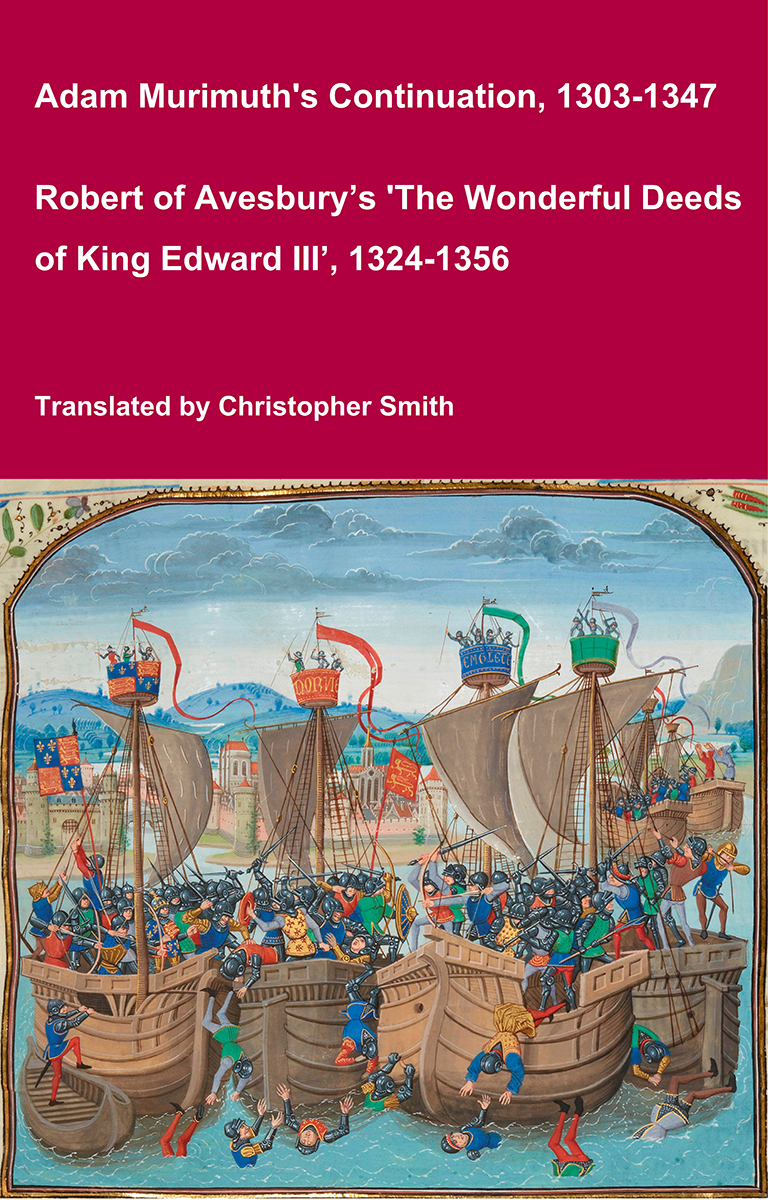
Adam Murimuth's Continuation and Robert of Avesbury’s 'The Wonderful Deeds of King Edward III'
This volume brings together two of the most important contemporary chronicles for the reign of Edward III and the opening phases of the Hundred Years’ War. Written in Latin by English clerical observers, these texts provide a vivid and authoritative window into the political, diplomatic, and military history of fourteenth-century England and its continental ambitions. Adam Murimuth Continuatio's Chronicarum continues an earlier chronicle into the mid-fourteenth century, offering concise but valuable notices on royal policy, foreign relations, and ecclesiastical affairs. Its annalistic structure makes it especially useful for establishing chronology and tracing the development of events year by year. Complementing it, Robert of Avesbury’s De gestis mirabilibus regis Edwardi tertii is a rich documentary chronicle preserving letters, treaties, and official records alongside narrative passages. It is an indispensable source for understanding Edward III’s claim to the French crown, the conduct of war, and the mechanisms of medieval diplomacy. Together, these works offer scholars, students, and enthusiasts a reliable and unembellished account of a transformative period in English and European history. Essential for anyone interested in medieval chronicles, the Hundred Years’ War, or the reign of Edward III.
Available at Amazon in eBook and Paperback format.

In 1638 Heneage Finch 1st Earl Nottingham (age 16) educated at Inner Temple.
In 1656 Roger Palmer 1st Earl Castlemaine (age 22) admitted at Inner Temple.
John Evelyn's Diary. 4th September 1666. The burning still rages, and it is now gotten as far as the Inner Temple. All Fleet Street [Map], the Old Bailey, Ludgate hill, Warwick lane, Newgate, Paul's chain, Watling street, now flaming, and most of it reduced to ashes; the stones of Paul's [Map] flew like grenados, the melting lead running down the streets in a stream, and the very pavements glowing with fiery redness, so as no horse, nor man, was able to tread on them, and the demolition had stopped all the passages, so that no help could be applied. The eastern wind still more impetuously driving the flames forward. Nothing but the Almighty power of God was able to stop them; for vain was the help of man.
In 1668 William Barnesley (age 19) was admitted to the Inner Temple. He was called to the bar in 1667 and made a bencher in 1694. In 1707 he was Treasurer.
John Evelyn's Diary. 30th April 1668. We sealed the deeds in Sir Edward Thurland's (age 61) chambers in the Inner Temple. I pray God bless it to me, it being a dear pennyworth; but the passion Sir R. Browne had for it, and that it was contiguous to our other grounds, engaged me!
In 1669 Orlando Bridgeman 1st Baronet (age 19) educated at Inner Temple.
In 1673 Heneage Finch 1st Earl Aylesford (age 24) was appointed Barrister at Inner Temple.
In 1680 Andrew Archer (age 20) admitted at Inner Temple.
In 1687 Thomas Newport 1st Baron Torrington (age 32) called to the bar at Inner Temple.
In 1715 Wilfrid Lawson 3rd Baronet (age 18) was admitted to the Inner Temple.
In 1716 Robert Grosvenor 6th Baronet (age 20) admitted at Inner Temple.
In 1723 Henry Archer (age 23) educated at Inner Temple.
In 1725 Wriothesley Digby (age 27) admitted at Inner Temple.
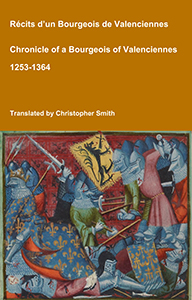
Chronicle of a Bourgeois of Valenciennes
Récits d’un bourgeois de Valenciennes aka The Chronicle of a Bourgeois of Valenciennes is a vivid 14th-century vernacular chronicle written by an anonymous urban chronicler from Valenciennes in the County of Hainaut. It survives in a manuscript that describes local and regional history from about 1253 to 1366, blending chronology, narrative episodes, and eyewitness-style accounts of political, military, and social events in medieval France, Flanders, and the Low Countries. The work begins with a chronological framework of events affecting Valenciennes and its region under rulers such as King Philip VI of France and the shifting allegiances of local nobility. It includes accounts of conflicts, sieges, diplomatic manoeuvres, and the impact of broader struggles like the Hundred Years’ War on urban life in Hainaut. Written from the perspective of a burgher (bourgeois) rather than a monastery or royal court, the chronicle offers a rare lay viewpoint on high politics and warfare, reflecting how merchants, townspeople, and civic institutions experienced the turbulence of the 13th and 14th centuries. Its narrative style combines straightforward reporting of events with moral and civic observations, making it a valuable source for readers interested in medieval urban society, regional politics, and the lived experience of war and governance in pre-modern Europe.
Available at Amazon in eBook and Paperback format.
In 1740 John Buller (age 18) entered Middle Temple and Inner Temple in 1743. He was called to the bar in February 1747.