

The History of William Marshal was commissioned by his son shortly after William’s death in 1219 to celebrate the Marshal’s remarkable life; it is an authentic, contemporary voice. The manuscript was discovered in 1861 by French historian Paul Meyer. Meyer published the manuscript in its original Anglo-French in 1891 in two books. This book is a line by line translation of the first of Meyer’s books; lines 1-10152. Book 1 of the History begins in 1139 and ends in 1194. It describes the events of the Anarchy, the role of William’s father John, John’s marriages, William’s childhood, his role as a hostage at the siege of Newbury, his injury and imprisonment in Poitou where he met Eleanor of Aquitaine and his life as a knight errant. It continues with the accusation against him of an improper relationship with Margaret, wife of Henry the Young King, his exile, and return, the death of Henry the Young King, the rebellion of Richard, the future King Richard I, war with France, the death of King Henry II, and the capture of King Richard, and the rebellion of John, the future King John. It ends with the release of King Richard and the death of John Marshal.
Available at Amazon in eBook and Paperback format.
Kenilworth Castle is in Kenilworth, Warwickshire, Castles in Warwickshire.
In 1209 William Cantilupe Baron [aged 50] was appointed High Sheriff of Warwickshire and High Sheriff of Leicestershire after which his main residence was Kenilworth Castle [Map].
On 28th May 1265 King Edward I of England [aged 25], with the help of Roger Leybourne [aged 50], escaped from Kenilworth Castle [Map] whilst on a hunting trip. He had been held there as a hostage following the Battle of Lewes as a condition of the Mise of Lewes (the now lost peace treaty).
On 31st October 1266 the Dictum of Kenilworth was issued. The Dictum was a peace agreement between King Henry III of England [aged 59] and the rebels who were besieged in the impregnable Kenilworth Castle [Map]. The committee included: Bishop Walter Branscombe [aged 46], Archbishop Walter Giffard [aged 41], Bishop Nicholas Ely, Gilbert de Clare 8th Earl Gloucester 7th Earl Hertford, Humphrey Bohun 2nd Earl Hereford 1st Earl Essex [aged 62], Philip Basset [aged 82], John Balliol [aged 58], Robert Walerand, Alan Zouche [aged 63], Roger Somery 2nd Baron Dudley [aged 76], and Warin Bassingbourne.
Robert Ferrers 6th Earl of Derby [aged 27] and Henry Hastings [aged 31] were fined seven times their annual income. The Dictum, however, required the rebels to pay their fines before being restored to their lands; something of a Catch-22 since if they weren't restored to their lands, they would have no income to pay the fine.
On 14th December 1266 the garrison at Kenilworth Castle [Map] surrendered some six weeks after the signing of the Dictum of Kenilworth.
On 24th September 1275 Humphrey Bohun 2nd Earl Hereford 1st Earl Essex [aged 71] died at Kenilworth Castle [Map]. He was buried at Llanthony Secunda Priory, Gloucestershire [Map]. His grandson Humphrey [aged 26] succeeded 3rd Earl Hereford, 2nd Earl Essex.
In 1279 Agnes Cantilupe [aged 77] died at Kenilworth Castle [Map].
On 16th November 1326 King Edward II of England [aged 42] was captured at Pant y Brâd, Llantrisant. He was imprisoned at Llantrisant Castle, Glamorganshire [Map]. Thereafter he was taken to Kenilworth Castle [Map], then Berkeley Castle [Map]. With him at the time of his capture were Hugh "Younger" Despencer 1st Baron Despencer [aged 40], Robert Holden, controller of his wardrobe; Robert Baldock, chancellor of England; two knights, one sergeant-at-arms, one valet and one clerk.
On 24th June 1380 John Hastings 3rd Earl Pembroke [aged 7] and Elizabeth Lancaster Duchess Exeter [aged 17] were married at Kenilworth Castle [Map]. She by marriage Countess Pembroke. She the daughter of John of Gaunt 1st Duke Lancaster [aged 40] and Blanche Duchess of Lancaster. He the son of John Hastings 2nd Earl Pembroke and Anne Manny Countess Pembroke. They were half third cousins. He a great x 2 grandson of King Edward I of England. She a granddaughter of King Edward III of England.
Around 1406 Eleanor Holland Baroness Audley Heighley was born illegitimately to Edmund Holland 4th Earl Kent [aged 21] and Constance York Countess Gloucester [aged 32] at Kenilworth Castle [Map]. She a great granddaughter of King Edward III of England.
In 1443 Eleanor Cobham Duchess of Gloucester [aged 43] was imprisoned at Kenilworth Castle [Map].
On 12th August 1469 Woodvilles father and son were beheaded at Kenilworth Castle [Map] by supporters of Richard "Kingmaker" Neville Earl Warwick, 6th Earl Salisbury [aged 40].
Richard Woodville 1st Earl Rivers [aged 64] was beheaded. His son Anthony [aged 29] succeeded 2nd Earl Rivers, 2nd Baron Rivers. Elizabeth Scales Countess Rivers by marriage Countess Rivers.
John Woodville [aged 24] was beheaded.
A Brief Latin Chronicle. On 12th August 1469. On the Saturday before the Assumption of the most blessed Virgin Mary, Lord de Rywans [aged 64] along with Lord John [aged 24], his son, were captured, and they were executed together near the castle of Kenilworth [Map].
Die Sabbati proximo ante Assumptionem beatissime semper Virginis Marie captus est Dominus de Rywans cum domino Johanne filio suo, et juxta castrum de Kelingworth pariter docollati sunt.
A Brief Latin Chronicle. 13th August 1469. On the Saturday before the Assumption of the Blessed Virgin Mary (August 13), Lord de Rywans [deceased] and his son, Lord John [deceased], were captured and, near Kenilworth Castle [Map], were beheaded together.
Die Sabbati proximo ante Assumptionem beatissime semper Virginis Marie captus est Dominus de Rywans cum domino Johanne filio suo, et juxta castrum de Kelingworth pariter docollati sunt.
On 21st August 1565 William Devereux of Merevale [aged 40] was knighted at Kenilworth Castle [Map] by Robert Dudley 1st Earl of Leicester [aged 33].


In 1566 John Lyttelton of Frankley [aged 46] was knighted by Queen Elizabeth I [aged 32] at Kenilworth Castle [Map].


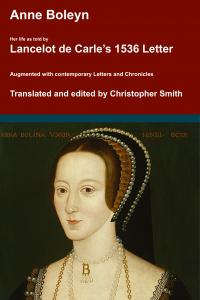
Anne Boleyn. Her Life as told by Lancelot de Carle's 1536 Letter.
In 1536, two weeks after the execution of Anne Boleyn, her brother George and four others, Lancelot du Carle, wrote an extraordinary letter that described Anne's life, and her trial and execution, to which he was a witness. This book presents a new translation of that letter, with additional material from other contemporary sources such as Letters, Hall's and Wriothesley's Chronicles, the pamphlets of Wynkyn the Worde, the Memorial of George Constantyne, the Portuguese Letter and the Baga de Secrets, all of which are provided in Appendices.
Available at Amazon in eBook and Paperback format.
Letters of the Court of James I 1618. [5th October 1618]. The current runs strong here, that Sir Fulk Greville [aged 64] shall be treasurer, but the grounds of that conjecture are not certain. An assured thing they say it is, that the Marquis of Buckingham [aged 26] hath gotten the survivance of the Admiralty granted him, in a joint patent with the lord admiral that is; and the same hath passed the seals already. Sir Robert Cary [aged 58] hath now perfected his suit concerning Killingworth [Map], and intends a new voyage thither soon after Allhallowtide. I have renewed my former motions concerning you, and he promises the accomplishment.


