

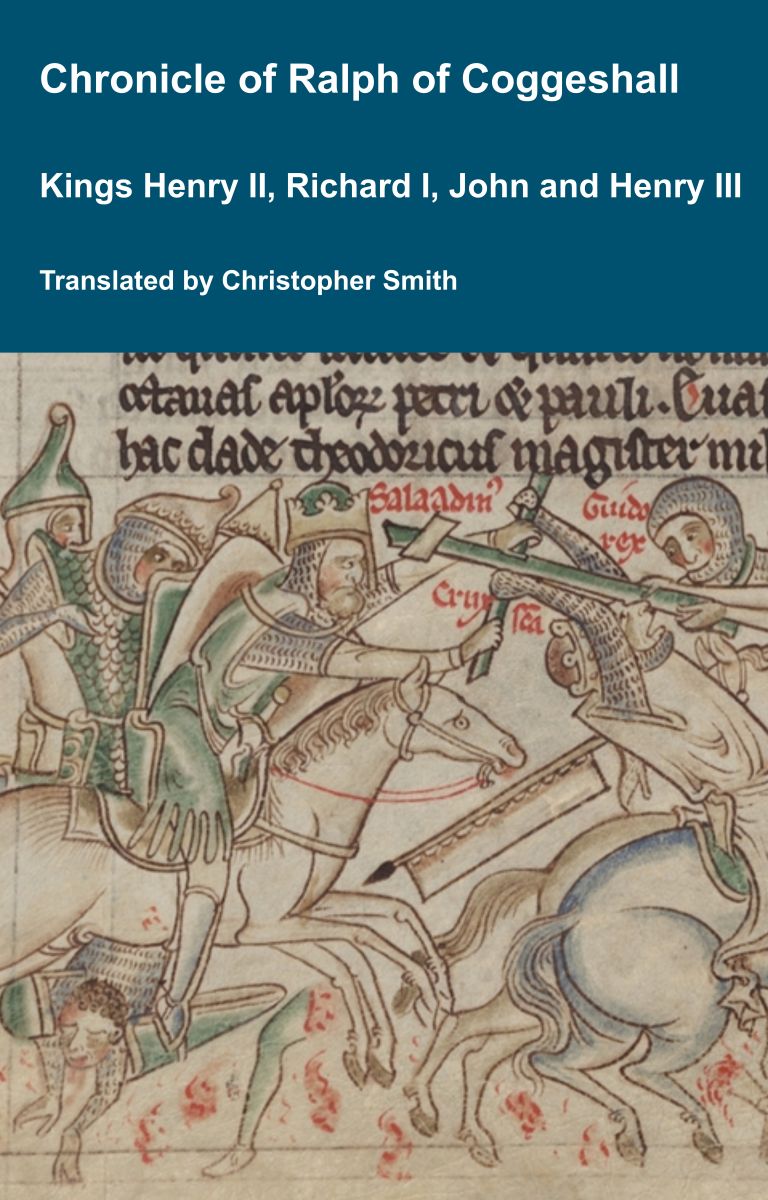
Chronicle of Abbot Ralph of Coggeshall
The Chronicle of Abbot Ralph of Coggeshall (Chronicon Anglicanum) is an indispensable medieval history that brings to life centuries of English and European affairs through the eyes of a learned Cistercian monk. Ralph of Coggeshall, abbot of the Abbey of Coggeshall in Essex in the early 13th century, continued and expanded his community’s chronicle, documenting events from the Norman Conquest of 1066 into the tumultuous reign of King Henry III. Blending eyewitness testimony, careful compilation, and the monastic commitment to record-keeping, this chronicle offers a rare narrative of political intrigue, royal power struggles, and social upheaval in England and beyond. Ralph’s work captures the reigns of pivotal figures such as Richard I and King John, providing invaluable insights into their characters, decisions, and the forces that shaped medieval rule. More than a simple annal, Chronicon Anglicanum conveys the texture of medieval life and governance, making it a rich source for scholars and readers fascinated by English history, monastic authorship, and the shaping of the medieval world.
Available at Amazon in eBook and Paperback format.
Lincoln's Inn Fields is in Holborn Camden.
See: Cardigan House Lincoln's Inn Fields, Duke of York's Playhouse, Great Queen Street, Lincoln's Inn Fields Theatre, Queen's Street, Theatre Royal aka King's House [Map].
On 27th October 1661 Thomas Coventry 2nd Baron Coventry [aged 55] died at Lincoln's Inn Fields. He was buried at St Mary Magdalene's Church, Croome D'Abitot [Map]. His son George [aged 33] succeeded 3rd Baron Coventry.
Samuel Pepys' Diary. 11th November 1661. And after dinner I went away, and left my wife and ladies together, and all their work was about this lace of hers. Captain Ferrers and I went together, and he carried me the first time that ever I saw any gaming house, to one, entering into Lincoln's-Inn-Fields, at the end of Bell Yard, where strange the folly of men to lay and lose so much money, and very glad I was to see the manner of a gamester's life, which I see is very miserable, and poor, and unmanly. And thence he took me to a dancing school in Fleet Street, where we saw a company of pretty girls dance, but I do not in myself like to have young girls exposed to so much vanity.

Samuel Pepys' Diary. 18th June 1662. At noon Mr. Creed came to me about business, and he and I walked as far as Lincoln's Inn Fields together. After a turn or two in the walks we parted, and I to my Lord Crew's and dined with him; where I hear the courage of Sir H. Vane [deceased] at his death is talked on every where as a miracle.
Samuel Pepys' Diary. 12th November 1662. At noon dined at home with my wife, and by and by, by my wife's appointment came two young ladies, sisters, acquaintances of my wife's brother's, who are desirous to wait upon some ladies, and proffer their service to my wife. The youngest, indeed, hath a good voice, and sings very well, besides other good qualitys; but I fear hath been bred up with too great liberty for my family, and I fear greater inconveniences of expenses, and my wife's liberty will follow, which I must study to avoid till I have a better purse; though, I confess, the gentlewoman, being pretty handsome, and singing, makes me have a good mind to her. Anon I took them by coach and carried them to a friend's of theirs, in Lincoln's Inn Fields, and there I left them and I to the Temple [Map] by appointment to my cousin Roger's chamber, where my uncle Thomas and his son Thomas met us, I having hoped that they would have agreed with me to have had [it] ended by my cozen Roger [aged 45], but they will have two strangers to be for them against two others of mine, and so we parted without doing any thing till the two send me the names of their arbiters.
Samuel Pepys' Diary. 6th February 1663. Thence to Lincoln's Inn Fields; and it being too soon to go to dinner, I walked up and down, and looked upon the outside of the new theatre, now a-building in Covent Garden [Map], which will be very fine. And so to a bookseller's in the Strand, and there bought Hudibras again, it being certainly some ill humour to be so against that which all the world cries up to be the example of wit; for which I am resolved once again to read him, and see whether I can find it or no.
Samuel Pepys' Diary. 12th June 1663. At noon to the Exchange [Map] and so home to dinner, and abroad with my wife by water to the Royall Theatre [Map]; and there saw "The Committee", a merry but indifferent play, only Lacey's part, an Irish footman, is beyond imagination. Here I saw my Lord Falconbridge [aged 36], and his Lady, my Lady Mary Cromwell [aged 26], who looks as well as I have known her, and well clad; but when the House began to fill she put on her vizard1, and so kept it on all the play; which of late is become a great fashion among the ladies, which hides their whole face.
Note 1. Masks were commonly used by ladies in the reign of Elizabeth, and when their use was revived at the Restoration for respectable women attending the Theatre [Map], they became general. They soon, however, became the mark of loose women, and their use was discontinued by women of repute. On June 1st, 1704, a song was sung at the Theatre [Map] in Lincoln's Inn Fields called "The Misses' Lamentation for want of their Vizard Masques at the Theatre [Map]". Mr. R. W. Lowe gives several references to the use of vizard masks at the Theatre [Map] in his interesting biography, "Thomas Betterton [aged 27]"..


Samuel Pepys' Diary. 20th January 1664. At his lodgings this morning there came to him Mr. W. Montague's [aged 46] fine lady, which occasioned my Lord's calling me to her about some business for a friend of hers preferred to be a midshipman at sea. My Lord recommended the whole matter to me. She is a fine confident lady, I think, but not so pretty as I once thought her. My Lord did also seal a lease for the house he is now taking in Lincoln's Inn Fields, which stands him in 250 per annum rent.
Samuel Pepys' Diary. 10th February 1664. Up, and by coach to my Lord Sandwich [aged 38], to his new house, a fine house, but deadly dear, in Lincoln's Inne Fields, where I found and spoke a little to him. He is high and strange still, but did ask me how my wife did, and at parting remembered him to his cozen, which I thought was pretty well, being willing to flatter myself that in time he will be well again.


Samuel Pepys' Diary. 19th February 1664. After dinner I to the office, where we should have met upon business extraordinary, but business not coming we broke up, and I thither again and took my wife; and taking a coach, went to visit my Ladys Jemimah and Paulina Montagu, and Mrs. Elizabeth Pickering [aged 22], whom we find at their father's new house1 in Lincolne's Inn Fields; but the house all in dirt. They received us well enough; but I did not endeavour to carry myself over familiarly with them; and so after a little stay, there coming in presently after us my Lady Aberguenny [aged 34] and other ladies, we back again by coach, and visited, my wife did, my she cozen Scott, who is very ill still, and thence to Jaggard's again, where a very good supper and great store of plate; and above all after supper Mrs. Jaggard did at my entreaty play on the Vyall, but so well as I did not think any woman in England could and but few Maisters, I must confess it did mightily surprise me, though I knew heretofore that she could play, but little thought so well.
Note 1. The Earl of Sandwich had just moved to a house in Lincoln's Inn Fields. Elizabeth Dickering, who afterwards married John Creed, was niece to Lord Sandwich [aged 38].
William of Worcester's Chronicle of England
William of Worcester, born around 1415, and died around 1482 was secretary to John Fastolf, the renowned soldier of the Hundred Years War, during which time he collected documents, letters, and wrote a record of events. Following their return to England in 1440 William was witness to major events. Twice in his chronicle he uses the first person: 1. when writing about the murder of Thomas, 7th Baron Scales, in 1460, he writes '… and I saw him lying naked in the cemetery near the porch of the church of St. Mary Overie in Southwark …' and 2. describing King Edward IV's entry into London in 1461 he writes '… proclaimed that all the people themselves were to recognize and acknowledge Edward as king. I was present and heard this, and immediately went down with them into the city'. William’s Chronicle is rich in detail. It is the source of much information about the Wars of the Roses, including the term 'Diabolical Marriage' to describe the marriage of Queen Elizabeth Woodville’s brother John’s marriage to Katherine, Dowager Duchess of Norfolk, he aged twenty, she sixty-five or more, and the story about a paper crown being placed in mockery on the severed head of Richard, 3rd Duke of York.
Available at Amazon in eBook and Paperback format.

John Evelyn's Diary. 1st July 1664. Went to see Mr. Povey's [aged 50] elegant house in Lincoln's Inn Fields, where the perspective in his court, painted by Streeter [aged 43], is indeed excellent, with the vases in imitation of porphyry, and fountains; the inlaying of his closet; above all, his pretty cellar and ranging of his wine bottles.
Samuel Pepys' Diary. 2nd December 1664. Thence homeward, and the coach broke with us in Lincoln's Inn Fields, and so walked to Fleete Streete, and there took coach and home, and to my office, whither by and by comes Captain Cocke [aged 47], and then Sir W. Batten [aged 63], and we all to Sir J. Minnes [aged 65], and I did give them a barrel of oysters I had given to me, and so there sat and talked, where good discourse of the late troubles, they knowing things, all of them, very well; and Cocke, from the King's [aged 34] own mouth, being then entrusted himself much, do know particularly that the King's credulity to Cromwell's promises, private to him, against the advice of his friends and the certain discovery of the practices and discourses of Cromwell in council (by Major Huntington)1 did take away his life and nothing else. Then to some loose atheisticall discourse of Cocke's, when he was almost drunk, and then about 11 o'clock broke up, and I to my office, to fit up an account for Povy [aged 50], wherein I hope to get something. At it till almost two o'clock, then to supper and to bed.
Note 1. According to Clarendon the officer here alluded to was a major in Cromwell's own regiment of horse, and employed by him to treat with Charles I whilst at Hampton Court [Map]; but being convinced of the insincerity of the proceeding, communicated his suspicions to that monarch, and immediately gave up his commission. We hear no more of Huntington till the Restoration, when his name occurs with those of many other officers, who tendered their services to the King. His reasons for laying down his commission are printed in Thurloe's "State Papers" and Maseres's "Tracts". B.

Samuel Pepys' Diary. 13th January 1665. Up betimes and walked to my Lord Bellasses's [aged 50] lodgings in Lincolne's Inne Fieldes, and there he received and discoursed with me in the most respectfull manner that could be, telling me what a character of my judgment, and care, and love to Tangier [Map] he had received of me, that he desired my advice and my constant correspondence, which he much valued, and in my courtship, in which, though I understand his designe very well, and that it is only a piece of courtship, yet it is a comfort to me that I am become so considerable as to have him need to say that to me, which, if I did not do something in the world, would never have been. Here well satisfied I to Sir Ph. Warwicke [aged 55], and there did some business with him; thence to Jervas's and there spent a little idle time with him, his wife, Jane, and a sweetheart of hers.


Samuel Pepys' Diary. 21st February 1665. So to the office, and after office my Lord Brunckerd [aged 45] carried me to Lincolne's Inne Fields, and there I with my Lady Sandwich [aged 40] (good lady) talking of innocent discourse of good housewifery and husbands for her daughters, and the luxury and looseness of the times and other such things till past 10 o'clock at night, and so by coach home, where a little at my office, and so to supper and to bed. My Lady tells me how my Lord Castlemayne [aged 31] is coming over from France, and is believed will be made friends with his Lady [aged 24] again. What mad freaks the Mayds of Honour at Court have: that Mrs. Jenings [aged 18], one of the Duchesses mayds, the other day dressed herself like an orange wench, and went up and down and cried oranges; till falling down, or by such accident, though in the evening, her fine shoes were discerned, and she put to a great deale of shame; that such as these tricks being ordinary, and worse among them, thereby few will venture upon them for wives: my Baroness Castlemayne will in merriment say that her daughter (not above a year old or two) will be the first mayde in the Court that will be married. This day my Lord Sandwich [aged 39] writ me word from the Downes, that he is like to be in towne this week.
Samuel Pepys' Diary. 23rd February 1666. Up betimes, and out of doors by 6 of the clock, and walked (W. Howe with me) to my Lord Sandwich's [aged 40], who did lie the last night at his house in Lincoln's Inne Fields. It being fine walking in the morning, and the streets full of people again. There I staid, and the house full of people come to take leave of my Lord, who this day goes out of towne upon his embassy towards Spayne. And I was glad to find Sir W. Coventry [aged 38] to come, though I know it is only a piece of courtshipp. I had much discourse with my Lord, he telling me how fully he leaves the King [aged 35] his friend and the large discourse he had with him the other day, and how he desired to have the business of the prizes examined before he went, and that he yielded to it, and it is done as far as it concerns himself to the full, and the Lords Commissioners for prizes did reprehend all the informers in what related to his Lordship, which I am glad of in many respects. But we could not make an end of discourse, so I promised to waite upon (him) on Sunday at Cranborne, and took leave and away hence to Mr. Hales's [aged 66] with Mr. Hill [aged 36] and two of the Houblons, who come thither to speak with me, and saw my wife's picture, which pleases me well, but Mr. Hill's picture never a whit so well as it did before it was finished, which troubled me, and I begin to doubt the picture of my Lady Peters my wife takes her posture from, and which is an excellent picture, is not of his making, it is so master-like. I set them down at the 'Change [Map] and I home to the office, and at noon dined at home and to the office again.

Samuel Pepys' Diary. 28th December 1666. Up, and Creed and I walked (a very fine walk in the frost) to my Lord Bellasses [aged 52], but missing him did find him at White Hall, and there spoke with him about some Tangier business. That done, we to Creed's lodgings, which are very pretty, but he is going from them. So we to Lincoln's Inne Fields, he to Ned Pickering's [aged 48], who it seems lives there, keeping a good house, and I to my Lord Crew's [aged 68], where I dined, and hear the newes how my Lord's brother, Mr. Nathaniel Crew [aged 33], hath an estate of 6 or £700 per annum, left him by the death of an old acquaintance of his, but not akin to him at all. And this man is dead without will, but had, above ten years since, made over his estate to this Mr. Crew, to him and his heirs for ever, and given Mr. Crew the keeping of the deeds in his own hand all this time; by which, if he would, he might have taken present possession of the estate, for he knew what they were. This is as great an act of confident friendship as this latter age, I believe, can shew.


Samuel Pepys' Diary. 20th February 1667. Thence with my tallies home, and a little dinner, and then with my wife by coach to Lincoln's Inn Fields, sent her to her brother's [aged 27], and I with Lord Bellasses [aged 52] to the Chancellor's [aged 58]. Lord Bellasses tells me how the King of France [aged 28] hath caused the stop to be made to our proposition of treating in The Hague; that he being greater than they, we may better come and treat at Paris: so that God knows what will become of the peace!


Samuel Pepys' Diary. 20th May 1667. Having done my business, I then homeward, and overtook Mr. Commander; so took him into a coach with me, and he and I into Lincoln's Inne Fields, there to look upon the coach-houses to see what ground is necessary for coach-house and horses, because of that that I am going about to do, and having satisfied myself in this he and I to Mr. Hide's to look upon the ground again behind our house, and concluded upon his going along with us to-morrow to see some stables, he thinking that we demand more than is necessary.
Samuel Pepys' Diary. 21st May 1667. After dinner I with Mr. Commander and Mr. Hide's brother to Lincolne's Inne Fields, and there viewed several coach-houses, and satisfied ourselves now fully in it, and then there parted, leaving the rest to future discourse between us.
Samuel Pepys' Diary. 30th December 1667. Thence to the Old Exchange [Map] together, he telling me that he believes there will be no such turning out of great men as is talked of, but that it is only to fright people, but I do fear there may be such a thing doing. He do mightily inveigh against the folly of the King [aged 37] to bring his matters to wrack thus, and that we must all be undone without help. I met with Cooling at the Temple-gate, after I had been at both my booksellers and there laid out several pounds in books now against the new year. From the 'Change [Map] (where I met with Captain Cocke [aged 50], who would have borrowed money of me, but I had the grace to deny him, he would have had 3 or £400) I with Cocke and Mr. Temple (whose wife was just now brought to bed of a boy, but he seems not to be at all taken with it, which is a strange consideration how others do rejoice to have a child born), to Sir G. Carteret's [aged 57], in Lincoln's Inn Fields, and there did dine together, there being there, among other company, Mr. Attorney Montagu [aged 49], and his fine lady, a fine woman.
Chronicle of a Bourgeois of Valenciennes
Récits d’un bourgeois de Valenciennes aka The Chronicle of a Bourgeois of Valenciennes is a vivid 14th-century vernacular chronicle written by an anonymous urban chronicler from Valenciennes in the County of Hainaut. It survives in a manuscript that describes local and regional history from about 1253 to 1366, blending chronology, narrative episodes, and eyewitness-style accounts of political, military, and social events in medieval France, Flanders, and the Low Countries. The work begins with a chronological framework of events affecting Valenciennes and its region under rulers such as King Philip VI of France and the shifting allegiances of local nobility. It includes accounts of conflicts, sieges, diplomatic manoeuvres, and the impact of broader struggles like the Hundred Years’ War on urban life in Hainaut. Written from the perspective of a burgher (bourgeois) rather than a monastery or royal court, the chronicle offers a rare lay viewpoint on high politics and warfare, reflecting how merchants, townspeople, and civic institutions experienced the turbulence of the 13th and 14th centuries. Its narrative style combines straightforward reporting of events with moral and civic observations, making it a valuable source for readers interested in medieval urban society, regional politics, and the lived experience of war and governance in pre-modern Europe.
Available at Amazon in eBook and Paperback format.

Samuel Pepys' Diary. 5th January 1668. From the Vice-Chamberlain [aged 58] up and down the house till Chapel done, and then did speak with several that I had a mind to, and so intending to go home, my Baroness Carteret [aged 66] saw and called me out of her window, and so would have me home with her to Lincoln's Inn Fields to dinner, and there we met with my Lord Brereton [aged 36], and several other strangers, to dine there; and I find him a very sober and serious, able man, and was in discourse too hard for the Bishop of Chester, who dined there; and who, above all books lately wrote, commending the matter and style of a late book, called "The Causes of the Decay of Piety", I do resolve at his great commendation to buy it. Here dined also Sir Philip Howard [aged 37], a Barkeshire Howard, whom I did once hear swear publickly and loud in the Matted Gallery that he had not been at a wench in so long a time. He did take occasion to tell me at the table that I have got great ground in the Parliament, by my ready answers to all that was asked me there about the business of Chatham, Kent [Map], and they would never let me be out of employment, of which I made little; but was glad to hear him, as well as others, say it. And he did say also, relating to Commissioner Pett [aged 57], that he did not think that he was guilty of anything like a fault, that he was either able or concerned to amend, but only the not carrying up of the ships higher, he meant; but he said, three or four miles lower down, to Rochester, Kent [Map] Bridge, which is a strange piece of ignorance in a Member of Parliament at such a time as this, and after so many examinations in the house of this business; and did boldly declare that he did think the fault to lie in my Lord Middleton [aged 60], who had the power of the place, to secure the boats that were made ready by Pett, and to do anything that he thought fit, and was much, though not altogether in the right, for Spragg, that commanded the river, ought rather to be charged with the want of the boats and the placing of them.
Samuel Pepys' Diary. 23rd February 1668. Thence by coach, with Brisband, to Sir G. Carteret's [aged 58], in Lincoln's Inn Fields, and there dined: a good dinner and good company; and after dinner he and I alone, discoursing of my Lord Sandwich's [aged 42] matters; who hath, in the first business before the House, been very kindly used beyond expectation, the matter being laid by, till his coming home and old Mr. Vaughan [aged 64] did speak for my Lord, which I am mighty glad of. The business of the prizes is the worst that can be said, and therein I do fear something may lie hard upon him; but, against this, we must prepare the best we can for his defence.
Samuel Pepys' Diary. 1st March 1668. Thence to visit Sir H. Cholmly [aged 35], who continues still sick of his cold, and thence calling, but in vain, to speak with Sir G. Carteret [aged 58] at his house in Lincoln's Inn Fields, where I spoke with nobody, but home, where spent the evening talking with W. Hewer [aged 26] about business of the House, and declaring my expectation of all our being turned out. Hither comes Carcasse to me about business, and there did confess to me of his own accord his having heretofore discovered as a complaint against Sir W. Batten, Sir W. Pen [aged 46] and me that we did prefer the paying of some men to man "The Flying Greyhound" to others, by order under our hands. The thing upon recollection I believe is true, and do hope no great matter can be made of it, but yet I would be glad to have my name out of it, which I shall labour to do; in the mean time it weighs as a new trouble on my mind, and did trouble me all night. So without supper to bed, my eyes being also a little overwrought of late that I could not stay up to read.

Samuel Pepys' Diary. 8th March 1668. At noon, after sermon, I to dinner with Sir G. Carteret [aged 58] to Lincoln's Inn Fields, where I find mighty deal of company-a solemn day for some of his and her friends, and dine in the great dining-room above stairs, where Sir G. Carteret himself, and I, and his son, at a little table by, the great table being full of strangers. Here my Lady Jem. do promise to come, and bring my Lord Hinchingbrooke [aged 20] and his lady some day this week, to dinner to me, which I am glad of.
Samuel Pepys' Diary. 10th March 1668. Thence with Sir Prince homewards, calling at Lincolne's Inn Fields: but my Lady Jemimah was not within: and so to Newgate, where he stopped to give directions to the jaylor about a Knight, one Sir Thomas Halford brought in yesterday for killing one Colonel Temple [Map], falling out at a taverne. So thence as far as Leadenhall, and there I 'light, and back by coach to Lincoln's Inn Fields; but my Lady was not come in, and so I am at a great loss whether she and her brother Hinchingbroke [Map] and sister [aged 27] will dine with me to-morrow or no, which vexes me.
Samuel Pepys' Diary. 11th March 1668. Thence walked down to the Three Cranes and there took boat to White Hall, where by direction I waited on the Duke of York [aged 34] about office business, and so by water to Westminster, where walking in the Hall most of the morning, and up to my Lady Jem. in Lincoln's Inn Fields to get her to appoint the day certain when she will come and dine with me, and she hath appointed Saturday next. So back to Westminster; and there still walked, till by and by comes Sir W. Coventry [aged 40], and with him Mr. Chichly [aged 53] and Mr. Andrew Newport [aged 48], I to dinner with them to Mr. Chichly's, in Queene [aged 58] Street, in Covent Garden [Map]. A very fine house, and a man that lives in mighty great fashion, with all things in a most extraordinary manner noble and rich about him, and eats in the French fashion all; and mighty nobly served with his servants, and very civilly; that I was mighty pleased with it: and good discourse. He is a great defender of the Church of England, and against the Act for Comprehension, which is the work of this day, about which the House is like to sit till night.


Samuel Pepys' Diary. 16th November 1668. Up, and by water to White Hall, and there at the robe chamber at a Committee for Tangier, where some of us-my Lord Sandwich [aged 43], Sir W. Coventry [aged 40], and myself, with another or two-met to debate the business of the Mole, and there drew up reasons for the King's taking of it into his own hands, and managing of it upon accounts with Sir H. Cholmley. This being done I away to Holborne, about Whetstone's Park, where I never was in my life before, where I understand by my wife's discourse that Deb. is gone, which do trouble me mightily that the poor girle should be in a desperate condition forced to go thereabouts, and there not hearing of any such man as Allbon, with whom my wife said she now was, I to the Strand, and there by sending Drumbleby's boy, my flageolet maker, to Eagle Court, where my wife also by discourse lately let fall that he did lately live, I find that this Dr. Allbon is a kind of poor broken fellow that dare not shew his head nor be known where he is gone, but to Lincoln's Inn Fields I went to Mr. Povy's [aged 54], but missed him, and so hearing only that this Allbon is gone to Fleet Street, I did only call at Martin's, my bookseller's, and there bought "Cassandra", and some other French books for my wife's closet, and so home, having eat nothing but two pennyworths of oysters, opened for me by a woman in the Strand, while the boy went to and again to inform me about this man, and therefore home and to dinner, and so all the afternoon at the office, and there late busy, and so home to supper, and pretty pleasant with my wife to bed, rested pretty well.
Samuel Pepys' Diary. 18th November 1668. Lay long in bed talking with my wife, she being unwilling to have me go abroad, saying and declaring herself jealous of my going out for fear of my going to Deb., which I do deny, for which God forgive me, for I was no sooner out about noon but I did go by coach directly to Somerset House [Map], and there enquired among the porters there for Dr. Allbun, and the first I spoke with told me he knew him, and that he was newly gone into Lincoln's Inn Fields, but whither he could not tell me, but that one of his fellows not then in the way did carry a chest of drawers thither with him, and that when he comes he would ask him. This put me into some hopes, and I to White Hall, and thence to Mr. Povy's [aged 54], but he at dinner, and therefore I away and walked up and down the Strand between the two turnstiles, hoping to see her out of a window, and then employed a porter, one Osberton, to find out this Doctor's lodgings thereabouts, who by appointment comes to me to Hercules Pillars, where I dined alone, but tells me that he cannot find out any such, but will enquire further.
Samuel Pepys' Diary. 15th January 1669. Thence he and I out of doors, but he to Sir J. Duncomb [aged 46], and I to White Hall through the Park, where I met the King [aged 38] and the Duke of York [aged 35], and so walked with them, and so to White Hall, where the Duke of York met the office and did a little business; and I did give him thanks for his favour to me yesterday, at the Committee of Tangier, in my absence, Mr. Povy [aged 55] having given me advice of it, of the discourse there of doing something as to the putting the payment of the garrison into some undertaker's hand, Alderman Backewell [aged 51], which the Duke of York would not suffer to go on, without my presence at the debate. And he answered me just thus: that he ought to have a care of him that do the King's business in the manner that I do, and words of more force than that. Then down with Lord Brouncker [aged 49] to Sir R. Murray [aged 61], into the King's little elaboratory, under his closet, a pretty place; and there saw a great many chymical glasses and things, but understood none of them. So I home and to dinner, and then out again and stop with my wife at my cozen Turner's where I staid and sat a while, and carried The. [aged 17] and my wife to the Duke of York's house, to "Macbeth", and myself to White Hall, to the Lords of the Treasury, about Tangier business; and there was by at much merry discourse between them and my Lord Anglesey [aged 54], who made sport of our new Treasurers, and called them his deputys, and much of that kind. And having done my own business, I away back, and carried my cozen Turner and sister Dyke to a friend's house, where they were to sup, in Lincoln's Inn Fields; and I to the Duke of York's house and saw the last two acts, and so carried The. thither, and so home with my wife, who read to me late, and so to supper and to bed. This day The. Turner shewed me at the play my Baroness Portman [aged 29], who has grown out of my knowledge.

Samuel Pepys' Diary. 23rd April 1669. Going to rise, without saying anything, my wife stopped me; and, after a little angry talk, did tell me how she spent all day yesterday with M. Batelier and her sweetheart, and seeing a play at the New Nursery, which is set up at the house in Lincoln's Inn Fields, which was formerly the King's house [Map]. So that I was mightily pleased again, and rose a with great content; and so by water to White Hall, and there to the Council-Chamber, and heard two or three causes: among others, that of the complaint of Sir Philip Howard [aged 38] and Watson, the inventors, as they pretend, of the business of varnishing and lackerworke, against the Company of Painters, who take upon them to do the same thing; where I saw a great instance of the weakness of a young Counsel not used to such an audience, against the Solicitor-General and two more able Counsel used to it. Though he had the right of, his side, and did prevail for what he pretended to against the rest, yet it was with much disadvantage and hazard. Here, also I heard Mr. Papillion [aged 45] make his defence to the King [aged 38], against some complaints of the Farmers of Excise; but it was so weak, and done only by his own seeking, that it was to his injury more than profit, and made his case the worse, being ill managed, and in a cause against the King.
On 19th May 1676 John Greenhill [aged 32] died. He had been returning home somewhat less than sober from an evening in the Vine Tavern when he fell into a ditch in Long Acre. He was carried to his lodgings in Lincoln's Inn Fields but didn't recover. He was buried in St Giles in the Fields.
Abbot John Whethamstede’s Chronicle of the Abbey of St Albans
Abbot John Whethamstede's Register aka Chronicle of his second term at the Abbey of St Albans, 1451-1461, is a remarkable text that describes his first-hand experience of the beginning of the Wars of the Roses including the First and Second Battles of St Albans, 1455 and 1461, respectively, their cause, and their consequences, not least on the Abbey itself. His text also includes Loveday, Blore Heath, Northampton, the Act of Accord, Wakefield, and Towton, and ends with the Coronation of King Edward IV. In addition to the events of the Wars of the Roses, Abbot John, or his scribes who wrote the Chronicle, include details in the life of the Abbey such as charters, letters, land exchanges, visits by legates, and disputes, which provide a rich insight into the day-to-day life of the Abbey, and the challenges faced by its Abbot.
Available at Amazon in eBook and Paperback format.

John Evelyn's Diary. 25th August 1676. Dined with Sir John Banks [aged 49] at his house in Lincoln's Inn Fields, on recommending Mr. Upman to be tutor to his son going into France. This Sir John Banks was a merchant of small beginning, but had amassed £100,000.
John Evelyn's Diary. 21st July 1683. Lord Russell [aged 43] was beheaded in Lincoln's Inn Fields, the executioner giving him three butcherly strokes. The speech he made, and the paper which he gave the Sheriff of declaring his innocence, the nobleness of the family, the piety and worthiness of the unhappy gentleman, wrought much pity, and occasioned various discourses on the plot.


On 14th February 1737 Charles Talbot 1st Baron Talbot [aged 52] died at Lincoln's Inn Fields. His son William [aged 26] succeeded 2nd Baron Talbot of Hensol in Glamorganshire. Mary Cardonnel Countess Talbot [aged 18] by marriage Baroness Talbot of Hensol in Glamorganshire.


Diary of Caroline Girlie. 6th May 1760. Earl Ferrers [deceased] was carried from the Tower [Map] to Tyburn [Map] executed by a party of Horse and Foot Guards, a Clergyman and the two Sherifs were in the Coach with him he poor unhappy man was drest in his wedding suit, dating as he himself said his whole unhappy conduct from a forced marriage. He observed that the apparatus, and being made a spectacle of to so vast a multitude was greatly worse than death itself the procession was two hours & 3/4 from setting out, the Landau & six in which he was ye Sheriffs each in their Chariots one mourning Coach and a Hearse attended, and return'd thro' Lincoln's Inn Fields about one, I think I never shall forget a procession so moving, to know a man an hour before in perfect health then a Lifeless corpse, yet a just victim to his Country, for the abuse of that power his rank in Life had given him a Title too, his rank indeed caused his punishment, as the good Old King, in answer to numerous petitions of his greatly to be pitied Family made this memorable speech, "That for the last years of his Life, he had been beyond his most Sanguine hopes successful, for which he should ever return thanks to God, and on his part he had and always would endeavour to Administer justice as he ought, as Events had shown by the punishment of his most exalted Subjects". This was a noble answer. yet none could help pitying this unhappy Lord, his intellects most probably was rather more in fault than his heart in the murder for which he Suffer'd, and had he been low born his majesty would have shewn more Mercy without such strict Justice.

On 26th July 1712 George Brudenell aka Montagu 1st Duke Montagu was born to George Brudenell 3rd Earl Cardigan [aged 26] and Elizabeth Bruce 3rd Countess Cardigan [aged 23] at Cardigan House Lincoln's Inn Fields. He married 7th July 1730 his fourth cousin once removed Mary Montagu Duchess of Montagu, daughter of John Montagu 2nd Duke Montagu and Mary Churchill Duchess of Montagu, and had issue.
In 1745 Arthur Devis [aged 32] established a studio at Great Queen Street.
In 1661 Henry Harris [aged 27] joined William Davenant's [aged 55] company at the Lincoln's Inn Fields Theatre.
Samuel Pepys' Diary. 6th August 1663. After dinner to talk and laugh. I drank no wine, but sent for some water; the beer not being good. A fiddler was sent for, and there one Mrs. Lurkin, a neighbour, a good, and merry poor woman, but a very tall woman, did dance and show such tricks that made us all merry, but above all a daughter of Mr. Brumfield's, black, but well-shaped and modest, did dance very well, which pleased me mightily. I begun the Duchess with her, but could not do it; but, however, I came off well enough, and made mighty much of her, kissing and leading her home, with her cozen Anthony and Kate Joyce (Kate being very handsome and well, that is, handsomely dressed to-day, and I grew mighty kind and familiar with her, and kissed her soundly, which she takes very well) to their house, and there I left them, having in our way, though nine o'clock at night, carried them into a puppet play in Lincolnes Inn Fields, where there was the story of Holofernes, and other clockwork, well done. There was at this house today Mr. Lawrence, who did give the name, it seems, to my cozen Joyce's child, Samuel, who is a very civil gentleman, and his wife a pretty woman, who, with Kate Joyce, were stewards of the feast to-day, and a double share cost for a man and a woman came to 16s., which I also would pay, though they would not by any means have had me do so.
On 1st June 1703 Margherita de L'Epine [aged 23] appeared at Lincoln's Inn Fields Theatre.
On 8th June 1703 Margherita de L'Epine [aged 23] appeared at Lincoln's Inn Fields Theatre when a song called 'The Nightingale' was added to her répertoire.
John Evelyn's Diary. 26th May 1671. The Earl of Bristol's [aged 58] house in Queen's Street was taken for the Commissioners of Trade and Plantations, and furnished with rich hangings of the King's [aged 40]. It consisted of seven rooms on a floor, with a long gallery, gardens, etc. This day we met the Duke of Buckingham [aged 43], Earl of Lauderdale [aged 55], Lord Culpeper, Sir George Carteret [aged 61], Vice-Chamberlain, and myself, had the oaths given us by the Earl of Sandwich [aged 45], our President. It was to advise and counsel his Majesty, to the best of our abilities, for the well-governing of his Foreign Plantations, etc., the form very little differing from that given to the Privy Council. We then took our places at the Board in the Council-Chamber, a very large room furnished with atlases, maps, charts, globes, etc. Then came the Lord Keeper, Sir Orlando Bridgeman [aged 65], Earl of Arlington [aged 53], Secretary of State, Lord Ashley, Mr. Treasurer [aged 40], Sir John Trevor [aged 34], the other Secretary, Sir John Duncomb [aged 49], Lord Allington [aged 31], Mr. Grey, son to the Lord Grey, Mr. Henry Broncher, Sir Humphrey Winch [aged 49], Sir John Finch, Mr. Waller [aged 65], and Colonel Titus [aged 48], of the bedchamber, with Mr. Slingsby, Secretary to the Council, and two Clerks of the Council, who had all been sworn some days before. Being all set, our Patent was read, and then the additional Patent, in which was recited this new establishment; then, was delivered to each a copy of the Patent, and of instructions: after which, we proceeded to business.