

The History of William Marshal was commissioned by his son shortly after William’s death in 1219 to celebrate the Marshal’s remarkable life; it is an authentic, contemporary voice. The manuscript was discovered in 1861 by French historian Paul Meyer. Meyer published the manuscript in its original Anglo-French in 1891 in two books. This book is a line by line translation of the first of Meyer’s books; lines 1-10152. Book 1 of the History begins in 1139 and ends in 1194. It describes the events of the Anarchy, the role of William’s father John, John’s marriages, William’s childhood, his role as a hostage at the siege of Newbury, his injury and imprisonment in Poitou where he met Eleanor of Aquitaine and his life as a knight errant. It continues with the accusation against him of an improper relationship with Margaret, wife of Henry the Young King, his exile, and return, the death of Henry the Young King, the rebellion of Richard, the future King Richard I, war with France, the death of King Henry II, and the capture of King Richard, and the rebellion of John, the future King John. It ends with the release of King Richard and the death of John Marshal.
Available at Amazon in eBook and Paperback format.

Around 1488 Thomas Audley 1st Baron Audley Walden was born to Geoffrey Audley [aged 38] at Earls Colne, Essex [Map]. He was educated at Magdalene College aka Buckingham, Cambridge University and Middle Temple. He married (1) before 1538 Christina or Margaret Barnardiston (2) Elizabeth Grey Baroness Audley, daughter of Thomas Grey 2nd Marquess Dorset and Margaret Wotton Marchioness Dorset, and had issue.
In 1503 John Mordaunt 1st Baron Mordaunt [aged 23] educated at Middle Temple.
On 22nd May 1506 Edward Montagu [aged 21] admitted at Middle Temple.
On 2nd November 1518 Richard Brydges [aged 18] admitted at Middle Temple.
In 1561 Thomas Paget 3rd Baron Paget Beaudasert [aged 17] admitted at Middle Temple.
Around 1574 Richard Carew [aged 18] educated at Middle Temple.
In 1575 Walter Raleigh [aged 21] educated at Middle Temple.


In 1576 Amyas Bampfylde of Poltimore and North Molton [aged 16] studied law at the Middle Temple.
In 1579 Henry Savile 1st Baronet was born to John Savile [aged 34] and Jane Garth. He was educated at Merton College, Oxford University and in 1593 he entered the Middle Temple. He married before 23rd June 1632 Mary Dent.
Chronicle of Walter of Guisborough
A canon regular of the Augustinian Guisborough Priory, Yorkshire, formerly known as The Chronicle of Walter of Hemingburgh, describes the period from 1066 to 1346. Before 1274 the Chronicle is based on other works. Thereafter, the Chronicle is original, and a remarkable source for the events of the time. This book provides a translation of the Chronicle from that date. The Latin source for our translation is the 1849 work edited by Hans Claude Hamilton. Hamilton, in his preface, says: 'In the present work we behold perhaps one of the finest samples of our early chronicles, both as regards the value of the events recorded, and the correctness with which they are detailed; Nor will the pleasing style of composition be lightly passed over by those capable of seeing reflected from it the tokens of a vigorous and cultivated mind, and a favourable specimen of the learning and taste of the age in which it was framed.'
Available at Amazon in eBook and Paperback format.
In 1583 Thomas Culpepper [aged 22] educated at Middle Temple.
In 1585 Richard Edgecumbe [aged 15] educated at Middle Temple.
In March 1595 John Salusbury [aged 28] assisted at Middle Temple.
Around 1596 Richard Carew 1st Baronet [aged 16] educated at Middle Temple.
In 1606 Henry Borlase [aged 16] was a student at Middle Temple.
In 1607 John Bampylde [aged 21] studied law at the Middle Temple.
In October 1611 John Burgoyne 1st Baronet [aged 19] was admitted to the Middle Temple.
On 13th November 1615 Robert Bernard 1st Baronet [aged 14] was admitted to the Middle Temple.
In 1616 Algernon Percy 10th Earl of Northumberland [aged 13] educated at Middle Temple.


On 14th June 1616 Geoffrey Palmer 1st Baronet [aged 18] was admitted to the Middle Temple and called to the bar on 23rd May 1623.
In 1619 Adrian Scrope [aged 17] educated at Middle Temple.
Around 1623 Bulstrode Whitelocke [aged 17] educated at Middle Temple.


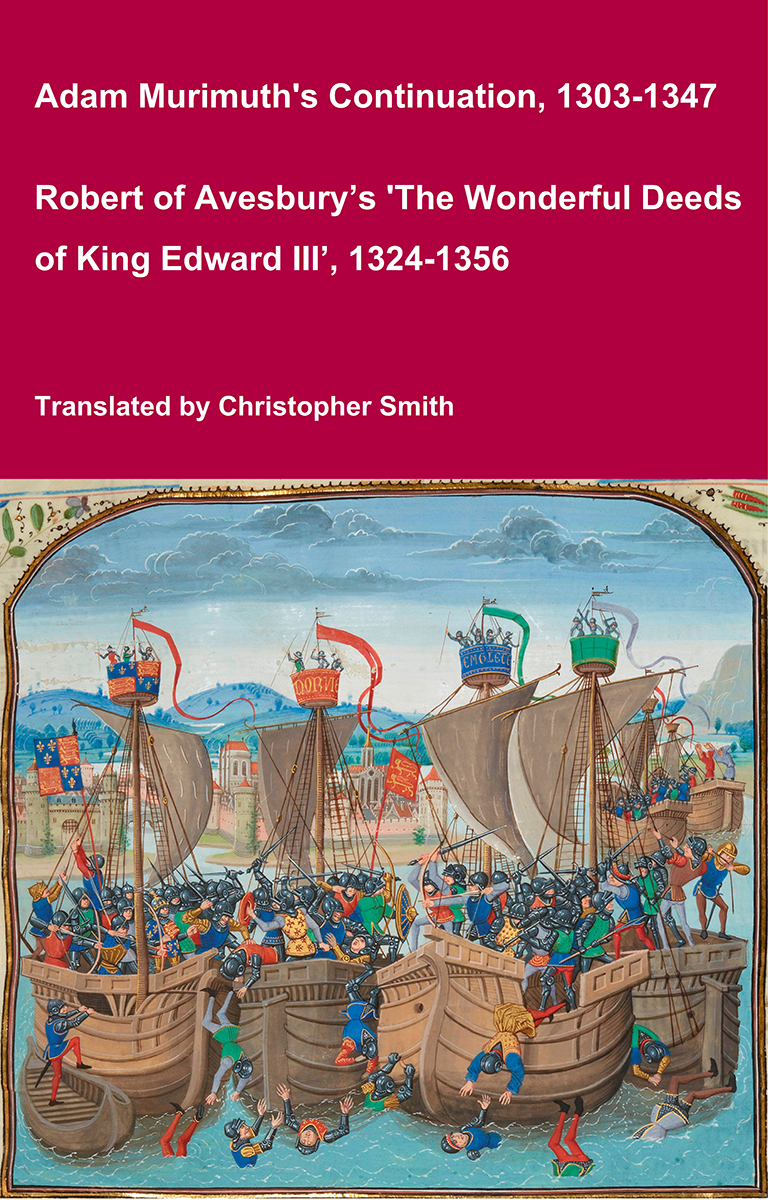
Adam Murimuth's Continuation and Robert of Avesbury’s 'The Wonderful Deeds of King Edward III'
This volume brings together two of the most important contemporary chronicles for the reign of Edward III and the opening phases of the Hundred Years’ War. Written in Latin by English clerical observers, these texts provide a vivid and authoritative window into the political, diplomatic, and military history of fourteenth-century England and its continental ambitions. Adam Murimuth Continuatio's Chronicarum continues an earlier chronicle into the mid-fourteenth century, offering concise but valuable notices on royal policy, foreign relations, and ecclesiastical affairs. Its annalistic structure makes it especially useful for establishing chronology and tracing the development of events year by year. Complementing it, Robert of Avesbury’s De gestis mirabilibus regis Edwardi tertii is a rich documentary chronicle preserving letters, treaties, and official records alongside narrative passages. It is an indispensable source for understanding Edward III’s claim to the French crown, the conduct of war, and the mechanisms of medieval diplomacy. Together, these works offer scholars, students, and enthusiasts a reliable and unembellished account of a transformative period in English and European history. Essential for anyone interested in medieval chronicles, the Hundred Years’ War, or the reign of Edward III.
Available at Amazon in eBook and Paperback format.
In 1625 Thomas Sandes [aged 24] barrister-at-law at the Middle Temple.
Around 1628 Edward Hyde 1st Earl Clarendon [aged 18] educated at Middle Temple.


In 1629 Thomas Thynne [aged 19] entered at Middle Temple.
John Evelyn's Diary. 11th April 1640. I went to London to see the solemnity of his Majesty's [aged 39] riding through the city in state to the Short Parliament, which began the 13th following,-a very glorious and magnificent sight, the King circled with his royal diadem and the affections of his people: but the day after I returned to Wotton, Surrey [Map] again, where I stayed, my father's [aged 53] indisposition suffering great intervals, till April 27th, when I was sent to London to be first resident at the Middle Temple: so as my being at the University, in regard of these avocations, was of very small benefit to me. Upon May the 5th following, was the Parliament unhappily dissolved; and, on the 20th I returned with my brother George to Wotton, Surrey [Map], who, on the 28th of the same month, was married at Albury to Mrs. Caldwell (an heiress of an ancient Leicestershire family1, where part of the nuptials were celebrated.
Note 1. A daughter of Daniel Caldwell, Esq., by Mary, daughter of George Duncomb, Esq., of Albury. She died 15th May, 1644, and he afterwards married the widow of Sir John Cotton.


John Evelyn's Diary. 12th October 1641. From Dover, I that night rode post to Canterbury, Kent [Map]. Here I visited the cathedral [Map], then in great splendour, those famous windows being entire, since demolished by the fanatics. The next morning, by Sittingboume [Map], I came to Rochester [Map], and thence to Gravesend [Map], where a light-horseman (as they call it) taking us in, we spent our tide as far as Greenwich [Map]. From hence, after we had a little refreshed ourselves at the College, (for by reason of the contagion then in London we balked the inns,) we came to London landing at Arundel-stairs [Map]. Here I took leave of his Lordship [aged 56], and retired to my lodgings in the Middle Temple, being about two in the morning, the 14th of October.


John Evelyn's Diary. 15th December 1641. I was elected one of the Comptrollers of the Middle Temple revellers, as the fashion of the young students and gentlemen was, the Christmas being kept this year with great solemnity; but, being desirous to pass it in the country, I got leave to resign my staff of office, and went with my brother Richard to Wotton, Surrey [Map].
On 21st January 1645 John Bernard 2nd Baronet [aged 14] was admitted to the Middle Temple.
John Evelyn's Diary. 14th October 1647. To Sayes Court, Deptford [Map], at Deptford, in Kent (since my house), where I found Mr. Pretyman, my wife's [aged 12] uncle, who had charge of it and the estate about it, during my father-in-law's residence in France. On the 15th, I again occupied my own chambers in the Middle Temple.
In 1652 William Willoughby 6th Baron Willoughby of Parham [aged 36] studied at Middle Temple.
In 1656 Francis Winnington [aged 21] was admitted to the Middle Temple. He was called to the bar in 1660.
Samuel Pepys' Diary. 15th July 1661. Then with Dr. Fairbrother (whom I met there) to the Rose tavern [Map], and called for some wine, and there met fortunately with Mr. Turner of our office, and sent for his wife, and were very merry (they being come to settle their son here), and sent also for Mr. Sanchy, of Magdalen, with whom and other gentlemen, friends of his, we were very merry, and I treated them as well as I could, and so at noon took horse again, having taken leave of my cozen Angier, and rode to Impington, where I found my old uncle [aged 78]1 sitting all alone, like a man out of the world: he can hardly see; but all things else he do pretty livelyly.
Note 1. Talbot Pepys, sixth son of John Pepys of Impington, was born 1583, and therefore at this time he was seventy-eight years of age. He was educated at Trinity Hall, Cambridge, and called to the bar at the Middle Temple in 1605. He was M.P. for Cambridge in 1625, and Recorder of Cambridge from 1624 to 1660, in which year he was succeeded by his son Roger [aged 44]. He died of the plague, March, 1666, aged eighty-three.
John Evelyn's Diary. 9th January 1668. Went to see the revels at the Middle Temple, which is also an old riotous custom, and has relation neither to virtue nor policy.
The Deeds of the Dukes of Normandy
The Gesta Normannorum Ducum [The Deeds of the Dukes of Normandy] is a landmark medieval chronicle tracing the rise and fall of the Norman dynasty from its early roots through the pivotal events surrounding the Norman Conquest of England. Originally penned in Latin by the monk William of Jumièges shortly before 1060 and later expanded at the behest of William the Conqueror, the work chronicles the deeds, politics, battles, and leadership of the Norman dukes, especially William’s own claim to the English throne. The narrative combines earlier historical sources with firsthand information and oral testimony to present an authoritative account of Normandy’s transformation from a Viking settlement into one of medieval Europe’s most powerful realms. William’s history emphasizes the legitimacy, military prowess, and governance of the Norman line, framing their expansion, including the conquest of England, as both divinely sanctioned and noble in purpose. Later chroniclers such as Orderic Vitalis and Robert of Torigni continued the history, extending the coverage into the 12th century, providing broader context on ducal rule and its impact. Today this classic work remains a foundational source for understanding Norman identity, medieval statesmanship, and the historical forces that reshaped England and Western Europe between 800AD and 1100AD.
Available at Amazon in eBook and Paperback format.
John Evelyn's Diary. 3rd August 1668. Mr. Bramstone (son to Judge B), my old fellow-traveler, now reader at the Middle Temple, invited me to his feast, which was so very extravagant and great as the like had not been seen at any time. There were the Duke of Ormond [aged 57], Privy Seal [aged 62], Bedford [aged 52], Belasis [aged 54], Halifax [aged 34], and a world more of Earls and Lords.


John Evelyn's Diary. 4th August 1669. I was invited by Sir Henry Peckham [aged 54] to his reading feast in the Middle Temple, a pompous entertainment, where were the Archbishop of Canterbury [aged 71], all the great Earls and Lords, etc. I had much discourse with my Lord Winchelsea [aged 41], a prodigious talker; and the Venetian Ambassador [Signor Muccinigo].

John Evelyn's Diary. 2nd May 1672. My son, John [aged 17], was specially admitted of the Middle Temple by Sir Francis North [aged 34], his Majesty's [aged 41] Solicitor-General, and since Chancellor. I pray God bless this beginning, my intention being that he should seriously apply himself to the study of the law.

John Evelyn's Diary. 16th December 1686. I carried the Countess of Sunderland [aged 40] to see the rarities of one Mr. Charlton in the Middle Temple, who showed us such a collection as I had never seen in all my travels abroad either of private gentlemen, or princes. It consisted of miniatures, drawings, shells, insects, medals, natural things, animals (of which divers, I think 100, were kept in glasses of spirits of wine), minerals, precious stones, vessels, curiosities in amber, crystal, agate, etc.; all being very perfect and rare of their kind, especially his books of birds, fish, flowers, and shells, drawn and miniatured to the life. He told us that one book stood him in £300; it was painted by that excellent workman, whom the late Gaston, Duke of Orléans, employed. This gentleman's whole collection, gathered by himself, traveling over most parts of Europe, is estimated at £8,000. He appeared to be a modest and obliging person.
Around 1689 Spencer Compton 1st Earl Wilmington [aged 16] admitted at Middle Temple.

In 1692 Edward Bagot 4th Baronet [aged 17] was educated at the Middle Temple.
On 18th May 1694 Edward Winnington aka Jeffreys [aged 24] was called to the bar at Middle Temple.
On 30th July 1698 Brian Broughton 3rd Baronet [aged 20] was admitted to Middle Temple.
John Evelyn's Diary. 4th September 1699. My worthy brother [aged 82] died at Wotton, Surrey [Map], in the 83d year of his age, of perfect memory and understanding. He was religious, sober, and temperate, and of so hospitable a nature, that no family in the county maintained that ancient custom of keeping, as it were, open house the whole year in the same manner, or gave more noble or free entertainment to the county on all occasions, so that his house was never free. There were sometimes twenty persons more than his family, and some that stayed there all the summer, to his no small expense; by this he gained the universal love of the county. He was born at Wotton, Surrey [Map], went from the free school at Guildford, Surrey [Map] to Trinity College, Oxford University, Oxford, thence to the Middle Temple, as gentlemen of the best quality did, but without intention to study the law as a profession. He married the daughter of Colwall, of a worthy and ancient family in Leicestershire, by whom he had one son; she dying in 1643, left George her son an infant, who being educated liberally, after traveling abroad, returned and married one Mrs. Gore, by whom he had several children, but only three daughters survived. He was a young man of good understanding, but, over-indulging his ease and pleasure, grew so very corpulent, contrary to the constitution of the rest of his father's relations, that he died. My brother afterward married a noble and honorable lady, relict of Sir John Cotton, she being an Offley, a worthy and ancient Staffordshire family, by whom he had several children of both sexes. This lady died, leaving only two daughters and a son. The younger daughter died before marriage; the other afterward married Sir Cyril Wych [aged 67], a noble and learned gentleman (son of Sir -- Wych), who had been Ambassador at Constantinople, and was afterward made one of the Lords Justices of Ireland. Before this marriage, her only brother married the daughter of Eversfield, of Sussex, of an honorable family, but left a widow without any child living; he died about 1691, and his wife not many years after, and my brother resettled the whole estate on me. His sister, Wych, had a portion of £6,000, to which was added £300 more; the three other daughters, with what I added, had about £5,000 each. My brother died on the 5th of October, in a good old age and great reputation, making his beloved daughter, Lady Wych, sole executrix, leaving me only his library and some pictures of my father, mother, etc. She buried him with extraordinary solemnity, rather as a nobleman than as a private gentleman. There were, as I computed, above 2,000 persons at the funeral, all the gentlemen of the county doing him the last honors. I returned to London, till my lady should dispose of herself and family.
In 1701 Hungerford Hoskyns 4th Baronet [aged 24] was admitted to Middle Temple.
In 1708 Jacob Bouverie 1st Viscount Folkestone [aged 13] admitted at Middle Temple.
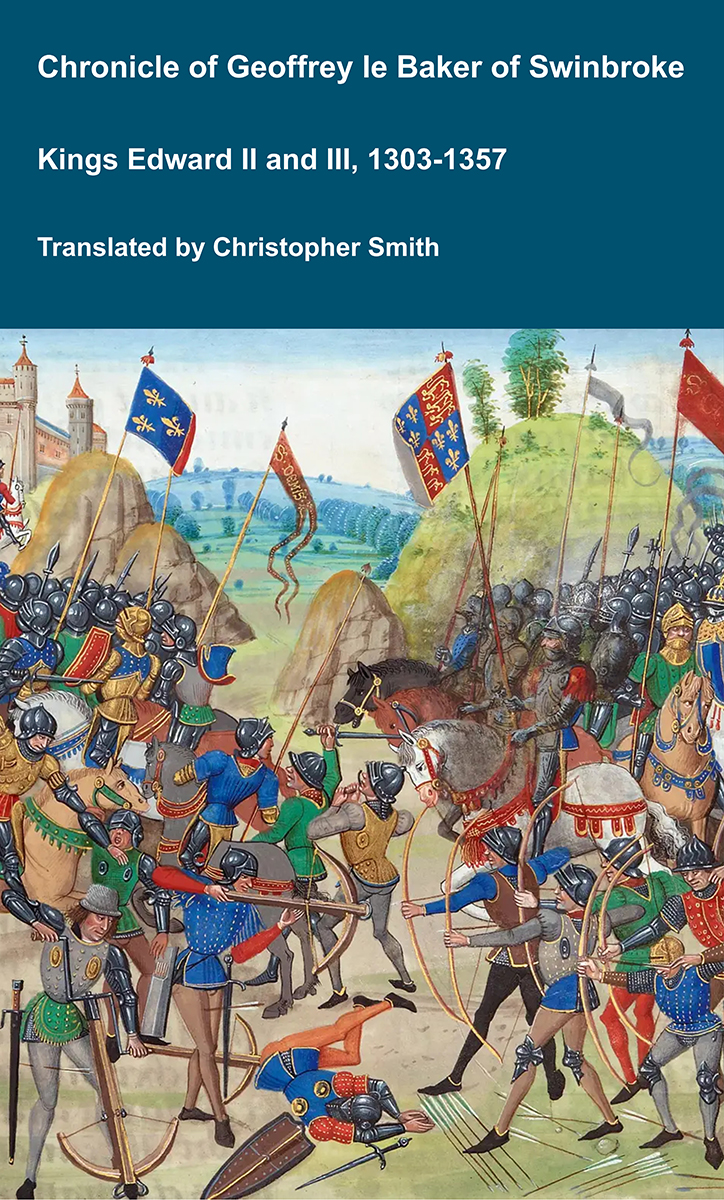
Chronicle of Geoffrey le Baker of Swinbroke
Baker was a secular clerk from Swinbroke, now Swinbrook, an Oxfordshire village two miles east of Burford. His Chronicle describes the events of the period 1303-1356: Gaveston, Bannockburn, Boroughbridge, the murder of King Edward II, the Scottish Wars, Sluys, Crécy, the Black Death, Winchelsea and Poitiers. To quote Herbert Bruce 'it possesses a vigorous and characteristic style, and its value for particular events between 1303 and 1356 has been recognised by its editor and by subsequent writers'. The book provides remarkable detail about the events it describes. Baker's text has been augmented with hundreds of notes, including extracts from other contemporary chronicles, such as the Annales Londonienses, Annales Paulini, Murimuth, Lanercost, Avesbury, Guisborough and Froissart to enrich the reader's understanding. The translation takes as its source the 'Chronicon Galfridi le Baker de Swynebroke' published in 1889, edited by Edward Maunde Thompson.
Available at Amazon in eBook and Paperback format.

On 10th February 1712 Edmund Prideaux [aged 18] entered Middle Temple.
In 1718 Henry Archer [aged 18] educated at Middle Temple.
On 8th July 1719 Andrew Wilkinson of Boroughbridge, Yorkshire [aged 22] was admitted to Middle Temple.
On 29th October 1723 Henry Streatfield [aged 17] admitted at Middle Temple.
On 9th February 1728 Francis Winnington of Broadway [aged 24] was called to the bar at Middle Temple.
On 20th February 1729 John Turner 3rd Baronet [aged 16] was admitted to the Middle Temple.
In 1740 John Buller [aged 18] entered Middle Temple and Inner Temple in 1743. He was called to the bar in February 1747.
John Evelyn's Diary. 13th February 1637: I was especially admitted (and, as I remember, my other brother) into the Middle Temple, London, though absent, and as yet at school. There were now large contributions to the distressed Palatinates.