

Chronicle of Walter of Guisborough
A canon regular of the Augustinian Guisborough Priory, Yorkshire, formerly known as The Chronicle of Walter of Hemingburgh, describes the period from 1066 to 1346. Before 1274 the Chronicle is based on other works. Thereafter, the Chronicle is original, and a remarkable source for the events of the time. This book provides a translation of the Chronicle from that date. The Latin source for our translation is the 1849 work edited by Hans Claude Hamilton. Hamilton, in his preface, says: 'In the present work we behold perhaps one of the finest samples of our early chronicles, both as regards the value of the events recorded, and the correctness with which they are detailed; Nor will the pleasing style of composition be lightly passed over by those capable of seeing reflected from it the tokens of a vigorous and cultivated mind, and a favourable specimen of the learning and taste of the age in which it was framed.'
Available at Amazon in eBook and Paperback format.
Millbarrow Long Barrow is in Winterbourne Monkton, Wiltshire [Map], Avebury Long Barrows.
Carbon Date. 2560BC. Location: Millbarrow Long Barrow [Map]
Report: Antler, id as red deer, 2047, from context 234, primary fill inner ditch, N side at Millbarrow chambered tomb, Winterbourne Monkton, Wiltshire, England. Subm A Whittle 1990. Comment (subm): Compare series OxA-3169 to -3172 and -3198. The series shows activity starting before, but running after, the enclosure on Windmill Hill to the south. [Ed: calibrated dates given in second ref below.]
ID: 7156, C14 ID: BM-2730 Date BP: 4560 +/- 70, Start Date BP: 4490, End BP: 4630
OS Letter: SU, OS East: 95, OS North: 722
Archaeologist Name: A Whittle 1989
Council for British Archaeology (2012) Archaeological Site Index to Radiocarbon Dates from Great Britain and Ireland [data-set]. York: Archaeology Data Service [distributor] https://doi.org/10.5284/1017767
Reference Name: Archaeometry, 34, 1992, 143; Wiltshire Archaeol Natur Hist Mag, 87, 1994, 26
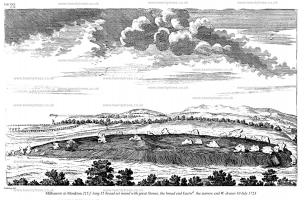
Avebury by William Stukeley. Table XXX. Milbarrow [Map] in Monkton 215 f. long 55 broad set round with great Stones, the broad end Eastwd. the narrow end W. drawn 10 Iuly 1723
Avebury by William Stukeley. In Monkton, west of the town, is a large and flat long barrow [Map] [Millbarrow Long Barrow [Map]], set round with stones, which I have depicted in plate XXX, 'tis just 120 cubits long, 30 cubits broad in the broadest end. It stands due east and west, the broadest end eastward. Its breadth the fourth part of its length: a most magnificent sepulchre, and called Milbarrow [Map].
Wiltshire Archaeological Magazine 1854 V1 Pages 303-304. Tumulus [Monkton Fields Long Barrow [Map]] at Winterbourne-Monkton. Discovery of an Ancient Tumulus, At Winterbourne-Monkton.
A curious, and possibly important discovery, exhibiting one of the ancient modes of sepulture in this country, has recently been made at Winterbourne-Monkton, about three hundred yards west of "Mill-barrow [Map]," and a mile and-a-half north of Avebury.
For many years a large flat Sarsen stone [Monkton Fields Long Barrow [Map]] (partially seen above the surface of the ground) had been the cause of many ungentle maledictions from the various clod-hoppers, who, from time to time, have followed the plough's-tail in this particular locality. Forbearance being worn out, Mr. Eyles, the present occupier of the land, by whose kindness and assistance we have been allowed to investigate the spot, sent several men to dig a large hole on one side of it,—in fact to bury it. Indoing this they found the soil beneath the stone to be of a different quality from the natural subsoil; which is here chalk marl. They consequently excavated part of the earth and found several human bones, when night put an end to their operations. This discovery led to a more minute investigation, the results of which are as follows:—
The stone is lying flat, and is of considerable size, measuring nine feet four or five inches, each way, and varying from two feet six inches, to nearly four feet in thickness. By removing the soil beneath the stone we discovered a chamber dug in the natural chalk about seven or eight feet in diameter, somewhat circular in shape, and four feet in depth measuring from the under surface of the stone. This chamber was paved at the bottom with small irregularly shaped Sarsen stones, placed so closely that a 'pick' could with difficulty be inserted between them. On this pavement were four or five human skeletons, in a most confused state, covered with Sarsen stones, weighing from ten pounds to a half a ewt. each, and about twenty or thirty in number—over these again was a layer of mould up to the top stone which covered all. The skeletons did not seem to have been deposited in any particular direction. The skulls, thigh-bones, &c., were in such close proximity that one would suppose they were originally placed in a sitting posture, when the weight of stones and earth would naturally force them into the apparently confused state in which we found them. The jaw bones were in excellent preservation, as were also the teeth. One jaw evidently belonged to a child, as the second teeth are not cut, but remain still in the jaw.
Wiltshire Archaeological Magazine 1857 V4 Pages 307-363. The Mill barrow at Monkton [Map], a mile or more north of Abury, and of which Stukeley gives an engraving, was 215 feet long and 55 broad, and was set round with great stones, the broad end east, the narrow west. Aubrey says, "The barrow is a yard high at least." It was levelled not many years ago. Dr. Merewether "saw the man who was employed in the profanation. It contained," he said, "a sort of room built up wi' big sarsens put together like, as well as a mason could set them; in the room was a sight of black stuff, and it did smill nation bad."