

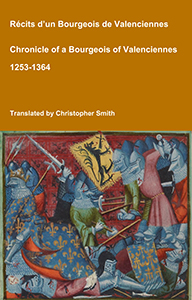
Chronicle of a Bourgeois of Valenciennes
Récits d’un bourgeois de Valenciennes aka The Chronicle of a Bourgeois of Valenciennes is a vivid 14th-century vernacular chronicle written by an anonymous urban chronicler from Valenciennes in the County of Hainaut. It survives in a manuscript that describes local and regional history from about 1253 to 1366, blending chronology, narrative episodes, and eyewitness-style accounts of political, military, and social events in medieval France, Flanders, and the Low Countries. The work begins with a chronological framework of events affecting Valenciennes and its region under rulers such as King Philip VI of France and the shifting allegiances of local nobility. It includes accounts of conflicts, sieges, diplomatic manoeuvres, and the impact of broader struggles like the Hundred Years’ War on urban life in Hainaut. Written from the perspective of a burgher (bourgeois) rather than a monastery or royal court, the chronicle offers a rare lay viewpoint on high politics and warfare, reflecting how merchants, townspeople, and civic institutions experienced the turbulence of the 13th and 14th centuries. Its narrative style combines straightforward reporting of events with moral and civic observations, making it a valuable source for readers interested in medieval urban society, regional politics, and the lived experience of war and governance in pre-modern Europe.
Available at Amazon in eBook and Paperback format.
Newbury, Berkshire is in Berkshire.
See: Newbury Bridge [Map], Northbrook Street, Newbury, Pelican Inn Newbury, Speen, Newbury [Map], St Nicholas' Church, Newbury, Winchcombe, Newbury.
In 1628 Thomas Millington was born at Newbury, Berkshire [Map].
In 1635 Thomas Chamberlayne 2nd Baronet was born to Thomas Chamberlayne 1st Baronet (age 26) at Newbury, Berkshire [Map]. He married 8th April 1657 Margaret Prideaux and had issue.
After 1635 James Chamberlayne 3rd Baronet was born to Thomas Chamberlayne 1st Baronet (age 26) at Newbury, Berkshire [Map].
On 20th September 1643 the First Battle of Newbury was fought at Newbury, Berkshire [Map] with King Charles I of England, Scotland and Ireland (age 42) commanding the Royalist army and Robert Devereux 3rd Earl Essex (age 52) commanding the victorious Parliamentary army. For King Charles I of England, Scotland and Ireland John Byron 1st Baron Byron (age 44) fought with distinction.
Henry Bertie was killed.
Robert Dormer 1st Earl Carnarvon (age 33) was killed. His son Charles (age 10) succeeded 2nd Earl Carnarvon, 3rd Baron Dormer of Wyng in Buckinghamshire, 3rd Baronet Dormer of Wyng in Buckinghamshire.
William Villiers 2nd Viscount Grandison (age 29) was killed. His brother John succeeded 3rd Viscount Grandison.
Edward Villiers (age 23) fought.
Lucius Carey 2nd Viscount Falkland (age 33) was killed. His son Lucius (age 11) succeeded 3rd Viscount Falkland.
Richard Neville (age 28) served under the Earl Carnarvon. Carnarvon was killed and Neville took up the command as a Colonel of Horse.
Major General Charles Fleetwood (age 25) was wounded.


John Evelyn's Diary. 9th June 1654. Dined at Marlborough [Map], which having been lately fired, was now new built. At one end of this town, we saw my Lord Seymour's (age 64) house, but nothing observable save the Mount, to which we ascended by windings for near half a mile. It seems to have been cast up by hand. We passed by Colonel Popham's (age 49), a noble seat, park, and river. Thence, to Newbury [Map], a considerable town, and Donnington, famous for its battle, siege, and castle, this last had been in the possession of old Geoffrey Chaucer. Then to Aldermaston, a house of Sir Humphrey Forster's, built à la moderne. Also, that exceedingly beautiful seat of my Lord Pembroke (age 33), on the ascent of hill, flanked with wood, and regarding the river, and so, at night, to Cadenham, the mansion of Edward Hungerford (age 21), Esq, uncle to my wife (age 19), where we made some stay. The rest of the week we did nothing but feast and make good cheer, to welcome my wife.
Samuel Pepys' Diary. 16th June 1668. Tuesday. So paying the reckoning, 14s. 4d., and servants, 2s., poor 1s., set out; and overtook one coach and kept a while company with it, till one of our horses losing a shoe, we stopped and drank and spent 1s. So on, and passing through a good part of this county of Wiltshire, saw a good house of Alexander Popham's (age 63), and another of my Lord Craven's (age 60), I think in Barkeshire. Come to Newbery [Map], and there dined, which cost me, and musick, which a song of the old courtier of Queen Elizabeth's, and how he was changed upon the coming in of the King (age 38), did please me mightily, and I did cause W. Hewer (age 26) to write it out, 3s. 6d. Then comes the reckoning, forced to change gold, 8s. 7d.; servants and poor, 1s. 6d. So out, and lost our way, which made me vexed, but come into it again; and in the evening betimes come to Reading [Map], and there heard my wife read more of "Mustapha", and then to supper, and then I to walk about the town, which is a very great one, I think bigger than Salsbury: a river runs through it, in seven branches, and unite in one, in one part of the town, and runs into the Thames half-a-mile off one odd sign of the Broad Face. W. Hewer troubled with the headake we had none of his company last night, nor all this day nor night to talk. Then to my inn, and so to bed.


The River Lambourn rises at Lambourne, Berkshire [Map] from where it flows broadly south-east through Eastbury, Berkshire [Map], East Garston, Berkshire [Map], Great Shefford, Berkshire [Map], Welford, Berkshire [Map], Boxford, Berkshire [Map] to Newbury, Berkshire [Map] where it joins the River Kennet.
Newbury Bridge [Map], also known as Kennet Bridge or Town Bridge, is a bridge over the River Kennet. In 1312, King Edward II directed that the bridge should be kept in good order.
On 2nd December 1557 John Winchcombe aka Smallwood aka Jack of Newbury (age 68) died at his home on Northbrook Street, Newbury. He was buried at St Nicholas' Church, Newbury on 8th December 1557.
On 25th December 1744 Henry Brydges 2nd Duke Chandos (age 36) and Anne Wells Duchess Chandos were married at Keith's Chapel, Mayfair. She by marriage Duchess Chandos. Two versions of their meeting are related... He the son of James Brydges 1st Duke Chandos and Mary Lake.
Notes & Queries 1870 4th Series, Vol. 6, p.179: Lord Omery remarked, on 15th January 1745, "Of her person & character people speak variously, but all agree that both are very bad." He was speaking of Anne, Duchess of Chandos. She was the daughter of one John Wells of Newbury (& St. Marylebone) whose arms appear as azure, three fountains proper, on her hatchment at Keynsham Church. She was chambermaid at the Pelican Inn Newbury, and married to Jeffries the Ostler there. There is a story about the Duchess told by an old lady of Newbury, who was ten years old at the time. Henry Bridges, 2nd Duke of Chandos, while on his way to London, dined at the Pelican Inn in Newbury, with a companion (it has been claimed that the Inn was the Marlborough Castle, but this is incorrect). After dinner there was a stir and a bustle in the Inn Yard. The explanation came that "A man is going to sell his wife and they are leading her up the yard with a halter round her neck". "We will go and see the sale, " said the Duke. On entering the yard, however, he was so smitten with the woman's beauty and the patient way she waited to be set free from her ill‑conditioned husband, the Inn's ostler, that he bought her himself. She was his mistress for some years. In August 1738 his wife died, and by 1744 the ostler was dead also, and the two were finally married at Mr. Keith's Chapel, Mayfair on 25th December 1744.
The Gentleman's Magazine 1832. The Duke of Chandos, while staying at a small country inn, saw the ostler beating his wife in a most cruel manner; he interfered and literally bought her for half a crown. She was a young and pretty woman; the Duke had her educated; and on the husband's death he married her. On her death-bed, she had her whole household assembled, told them her history, and drew from it a touching moral of reliance on Providence; as from the most wretched situation, she had been suddenly raised to one of the greatest prosperity; she entreated their forgiveness if at any time she had given needless offence, and then dismissed them with gifts; dying almost in the very act.
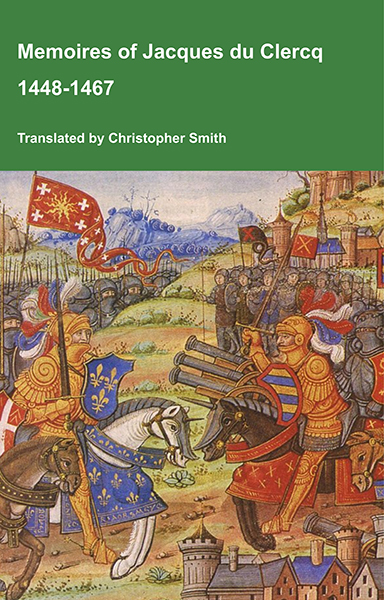
This is a translation of the 'Memoires of Jacques du Clercq', published in 1823 in two volumes, edited by Frederic, Baron de Reissenberg. In his introduction Reissenberg writes: 'Jacques du Clercq tells us that he was born in 1424, and that he was a licentiate in law and a counsellor to Philip the Good, Duke of Burgundy, in the castellany of Douai, Lille, and Orchies. It appears that he established his residence at Arras. In 1446, he married the daughter of Baldwin de la Lacherie, a gentleman who lived in Lille. We read in the fifth book of his Memoirs that his father, also named Jacques du Clercq, had married a lady of the Le Camelin family, from Compiègne. His ancestors, always attached to the counts of Flanders, had constantly served them, whether in their councils or in their armies.' The Memoires cover a period of nineteen years beginning in in 1448, ending in in 1467. It appears that the author had intended to extend the Memoirs beyond that date; no doubt illness or death prevented him from carrying out this plan. As Reissenberg writes the 'merit of this work lies in the simplicity of its narrative, in its tone of good faith, and in a certain air of frankness which naturally wins the reader’s confidence.' Du Clercq ranges from events of national and international importance, including events of the Wars of the Roses in England, to simple, everyday local events such as marriages, robberies, murders, trials and deaths, including that of his own father in Book 5; one of his last entries.
Available at Amazon in eBook and Paperback format.
Ermine Street 41a travels from Silchester Roman Fort [Map] to Speen, Newbury [Map].
Ermine Street 41b travels from Speen, Newbury [Map] through Baydon, Wiltshire [Map], Wanborough, Wiltshire [Map], Blunsdon St Andrew, Wiltshire [Map] to Cirencester, Gloucestershire [Map]. Whilst Margery's scheme doesn't say so, the road appears to continues from Cirencester, Gloucestershire [Map] to Gloucester [Map].
The Roman Road from Silchester to Bath connected Silchester, Hampshire [Map] with Bath, Somerset [Map] via Speen, Newbury [Map], Cunetio Roman Town [Map], Verlucio Roman Town [Map] and Lacock [Map] where it crossed the Gloucestershire River Avon.
On 27th October 1644 Maurice Palatinate Simmern (age 23) fought for the defeated Royalist army at the Second Battle of Newbury at Speen, Newbury [Map]. Thomas Wentworth 1st Earl Cleveland (age 53) was captured. Edward St John (age 27) was killed.
James Harington 3rd Baronet (age 36), who had his horse shot from under him, commanded five regiments.
Mountjoy Blount 1st Earl Newport (age 47) fought for the Royalist Army.
Anthony Mansel of Ischoed was killed fighting for the Royalists.


On 24th October 1668 William Craven 2nd Baron Craven was born to William Craven (age 30) and Margaret Clapham (age 19) at Benham Park, Speen, Newbury. He married 12th October 1697 Elizabeth Skipwith Baroness Craven.
In 1700 William Craven 3rd Baron Craven was born to William Craven 2nd Baron Craven (age 31) at Benham Park, Speen, Newbury.

Before 1791 Thomas Beach (age 52). Portrait of William Craven 6th Baron Craven (age 52) holding the plans of Benham Park.
In 1519 John Winchcombe aka Smallwood died. He was buried at St Nicholas' Church, Newbury where he has a brass as directed in his will:
Almighty God, to Our Blessed Lady St. Mary the Virgin and to all the Holy Company of Heaven ... buried in Our Lady Chancel, in the parish church of Newbury, by the side of his first wife, Alice, and a stone to be laid upon us both."
He bequeaths to the mother church of Salisbury, 11d, to the High Altar of the Church of Newbury "for offerings negligently forgotten," 11d and makes bequests to the several other altars in the church.
To his wife, Joan, he bequeaths 100 marks sterling, also his "household stuff" together with his cattle, wood, corn, hay and other effects; also half his plate. He further bequeaths to her for life, and afterwards to his son, John (age 30), his interest in lands and tenements he holds of the Dean and Chapter of Windsor, reserving to his said son, John, the racks and tenters in a close called "Culverhouse."
On 2nd December 1557 John Winchcombe aka Smallwood aka Jack of Newbury (age 68) died at his home on Northbrook Street, Newbury. He was buried at St Nicholas' Church, Newbury on 8th December 1557.
In 1489 John Winchcombe aka Smallwood aka Jack of Newbury was born to John Winchcombe aka Smallwood at Winchcombe, Newbury.