

The History of William Marshal was commissioned by his son shortly after William’s death in 1219 to celebrate the Marshal’s remarkable life; it is an authentic, contemporary voice. The manuscript was discovered in 1861 by French historian Paul Meyer. Meyer published the manuscript in its original Anglo-French in 1891 in two books. This book is a line by line translation of the first of Meyer’s books; lines 1-10152. Book 1 of the History begins in 1139 and ends in 1194. It describes the events of the Anarchy, the role of William’s father John, John’s marriages, William’s childhood, his role as a hostage at the siege of Newbury, his injury and imprisonment in Poitou where he met Eleanor of Aquitaine and his life as a knight errant. It continues with the accusation against him of an improper relationship with Margaret, wife of Henry the Young King, his exile, and return, the death of Henry the Young King, the rebellion of Richard, the future King Richard I, war with France, the death of King Henry II, and the capture of King Richard, and the rebellion of John, the future King John. It ends with the release of King Richard and the death of John Marshal.
Available at Amazon in eBook and Paperback format.
Rotherham is in South Yorkshire.
See: All Saints Church, Rotherham, Kimberworth, Rotherham, Moorgate General Hospital, Rotherham, , Templeborough [Map], Upper Clara Street, Rotherham.
On 24th August 1423 Archbishop Thomas Rotherham was born to Thomas Rotherham of Brookgate in Rotherham and Alice Scott at Rotherham [Map].
On 8th August 1561 Robert Swift (age 83) died at Rotherham [Map]. He was buried at All Saints Church, Rotherham where the inscription on his monument reads: "Here vnder this Tombe are placyd and buried the Bodyes of Robarte Swifte Esquier, and Anne his fyrste wyfe, who lyvyde manye yeares in this Towne of Rotherhm, in vertuus fame grett wellthe, and good woorship. They were pytyfulle to the poore and relevyd them lyberallye, and to theyr Frend" no les fayth fulle, then Bowntyfulle. Trulye they Fearyd God, who plen tuuslye powryd his Blessing" vppon theym. The sayd Anne dyed in the moneth of June, in the yere of o' Lorde God 1539, in the 67. year of heir age; and the sayd Robarte deptyd ye viijth day of August," in the yere of o' Lorde God 1561, in the 84. yeare of his age. On whose Sowlles, withe all Chrysten Sowlles, th' omnipotent Lorde haue marcy. Amen."
Henry Machyn's Diary. 6th September 1561. The vj day of September was serten gayre [gear] [made] for on [one] master Swyft (deceased), sqwyre, cott-armur, pennon of armes, and a ij skochyons, at Roderam [Map], in Yorke-shyre.
Note. P. 266. Master Swift of Rotherham. Robert Swift esquire, mercer, of Rotherham, where he "lyvyde many yeares in vertuous fame, grett wellthe, and good woorship," and had attained his 84th year. See his epitaph in Hunter's South Yorkshire, vol. ii. p. 18, and further particulars of him and his family in vol. i. of that work, p. 205. The name of his eldest son is of constant occurrence in Lodge's Illustrations, as one of the servants and most frequent correspondents of the earl of Shrewsbury.
The River Don rises at Dunford Bridge [Map] after which it flows broadly east through Penistone [Map] then south through Oughtibridge [Map], Sheffield [Map] then east through Rotherham [Map], past Conisbrough Castle [Map], Doncaster [Map] and Stainforth [Map] before joining the River Ouse at Goole [Map]. Originally the River Don was a tributary of the River Trent forming the northern boundary of the Isle of Axholme [Map] but was re-engineered by Cornelius Vermuyden as the Dutch River in the 1620s.
The River Rother rises at Clay Cross, Derbyshire [Map] then flows through Chesterfield, Derbyshire [Map] and Sheffield [Map] after which it joins the River Don which then flows through Rotherham [Map] to which the River Rother gives its name.
In June 1539 Anne Taylor (age 67) died. She was buried at All Saints Church, Rotherham.
On 8th August 1561 Robert Swift (age 83) died at Rotherham [Map]. He was buried at All Saints Church, Rotherham where the inscription on his monument reads: "Here vnder this Tombe are placyd and buried the Bodyes of Robarte Swifte Esquier, and Anne his fyrste wyfe, who lyvyde manye yeares in this Towne of Rotherhm, in vertuus fame grett wellthe, and good woorship. They were pytyfulle to the poore and relevyd them lyberallye, and to theyr Frend" no les fayth fulle, then Bowntyfulle. Trulye they Fearyd God, who plen tuuslye powryd his Blessing" vppon theym. The sayd Anne dyed in the moneth of June, in the yere of o' Lorde God 1539, in the 67. year of heir age; and the sayd Robarte deptyd ye viijth day of August," in the yere of o' Lorde God 1561, in the 84. yeare of his age. On whose Sowlles, withe all Chrysten Sowlles, th' omnipotent Lorde haue marcy. Amen."
On 24th November 1816 Llewellynn Jewitt was born to Arthur Jewitt (age 44) and Martha Sheldon of Crooke's Moor in Sheffield at Kimberworth, Rotherham. The youngest of seventeen children. He married Elizabeth Sage.
On 19th February 1957 Frederick Oxley (age 76) died. England & Wales, National Probate Calendar: "Of 39 Upper Clara Street, Rotherham [Map] died 19 Feb 1957 at Moorgate General Hospital, Rotherham. Administration Wakefield 02 April to Edith Anne Oxley widow. Effects £146 2s 4d.
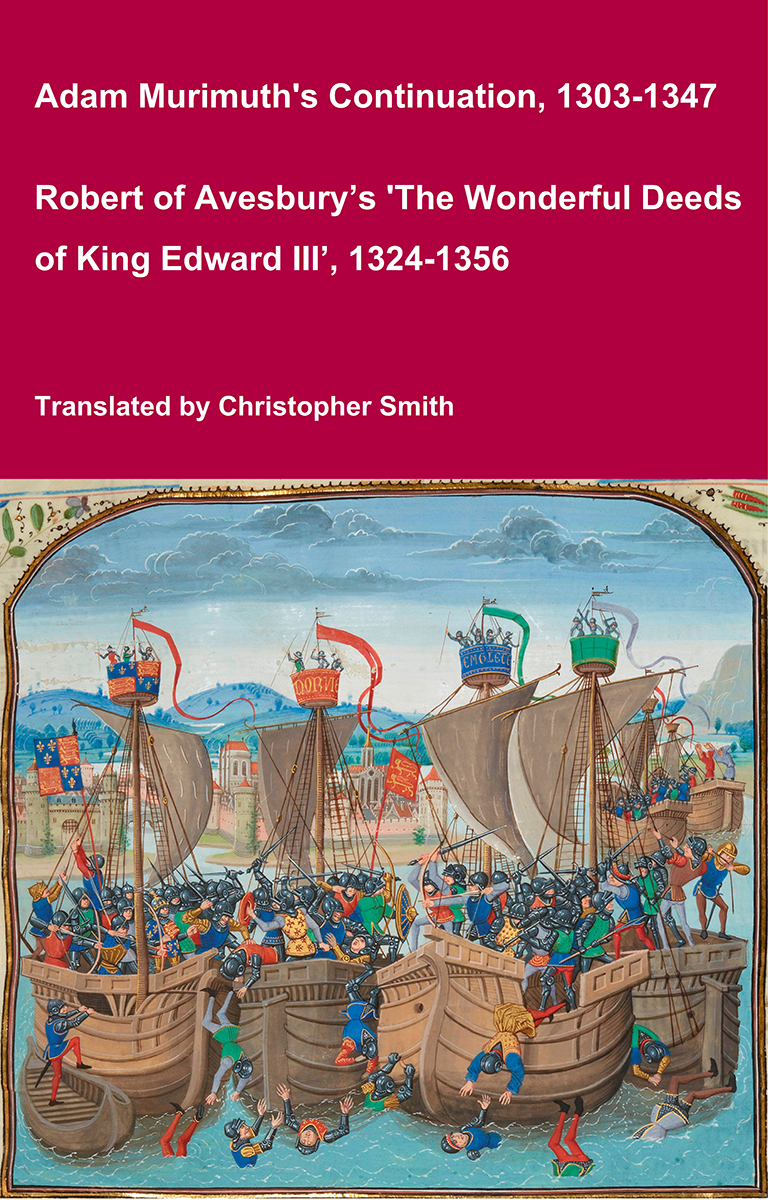
Adam Murimuth's Continuation and Robert of Avesbury’s 'The Wonderful Deeds of King Edward III'
This volume brings together two of the most important contemporary chronicles for the reign of Edward III and the opening phases of the Hundred Years’ War. Written in Latin by English clerical observers, these texts provide a vivid and authoritative window into the political, diplomatic, and military history of fourteenth-century England and its continental ambitions. Adam Murimuth Continuatio's Chronicarum continues an earlier chronicle into the mid-fourteenth century, offering concise but valuable notices on royal policy, foreign relations, and ecclesiastical affairs. Its annalistic structure makes it especially useful for establishing chronology and tracing the development of events year by year. Complementing it, Robert of Avesbury’s De gestis mirabilibus regis Edwardi tertii is a rich documentary chronicle preserving letters, treaties, and official records alongside narrative passages. It is an indispensable source for understanding Edward III’s claim to the French crown, the conduct of war, and the mechanisms of medieval diplomacy. Together, these works offer scholars, students, and enthusiasts a reliable and unembellished account of a transformative period in English and European history. Essential for anyone interested in medieval chronicles, the Hundred Years’ War, or the reign of Edward III.
Available at Amazon in eBook and Paperback format.
Between 43AD and 68AD an earth and wood Roman fort was first built at Templeborough [Map]. It was later rebuilt in stone. It is thought to have been occupied until the Roman withdrawal from Britain c. 410. Icknield Street crossed the River Don near the fort.
Icknield Street 18e Chesterfield to Templeborough. The route of Icknield Street from Chesterfield, Derbyshire [Map] to Templeborough [Map] is unknown. Speculatively it passed through Old Whittington [Map], Hundall, Derbyshire [Map], Highlane, South Yorkshire [Map], Orgreave [Map].
Icknield Street, aka Ryknild Street, is a Roman Road from Bourton-on-the-Water [Map] to Templeborough [Map]. Icknield Street is road RM18 in Ivan Margary's book 'Roman Roads in Britain'.
Photo of 39 Upper Clara Street, Rotherham [Map].
On 19th February 1957 Frederick Oxley (age 76) died. England & Wales, National Probate Calendar: "Of 39 Upper Clara Street, Rotherham [Map] died 19 Feb 1957 at Moorgate General Hospital, Rotherham. Administration Wakefield 02 April to Edith Anne Oxley widow. Effects £146 2s 4d.