

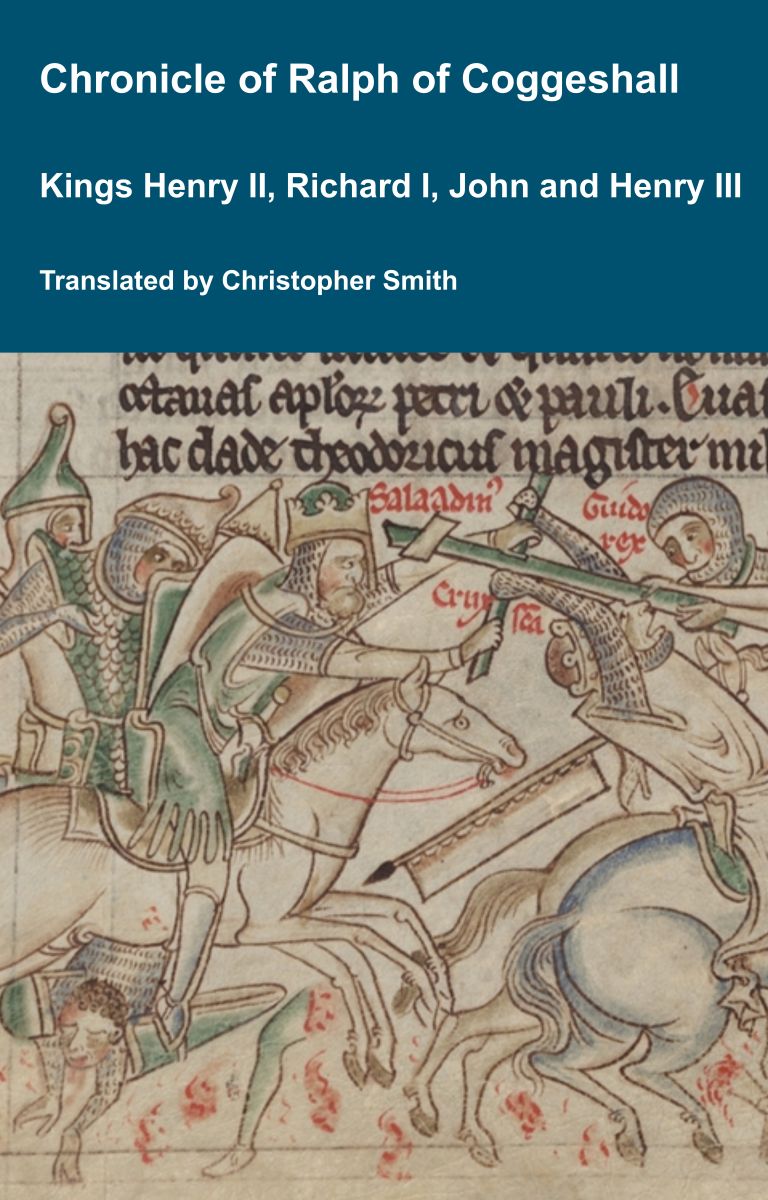
Chronicle of Abbot Ralph of Coggeshall
The Chronicle of Abbot Ralph of Coggeshall (Chronicon Anglicanum) is an indispensable medieval history that brings to life centuries of English and European affairs through the eyes of a learned Cistercian monk. Ralph of Coggeshall, abbot of the Abbey of Coggeshall in Essex in the early 13th century, continued and expanded his community’s chronicle, documenting events from the Norman Conquest of 1066 into the tumultuous reign of King Henry III. Blending eyewitness testimony, careful compilation, and the monastic commitment to record-keeping, this chronicle offers a rare narrative of political intrigue, royal power struggles, and social upheaval in England and beyond. Ralph’s work captures the reigns of pivotal figures such as Richard I and King John, providing invaluable insights into their characters, decisions, and the forces that shaped medieval rule. More than a simple annal, Chronicon Anglicanum conveys the texture of medieval life and governance, making it a rich source for scholars and readers fascinated by English history, monastic authorship, and the shaping of the medieval world.
Available at Amazon in eBook and Paperback format.
 Fisherton Gallows
 George Inn
 Salisbury Cathedral
 Arundells House, Salisbury Cathedral Close
 Malmesbury House, Salisbury Cathedral Close
 Salisbury and South Wiltshire Museum
 Salisbury Marketplace, Wiltshire
 St Martin's Church, Salisbury
 St Thomas' Church, Salisbury
Salisbury, Wiltshire is in Alderbury Hundred, Wiltshire.
On 22nd September 1934 Cecil Herbert Edward Chubb 1st Baronet [aged 58] died at his home Rothwell Dene, Bournemouth. He was buried at Devizes Road Cemetery, Salisbury. His son John [aged 30] succeeded 2nd Baronet Chubb of Stonehenge in Wiltshire.

Foxe's Book of Martyrs. 24th March 1556. Those articles thus answered, (for their articles were one, and their answers in manner like,) the chancellor read their condemnation, and so delivered them to the sheriff: Then spake John Spicer, saying; "O Master Sheriff, now must you be their butcher, that you may be guilty also with them of innocent blood before the Lord." This was the twenty-third day of March, anno 1556; and the twenty-fourth day of the same month they were carried out of the common gaol [Map] to a place betwixt Salisbury and Wilton, where were two posts set for them to be burnt at: which men coming to the place, kneeled down, and made their prayers secretly together; and then, being disclothed to their shirts, John Maundrel spake with a loud voice, "Not for all Salisbury;" which words men judged to be an answer to the sheriff, which offered him the queen's pardon if he would recant. And after that in like manner spake John Spicer, saying, "This is the joyfullest day that ever I saw." Thus were they three burnt at two stakes; where most constantly they gave their bodies to the fire, and their souls to the Lord, for testimony of his truth.
Note. Tradition suggests they were burned at the location of the Spike, indicating a stake or, subsequently, a gallows, indicated 'S' bottom left on John Speed's map of 1611.
Samuel Pepys' Diary. 10th June 1668. Thence set out with a guide, who saw us to Newmarket-heath, and then left us, 3s. 6d. So all over the Plain by the sight of the steeple, the Plain high and low, to Salisbury, by night; but before I come to the town, I saw a great fortification, and there 'light, and to it and in it; and find it prodigious, so as to frighten me to be in it all alone at that time of night, it being dark. I understand, since, it to be that, that is called Old Sarum [Map]. Come to the George Inne [Map], where lay in a silk bed; and very good diet. To supper; then to bed.
After 1603 Richard Montpesson retired to Salisbury where he largely rebuilt the house known as Arundells House, Salisbury Cathedral Close [Map].
On 2nd August 1618 William Cavendish 1st Earl Devonshire [aged 65] was created 1st Earl Devonshire, at the Bishop's Palace, Salisbury Cathedral. Elizabeth Boughton Countess Devonshire [aged 50] by marriage Countess Devonshire.
On 22nd December 1780 James Harris [aged 71] died at Malmesbury House, Salisbury Cathedral Close [Map]. On 28th December 1780 he was buried at Salisbury Cathedral [Map]. There is a memorial in the South Transept.
2300BC. Stonehenge Archer [Map] is remains of a man aged around thirty at his death who died around 2300BC found in the Outer Ditch of Stonehenge. With his remains were a stone wrist guard and a number of flint arrowheads. Several of the arrowheads' tips were located in the skeleton's bones, suggesting that the man had been killed by them.
In 1978 his remains were excavated by Richard J C Atkinson [aged 57] and Professor John G Evans [aged 36]. The remains are now in display in Salisbury and South Wiltshire Museum [Map].
On 17th January 1469 Warwick's supporters were executed in Salisbury Marketplace [Map] in the presence of King Edward IV of England [aged 26]:
Thomas Hungerford was beheaded. His father Robert Hungerford 3rd Baron Hungerford 1st Baron Moleyns had been executed five years previously after the Battle of Hexham.
Henry Courtenay was beheaded.
On 2nd November 1483 Henry Stafford 2nd Duke of Buckingham [aged 29] was beheaded in Salisbury Marketplace [Map] for his part in the rebellion. Duke of Buckingham forfeit. His son Edward [aged 5] succeeded 8th Earl Stafford, 9th Baron Stafford.
On 24th March 1556 Protestant Martyrs Willam Coberley, John Maundrel and John Spicer were burned at the stake in Salisbury Marketplace, Wiltshire [Map].
Henry Machyn's Diary. 6th March 1557. The sam day was hangyd at Salysbere in the markett plasse [Map] the lord Sturtun [aged 37] for the deth of old master Argylle and yong Argyll ys sune; the wyche they wher shamfully murdered by the lord, and dyvers of ys servandes; the wyche he mad grett lamentasyon at ys deth for that wyllfull ded that was done, and sayd as he was on the ladder (unfinished).
St Martin's Church, Salisbury is also in Churches in Wiltshire.
On or before 10th October 1814, the date he was buried at St Martin's Church, Salisbury [Map], probably on 2nd October 1814, Francis Webb [deceased] died.
St Thomas' Church, Salisbury is also in Churches in Wiltshire.
On 1st December 1800 Rear-Admiral John Stanhope [aged 56] died at Salisbury. He was buried at St Thomas' Church, Salisbury [Map].