

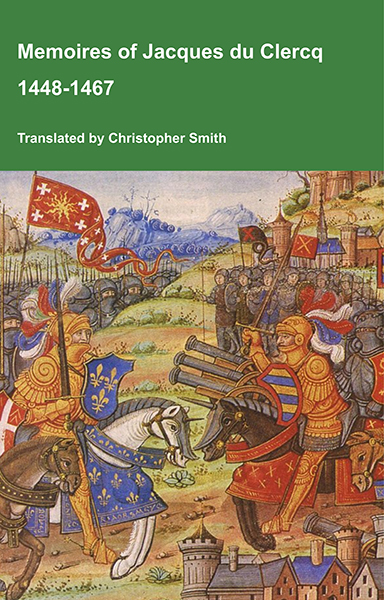
This is a translation of the 'Memoires of Jacques du Clercq', published in 1823 in two volumes, edited by Frederic, Baron de Reissenberg. In his introduction Reissenberg writes: 'Jacques du Clercq tells us that he was born in 1424, and that he was a licentiate in law and a counsellor to Philip the Good, Duke of Burgundy, in the castellany of Douai, Lille, and Orchies. It appears that he established his residence at Arras. In 1446, he married the daughter of Baldwin de la Lacherie, a gentleman who lived in Lille. We read in the fifth book of his Memoirs that his father, also named Jacques du Clercq, had married a lady of the Le Camelin family, from Compiègne. His ancestors, always attached to the counts of Flanders, had constantly served them, whether in their councils or in their armies.' The Memoires cover a period of nineteen years beginning in in 1448, ending in in 1467. It appears that the author had intended to extend the Memoirs beyond that date; no doubt illness or death prevented him from carrying out this plan. As Reissenberg writes the 'merit of this work lies in the simplicity of its narrative, in its tone of good faith, and in a certain air of frankness which naturally wins the reader’s confidence.' Du Clercq ranges from events of national and international importance, including events of the Wars of the Roses in England, to simple, everyday local events such as marriages, robberies, murders, trials and deaths, including that of his own father in Book 5; one of his last entries.
Available at Amazon in eBook and Paperback format.
Shrewsbury, Shropshire is in Shropshire.
Anglo-Saxon Chronicle. 1016. This year came King Knute [aged 21] with a marine force of one hundred and sixty ships, and Earldorman Eadric Streona with him, over the Thames into Mercia at Cricklade, Wiltshire [Map]; whence they proceeded to Warwickshire, during the middle of the winter, and plundered therein, and burned, and slew all they met. Then began Edmund the etheling [aged 26] to gather an army, which, when it was collected, could avail him nothing, unless the king [aged 50] were there and they had the assistance of the citizens of London. The expedition therefore was frustrated, and each man betook himself home. After this, an army was again ordered, under full penalties, that every person, however distant, should go forth; and they sent to the king in London, and besought him to come to meet the army with the aid that he could collect. When they were all assembled, it succeeded nothing better than it often did before; and, when it was told the king, that those persons would betray him who ought to assist him, then forsook he the army, and returned again to London. Then rode Edmund the etheling to Earl Utred in Northumbria; and every man supposed that they would collect an army King Knute; but they went into Stafforddhire, and to Shrewsbury, Shropshire [Map], and to Chester, Cheshire [Map]; and they plundered on their parts, and Knute on his. He went out through Buckinghamshire to Bedfordshire; thence to Huntingdonshire, and so into Northamptonshire along the fens to Stamford [Map]. Thence into Lincolnshire. Thence to Nottinghamshire; and so into Northumbria toward York [Map]. When Utred understood this, he ceased from plundering, and hastened northward, and submitted for need, and all the Northumbrians with him; but, though he gave hostages, he was nevertheless slain by the advice of Earldorman Eadric Streona, and Thurkytel, the son of Nafan, with him.
The Itinerary of Archbishop Baldwin through Wales: Book 2 Chapter 12. From Oswaldestree, we directed our course towards Shrewsbury [Map] (Salopesburia), which is nearly surrounded by the river Severn, where we remained a few days to rest and refresh ourselves; and where many people were induced to take the cross, through the elegant sermons of the archbishop and archdeacon. We also excommunicated Owen de Cevelioc, because he alone, amongst the Welsh princes, did not come to meet the archbishop with his people. Owen was a man of more fluent speech than his contemporary princes, and was conspicuous for the good management of his territory. Having generally favoured the royal cause, and opposed the measures of his own chieftains, he had contracted a great familiarity with king Henry II. Being with the king at table at Shrewsbury, Henry, as a mark of peculiar honour and regard, sent him one of his own loaves; he immediately brake it into small pieces, like alms-bread, and having, like an almoner, placed them at a distance from him, he took them up one by one and ate them. The king requiring an explanation of this proceeding, Owen, with a smile, replied, "I thus follow the example of my lord;" keenly alluding to the avaricious disposition of the king, who was accustomed to retain for a long time in his own hands the vacant ecclesiastical benefices.
In 1240 Phillip Burnell was born to Hugh Burnell [aged 45] at Shrewsbury, Shropshire [Map].
On 22nd June 1283 Dafydd ap Gruffudd Aberffraw Prince of Wales [aged 44] and Owain ap Dafydd Aberffraw [aged 8] were captured at Bera Mawr, Bangor. Dafydd, seriously wounded in the struggle, was brought to King Edward's [aged 44] camp at Rhuddlan [Map] that same night. Dafydd was taken from there to Chester, Cheshire [Map] and then on to Shrewsbury, Shropshire [Map]. Dafydd and Dafydd's wife Elizabeth de Ferrers [aged 43], their daughter Gwladys, infant niece Gwenllian ferch Llywelyn [aged 1], and Dafydd's six illegitimate daughters were also taken prisoner at the same time.
On 3rd October 1283 Dafydd ap Gruffudd Aberffraw Prince of Wales [aged 45] was hanged, drawn and quartered at Shrewsbury, Shropshire [Map]. The first prominent person known to have suffered being hanged, drawn and quartered. Dafydd was dragged through the streets of Shrewsbury, Shropshire [Map] attached to a horse's tail, then hanged alive, revived, then disembowelled and his entrails burned before him for "his sacrilege in committing his crimes in the week of Christ's passion", and then his body cut into four-quarters "for plotting the king's death". Geoffrey of Shrewsbury was paid 20 shillings for carrying out the act.
Before 17th November 1326 Edmund Fitzalan 2nd or 9th Earl of Arundel [aged 41] was captured by John Charleton 1st Baron Cherleton [aged 58] at Shrewsbury, Shropshire [Map] whilst attempting to gather troops to suport King Edward II of England [aged 42].
Around 1362 Thomas Percy was born to Henry Percy 1st Earl of Northumberland [aged 20] and Margaret Neville [aged 32] at Shrewsbury, Shropshire [Map]. He a great x 3 grandson of King Henry III of England. He married his fourth cousin once removed Elizabeth Strathbogie, daughter of David IV Strathbogie 12th Earl Atholl and Elizabeth Ferrers Countess Atholl, and had issue.


On 19th January 1383 Nicholas Haudlo Burnell 1st Baron Burnell [aged 57] died at Shrewsbury, Shropshire [Map]. His son Hugh [aged 36] succeeded 2nd Baron Burnell 2C. Philippa Pole Baroness Burnell [aged 27] by marriage Baroness Burnell 2C.
On 31st August 1401 Nicholas III Longford [aged 50] died at Shrewsbury, Shropshire [Map].
In 1445 Anne Talbot was born to John Talbot 2nd Earl of Shrewsbury [aged 27] and Elizabeth Butler Countess Shrewsbury and Waterford [aged 21] at Shrewsbury, Shropshire [Map]. She married (1) before 1450 Ralph Shirley (2) before 1451 Henry Vernon and had issue.
On 8th September 1473 Elizabeth Butler Countess Shrewsbury and Waterford [aged 49] died at Shrewsbury, Shropshire [Map].
On 17th May 1494 Anne Talbot [aged 49] died at Shrewsbury, Shropshire [Map]. She was buried at St Bartholemew's Church, Tong [Map].
Annales of England by John Stow. The 15 of April, the infections sweating sicknesse began at Shrewsbury, Shropshire [Map], which ended not in the North part of England untill the ende of September. "In this space what number died, it cannot be well accompted, but certaine it is that in London in fewe daies 960. gave up the ghost: if began in London the 9. of July, and the 12. of July it was most vehement, which was so terrible, that people being in best health, were sodainly taken, and dead in foure and twenty houres, and twelve, or lesse, for lacke of skill in guiding them in their sweat. And it is to be noted, that this mortalitie fell chiefely or rather on men, and those also of the best age, as betweene thirty and forty yeares, fewe women, nor children, nor olde men died thereof. Sleeping in the beginning was present death, for if they were suffered to sleepe but half a quarter of an houre, they never spake after, nor had any knowledge, but when they wakened fell into panges of death. This was a terrible time in London, for many one lost sodainly his friends, by the sweat, and their money by the proclamation. Seven honest householders did sup together, and before eight of the clocke in the next morning, four them were dead: they that were taken with full stomacks escaped hardly. This sickenesse followed English men as well within the realme, as in strange countries: wherefore this nation was much afeard of it, and for the time began to repent and remember God but as the disease relented, the devotion deceased. The first weeke died in London 800 persons.

On 4th November 1604 William Herbert 3rd Earl Pembroke [aged 24] and Mary Talbot Countess Pembroke [aged 10] were married at Shrewsbury, Shropshire [Map]. She by marriage Countess Pembroke. She the daughter of Gilbert Talbot 7th Earl of Shrewsbury [aged 51] and Mary Cavendish Countess Shrewsbury and Waterford [aged 48]. He the son of Henry Herbert 2nd Earl Pembroke and Mary Sidney Countess Pembroke [aged 43]. They were fourth cousin once removed.
On 20th January 1854 Robert Henry Herbert [aged 65] died at Shrewsbury, Shropshire [Map]. He was buried at St Mary the Virgin Church, Bromfield.
This is a translation of the 'Memoires of Jacques du Clercq', published in 1823 in two volumes, edited by Frederic, Baron de Reissenberg. In his introduction Reissenberg writes: 'Jacques du Clercq tells us that he was born in 1424, and that he was a licentiate in law and a counsellor to Philip the Good, Duke of Burgundy, in the castellany of Douai, Lille, and Orchies. It appears that he established his residence at Arras. In 1446, he married the daughter of Baldwin de la Lacherie, a gentleman who lived in Lille. We read in the fifth book of his Memoirs that his father, also named Jacques du Clercq, had married a lady of the Le Camelin family, from Compiègne. His ancestors, always attached to the counts of Flanders, had constantly served them, whether in their councils or in their armies.' The Memoires cover a period of nineteen years beginning in in 1448, ending in in 1467. It appears that the author had intended to extend the Memoirs beyond that date; no doubt illness or death prevented him from carrying out this plan. As Reissenberg writes the 'merit of this work lies in the simplicity of its narrative, in its tone of good faith, and in a certain air of frankness which naturally wins the reader’s confidence.' Du Clercq ranges from events of national and international importance, including events of the Wars of the Roses in England, to simple, everyday local events such as marriages, robberies, murders, trials and deaths, including that of his own father in Book 5; one of his last entries.
Available at Amazon in eBook and Paperback format.
The River Severn rises on Plynlimon [Map] after which it passes Llanidloes [Map], Caersws [Map], Welshpool [Map], Crew Green [Map], Shrawardine, Shropshire [Map], Shrewsbury, Shropshire [Map], Wroxeter, Shropshire [Map], Coalport, Shropshire [Map], Bridgnorth, Shropshire [Map], Bewdley, Worcestershire [Map], Stourport-on-Severn, Worcestershire [Map] to Worcester, Worcestershire [Map]
From Worcester the rivers flows through Upton-upon-Severn, Worcestershire [Map] to Tewkesbury, Gloucestershire [Map] where it is joined by the Warwickshire River Avon, Gloucester [Map] becoming the Severn Estuary around Thornwell, Monmouthshire [Map].

On 21st July 1403 King Henry IV of England [aged 36], with his son the future King Henry V of England [aged 16], defeated the rebel army of Henry "Hotspur" Percy [aged 39] at the Battle of Shrewsbury at the site now known as Battlefield, Shrewsbury [Map]. King Henry V of England took an arrow to the side of his face. John Stanley [aged 53] was wounded in the throat. Thomas Strickland [aged 36] fought and was awarded £38 and two of the rebel Henry's horses. Richard Beauchamp 13th Earl Warwick [aged 21] fought for the King. Walter Blount [aged 55], the King's Standard Bearer, was killed by Archibald Douglas 1st Duke Touraine [aged 31].
Thomas Wendesley [aged 59], Edmund Cockayne [aged 47] and Robert Goushill were killed.
Edmund Stafford 5th Earl Stafford [aged 25] was killed. His son Humphrey Stafford succeeded 6th Earl Stafford, 7th Baron Stafford.
Hugh Shirley [aged 52] was killed; he was one of four knights dressed as King Henry IV of England.
Of the rebels, Henry "Hotspur" Percy, Madog Kynaston [aged 43] and John Clifton were killed.
Thomas Percy 1st Earl of Worcester [aged 60] was beheaded after the battle. Earl Worcester extinct.
Richard Vernon 11th Baron Shipbrook [aged 48] was hanged. Baron Shipbrook forfeit.
John Rossall was killed. His sister Eleanor Rossall [aged 26] inherited a half-share in the Rossall Shrewsbury [Map] estates.
John Massey [aged 65] was killed.
On 25th March 1796 William Feilding 6th Earl Desmond 7th Earl Denbigh was born to William Feilding [aged 35] and Anne Catherine Powys at Berwick House, Shrewsbury. He married 8th May 1822 Mary Elizabeth Kitty Moreton Countess Desmond and Denbigh, daughter of Thomas Reynolds-Moreton 1st Earl Ducie and Frances Herbert Baroness Ducie Tortworth, and had issue.
Haughmond Abbey is also in Abbeys in England.
On 25th September 1292 Alice Saluzzo Countess Arundel died. She was buried at Haughmond Abbey [Map].
On 9th March 1302 Richard Fitzalan 1st or 8th Earl of Arundel [aged 35] died. He was buried at Haughmond Abbey [Map]. His son Edmund [aged 16] succeeded 2nd or 9th Earl Arundel.
On 17th November 1326 Edmund Fitzalan 2nd or 9th Earl of Arundel [aged 41] was beheaded at Hereford [Map]. Earl Arundel forfeit. According to the Llandaff Chronicle he was executed by a "worthless wretch" ("villissimi ribaldi") with a blunt sword requiring twenty-two strokes although I have been unable to find a copy of the Chronicle to confirm this story. He was initially buried at the Franciscan Church, Hereford, subsequently reburied at his family's traditional place of burial Haughmond Abbey [Map].
On 21st July 1403 King Henry IV of England [aged 36], with his son the future King Henry V of England [aged 16], defeated the rebel army of Henry "Hotspur" Percy [aged 39] at the Battle of Shrewsbury at the site now known as Battlefield, Shrewsbury [Map]. King Henry V of England took an arrow to the side of his face. John Stanley [aged 53] was wounded in the throat. Thomas Strickland [aged 36] fought and was awarded £38 and two of the rebel Henry's horses. Richard Beauchamp 13th Earl Warwick [aged 21] fought for the King. Walter Blount [aged 55], the King's Standard Bearer, was killed by Archibald Douglas 1st Duke Touraine [aged 31].
Thomas Wendesley [aged 59], Edmund Cockayne [aged 47] and Robert Goushill were killed.
Edmund Stafford 5th Earl Stafford [aged 25] was killed. His son Humphrey Stafford succeeded 6th Earl Stafford, 7th Baron Stafford.
Hugh Shirley [aged 52] was killed; he was one of four knights dressed as King Henry IV of England.
Of the rebels, Henry "Hotspur" Percy, Madog Kynaston [aged 43] and John Clifton were killed.
Thomas Percy 1st Earl of Worcester [aged 60] was beheaded after the battle. Earl Worcester extinct.
Richard Vernon 11th Baron Shipbrook [aged 48] was hanged. Baron Shipbrook forfeit.
John Rossall was killed. His sister Eleanor Rossall [aged 26] inherited a half-share in the Rossall Shrewsbury [Map] estates.
John Massey [aged 65] was killed.
In 1845 Watkin Williams-Wynn 6th Baronet [aged 24] was appointed Treasurer of the Salop Informary, Shrewsbury.
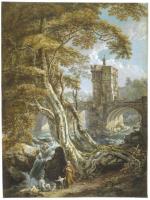
Before 1809. Paul Sandby [aged 77]. "Shrewsbury Bridge".
Around 1565 Francis Newport [aged 10] educated at Shrewsbury School, Shrewsbury.
In 1565 Thomas Harries aka Harris 1st Baronet [aged 15] educated at Shrewsbury School, Shrewsbury.

Around 1566 Philip Sidney [aged 11] educated at Shrewsbury School, Shrewsbury.
Around 1566 Fulk Greville 13th Baron Latimer 5th Baron Willoughby 1st Baron Brooke [aged 11] educated at Shrewsbury School, Shrewsbury.
On 7th April 1767 Cecil Weld-Forester 1st Baron Forester was baptised at St Chad's Church, Shrewsbury.
After 22nd July 1403 Thomas Percy 1st Earl of Worcester [deceased] was buried at St Peter's Church, Shrewsbury.