William of Worcester's Chronicle of England
William of Worcester, born around 1415, and died around 1482 was secretary to John Fastolf, the renowned soldier of the Hundred Years War, during which time he collected documents, letters, and wrote a record of events. Following their return to England in 1440 William was witness to major events. Twice in his chronicle he uses the first person: 1. when writing about the murder of Thomas, 7th Baron Scales, in 1460, he writes '… and I saw him lying naked in the cemetery near the porch of the church of St. Mary Overie in Southwark …' and 2. describing King Edward IV's entry into London in 1461 he writes '… proclaimed that all the people themselves were to recognize and acknowledge Edward as king. I was present and heard this, and immediately went down with them into the city'. William’s Chronicle is rich in detail. It is the source of much information about the Wars of the Roses, including the term 'Diabolical Marriage' to describe the marriage of Queen Elizabeth Woodville’s brother John’s marriage to Katherine, Dowager Duchess of Norfolk, he aged twenty, she sixty-five or more, and the story about a paper crown being placed in mockery on the severed head of Richard, 3rd Duke of York.
Available at Amazon in eBook and Paperback format.
South Bailey, Durham is in Durham, County Durham [Map].
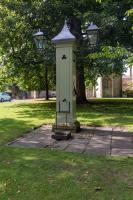
The Water Pump in the South Bailey, Durham. A Grade II Listed Building. Late C18/early C19. Stone base; wood boarded column enclosing pump with iron handle and bucket stand. Tall square column; long curved handle on north side; C19 square gas lamp on wrought iron bracket attached to east side over water pipe and bucket stand. Moulded square stone base.
Tower on the riverside of the South Bailey, Durham with covered alley into the College.
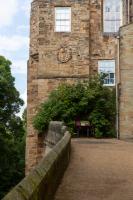
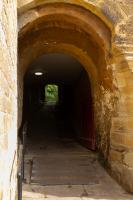
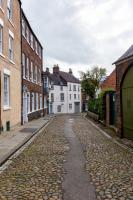
South Bailey, Durham.
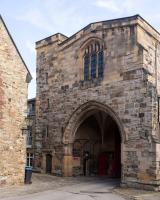
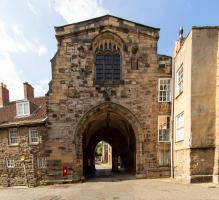
1500. The College Gateway, or Priory Gateway from the South Bailey, Durham was commissioned in 1500, by Prior Castell replacing an earlier gatehouse. A chapel dedicated to St Helen, is to be found in the upper storey of the gatehouse. North of the College Gate was a room for the Children of Almonry – poor children that were fed, clothed and schooled by the Abbey.
In 1736 Elizabeth Blakiston (age 85) died. She was buried at St James the Less Church, South Bailey, Durham.
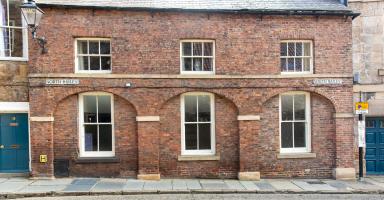
Around 1750. Arcaded 18th century building opposite the Priory/College Gateway that defines the boundary between the North and South Baileys.
On 27th January 1918 Reverend William Greenwell (age 97) died unmarried at his home 27 South Bailey, Durham.


On 15th February 2018 HRH The Prince of Wales (age 69) unveiled a plaque at Bowes House, St Johns College, South Bailey, Durham to Dame Elizabeth Bowes 1651-1736 nee Blakiston, ancestor of his mother Queen Elizabeth II of the United Kingdom (age 91).
Elizabeth Blakiston: In 1651 she was born to Francis Blakiston 3rd Baronet. In 1693 William Bowes of Streatlam and she were married. In 1736 she died. She was buried at St James the Less Church, South Bailey, Durham.


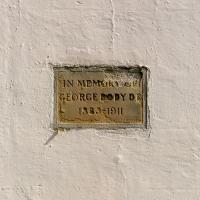
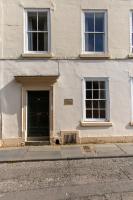
Memorial to George Body on nineteen South Bailey, Durham.