

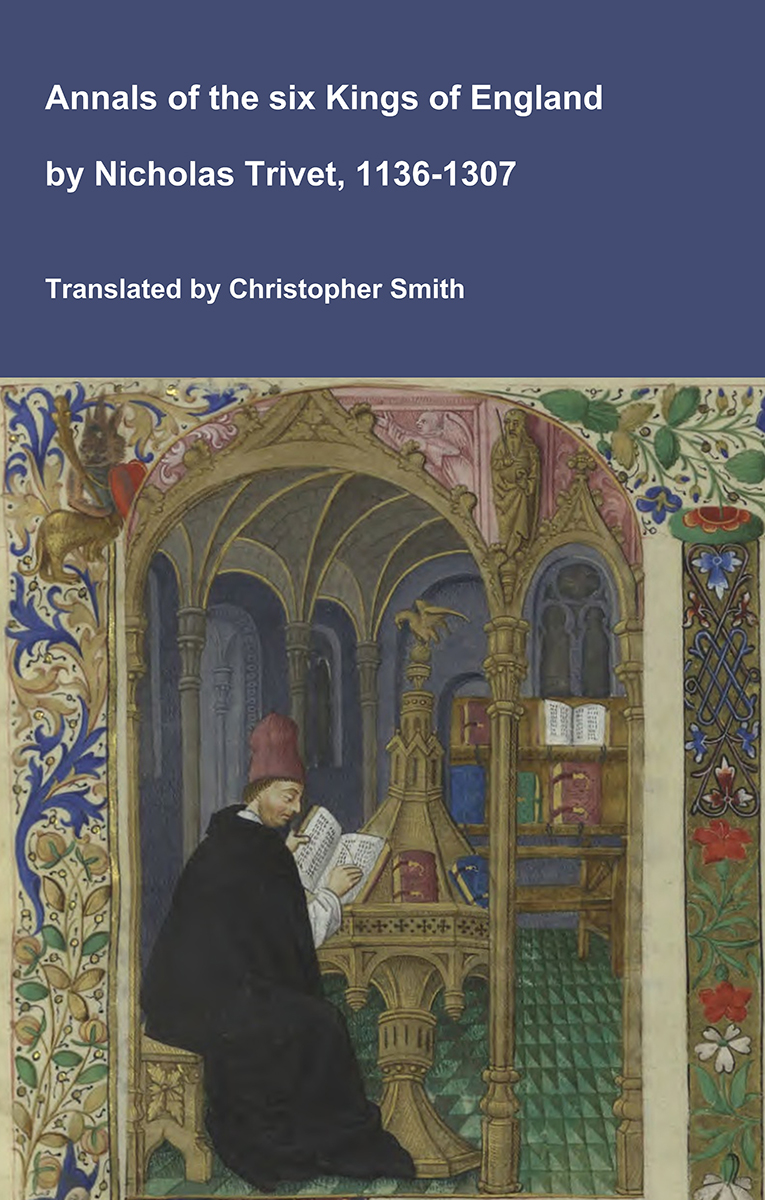
Annals of the six Kings of England by Nicholas Trivet
Translation of the Annals of the Six Kings of England by that traces the rise and rule of the Angevin aka Plantagenet dynasty from the mid-12th to early 14th century. Written by the Dominican scholar Nicholas Trivet, the work offers a vivid account of English history from the reign of King Stephen through to the death of King Edward I, blending political narrative with moral reflection. Covering the reigns of six monarchs—from Stephen to Edward I—the chronicle explores royal authority, rebellion, war, and the shifting balance between crown, church, and nobility. Trivet provides detailed insight into defining moments such as baronial conflicts, Anglo-French rivalry, and the consolidation of royal power under Edward I, whose reign he describes with particular immediacy. The Annals combines careful year-by-year reporting with thoughtful interpretation, presenting history not merely as a sequence of events but as a moral and political lesson. Ideal for readers interested in medieval history, kingship, and the origins of the English state, this chronicle remains a valuable and accessible window into the turbulent world of the Plantagenet kings.
Available at Amazon in eBook and Paperback format.
South Derbyshire is in Derbyshire.
Carbon Date. 2700BC. Late Neolithic Carbon Dates
Report: Carbonised grain, from pit sealed by Beaker barrow at Aston-on-Trent, Derbyshire, England.
ID: 4189, C14 ID: BM-271 Date BP: 4700 +/- 150, Start Date BP: 4550, End BP: 4850
OS Letter: SK, OS East: 422, OS North: 291
Archaeologist Name: D Reaney
Reference Name: Radiocarbon, 11, 1969, 288; Derbyshire Archaeol J, 88, 1968, 68-81
Council for British Archaeology (2012) Archaeological Site Index to Radiocarbon Dates from Great Britain and Ireland [data-set]. York: Archaeology Data Service [distributor] https://doi.org/10.5284/1017767

All Saints Church, Aston-on-Trent is also in Churches in Derbyshire.
On 25th May 1742 James Shuttleworth [aged 28] and Mary Holden were married at All Saints Church, Aston-on-Trent [Map]. They had four sons and three daughters.

On 4th November 1784 Thomas Gascoigne 8th Baronet [aged 39] and Mary Shuttleworth Lady Turner and Gascoigne [aged 33] were married at All Saints Church, Aston-on-Trent [Map]. She by marriage Lady Gascoigne of Barnbow and Parlington in Yorkshire.
Around 1414 Alice Booth was born to Henry Booth of Harleston in Derbyshire [aged 29] and Isabel Fynderne at Arleston, Derbyshire [Map]. She married in or before 1424 Nicholas Fitzherbert and had issue.
Around 1478 William Blount 4th Baron Mountjoy was born to John Blount 3rd Baron Mountjoy [aged 28] and Lora Berkeley Countess Ormonde at Barton Blount, Derbyshire [Map]. He married (1) 1497 Elizabeth Saye Baroness Mountjoy and had issue (2) before 30th July 1509 Inez Venegas Baroness Mountjoy (3) February 1515 Alice Keble Baroness Mountjoy, daughter of Henry Keble, and had issue (4) 29th July 1523 Dorothy Grey Baroness Mountjoy, Willoughby and Latimer, daughter of Thomas Grey 1st Marquess Dorset and Cecily Bonville Marchioness Dorset, and had issue.
On 5th June 1699 Thomas Gresley 2nd Baronet [aged 71] died. He was buried at St George and St Mary's Church, Church Gresley. His son William [aged 37] succeeded 3rd Baronet Gresley of Drakelow in Derbyshire.
On 31st July 1736 Dorothy Bowyer died. She was buried at St George and St Mary's Church, Church Gresley.
On 12th October 1837 Roger Gresley 8th Baronet [aged 37] died. He was buried at St George and St Mary's Church, Church Gresley on 28th October 1837. His first cousin William [aged 31] succeeded 9th Baronet Gresley of Drakelow in Derbyshire.
On 3rd November 1552 Thomas Gresley was born to William Gresley [aged 27] and Catherine Aston at Drakelow, Derbyshire [Map]. He married (1) in or before 1580 Katharine Walsingham and had issue (2) after 1595 Mary Southwell.
On 5th September 1610 Thomas Gresley [aged 57] died at Drakelow, Derbyshire [Map].
Henrici Quinti, Angliæ Regis, Gesta, is a first-hand account of the Agincourt Campaign, and subsequent events to his death in 1422. The author of the first part was a Chaplain in King Henry's retinue who was present from King Henry's departure at Southampton in 1415, at the siege of Harfleur, the battle of Agincourt, and the celebrations on King Henry's return to London. The second part, by another writer, relates the events that took place including the negotiations at Troye, Henry's marriage and his death in 1422.
Available at Amazon in eBook and Paperback format.
On 11th January 1727 Nigel Gresley 6th Baronet was born to Thomas Gresley 4th Baronet [aged 28] and Dorothy Bowyer at Drakelow Hall, Derbyshire. He married 18th May 1752 Elizabeth Wynn Lady Gresley and had issue.
On 27th January 1776 Nigel Bowyer Gresley 7th Baronet [aged 23] and Wilmot Gresley were married by which he acquired Drakelow Hall, Derbyshire. They were first cousins.
In 1197 Ermentrude Ferrers was born to Robert Ferrers [aged 20] and Joan Boclande [aged 14] at Egginton, Derbyshire [Map]. She married Henry Fitzgerald and had issue.
In 1253 Robert Stafford was born to Robert Stafford [aged 37] and Alice Corbet [aged 28] at Egginton, Derbyshire [Map]. He married his first cousin once removed Gundreda Stafford and had issue.
In 1278 Johanna Stafford was born to Robert Stafford [aged 25] and Gundreda Stafford [aged 26] at Egginton, Derbyshire [Map]. Coefficient of inbreeding 3.12%.
Saint Wilfred's Chuirch, Egginton is also in To Do List.
On 10th August 1790 Ashton Mosley [aged 22] and Mary Morley [aged 37] were married at Saint Wilfred's Chuirch, Egginton [Map].
On 9th October 1860 Henry Edmund Every was born to Henry Flower Every 10th Baronet [aged 29] and Mary Isabella Hollond Lady Every [aged 20]. He was baptised on 6th December 1890 at Saint Wilfred's Chuirch, Egginton [Map].
Around 1433 John Fitzherbert was born to Nicholas Fitzherbert [aged 33] and Alice Booth [aged 19] at Etwall, Derbyshire [Map]. He married in or before 1480 Margaret Babington and had issue.
In 1455 Margaret Babington was born to John Babington [aged 32] and Isabel Bradbourne [aged 28] at Etwall, Derbyshire [Map]. She married in or before 1480 John Fitzherbert and had issue.
St Peter's Church, Hartshorne is also in Churches in Derbyshire.
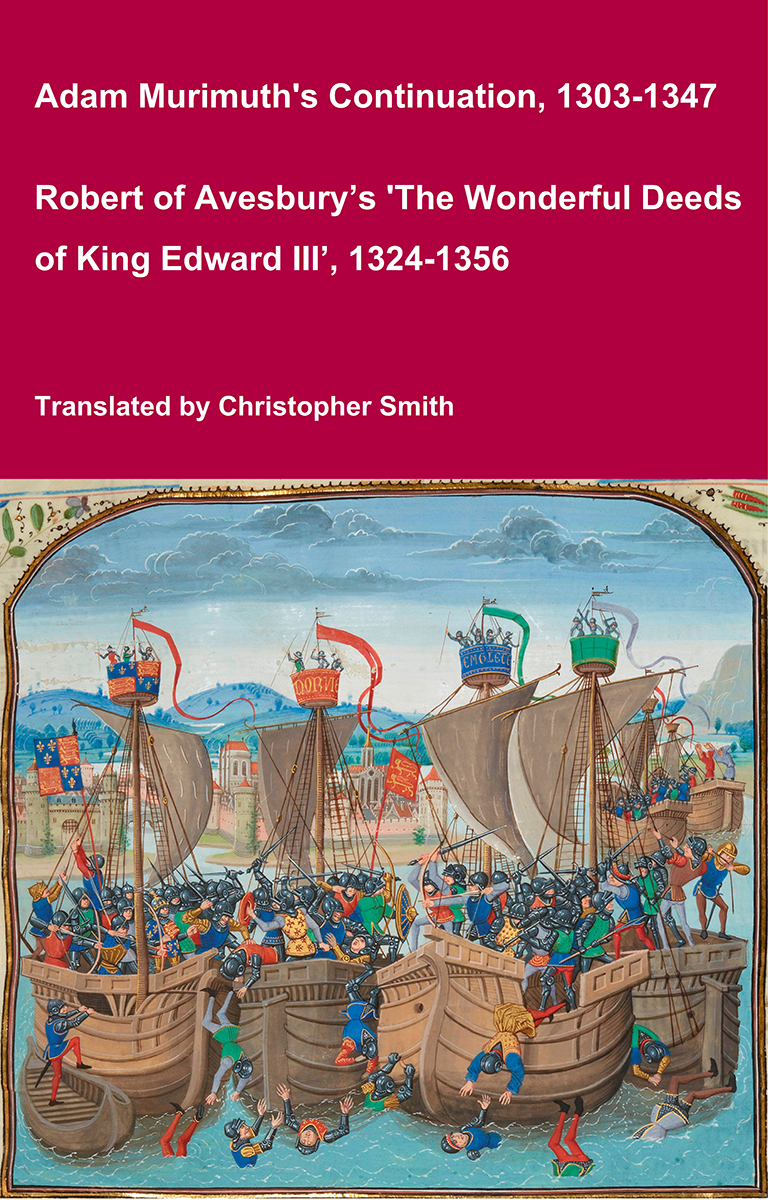
Adam Murimuth's Continuation and Robert of Avesbury’s 'The Wonderful Deeds of King Edward III'
This volume brings together two of the most important contemporary chronicles for the reign of Edward III and the opening phases of the Hundred Years’ War. Written in Latin by English clerical observers, these texts provide a vivid and authoritative window into the political, diplomatic, and military history of fourteenth-century England and its continental ambitions. Adam Murimuth Continuatio's Chronicarum continues an earlier chronicle into the mid-fourteenth century, offering concise but valuable notices on royal policy, foreign relations, and ecclesiastical affairs. Its annalistic structure makes it especially useful for establishing chronology and tracing the development of events year by year. Complementing it, Robert of Avesbury’s De gestis mirabilibus regis Edwardi tertii is a rich documentary chronicle preserving letters, treaties, and official records alongside narrative passages. It is an indispensable source for understanding Edward III’s claim to the French crown, the conduct of war, and the mechanisms of medieval diplomacy. Together, these works offer scholars, students, and enthusiasts a reliable and unembellished account of a transformative period in English and European history. Essential for anyone interested in medieval chronicles, the Hundred Years’ War, or the reign of Edward III.
Available at Amazon in eBook and Paperback format.
On 27th April 1799 Stebbing Shaw [aged 37] succeeded his father as Rector of St Peter's Church, Hartshorne [Map].
Around 1653 John Coke was born to Thomas Coke [aged 43] in Melbourne, Derbyshire [Map]. He married in or before 1674 Mary Leventhorpe, daughter of Thomas Leventhorpe 4th Baronet and Mary Bedell.

In 1674 Mary Coke was born to John Coke [aged 21] in Melbourne, Derbyshire [Map]. She married 21st November 1695 John Fanshawe of Parsloes.

On 19th February 1674 Thomas Coke was born to John Coke [aged 21] in Melbourne, Derbyshire [Map]. He was baptised on the same day. He married (1) June 1698 Mary Stanhope, daughter of Philip Stanhope 2nd Earl Chesterfield and Elizabeth Dormer Countess Chesterfield, and had issue (2) 15th October 1709 Mary Hale and had issue.
On 12th December 1877 Susan Millicent Reeve [aged 61] died at Melbourne, Derbyshire [Map].


After 18th January 1867. Melbourne Cemetery, Derbyshire [Map]. Grave of Ensign Henry Edward Gooch of the Coldstream Guards, one of four men responsble for the pivotal closing of the gate at Hougomont Chateau during the Battle of Waterloo.
In or before 1743 Matthew Lamb 1st Baronet [aged 37] and Charlotte Coke [aged 23] were married. She brought Melbourne Hall, Derbyshire [Map] to the Lamb family.

On 29th January 1853 Frederick Lamb 3rd Viscount Melbourne [aged 70] died without issue. Viscount Melbourne of Kilmore in County Cavan, Baron Beauvale of Beauvale in Nottinghamshire and Baronet Lamb of Brocket Hall in Hertfordshire extinct. Melbourne Hall, Derbyshire [Map] was inherited by his sister Emily Lamb Countess Cowper [aged 65].
The River Trent rises on Biddulph Moor, Staffordshire [Map] and flows, in a great horseshoe through, or near, Stoke-on-Trent, Staffordshire [Map], Stone, Staffordshire [Map], Essex Bridge [Map], Bishton Hall, Staffordshire [Map], Colwich, Staffordshire [Map] passing St Michael and All Angels Church, Colwich [Map], Rugeley, Staffordshire [Map], Kings Bromley, Staffordshire [Map], Alrewas, Staffordshire [Map], Burton-upon-Trent, Staffordshire [Map], Newton Solney, Derbyshire [Map], Repton, Derbyshire [Map], under Swarkestone Bridge, Derbyshire [Map], Sawley, Derbyshire [Map], Nottingham, Nottinghamshire [Map], Holme Pierrepoint, Nottinghamshire [Map], Stoke Ferry, Shelford [Map], under Gunthorpe Bridge, Nottinghamshire [Map], past Gunthorpe Lock [Map], Hoveringham, Nottingham [Map], Newark on Trent, Nottinghamshire [Map], Knaith [Map], Dunham Bridge [Map], Sutton on Trent, Nottinghamshire [Map], the Isle of Axholme [Map] and Gainsborough [Map] before joining the Humber Estuary at Trent Falls [Map].
Melbourne Castle is also in Castles in Derbyshire.
Around 1311 Thomas Plantagenet 2nd Earl of Leicester, 2nd Earl Lancaster, Earl of Salisbury and Lincoln [aged 33] commissioned the building of Melbourne Castle [Map] having received a license to crenallate his manor in from King Edward II of England [aged 26]; the castle wasn't completed before his execution. The records show £1,313 was spent on the project in the year 1313–14, of which £548 was paid to masons for dressing stone.
Chronicle of a Bourgeois of Valenciennes
Récits d’un bourgeois de Valenciennes aka The Chronicle of a Bourgeois of Valenciennes is a vivid 14th-century vernacular chronicle written by an anonymous urban chronicler from Valenciennes in the County of Hainaut. It survives in a manuscript that describes local and regional history from about 1253 to 1366, blending chronology, narrative episodes, and eyewitness-style accounts of political, military, and social events in medieval France, Flanders, and the Low Countries. The work begins with a chronological framework of events affecting Valenciennes and its region under rulers such as King Philip VI of France and the shifting allegiances of local nobility. It includes accounts of conflicts, sieges, diplomatic manoeuvres, and the impact of broader struggles like the Hundred Years’ War on urban life in Hainaut. Written from the perspective of a burgher (bourgeois) rather than a monastery or royal court, the chronicle offers a rare lay viewpoint on high politics and warfare, reflecting how merchants, townspeople, and civic institutions experienced the turbulence of the 13th and 14th centuries. Its narrative style combines straightforward reporting of events with moral and civic observations, making it a valuable source for readers interested in medieval urban society, regional politics, and the lived experience of war and governance in pre-modern Europe.
Available at Amazon in eBook and Paperback format.
In 1327 Melbourne Castle [Map] was given to Henry of Lancaster [aged 46] by the Crown.
In 1375 Catherine of Lancster [aged 1], daughter of John of Gaunt 1st Duke Lancaster [aged 34], was given her own room at Melbourne Castle [Map], and a Castilin attendant.
1415. After the Battle of Agincourt at which John Duke of Bourbon [aged 34] was captured Melbourne Castle [Map] served as his prison for nineteen years.
In 1604 Melbourne Castle [Map] and its grounds were bought by Henry Hastings 5th Earl Huntingdon [aged 17]. Between 1610 and 1637 was destroyed and its stones re-used.

Vesta Monumenta. 1733. Plate 1.40 depicts Melbourne Castle [Map]. Engraving by George [aged 49] Vertue after a drawing originally produced for a survey of the properties of the Duchy of Lancaster conducted by the Chancellor of the Duchy, Ambrose Cave, in 1561.
Around 1499 Eleanor Pole was born to German Pole of Radbourne [aged 19] in Radbourne, Derbyshire [Map]. She married Richard Curzon and had issue.
Around 1320 John Chandos was born at Radbourne Hall, Derbyshire [Map].
Around 28th October 1364 Ralph Cromwell [aged 39] died at West Hallam in Shardlow, Derbyshire [Map].
St James' Church, Smisby is also in Churches in Derbyshire.
St James' Church, Smisby [Map].
The church is normally kept locked but can be opened up by arrangement.
An alabaster slab in the west wall bears the figure of a lady: her hands are clasped on her breast and her feet rest on two small dogs The inscription is in Norman-French, a portion of the date and a few words are wholly illegible. On the north wall of the chancel is the monument of Henry Kendall and his wife, dated 1627.
The River Trent rises on Biddulph Moor, Staffordshire [Map] and flows, in a great horseshoe through, or near, Stoke-on-Trent, Staffordshire [Map], Stone, Staffordshire [Map], Essex Bridge [Map], Bishton Hall, Staffordshire [Map], Colwich, Staffordshire [Map] passing St Michael and All Angels Church, Colwich [Map], Rugeley, Staffordshire [Map], Kings Bromley, Staffordshire [Map], Alrewas, Staffordshire [Map], Burton-upon-Trent, Staffordshire [Map], Newton Solney, Derbyshire [Map], Repton, Derbyshire [Map], under Swarkestone Bridge, Derbyshire [Map], Sawley, Derbyshire [Map], Nottingham, Nottinghamshire [Map], Holme Pierrepoint, Nottinghamshire [Map], Stoke Ferry, Shelford [Map], under Gunthorpe Bridge, Nottinghamshire [Map], past Gunthorpe Lock [Map], Hoveringham, Nottingham [Map], Newark on Trent, Nottinghamshire [Map], Knaith [Map], Dunham Bridge [Map], Sutton on Trent, Nottinghamshire [Map], the Isle of Axholme [Map] and Gainsborough [Map] before joining the Humber Estuary at Trent Falls [Map].
Calke Abbey is also in Abbeys in England.
Henrici Quinti, Angliæ Regis, Gesta, is a first-hand account of the Agincourt Campaign, and subsequent events to his death in 1422. The author of the first part was a Chaplain in King Henry's retinue who was present from King Henry's departure at Southampton in 1415, at the siege of Harfleur, the battle of Agincourt, and the celebrations on King Henry's return to London. The second part, by another writer, relates the events that took place including the negotiations at Troye, Henry's marriage and his death in 1422.
Available at Amazon in eBook and Paperback format.

Before 28th May 1745 Johnathan "The Elder" Richardson [aged 78]. Portrait of John Manners 3rd Duke Rutland [aged 48]. Calke Abbey [Map].

On 1st January 1844 George Crewe 8th Baronet [aged 48] died at Calke Abbey [Map]. His son John [aged 20] succeeded 9th Baronet Harpur of Calke Abbey in Derbyshire.
