

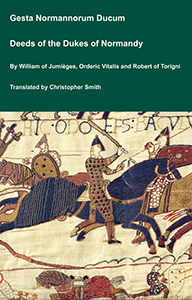
The Deeds of the Dukes of Normandy
The Gesta Normannorum Ducum [The Deeds of the Dukes of Normandy] is a landmark medieval chronicle tracing the rise and fall of the Norman dynasty from its early roots through the pivotal events surrounding the Norman Conquest of England. Originally penned in Latin by the monk William of Jumièges shortly before 1060 and later expanded at the behest of William the Conqueror, the work chronicles the deeds, politics, battles, and leadership of the Norman dukes, especially William’s own claim to the English throne. The narrative combines earlier historical sources with firsthand information and oral testimony to present an authoritative account of Normandy’s transformation from a Viking settlement into one of medieval Europe’s most powerful realms. William’s history emphasizes the legitimacy, military prowess, and governance of the Norman line, framing their expansion, including the conquest of England, as both divinely sanctioned and noble in purpose. Later chroniclers such as Orderic Vitalis and Robert of Torigni continued the history, extending the coverage into the 12th century, providing broader context on ducal rule and its impact. Today this classic work remains a foundational source for understanding Norman identity, medieval statesmanship, and the historical forces that reshaped England and Western Europe between 800AD and 1100AD.
Available at Amazon in eBook and Paperback format.
St Andrew Undershaft Church, Aldgate Ward is in Aldgate Ward, Churches in City of London.
In 1329 Geoffrey Denny was born at St Andrew Undershaft Church, Aldgate Ward [Map].
St Andrew Undershaft Church, Aldgate Ward [Map] is so named because of the Maypole that was erected each year opposite the church until 1517.
Henry Machyn's Diary. 16th April 1554. The xvj day of Aprell was sett up in sant Androwes Undershafft [Map] for master Kyrtun, alderman of London and marchand tayller of London, and marchand of the stapull of Calles, with a cote armur, iij penons of armes, goodly ons, and sett up over ys tombe.
Note. P. 60. Funeral ensigns of alderman Kyrton. Stephen Kirton, member of the Merchant-taylors in 1534. He was never sheriff or lord mayor. He bore four coats quarterly, 1. Argent, a fess and chevronel in chief gules; 2. Argent, a crescent and bordure sable; 3. Paly, argent and gules, a fess between three leopard's heads, all counterchanged; 4. Argent, a fesse between three butterflies gules. (Lord Mayors, &c. by Wm. Smith, Rouge-Dragon.)
On 19th October 1556 Bishop Henry Man died. He was buried at St Andrew Undershaft Church, Aldgate Ward [Map].
Henry Machyn's Diary. 22nd October 1556. The xxij day of October was bered doctur [Man], sumtime the pryor of Shen the charterhowse, and after mad bysshope of Man by kyng Edward the vjth; [and] was mared [married]; and bered at sant Andrews hundershaft [Map], London, and ded at master Whetheley('s) marchand tayller.
Note. P. 116. Burial of bishop Man at St. Andrew's Undershaft. "Henry Man, doctor of divinity in the university of Oxenford, and sometime bishop of Man, which Henry departed this life the 19. day of October, An. Do. 1556, and lyeth buried under this stone."—"before the doore within the chancell." (Stowe.) The letters patent of his appointment by Henry VIII. dated 22 Jan. 1545–6 are printed in Rymer's Fœdera, xv. 85.
Henry Machyn's Diary. 9th December 1560. The ix day of Desember was bered in sant Andrews undershaft [Map] mastores Lusun wedow, the wyff of master Lusun merser and stapoler and late shreyff of London, with a lx in blake gownes, and her plase and the chyrche hangyd with blake and armes, and a xxiiij clarkes syngyng; and she gayff xl gownes to men and women of brod cloth, and evere woman had nuw raylles, and ther was a sermon, and a iiij dosen of skochyons of armes; and after a gret dole, and after a grett dener.
Note. P. 245. Funeral of mistress Luson or Leveson. This was the widow of "Nicholas Leveson, mercer, sheriff 1535. Buried at St. Andrew's Undershaft." Arms, Azure, a fess undy argent and sable, between three leaves or. (List by Wm. Smith, Rougedragon.)
In 1582 Thomas Offley [aged 82] died. He was buried at St Andrew Undershaft Church, Aldgate Ward [Map].

On 10th June 1610 John Craven 1st Baron Craven was baptised at St Andrew Undershaft Church, Aldgate Ward [Map].
On 18th July 1618 William Craven [aged 70] died. He was buried at St Andrew Undershaft Church, Aldgate Ward [Map].
On 28th November 1626 Captain Lewes Roberts [aged 30] and Anne Williamott were married at St Andrew Undershaft Church, Aldgate Ward [Map].
On 11th November 1641 Christopher Clitherow [aged 63] died. He was buried at St Andrew Undershaft Church, Aldgate Ward [Map].
On 17th December 1656 Gervase Clifton 1st Baronet [aged 69] and Alice Hastings Lady Clifton [aged 50] were married at St Andrew Undershaft Church, Aldgate Ward [Map]. She by marriage Lady Clifton of Clifton in Nottinghamshire. She the daughter of Henry Hastings 5th Earl Huntingdon and Elizabeth Stanley Countess Huntingdon.
John Evelyn's Diary. 2nd December 1657. Dr. Raynolds [aged 58] (since Bishop of Norwich) preached before the company at St. Andrew Under-shaft [Map], on Nehemiah xiii. 31, showing, by the example of Nehemiah, all the perfections of a trusty person in public affairs, with many good precepts apposite to the occasion, ending with a prayer for God's blessing on the company and the undertaking.
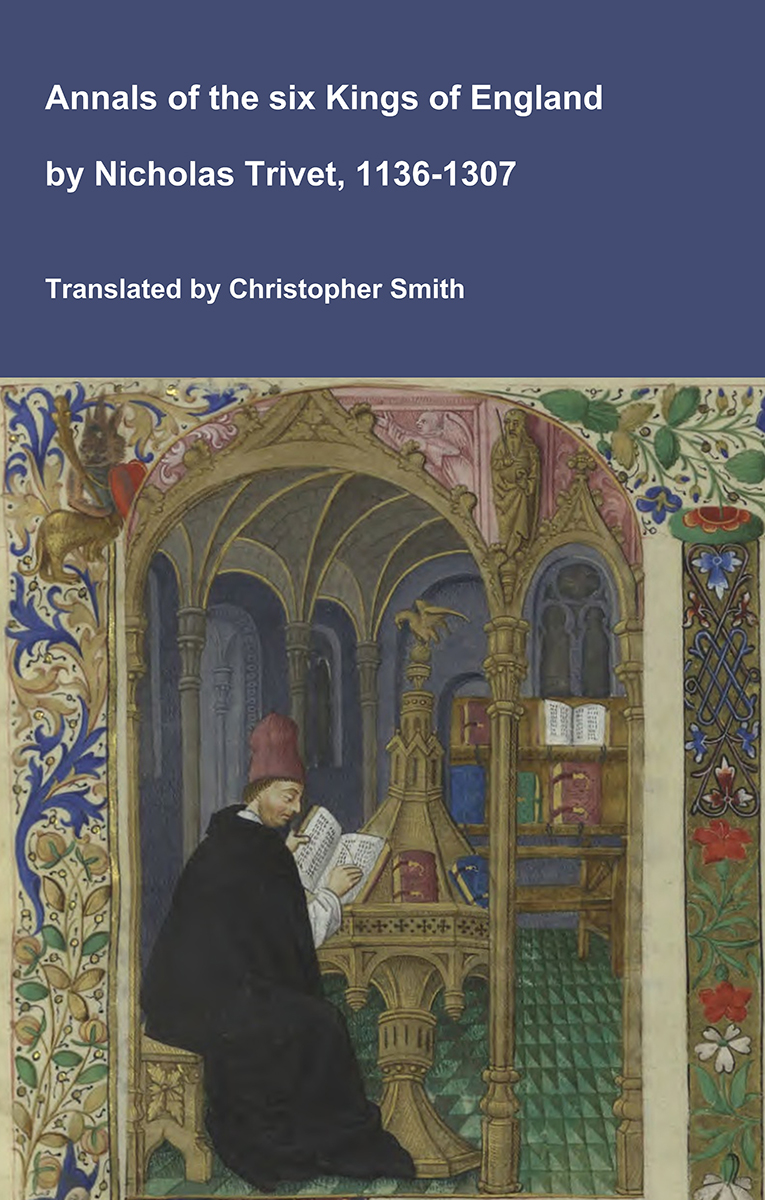
Annals of the six Kings of England by Nicholas Trivet
Translation of the Annals of the Six Kings of England by that traces the rise and rule of the Angevin aka Plantagenet dynasty from the mid-12th to early 14th century. Written by the Dominican scholar Nicholas Trivet, the work offers a vivid account of English history from the reign of King Stephen through to the death of King Edward I, blending political narrative with moral reflection. Covering the reigns of six monarchs—from Stephen to Edward I—the chronicle explores royal authority, rebellion, war, and the shifting balance between crown, church, and nobility. Trivet provides detailed insight into defining moments such as baronial conflicts, Anglo-French rivalry, and the consolidation of royal power under Edward I, whose reign he describes with particular immediacy. The Annals combines careful year-by-year reporting with thoughtful interpretation, presenting history not merely as a sequence of events but as a moral and political lesson. Ideal for readers interested in medieval history, kingship, and the origins of the English state, this chronicle remains a valuable and accessible window into the turbulent world of the Plantagenet kings.
Available at Amazon in eBook and Paperback format.
In 1671 John Dethick died at his estate in Tottenham [Map]. He was buried at St Andrew Undershaft Church, Aldgate Ward [Map].
On or before 5th August 1672, the date he was buried at St Andrew Undershaft Church, Aldgate Ward [Map], William Wight [aged 70] died.