

The History of William Marshal was commissioned by his son shortly after William’s death in 1219 to celebrate the Marshal’s remarkable life; it is an authentic, contemporary voice. The manuscript was discovered in 1861 by French historian Paul Meyer. Meyer published the manuscript in its original Anglo-French in 1891 in two books. This book is a line by line translation of the first of Meyer’s books; lines 1-10152. Book 1 of the History begins in 1139 and ends in 1194. It describes the events of the Anarchy, the role of William’s father John, John’s marriages, William’s childhood, his role as a hostage at the siege of Newbury, his injury and imprisonment in Poitou where he met Eleanor of Aquitaine and his life as a knight errant. It continues with the accusation against him of an improper relationship with Margaret, wife of Henry the Young King, his exile, and return, the death of Henry the Young King, the rebellion of Richard, the future King Richard I, war with France, the death of King Henry II, and the capture of King Richard, and the rebellion of John, the future King John. It ends with the release of King Richard and the death of John Marshal.
Available at Amazon in eBook and Paperback format.
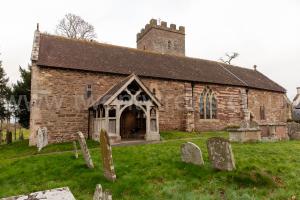
St Andrew's Church, Bredwardine is in Bredwardine, Herefordshire [Map], Churches in Herefordshire.
. Originally Anglo-Saxon, the current nave of St Andrew's Church, Bredwardine [Map] was constructed around 1080. The early church was believed to have a central tower but this and the original chancel were destroyed. There is a pronounced kink between nave and chancel.
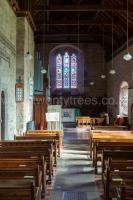
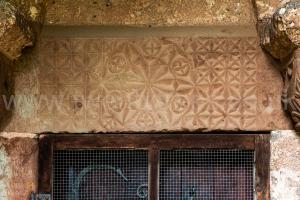
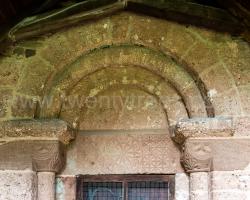
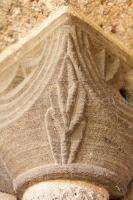
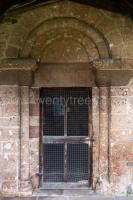
1200. St Andrew's Church, Bredwardine [Map]. Carving of lintel above north door. Possibly missing a Tympanum. From the Herefordshire School of Carving.
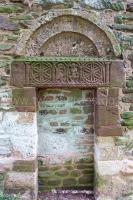
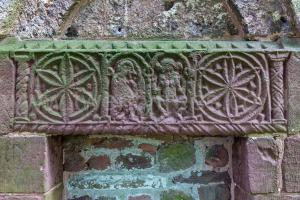
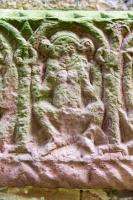
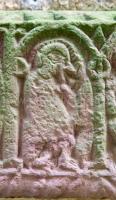
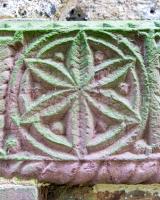
1200. St Andrew's Church, Bredwardine [Map]. Carving of lintel above the south door. Herefordshire School of Carving.
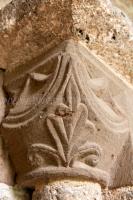
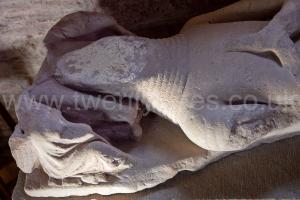
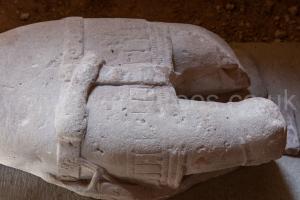
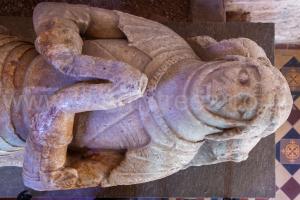
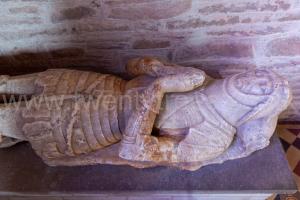
1400. St Andrew's Church, Bredwardine [Map]. Two effigies of unknown knights.
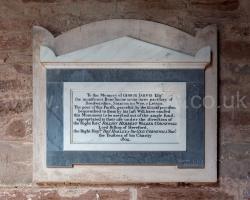
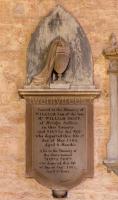
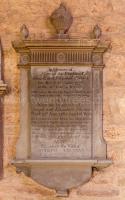
1904. St Andrew's Church, Bredwardine [Map]. Memorial to George Jarvis, died 1794. In the year preceding his death he changed his will leaving everything to the poor of the Parishes of Bredwardine, Staunton-on-Wye and Letton in the proportion 13:11:6. The trustees, who commissioned this memorial by Richard Westmacott (presumably, or possibly his father), were Bishop Folliott Cornewall, Thomas Harley and George Cornewall 3rd Baronet.
Bishop Folliott Cornewall: On or before 9th May 1754 he was born. He was baptised on 9th May 1754. In 1808 Bishop Folliott Cornewall was translated to Bishop of Worcester. In 1824 Bishop Robert Eden 3rd Baron Auckland was ordained Priest by Bishop Folliott Cornewall, then Bishop of Worcester. On 5th September 1831 he died.
George Cornewall 3rd Baronet: On 16th January 1774 he was born to George Amyand aka Cornewall 2nd Baronet and Catherine Cornewall. He was baptised at St George's Church, Hanover Square. On 26th September 1815 George Cornewall 3rd Baronet and Jane Naper Lady Cornewall were married. On 26th August 1819 George Amyand aka Cornewall 2nd Baronet died. His son George succeeded 3rd Baronet Amyand aka Cornewall of Moccas Court in Herefordshire. Jane Naper Lady Cornewall by marriage Lady Amyand aka Cornewall of Moccas Court in Herefordshire. On 27th December 1835 George Cornewall 3rd Baronet died. His son Velters succeeded 4th Baronet Amyand aka Cornewall of Moccas Court in Herefordshire.
After 2nd September 1915. St Andrew's Church, Bredwardine [Map]. Grave of Tom Gammon. Born in Bredwarine. King's Shropshire Light Infantry "C" Coy. 8th Bn. Died from an abscess aged twenty-three at the Cambridge Hospital in Aldershot where the battalion was training. The date of his daeth either 1st of September, as recorded on his grave, or the 2nd, as recorded on the memorial inside the Church. He was born in Bredwardine on June 25, 1892, to Thomas Arthur Gammond (died 1939) and Jane, née Davies (died 1935).


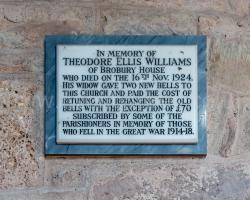
1918. St Andrew's Church, Bredwardine [Map]. Memorials to soldiers who died in World War I.
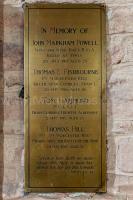
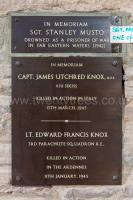
1942. St Andrew's Church, Bredwardine [Map]. Memorials to soldiers who died in World War II. The top memorial being a reference to the LIsbon Maru disaster. On her final voyage, Lisbon Maru was being used to transport prisoners of war between Hong Kong and Japan when it was torpedoed on 1 October 1942, sinking with a loss of over 800 British lives.
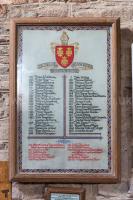
1954. Vicars of St Andrew's Church, Bredwardine [Map].