

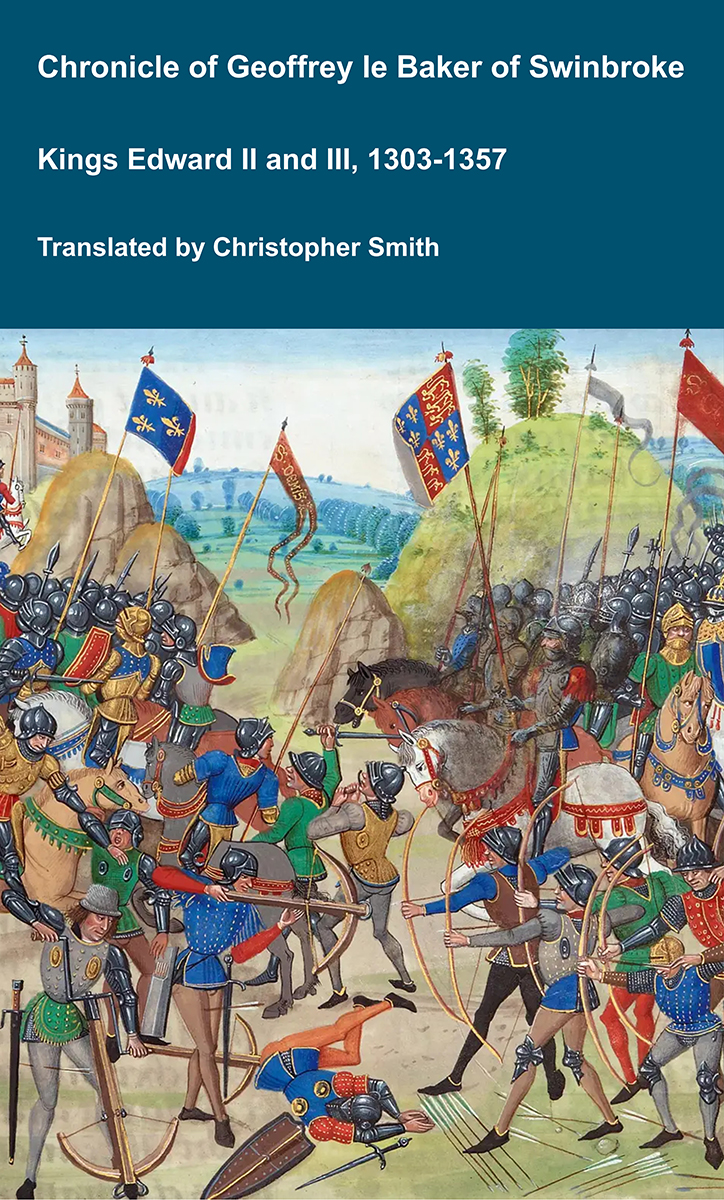
Chronicle of Geoffrey le Baker of Swinbroke
Baker was a secular clerk from Swinbroke, now Swinbrook, an Oxfordshire village two miles east of Burford. His Chronicle describes the events of the period 1303-1356: Gaveston, Bannockburn, Boroughbridge, the murder of King Edward II, the Scottish Wars, Sluys, Crécy, the Black Death, Winchelsea and Poitiers. To quote Herbert Bruce 'it possesses a vigorous and characteristic style, and its value for particular events between 1303 and 1356 has been recognised by its editor and by subsequent writers'. The book provides remarkable detail about the events it describes. Baker's text has been augmented with hundreds of notes, including extracts from other contemporary chronicles, such as the Annales Londonienses, Annales Paulini, Murimuth, Lanercost, Avesbury, Guisborough and Froissart to enrich the reader's understanding. The translation takes as its source the 'Chronicon Galfridi le Baker de Swynebroke' published in 1889, edited by Edward Maunde Thompson.
Available at Amazon in eBook and Paperback format.
St John's College, Cambridge University is in Cambridge University.
Around 1517 Anthony Denny [aged 15] educated at St John's College, Cambridge University [Map].
On 19th September 1522 Bishop George Day [aged 21] became a Fellow of St John's College, Cambridge University [Map].
In 1527 Roger Lupton [aged 71] established six scholarships to St John's College, Cambridge University [Map], to be awarded exclusively to boys from Sedbergh School with a preference for founder's kin
Around 1528 John Cheke [aged 13] educated at St John's College, Cambridge University [Map].
In 1530 Thomas Hoby was born to William Hoby of Leominster in Herefordshire and Katherine Forden. In 1546 he matriculated St John's College, Cambridge University [Map]. He married 27th June 1558 Elizabeth Cooke and had issue.

Around 1535 Thomas Wentworth 2nd Baron Wentworth [aged 10] educated at St John's College, Cambridge University [Map].
In May 1535 William Cecil 1st Baron Burghley [aged 14] educated at St John's College, Cambridge University [Map].


In 1537 Bishop George Day [aged 36] became Master of St John's College, Cambridge University [Map].

Around 1540 Thomas Cromwell was born to Gregory Cromwell 1st Baron Cromwell Oakham [aged 20] and Elizabeth Seymour Baroness Cromwell Oakham [aged 22]. He was educated at St John's College, Cambridge University [Map].
In 1542 Bishop John Christopherson became a Fellow of St John's College, Cambridge University [Map].
The History of William Marshal was commissioned by his son shortly after William’s death in 1219 to celebrate the Marshal’s remarkable life; it is an authentic, contemporary voice. The manuscript was discovered in 1861 by French historian Paul Meyer. Meyer published the manuscript in its original Anglo-French in 1891 in two books. This book is a line by line translation of the first of Meyer’s books; lines 1-10152. Book 1 of the History begins in 1139 and ends in 1194. It describes the events of the Anarchy, the role of William’s father John, John’s marriages, William’s childhood, his role as a hostage at the siege of Newbury, his injury and imprisonment in Poitou where he met Eleanor of Aquitaine and his life as a knight errant. It continues with the accusation against him of an improper relationship with Margaret, wife of Henry the Young King, his exile, and return, the death of Henry the Young King, the rebellion of Richard, the future King Richard I, war with France, the death of King Henry II, and the capture of King Richard, and the rebellion of John, the future King John. It ends with the release of King Richard and the death of John Marshal.
Available at Amazon in eBook and Paperback format.
Around 1542 William Dethick was born to Gilbert Dethick [aged 32]. He was educated at St John's College, Cambridge University [Map].
Around October 1548 Thomas Carew [aged 21] was educated at St John's College, Cambridge University [Map].
Around 1549 Thomas Browne [aged 14] educated at St John's College, Cambridge University [Map].
Around April 1549 Charles Willoughby 2nd Baron Willoughby of Parham [aged 12] was educated at St John's College, Cambridge University [Map].
Around 1550 Thomas Sackville 1st Earl Dorset [aged 14] educated at St John's College, Cambridge University [Map].


On 18th March 1558 Bishop Richard Howand [aged 17] was admitted pensioner at Christ's College, Cambridge University [Map], but he migrated to St John's College, Cambridge University [Map], where he graduated B.A. in 1561.
Around 1564 Edward Stafford [aged 12] educated at St John's College, Cambridge University [Map].
Around 1572 Ralph Eure 3rd Baron Eure [aged 13] educated at St John's College, Cambridge University [Map].

In 1574 Philip Howard 13th or 20th Earl of Arundel [aged 16] educated at St John's College, Cambridge University [Map].
In 1574 Bishop John Still [aged 40] was appointed Master of St John's College, Cambridge University [Map].
On 20th July 1577 Bishop Richard Howand [aged 36] was admitted as Master of St John's College, Cambridge University [Map].
William of Worcester's Chronicle of England
William of Worcester, born around 1415, and died around 1482 was secretary to John Fastolf, the renowned soldier of the Hundred Years War, during which time he collected documents, letters, and wrote a record of events. Following their return to England in 1440 William was witness to major events. Twice in his chronicle he uses the first person: 1. when writing about the murder of Thomas, 7th Baron Scales, in 1460, he writes '… and I saw him lying naked in the cemetery near the porch of the church of St. Mary Overie in Southwark …' and 2. describing King Edward IV's entry into London in 1461 he writes '… proclaimed that all the people themselves were to recognize and acknowledge Edward as king. I was present and heard this, and immediately went down with them into the city'. William’s Chronicle is rich in detail. It is the source of much information about the Wars of the Roses, including the term 'Diabolical Marriage' to describe the marriage of Queen Elizabeth Woodville’s brother John’s marriage to Katherine, Dowager Duchess of Norfolk, he aged twenty, she sixty-five or more, and the story about a paper crown being placed in mockery on the severed head of Richard, 3rd Duke of York.
Available at Amazon in eBook and Paperback format.
In 1585 Edward Denny 1st Earl Norwich [aged 15] was educated at St John's College, Cambridge University [Map].
In October 1585 Henry Wriothesley 3rd Earl of Southampton [aged 11] admitted at St John's College, Cambridge University [Map].


On 6th June 1589 Henry Wriothesley 3rd Earl of Southampton [aged 15] graduated at St John's College, Cambridge University [Map].
Around 1609 Thomas Wentworth 1st Earl Strafford [aged 15] educated at St John's College, Cambridge University [Map].


In 1615 Algernon Percy 10th Earl of Northumberland [aged 12] educated at St John's College, Cambridge University [Map].


In 1619 James Wriothesley [aged 13] entered at St John's College, Cambridge University [Map].
Around 1624 Thomas Fairfax 3rd Lord Fairfax [aged 11] educated at St John's College, Cambridge University [Map].
Around 1635 Charles Cecil [aged 16] educated at St John's College, Cambridge University [Map].

Around 1647 Francis North 1st Baron Guildford [aged 9] educated at St John's College, Cambridge University [Map].

John Evelyn's Diary. 31st August 1654. This evening, to Cambridge; and went first to St. John's College [Map], well built of brick, and library, which I think is the fairest of that University. One Mr. Benlowes has given it all the ornaments of pietra commessa, whereof a table and one piece of perspective is very fine; other trifles there also be of no great value, besides a vast old song-book, or Service, and some fair manuscripts. There hangs in the library the picture of John Williams, Archbishop of York, sometime Lord Keeper, my kinsman, and their great benefactor.
Around 1664 James Cecil 3rd Earl Salisbury [aged 16] educated at St John's College, Cambridge University [Map].
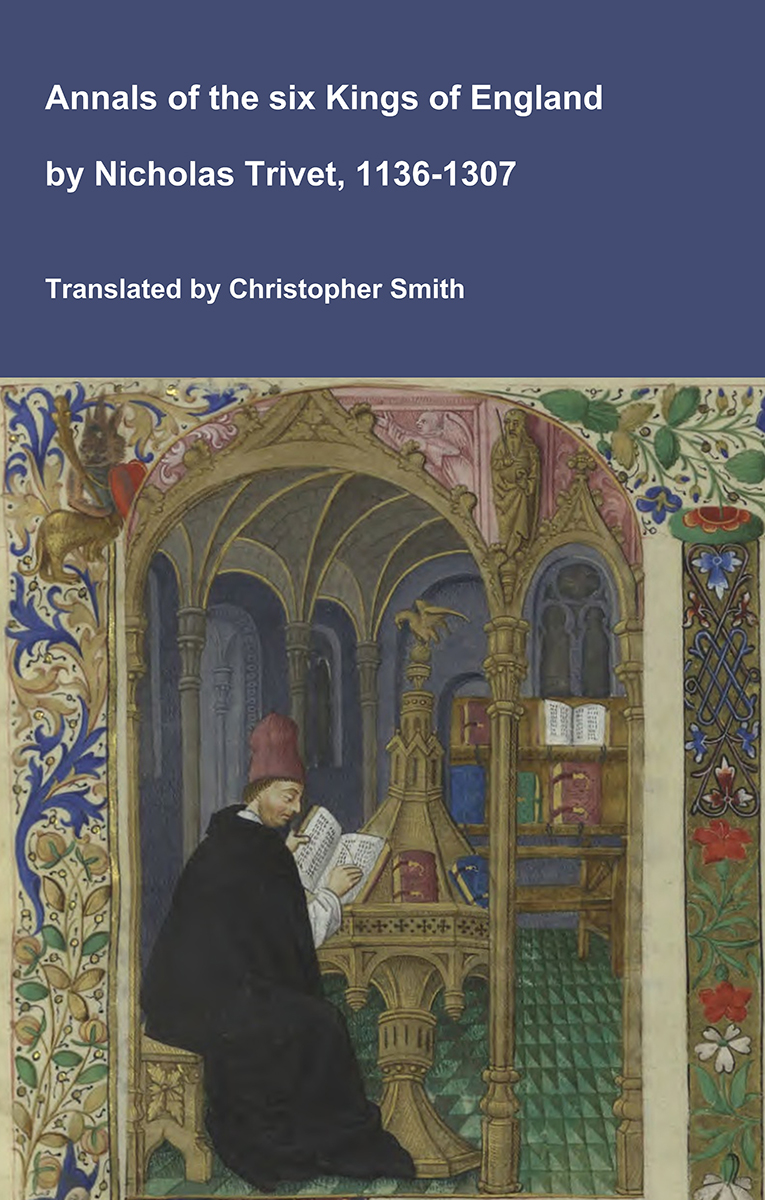
Annals of the six Kings of England by Nicholas Trivet
Translation of the Annals of the Six Kings of England by that traces the rise and rule of the Angevin aka Plantagenet dynasty from the mid-12th to early 14th century. Written by the Dominican scholar Nicholas Trivet, the work offers a vivid account of English history from the reign of King Stephen through to the death of King Edward I, blending political narrative with moral reflection. Covering the reigns of six monarchs—from Stephen to Edward I—the chronicle explores royal authority, rebellion, war, and the shifting balance between crown, church, and nobility. Trivet provides detailed insight into defining moments such as baronial conflicts, Anglo-French rivalry, and the consolidation of royal power under Edward I, whose reign he describes with particular immediacy. The Annals combines careful year-by-year reporting with thoughtful interpretation, presenting history not merely as a sequence of events but as a moral and political lesson. Ideal for readers interested in medieval history, kingship, and the origins of the English state, this chronicle remains a valuable and accessible window into the turbulent world of the Plantagenet kings.
Available at Amazon in eBook and Paperback format.
In 1666 Robert Marsham 4th Baronet [aged 15] matriculated at St John's College, Cambridge University [Map].
In 1667 Titus Oates [aged 17] transferred to St John's College, Cambridge University [Map] leaving the same year without a degree.

Samuel Pepys' Diary. 8th October 1667. And then to the garden, and there eat many grapes, and took some with us and so away thence, exceeding well satisfied, though not to that degree that, by my old esteem of the house, I ought and did expect to have done, the situation of it not pleasing me. Here we parted with Lowther [aged 26] and his friends, and away to Cambridge, it being foul, rainy weather, and there did take up at the Rose [Map], for the sake of Mrs. Dorothy Drawwater, the vintner's daughter, which is mentioned in the play of Sir Martin Marrall. Here we had a good chamber, and bespoke a good supper; and then I took my wife, and W. Hewer [aged 25], and Willet, it holding up a little, and shewed them Trinity College [Map] and St. John's Library [Map], and went to King's College Chapel [Map], to see the outside of it only; and so to our inne, and with much pleasure did this, they walking in their pretty morning gowns, very handsome, and I proud to find myself in condition to do this; and so home to our lodging, and there by and by, to supper, with much good sport, talking with the Drawers concerning matters of the town, and persons whom I remember, and so, after supper, to cards; and then to bed, lying, I in one bed, and my wife and girl in another, in the same room, and very merry talking together, and mightily pleased both of us with the girl. Saunders, the only violin in my time, is, I hear, dead of the plague in the late plague there.
In 1671 Henry Hobart 4th Baronet [aged 14] educated at St John's College, Cambridge University [Map].
On 6th February 1671 William Robinson 1st Baronet [aged 15] was admitted to St John's College, Cambridge University [Map].
On 30th April 1695 Richard Anguish aka Allin 1st Baronet [aged 36] was admitted to St John's College, Cambridge University [Map].
In 1699 Nicholas Leke 4th Earl Scarsdale [aged 17] admitted at St John's College, Cambridge University [Map].
In 1716 William Craven 3rd Baron Craven [aged 16] educated at St John's College, Cambridge University [Map].
In 1722 Samuel Pegge [aged 17] became a pensioner and scholar of St John's College, Cambridge University [Map], graduating BA in 1725, MA in 1729.
Around 1738 Peter Burrell [aged 13] educated at St John's College, Cambridge University [Map].
The History of William Marshal was commissioned by his son shortly after William’s death in 1219 to celebrate the Marshal’s remarkable life; it is an authentic, contemporary voice. The manuscript was discovered in 1861 by French historian Paul Meyer. Meyer published the manuscript in its original Anglo-French in 1891 in two books. This book is a line by line translation of the first of Meyer’s books; lines 1-10152. Book 1 of the History begins in 1139 and ends in 1194. It describes the events of the Anarchy, the role of William’s father John, John’s marriages, William’s childhood, his role as a hostage at the siege of Newbury, his injury and imprisonment in Poitou where he met Eleanor of Aquitaine and his life as a knight errant. It continues with the accusation against him of an improper relationship with Margaret, wife of Henry the Young King, his exile, and return, the death of Henry the Young King, the rebellion of Richard, the future King Richard I, war with France, the death of King Henry II, and the capture of King Richard, and the rebellion of John, the future King John. It ends with the release of King Richard and the death of John Marshal.
Available at Amazon in eBook and Paperback format.
Around 1747 Henry Carteret 1st Baron Carteret [aged 12] educated at St John's College, Cambridge University [Map].
In 1753 Henry Carteret 1st Baron Carteret [aged 18] graduated Master of Arts: Cambridge University at St John's College, Cambridge University [Map].
Around 1760 Robert Bertie 4th Duke Ancaster and Kesteven [aged 3] educated at St John's College, Cambridge University [Map].
On 18th August 1760 Patrick Blake 1st Baronet [aged 18] was admitted to St John's College, Cambridge University [Map].
On 17th September 1763 Charlton Leighton 4th Baronet [aged 16] was admitted to St John's College, Cambridge University [Map].
In 1767 John Henniker-Major 2nd Baron Henniker [aged 14] was admitted to St John's College, Cambridge University [Map]. He graduated MA in 1771 by Royal Mandate.
Around 1772 Peter Burrell Baron Willoughby, 1st Baron Gwydyr [aged 17] educated at St John's College, Cambridge University [Map].
Around 1786 William Charles Keppel 4th Earl Albermarle [aged 13] educated at St John's College, Cambridge University [Map].
In 1787 Thomas Thynne 2nd Marquess of Bath [aged 21] graduated Master of Arts: Cambridge University at St John's College, Cambridge University [Map].
On 8th June 1797 Henry William Powlett 3rd Baron Bayning was born to Charles Townshend 1st Baron Bayning [aged 67] and Annabella Smith-Powlett [aged 42]. He was educated at Eton College [Map] and St John's College, Cambridge University [Map]. Coefficient of inbreeding 3.24%.
Around 1800 John Lumley-Savile 8th Earl Scarborough [aged 11] educated at St John's College, Cambridge University [Map].
William of Worcester's Chronicle of England
William of Worcester, born around 1415, and died around 1482 was secretary to John Fastolf, the renowned soldier of the Hundred Years War, during which time he collected documents, letters, and wrote a record of events. Following their return to England in 1440 William was witness to major events. Twice in his chronicle he uses the first person: 1. when writing about the murder of Thomas, 7th Baron Scales, in 1460, he writes '… and I saw him lying naked in the cemetery near the porch of the church of St. Mary Overie in Southwark …' and 2. describing King Edward IV's entry into London in 1461 he writes '… proclaimed that all the people themselves were to recognize and acknowledge Edward as king. I was present and heard this, and immediately went down with them into the city'. William’s Chronicle is rich in detail. It is the source of much information about the Wars of the Roses, including the term 'Diabolical Marriage' to describe the marriage of Queen Elizabeth Woodville’s brother John’s marriage to Katherine, Dowager Duchess of Norfolk, he aged twenty, she sixty-five or more, and the story about a paper crown being placed in mockery on the severed head of Richard, 3rd Duke of York.
Available at Amazon in eBook and Paperback format.
In 1815 Frederick Henniker 2nd Baronet [aged 22] graduated from St John's College, Cambridge University [Map] with a BA.
In 1815 Thomas Cecil [aged 17] graduated at St John's College, Cambridge University [Map].
In 1829 Thomas Neville Abdy 1st Baronet [aged 18] matricuated St John's College, Cambridge University [Map]. He graduated in 1833 with a BA.
Around 1837 William Alleyne Cecil 3rd Marquess Exeter [aged 11] educated at St John's College, Cambridge University [Map].
In 1859 George Body [aged 18] matriculated St John's College, Cambridge University [Map] being awarded BA in 1862, MA in 1876, MA ad eundem in 1884 and DD in 1885.


On 29th October 1868 William Vere Reeve Fane aka King-Fane was born to William Dashwood Fane [aged 52] and Susan Millicent Reeve [aged 52] at 2 Norfolk Crescent. He was educated at St John's College, Cambridge University [Map]. He married 16th May 1895 Helen Beatrice Newman and had issue.
In 1930 William Law Williams 8th Baronet [aged 22] graduated from St John's College, Cambridge University [Map] with a BA.