

Chronicle of Walter of Guisborough
A canon regular of the Augustinian Guisborough Priory, Yorkshire, formerly known as The Chronicle of Walter of Hemingburgh, describes the period from 1066 to 1346. Before 1274 the Chronicle is based on other works. Thereafter, the Chronicle is original, and a remarkable source for the events of the time. This book provides a translation of the Chronicle from that date. The Latin source for our translation is the 1849 work edited by Hans Claude Hamilton. Hamilton, in his preface, says: 'In the present work we behold perhaps one of the finest samples of our early chronicles, both as regards the value of the events recorded, and the correctness with which they are detailed; Nor will the pleasing style of composition be lightly passed over by those capable of seeing reflected from it the tokens of a vigorous and cultivated mind, and a favourable specimen of the learning and taste of the age in which it was framed.'
Available at Amazon in eBook and Paperback format.
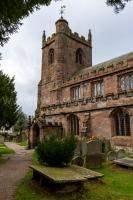
St Margaret's Church, Wrenbury is in Wrenbury, Cheshire [Map], Churches in Cheshire.
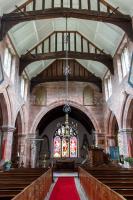
Around 1550. The present St Margaret's Church, Wrenbury [Map] dates from the early 16th century with alterations and additions in the 18th and 19th centuries; the nave and porch were restored in 1794, the chancel was rebuilt in 1806 and restored in 1865.
Combermere Papers. 1689. When Sir Thomas Cotton (age 17) reached the age of seventeen his father (age 53) received a most extraordinary proposal from Admiral Sir George Herbert (age 41) [Note. George a mistake for Arthur?] afterwards Lord Torrington which he seems to have accepted without the slightest misgiving as to its morality. George was uncle and guardian to Philadelphia (age 13) daughter and heiress of Sir Thomas Lynch twice Governor and Captain General of Jamaica who had died possessed of large estates in the West Indies a share in which Sir George coveted He therefore agreed to marry his ward though only thirteen years old to young Thomas Cotton on condition that his consent was purchased by a portion of the property. The marriage actually took place and the terms were duly carried out. Eventually Thomas though only a fourth son succeeded through the death of his elder brothers to the title and estates but did not enjoy them long dying in 1715 after only a three years tenure. His widow shortly afterwards married a Mr King on whom she bestowed the whole of her large fortune to the entire exclusion of her nine sons and six daughters. In the parish register of Wrenbury Church [Map] near Combermere the birth of a young King is recorded who soon after was christened there by the name of Cotton a novel compliment to the memory of the lady's first husband. Sir Thomas Lady Cotton survived her second partner for some years and lived at East Hyde a fine place in Hertfordshire where her four magnificent horses were the objects of great attention to her little niece Hester Salusbury afterwards Mrs Piozzi. The stately old lady was in the habit of driving about in the neigh bourhood of her country place in a ponderous anti quated coach drawn by four black horses as solemnly grand as herself The animals were the delight of her little niece who in her autobiography thus fondly alludes to them:
At East Hyde I learned to love horses and when my mother hoped I was gaining health by the fresh air I was kicking my heels in a corn bin and learning to drive of the old coachman who like everybody else small and great delighted in taking me for a pupil. Grandmamma kept four great ramping war horses chevaux entiers for her carriage with immense long manes and tails which we buckled and combed and when after long practice I showed her and my mother how two of them poor Colonel and Peacock would lick my hand for a lump of sugar or fine white bread much were they amazed and more when my skill in guiding them round the court yard on the break could no longer be doubted or denied though strictly prohibited for the future.


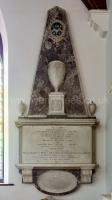
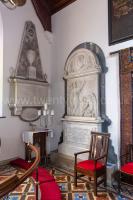
After 14th August 1775. St Margaret's Church, Wrenbury [Map]. Monument to Lynch Salusbury Cotton 4th Baronet (deceased) and Elizabeth Abigail Cotton Lady Cotton (age 62).
Lynch Salusbury Cotton 4th Baronet: Around 1705 he was born to Thomas Cotton 2nd Baronet and Philadelphia Lynch Lady Cotton. In or before 1739 Lynch Salusbury Cotton 4th Baronet and Elizabeth Abigail Cotton Lady Cotton were married. She by marriage Lady Cotton of Combermere in Cheshire. On 27th August 1748 Robert Salusbury Cotton 3rd Baronet died. His brother Lynch succeeded 4th Baronet Cotton of Combermere in Cheshire. On 14th August 1775 Lynch Salusbury Cotton 4th Baronet died. His son Robert succeeded 5th Baronet Cotton of Combermere in Cheshire.
Elizabeth Abigail Cotton Lady Cotton: In 1713 she was born to Rowland Cotton and Mary Sleigh. Combermere Papers. 1745. Sir Thomas was succeeded by his son Sir Robert who married Lady Betty Tollemache daughter of the Earl of Dysart and dying in 1748 without issue was succeeded by his brother Lynch. He married his cousin Miss Cotton of Ethwall and died in 1775 leaving behind him besides other issue Robert who succeeded him and was the father of Lord Combermere Roland an Admiral in the Royal Navy and father of General Sir Willoughby Cotton GCB at one time Commander in Chief at Bombay; Lynch; George, Dean of Chester; Thomas; William; Richard, an officer in the Army killed in action; Henry; and Calveley, Captain 1st Life Guards who married Miss Lockwood by whom he had Major General Sir Sidney Cotton KCB Admiral Frank Cotton and Major General Sir Arthur Cotton Kt., Madras Engineers, celebrated for his irrigation labours in India. On 4th January 1777 Elizabeth Abigail Cotton Lady Cotton died.
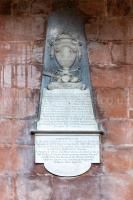
After 1798. St Margaret's Church, Wrenbury [Map]. Memorial to Samuel Barrow and Ann Barrow.
1805. St Margaret's Church, Wrenbury [Map]. Monument to Thomas Starky sculpted by John "The Younger" Bacon (age 28).


1809. St Margaret's Church, Wrenbury [Map]. Monument to John Jennings sculpted by John "The Younger" Bacon (age 32).


1815. St Margaret's Church, Wrenbury [Map]. Monument to Elinor Starky sculpted by John "The Younger" Bacon (age 38).


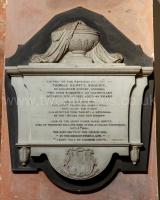
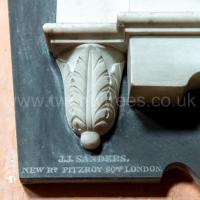
After 1827. St Margaret's Church, Wrenbury [Map]. Monument to Thomas and Maria Hewitt made by JJ Sanders of New Road, Fitzroy Square.
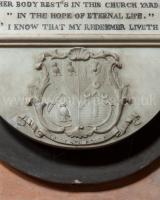
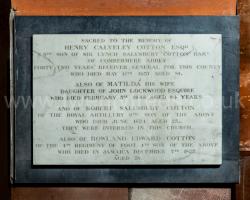
After 1837. St Margaret's Church, Wrenbury [Map]. Memorial to Henry Calveley Cotton (age 81), Matilda Lockwood (age 73), Robert Salusbury Cotton and Rowland Edward Cotton.
Chronicle of Walter of Guisborough
A canon regular of the Augustinian Guisborough Priory, Yorkshire, formerly known as The Chronicle of Walter of Hemingburgh, describes the period from 1066 to 1346. Before 1274 the Chronicle is based on other works. Thereafter, the Chronicle is original, and a remarkable source for the events of the time. This book provides a translation of the Chronicle from that date. The Latin source for our translation is the 1849 work edited by Hans Claude Hamilton. Hamilton, in his preface, says: 'In the present work we behold perhaps one of the finest samples of our early chronicles, both as regards the value of the events recorded, and the correctness with which they are detailed; Nor will the pleasing style of composition be lightly passed over by those capable of seeing reflected from it the tokens of a vigorous and cultivated mind, and a favourable specimen of the learning and taste of the age in which it was framed.'
Available at Amazon in eBook and Paperback format.
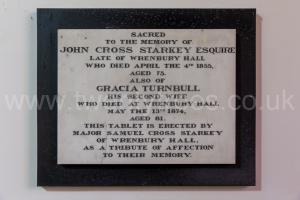
After 1855. St Margaret's Church, Wrenbury [Map]. Monument to John Cross Starkey and Gracia Turnbull.
On 21st February 1865 Stapleton Cotton 1st Viscount Combermere (age 91) died. His son Wellington (age 46) succeeded 2nd Viscount Combermere, 2nd Baron Combermere, 7th Baronet Cotton of Combermere in Cheshire.
St Margaret's Church, Wrenbury [Map]. Monument to Stapleton Cotton 1st Viscount Combermere sculpted by William "The Younger" Theed (age 61).
Wellington Stapleton-Cotton 2nd Viscount Combermere: On 24th November 1818 he was born to Stapleton Cotton 1st Viscount Combermere and Caroline Greville Viscountess Comberemere at Duncombe House, St Thomas. In 1844 Wellington Stapleton-Cotton 2nd Viscount Combermere and Susan Alice Sitwell were married. On 1st December 1891 Wellington Stapleton-Cotton 2nd Viscount Combermere died. His son Robert succeeded 3rd Viscount Combermere, 3rd Baron Combermere, 8th Baronet Cotton of Combermere in Cheshire. Isabel Marion Chetwynd Viscountess Combermere by marriage Viscountess Combermere.


