

Adam Murimuth's Continuation and Robert of Avesbury’s 'The Wonderful Deeds of King Edward III'
This volume brings together two of the most important contemporary chronicles for the reign of Edward III and the opening phases of the Hundred Years’ War. Written in Latin by English clerical observers, these texts provide a vivid and authoritative window into the political, diplomatic, and military history of fourteenth-century England and its continental ambitions. Adam Murimuth Continuatio's Chronicarum continues an earlier chronicle into the mid-fourteenth century, offering concise but valuable notices on royal policy, foreign relations, and ecclesiastical affairs. Its annalistic structure makes it especially useful for establishing chronology and tracing the development of events year by year. Complementing it, Robert of Avesbury’s De gestis mirabilibus regis Edwardi tertii is a rich documentary chronicle preserving letters, treaties, and official records alongside narrative passages. It is an indispensable source for understanding Edward III’s claim to the French crown, the conduct of war, and the mechanisms of medieval diplomacy. Together, these works offer scholars, students, and enthusiasts a reliable and unembellished account of a transformative period in English and European history. Essential for anyone interested in medieval chronicles, the Hundred Years’ War, or the reign of Edward III.
Available at Amazon in eBook and Paperback format.
St Mary & All Saints Church, Willoughby-on-the-Wolds is in Willoughby-on-the-Wolds, Nottinghamshire [Map], Churches in Nottinghamshire.
Monument to two unknown ladies in St Mary & All Saints Church, Willoughby-on-the-Wolds [Map].
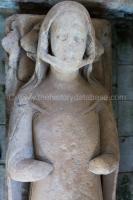
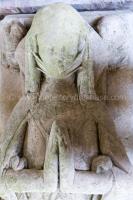
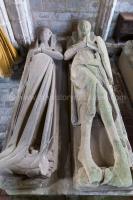
After 1325. St Mary & All Saints Church, Willoughby-on-the-Wolds [Map]. Monument to Richard Bugge aka Willoughby (deceased).
Richard Bugge aka Willoughby: Around 1233 he was born to Robert Bugge de Bingham at Willoughby-on-the-Wolds, Nottinghamshire [Map]. In 1325 Richard Bugge aka Willoughby died at Willoughby-on-the-Wolds, Nottinghamshire [Map].
On 14th March 1362 Richard Willoughby (age 72) died. He was buried at St Mary & All Saints Church, Willoughby-on-the-Wolds [Map].


In 1369 Richard Willoughby died. Monument in St Mary & All Saints Church, Willoughby-on-the-Wolds [Map]. Camail and Jupon Period.
Richard Willoughby: he was born to Richard Willoughby.
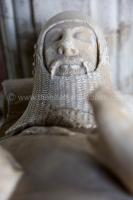
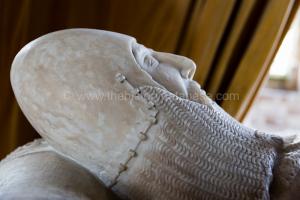
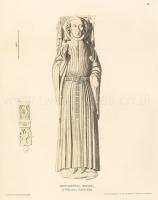
Effigy in Willoughby Church. Willoughby Church [Map]
THIS is supposed to be one of the Lords of Willoughby, in Nottinghamshire. Perhaps Sir Richard de Willoughby, who was Chief Justice of the King's Bench 11th Edward IIIa Chaucer says of his Serjeant-at-law,
"Justice he was full oftin in Assise,
By patent, and by pleine commissione;"
and that he was
"Girt with a ceint of silk with barris smale."
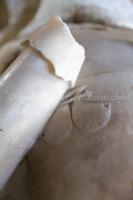
The tunic of the figure is confined by a richly-embossed girdle.
Details. Ornament of the girdle.
In 1417 Isabel Foljambe (age 22) was buried at St Mary & All Saints Church, Willoughby-on-the-Wolds [Map].
On or before 15th November 1448, the date he was buried at St Mary & All Saints Church, Willoughby-on-the-Wolds [Map], Hugh Willoughby died. Monument to Hugh Willoughby and Margaret Freville (age 47). Early Plate Bascinet and Gorget Period. Hip Belt. Horned Headdress. Chest with Weepers holding Shields. Dogs chewing at her dress with Studded Collar. Angels Supporting Pillow. Possibly Sutton and Prentys.
Hugh Willoughby: he was born to Edmund Willoughby and Isabel Annesley. Around 1395 Hugh Willoughby and Isabel Foljambe were married. Before 1419 Hugh Willoughby and Margaret Freville were married.
Margaret Freville: In 1401 she was born to Baldwin Freville. In 1493 she died.


Introduction. Of the usual Civil Costume of the fourteenth and fifteenth centuries, excellent examples will be found in the tombs of William of Hatfield, William of Windsor, Blanch dela Tour, and the mourners on the monument of Sir Roger de Kerdeston. One of these mourners, a female, and the figure of the Lady of Sir Miles Stapleton, have long pendant lappets to their sleeves. That of the Judge in Willoughby church [Map], Nottinghamshire, has a tunic to which very full sleeves are attached, and he is girt with a rich ceint, or girdle; an appendage of knights, civilians, and ecclesiastics (when unattired in the sacred vestments), in the fourteenth century.
"Change of clothing every day.
With golden girdles, great an small.'
Plowman's Tale.