

The History of William Marshal was commissioned by his son shortly after William’s death in 1219 to celebrate the Marshal’s remarkable life; it is an authentic, contemporary voice. The manuscript was discovered in 1861 by French historian Paul Meyer. Meyer published the manuscript in its original Anglo-French in 1891 in two books. This book is a line by line translation of the first of Meyer’s books; lines 1-10152. Book 1 of the History begins in 1139 and ends in 1194. It describes the events of the Anarchy, the role of William’s father John, John’s marriages, William’s childhood, his role as a hostage at the siege of Newbury, his injury and imprisonment in Poitou where he met Eleanor of Aquitaine and his life as a knight errant. It continues with the accusation against him of an improper relationship with Margaret, wife of Henry the Young King, his exile, and return, the death of Henry the Young King, the rebellion of Richard, the future King Richard I, war with France, the death of King Henry II, and the capture of King Richard, and the rebellion of John, the future King John. It ends with the release of King Richard and the death of John Marshal.
Available at Amazon in eBook and Paperback format.
St Mary's Church, Bury St Edmunds is in Bury St Edmunds, Suffolk [Map].
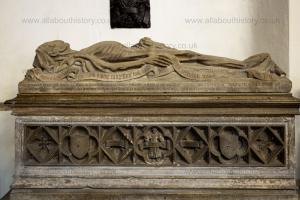
1467. The Cadaver tomb of John Baret at St Mary's Church, Bury St Edmunds. His tomb, which he had made before his death, once stood between the arch of the nave and his chantry. The roof painted with motto Grace me Govern and his SS collar is in wonderful preservation.
Around 1500. The nave roof at St Mary's Church, Bury St Edmunds is of single hammer-beam constructions, with eleven pairs of life-sized angels. The angels show a procession in honour of the Assumption of the Blessed Virgin Mary.
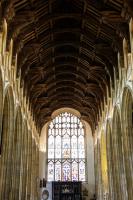
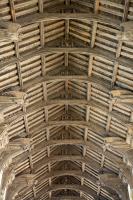
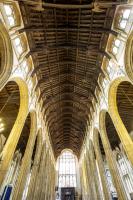
In 1501 William Carew died. He was buried at St Mary's Church, Bury St Edmunds.
William Carew: he was born to Nicholas Carew and Joan Courtenay. He a great x 4 grandson of King Edward I of England.
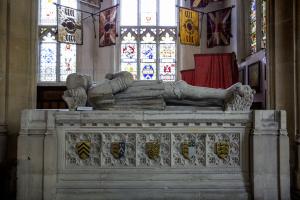
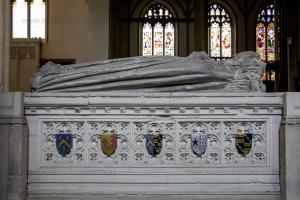
On 1st March 1536 Robert Drury (age 82) died. He was buried at St Mary's Church, Bury St Edmunds where he has a monument with him and his wife Anne Calthorpe represented.
Robert Drury: In 1454 he was born to Roger Drury of Hawstead in Suffolk at Hawstead, Suffolk. Before 1494 Robert Drury and Anne Calthorpe were married. On 15th October 1495 he was appointed Speaker of the House of Commons during the 5th Parliament of Henry VII. After 12th November 1529 Robert Drury and Anne Jerningham were married. The difference in their ages was 50 years.


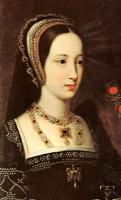
During the dissolution, around 4th November 1539, the remains of Mary Tudor Queen Consort France were reburied at St Mary's Church, Bury St Edmunds.
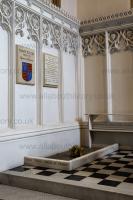
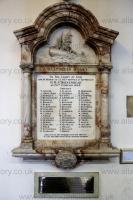
26th February 1852. Memorial at St Mary's Church, Bury St Edmunds to the fifty-five men of the Suffolk Regiment who drowned during the sinking of HMS Birkenhead from which the "Birkenhead Drill" i.e. women and children first, is named.
Rudyard Kipling's 1893 poem:
To take your chance in the thick of a rush, with firing all about,
Is nothing so bad when you've cover to 'and, an' leave an' likin' to shout;
But to stand an' be still to the Birken'ead drill is a damn tough bullet to chew,
An' they done it, the Jollies – 'Er Majesty's Jollies – soldier an' sailor too!
Their work was done when it 'adn't begun; they was younger nor me an' you;
Their choice it was plain between drownin' in 'eaps an' bein' mopped by the screw,
So they stood an' was still to the Birken'ead drill, soldier an' sailor too!